 Learn Arabic
Spanish is often described as a Romance language because it evolved from Latin. However, one of the most fascinating influences on modern Spanish comes from Arabic. In fact, thousands of Spanish words from Arabic remain part of everyday speech across Spain and Latin America.
Between 711 and 1492 AD, Muslims ruled much of the Iberian Peninsula, a period known as Al-Andalus. During these nearly eight centuries, Arabic became the language of government, science, architecture, trade, agriculture, and education. As Arabic speakers and Romance speakers lived together, their languages naturally mixed.
Today, linguists estimate that around 4,000 Spanish words from an Arabic origin still exist. Many are so common that native Spanish speakers never realize they originally came from Arabic.
Whether you’re learning Spanish, studying Arabic, or simply curious about language history, these shared words reveal one of history’s most remarkable cultural exchanges.
Why Does Spanish Have So Many Arabic Words?
The Arabic influence on Spanish began after Muslim armies entered the Iberian Peninsula in 711 AD. During the centuries that followed, Arabic became one of the region’s most important languages.
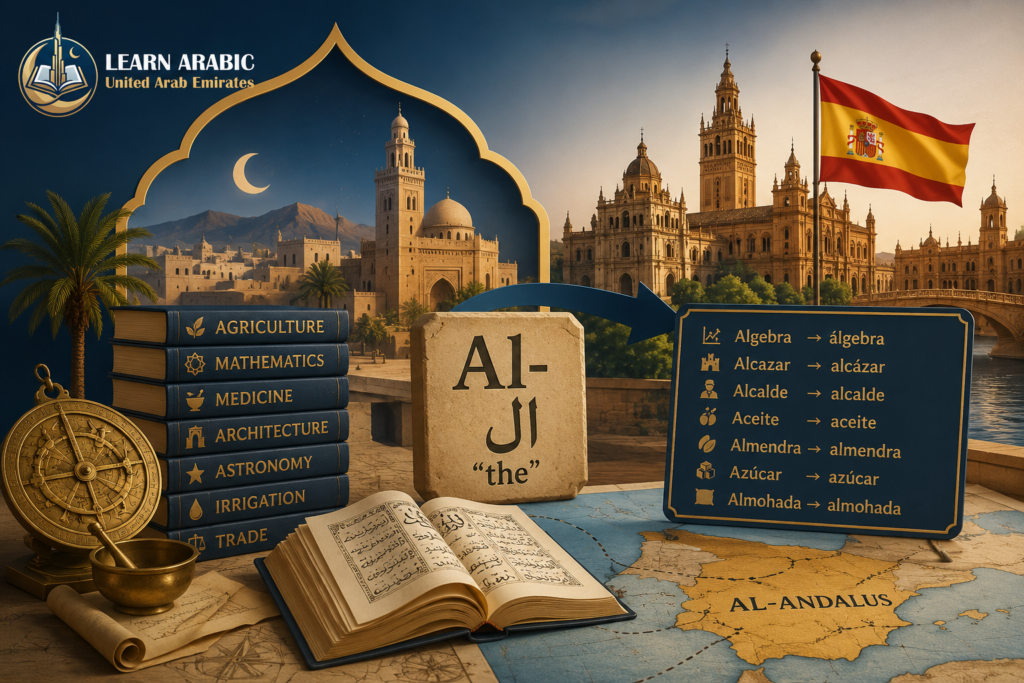
Muslims introduced new systems of:
- Agriculture
- Mathematics
- Medicine
- Architecture
- Astronomy
- Irrigation
- Trade
Along with these innovations came thousands of Arabic words.
After the Reconquista in 1492, Castilian Spanish gradually became the dominant language, but it retained a significant portion of Arabic vocabulary. Those borrowed words are still used throughout Spain and nearly every Spanish-speaking country today.
One easy clue is that many Spanish words from Arabic begin with Al-, which comes directly from the Arabic definite article ال (“the”).
The historical connection between Arabic and Spanish often inspires learners to explore Arabic for themselves. If you’d like to understand these linguistic roots in greater depth, our Self-Paced Arabic Course offers a flexible way to build your reading, grammar, and vocabulary skills at your own pace.

Food and Agriculture: Spanish Words Derived from Arabic
Arabic had an enormous influence on farming and cuisine in medieval Spain. Many fruits, vegetables, spices, and ingredients still carry their original Arabic names.
| Spanish Word | Meaning | Arabic Word | Transliteration |
| Arroz | Rice | الأرز | Ar-Ruzz |
| Aceite | Oil | الزيت | Az-Zayt |
| Aceituna | Olive | الزيتون | Az-Zaytūn |
| Azúcar | Sugar | السكر | As-Sukkar |
| Azafrán | Saffron | الزعفران | Az-Za’farān |
| Albahaca | Basil | الحبق | Al-Habaq |
| Albaricoque | Apricot | البرقوق | Al-Barqūq |
| Albóndiga | Meatball | البندق | Al-Bunduq |
| Berenjena | Eggplant | باذنجان | Bāḏinjān |
| Limón | Lemon | ليمون | Laymūn |
| Lima | Lime | ليمة | Līmah |
| Naranja | Orange | نارنج | Nāranj |
| Sandía | Watermelon | سندية | Sindiyyah |
| Jarabe | Syrup | شراب | Sharāb |
| Algodón | Cotton | القطن | Al-Qutn |
Why Did So Many Food Words Come from Arabic?
Arabic influence on Spanish food vocabulary reflects more than borrowed words—it tells the story of a major agricultural transformation during the period of Al-Andalus. Muslim farmers introduced advanced irrigation systems, waterwheels (norias), canals, and farming techniques that allowed crops to thrive in regions previously considered difficult to cultivate.
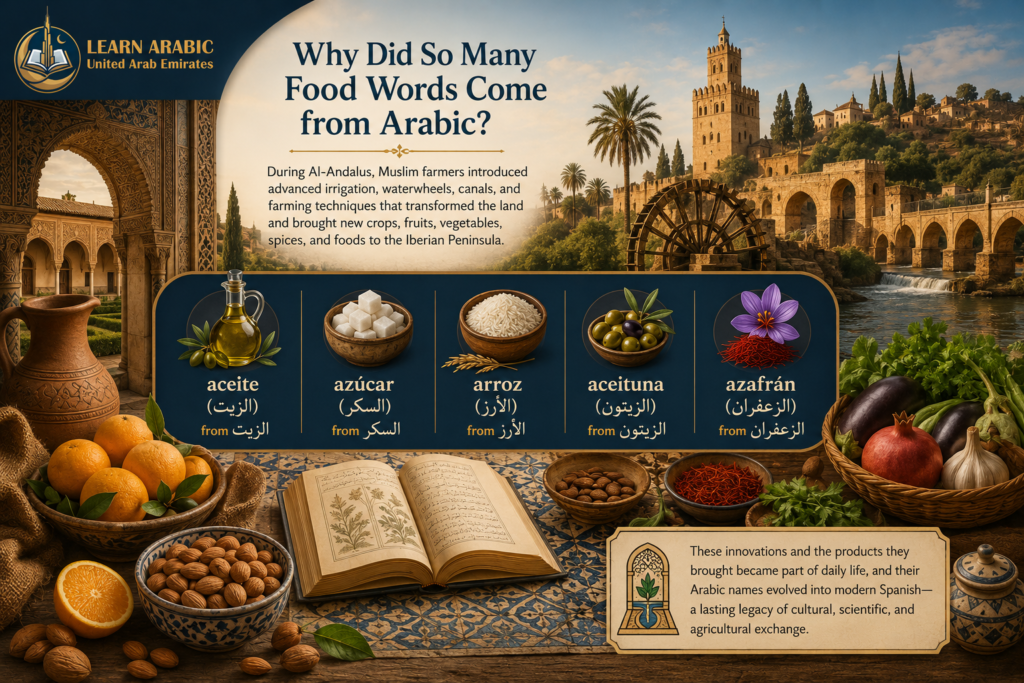
Along with these innovations came new fruits, vegetables, spices, and staple foods that gradually became part of everyday life in the Iberian Peninsula. Because many of these products were unfamiliar to local populations, their Arabic names were adopted alongside them. Over time, those names evolved into modern Spanish while preserving their Arabic roots.
Words such as aceite (from الزيت), azúcar (from السكر), arroz (from الأرز), aceituna (from الزيتون), and azafrán (from الزعفران) remain among the clearest examples of this linguistic legacy. Today, these words are used daily throughout the Spanish-speaking world, serving as lasting reminders of the agricultural, scientific, and cultural exchange that shaped medieval Spain.
Scientific and Mathematical Spanish Words with Arabic Origins
Many scientific discoveries reached medieval Europe through Arabic scholars. As a result, Spanish adopted numerous technical terms directly from Arabic.
| Spanish Word | Meaning | Arabic Word | Transliteration |
| Álgebra | Algebra | الجبر | Al-Jabr |
| Alquimia | Alchemy | الكيمياء | Al-Kīmiyā’ |
| Cifra | Digit / Zero | صفر | Sifr |
| Algoritmo | Algorithm | الخوارزمي | Al-Khwarizmi |
| Alcohol | Alcohol | الكحل | Al-Kuḥl |
These words eventually spread from Spanish into many other European languages, including English.
Read Also: Learn Arabic Phrases
Step Inside Our Classrooms
Don’t just take our word for it—see our community in action. Click below to watch real, live snippets from our recent classes and experience our engaging teaching style firsthand!
Master Arabic in the UAE
Experience world-class Arabic language training designed for students and professionals in the Emirates.
Book Your Free TrialHousehold and Everyday Spanish Words from Arabic
Some of the most frequently used Spanish vocabulary comes directly from Arabic.
| Spanish Word | Meaning | Arabic Word | Transliteration |
| Almohada | Pillow | المخدة | Al-Mikhaddah |
| Taza | Cup | طاسة | Ṭāsah |
| Jarra | Jar | جرة | Jarrah |
| Brújula | Compass | بوصلة | Būṣulah |
| Bellota | Acorn | بلوطة | Ballūṭah |
| Dado | Dice | عدد | A’dād |
| Momia | Mummy | مومياء | Mūmiyā’ |
| Azul | Blue | لازورد | Lāzuward |
| Café | Coffee | قهوة | Qahwah |
| Jirafa | Giraffe | زرافة | Zarāfah |
Common Spanish Words with Arabic Origins You Still Hear Today
Some Arabic-derived Spanish words are so common that millions of people use them every day without realizing their history.
| Spanish Word | Meaning | Arabic Word | Transliteration |
| Ojalá | Hopefully / God willing | إن شاء الله | In Shā’ Allāh |
| Hasta | Until | حتى | Ḥattā |
| Aduana | Customs | الديوان | Ad-Dīwān |
| Tarifa | Tariff | تعريفة | Ta’rīfah |
| Rincón | Corner | ركن | Rukn |
| Tambor | Drum | طنبور | Ṭunbūr |
| Guitarra* | Guitar (indirect Arabic influence) | قيثارة | Qīthārah |
| Noria | Water Wheel | ناعورة | Nā’ūrah |
| Alcázar | Fortress | القصر | Al-Qaṣr |
| Almacén | Warehouse | المخزن | Al-Makhzan |
Note: Not every word has a direct one-to-one origin. Some entered Spanish through Arabic after earlier Persian, Greek, or Sanskrit roots, but Arabic served as the bridge that introduced them into Iberia.
Government and Civic Vocabulary from Arabic
Arabic influenced not only everyday speech but also the administrative and civic vocabulary of medieval Spain. During the era of Al-Andalus, many terms related to governance, public institutions, taxation, and commerce entered Spanish and remained in use long after Arabic ceased to be the dominant language.
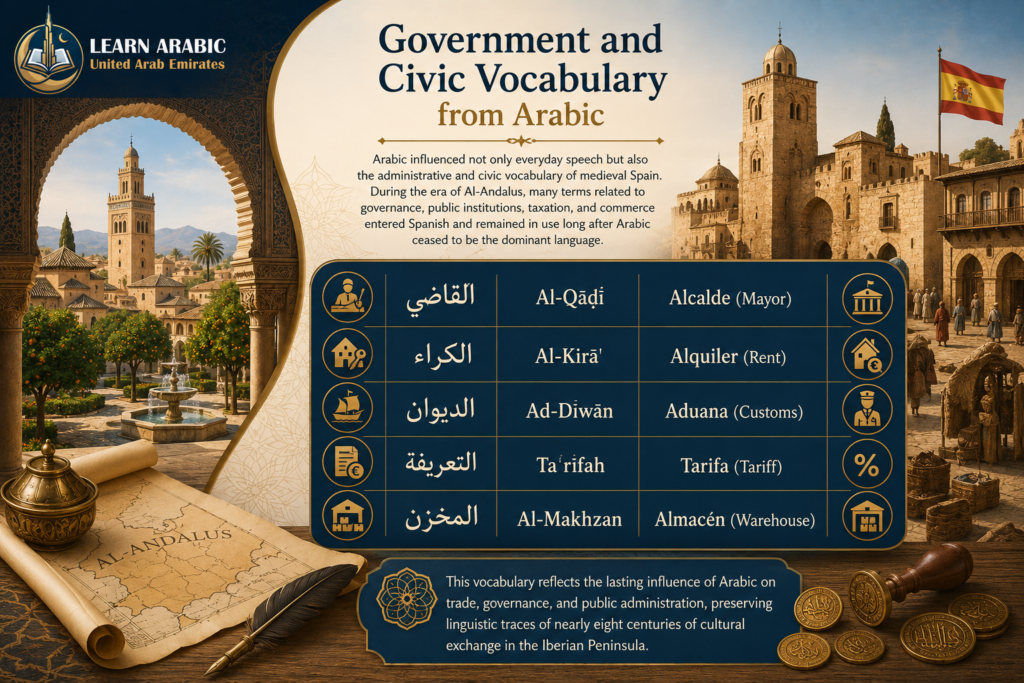
- القاضي — Al-Qāḍī — Alcalde (Mayor)
- الكراء — Al-Kirā’ — Alquiler (Rent)
- الديوان — Ad-Dīwān — Aduana (Customs)
- التعريفة — Taʿrīfah — Tarifa (Tariff)
- المخزن — Al-Makhzan — Almacén (Warehouse)
This vocabulary reflects the lasting influence of Arabic on trade, governance, and public administration, preserving linguistic traces of nearly eight centuries of cultural exchange in the Iberian Peninsula.
Patterns That Help You Recognize Arabic-Origin Spanish Words
Not all Spanish words of Arabic origin look the same, but many follow recognizable patterns that reveal their shared history. Once you know what to look for, you’ll begin spotting Arabic influences in everyday Spanish vocabulary. From the familiar Al- prefix to words related to farming, science, government, and household life, these patterns make it easier to recognize how deeply Arabic shaped the Spanish language.
| Pattern | Explanation | Example |
| Al- prefix | Comes from the Arabic definite article ال (“the”) | Alcalde, Alcázar, Almacén |
| Agriculture | Crops introduced by Muslim farmers | Arroz, Aceite, Azúcar |
| Science | Knowledge translated through Arabic scholars | Álgebra, Cifra, Alquimia |
| Government | Administrative vocabulary | Alcalde, Aduana |
| Household | Daily-life vocabulary | Almohada, Taza |
Recognizing these patterns makes it much easier to identify Spanish words from Arabic when reading or traveling.
If you’re introducing Arabic to young learners, building strong reading skills from the beginning makes recognizing Arabic roots much easier. Our Noorani Qaida Course for Kids helps children develop accurate pronunciation and reading before expanding their Arabic vocabulary.
Start Our Qaida Noorani Arabic Course for Kids in the UAE with a FREE Trial

Why Learning Arabic Makes Spanish Vocabulary Easier?
Many Spanish learners are surprised to discover how familiar Arabic vocabulary feels once they begin studying the language.
Understanding Arabic helps you:
- Recognize recurring roots.
- Remember vocabulary more quickly.
- Understand why many Spanish words begin with Al-.
- Appreciate the historical connection between the two cultures.
- Build stronger linguistic awareness across multiple languages.
For learners planning to communicate across the Arab world, studying both Modern Standard Arabic and regional varieties offers even greater advantages. Our Gulf Arabic Course helps students speak naturally in everyday conversations throughout the Gulf region.
Join Our Gulf Arabic Classes in the UAE with a FREE Trial

Common Misconceptions About Arabic Words in Spanish
The influence of Arabic on Spanish is significant, but it is often misunderstood Several common beliefs about Arabic loanwords are only partly true or overlook the complex history of linguistic exchange during the era of Al-Andalus. The following misconceptions help clarify what scholars know about the origins of these words.
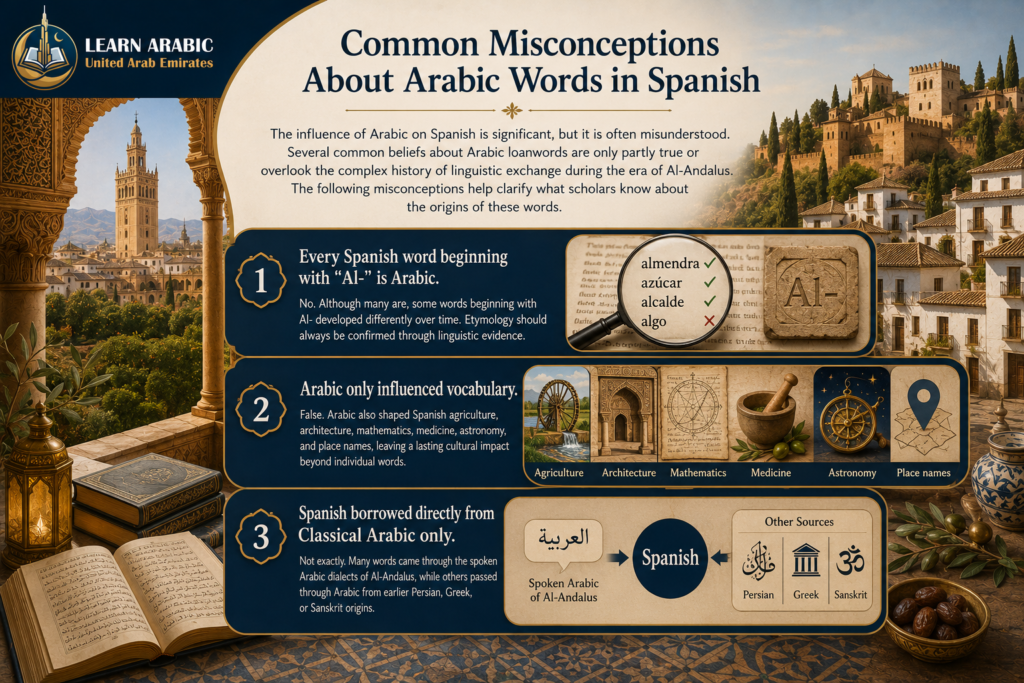
1. Every Spanish word beginning with “Al-” is Arabic.
No. Although many are, some words beginning with Al- developed differently over time. Etymology should always be confirmed through linguistic evidence.
2. Arabic only influenced vocabulary.
False. Arabic also shaped Spanish agriculture, architecture, mathematics, medicine, astronomy, and place names, leaving a lasting cultural impact beyond individual words.
3. Spanish borrowed directly from Classical Arabic only.
Not exactly. Many words came through the spoken Arabic dialects of Al-Andalus, while others passed through Arabic from earlier Persian, Greek, or Sanskrit origins.
See Our Classroom Environment in Action
Experience a sneak peek into our live sessions. Watch the video below to see our specialized instructors interacting with students, breakdown complex texts, and cultivate an engaging, respectful learning environment.
Master Arabic in the UAE
Experience world-class Arabic language training designed for students and professionals in the Emirates.
Book Your Free TrialDiscover the Arabic Behind Thousands of Spanish Words with UAE Arabic Learning Academy
Recognizing Spanish words with Arabic origins is a fascinating way to explore the connection between two languages, but understanding their meanings, pronunciation, and linguistic roots requires more than simply memorizing vocabulary. Learning Arabic helps you see how these shared words developed over centuries and gives you a deeper appreciation of both languages and the cultures they represent.
At UAE Arabic Learning Academy, you’ll build practical Arabic skills through structured lessons taught by experienced native instructors. Whether you want to learn Modern Standard Arabic, improve your speaking and reading skills, or understand the roots behind thousands of familiar Spanish words, our step-by-step courses provide the guidance and practice you need to make steady progress.
Start your free trial lesson today and discover the language that has shaped thousands of words in modern Spanish.

Our Arabic courses
- Arabic Course in the UAE
- Arabic Intensive Course
- Arabic Classes for Beginners (Learn Arabic from Scratch)
- Madinah Arabic Course
- Arabic Classes for Adults
- Self-Paced Arabic Course
- Arabic Speaking Classes
- Learn to Write Arabic Course
- Arabic Grammar Course
- Learn Arabic Alphabet Course
- Modern Standard Arabic (MSA) Course
- Quranic Arabic Course
- Fusha Arabic Course
- Classical Arabic Course
- Emirati Arabic Course
- Gulf Arabic Course
- Learn Saudi Arabic
- Business Arabic Course UAE
Master Arabic in the UAE
Experience world-class Arabic language training designed for students and professionals in the Emirates.
Book Your Free TrialConclusion
Arabic loanwords are woven into every layer of modern Spanish, from the food people eat and the places they visit to the scientific terms they study and the expressions they use every day. These words are more than historical curiosities—they reflect centuries of cultural exchange that continue to shape the language.
As you become familiar with common Arabic-derived vocabulary and the patterns behind it, you’ll find it easier to recognize word origins, expand your Spanish vocabulary, and appreciate the historical connections between the Arabic-speaking world and the Iberian Peninsula. Whether your interest is language learning, linguistics, or history, exploring these shared roots offers a deeper understanding of how Spanish developed into the language spoken by millions today.
Frequently Asked Questions
The history of Arabic in Spanish raises many interesting questions. Whether you’re curious about the number of Arabic loanwords, the origin of the Al- prefix, or how learning Arabic can improve your Spanish vocabulary, the answers below provide a quick and reliable overview.
How many Spanish words come from Arabic?
Linguists estimate that approximately 4,000 Spanish words have Arabic origins, although the exact number varies depending on how derivatives are counted.
Why do so many Spanish words begin with “Al-“?
The prefix Al- comes from the Arabic definite article ال, meaning “the.” During the centuries of Muslim rule in Spain, many borrowed words retained this prefix.
What is the most famous Spanish word from Arabic?
Ojalá is one of the best-known examples. It comes from the Arabic phrase إن شاء الله (In Shā’ Allāh), meaning “if God wills.”
Is Spanish closely related to Arabic?
No. Spanish is a Romance language descended from Latin, while Arabic is a Semitic language. However, centuries of cultural contact resulted in thousands of shared vocabulary items.
Does learning Arabic help with Spanish?
Yes. Understanding Arabic roots makes it easier to recognize many Spanish loanwords and provides valuable insight into the history and development of the Spanish language.
Related Articles
Learn Arabic



Leave a Reply