 Learn Arabic
If you’re searching for how to learn Arabic in one month in the UAE, here’s the honest starting point: you won’t reach fluency in 30 days, but you can build a real, usable foundation. That means the alphabet, everyday phrases, basic grammar, and enough confidence to hold a simple conversation with a colleague, a taxi driver, or a government service agent.
Living in Dubai, Abu Dhabi, or Sharjah, you can function in English almost everywhere — malls, offices, restaurants. But the moment you renew an Emirates ID at a Tas’heel centre, read a road sign heading toward Al Ain, or greet an Emirati neighbour in the lift, Arabic changes the interaction. Even basic Arabic shifts how you’re perceived, from a temporary visitor to someone who has made an effort to belong.
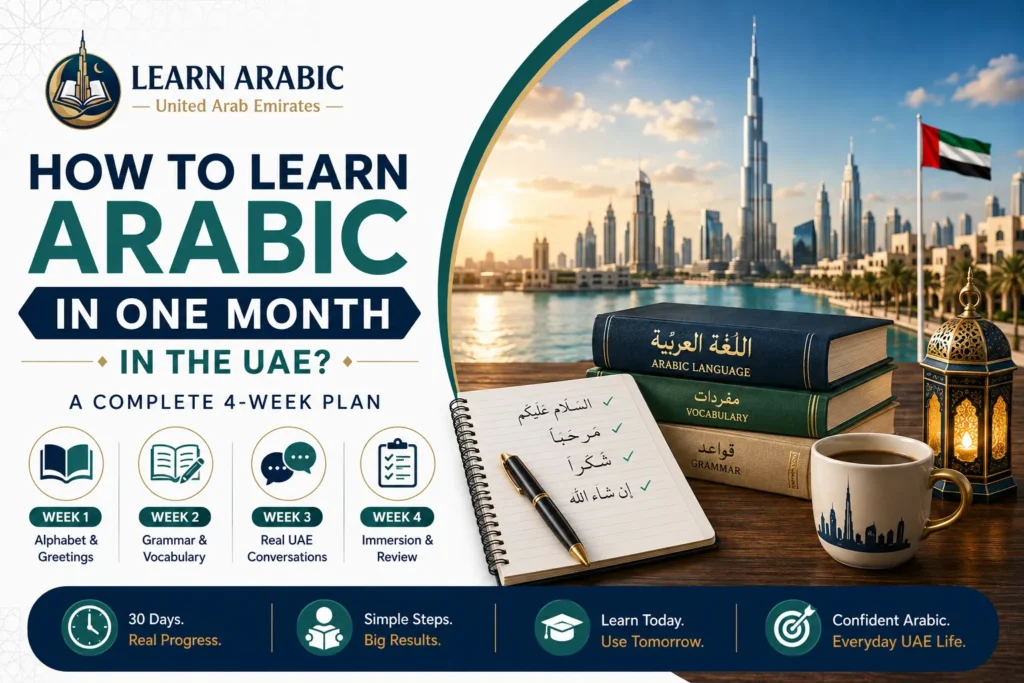
This guide breaks down exactly how to learn Arabic in one month in the UAE using a structured, week-by-week plan. Week 1 covers the alphabet and greetings, Week 2 covers grammar and vocabulary, Week 3 moves into real UAE conversations, and Week 4 focuses on immersion and review.
Week 1: Learn the Arabic Alphabet and Everyday UAE Greetings
Week 1 has one job: get you reading and writing the alphabet, and comfortable with the greetings you’ll hear on your very first day out — at the coffee shop, the building lobby, or the office.
Master the 28 Arabic Letters Day by Day
Arabic is written right to left, and each of its 28 letters changes shape depending on whether it sits at the start, middle, or end of a word. Spreading letter recognition across a week, rather than cramming it into one sitting, is what makes it stick.
| Day | Focus | Daily Activity (30 min) |
| Day 1 | Letters 1–7 (alif → khaa) | Learn names, isolated forms, and sounds |
| Day 2 | Letters 8–14 (daal → sheen) | Same method — names, forms, sounds |
| Day 3 | Letters 15–21 (saad → qaf) | Same method, slower pace on tricky sounds |
| Day 4 | Letters 22–28 (kaf → yaa) | Complete the alphabet |
| Day 5 | Positional forms | Write each letter in initial, medial, final form |
| Day 6 | Greetings | Learn 8–10 phrases used daily across the UAE |
| Day 7 | Review | Read simple vowelled words aloud |
Greetings and Phrases You’ll Actually Use in the UAE
As-salamu alaykum (السلام عليكم) is the standard greeting used across every emirate, from a Sharjah government office to a Dubai coffee shop, and the polite reply is wa alaykum as-salam. Marhaba (مرحبا) works as a lighter, everyday “hello.” Shukran (شكرا) for thank you and in shaa Allah (إن شاء الله) — “God willing” — come up constantly in casual UAE conversation, including from English-speaking colleagues who’ve picked it up locally.
By Day 7, your handwriting will likely still be shaky, and that’s normal — letter formation is a motor skill, not a memory task.For beginners, following a structured Arabic alphabet course can also make it easier to recognize each letter, understand its sound, and build a strong foundation from the beginning.
Week 2: Build Arabic Grammar and UAE Workplace Vocabulary
Week 2 shifts from recognising Arabic to constructing it — nouns, pronouns, simple sentences, and the specific vocabulary you’ll meet in UAE paperwork and daily errands.
Nouns, Pronouns and Simple Sentences
Arabic nouns carry gender (masculine or feminine), which affects the words around them. Personal pronouns — ana (أنا, I), anta/anti (أنتَ/أنتِ, you), huwa (هو, he), hiya (هي, she) — are your building blocks for simple subject-verb-object sentences.
| Day | Focus | Daily Activity (30 min) |
| Day 8 | Noun gender | Masculine and feminine patterns |
| Day 9 | Personal pronouns | ana, anta, huwa, hiya, nahnu |
| Day 10 | Basic verbs | went, ate, drank, wrote, read |
| Day 11 | The definite article (al-) | Practice with 20 common nouns |
| Day 12 | Simple sentences | Subject-verb-object construction |
| Day 13 | Numbers 1–20 | Essential for prices, dates, addresses |
| Day 14 | Days of the week | Full review of Week 2 vocabulary |
Government and Workplace Terms You’ll Meet in the UAE
A gap most textbooks miss: the vocabulary you’ll actually encounter isn’t generic. It’s Emirates ID, Tas’heel, Amer, DEWA, and Ejari — the names of the services and portals residents deal with regularly. Learning these specific terms alongside general grammar means Week 2 vocabulary connects directly to your real life, not an abstract phrasebook.
This is where most self-study plans fall apart — grammar taught in isolation from the words a learner actually needs. A sequenced curriculum, like the one Arabic Learning Centre builds around each student’s context, layers formal grammar and practical UAE vocabulary together so you’re not effectively learning two separate languages at once.
Week 3: Practice Real Conversations Across the UAE
By Week 3, you have enough alphabet and grammar to start producing language, not just recognising it. This week is about using Arabic in situations you’ll genuinely face.
Ordering, Bargaining and Asking Directions — From the Gold Souk to the Dubai Metro
Question words (man, ma, ayna, kayfa, mata — who, what, where, how, when) let you ask for what you need. Bargaining phrases matter specifically at Deira’s Gold Souk or Karama Market, where a fixed-price mindset doesn’t apply. Direction words (yameen/right, yassar/left, shimal/north, janoub/south) help outside the bilingual signage of the Dubai Metro, where not every street or shopkeeper offers an English translation.
| Day | Focus | Daily Activity (30 min) |
| Day 15 | Question words | Form and answer basic questions |
| Day 16 | Food and restaurants | Menu vocabulary, ordering phrases |
| Day 17 | Shopping and bargaining | Numbers, prices, negotiation phrases |
| Day 18 | Directions | Right, left, north, south, navigation |
| Day 19 | Describing people | Adjectives, physical description |
| Day 20 | Time expressions | Clock time, yesterday, today, tomorrow |
| Day 21 | First real conversation | 10-minute exchange with a native speaker |
The single biggest mistake in Week 3 is rehearsing phrases silently instead of saying them out loud to another person. Reading a phrase and producing it under the mild pressure of a real exchange are different skills, and only one of them helps you at an Abu Dhabi government counter.
If Day 21’s first attempt feels rough, that’s expected — it’s meant to expose gaps, not close them.If you’re struggling with forming Arabic letters correctly, focused Arabic writing practice can help you build better handwriting and writing habits from the start.
Week 4: Immerse Yourself in Emirati Arabic Culture and Review
The final week consolidates everything and adds cultural exposure — the part that turns memorised words into a language you actually recognise in daily UAE life.
UAE Arabic Media and Local Interactions
Watching a short Al Jazeera or Dubai TV clip with Arabic subtitles trains your ear to real speech speed, not the slowed-down audio of beginner apps. Majlis culture — the tradition of open, informal gathering and conversation common across Emirati households and community events — is worth understanding even before you’re fluent enough to participate; it shapes how conversations unfold in a way that’s genuinely different from Western small talk.
| Day | Focus | Daily Activity (30 min) |
| Day 22 | Daily routines | Describe your own day in Arabic |
| Day 23 | Arabic media — listening | One short news clip with subtitles |
| Day 24 | Arabic media — reading | One beginner-level Arabic article |
| Day 25 | Conversation practice | 15-minute exchange with a native speaker |
| Day 26 | Review — alphabet and grammar | Full recap of Weeks 1–2 |
| Day 27 | Review — vocabulary | Recap all 100+ words learned |
| Day 28 | Full dialogue practice | Write and speak a 10-sentence dialogue |
| Day 29 | Cultural immersion | Watch Arabic TV with subtitles |
| Day 30 | Self-assessment | Re-read Week 1 phrases; note your progress |
Step Inside Our Classrooms
Don’t just take our word for it—see our community in action. Click below to watch real, live snippets from our recent classes and experience our engaging teaching style firsthand!
Master Arabic in the UAE
Experience world-class Arabic language training designed for students and professionals in the Emirates.
Book Your Free TrialModern Standard Arabic vs. Gulf Arabic — Which One Do You Need in the UAE?
Gulf Arabic, often called Khaleeji, is the everyday spoken dialect used across the UAE, Saudi Arabia, Qatar, Bahrain, Kuwait, and Oman. It differs from MSA in pronunciation, vocabulary, and some grammar shortcuts used in casual speech.
For your first month, MSA is the better foundation. It’s what appears on signage, government forms, and news broadcasts, and it transfers directly into any Gulf dialect later. If your goal is chatting comfortably with Emirati colleagues or your building’s watchman, layer in Khaleeji phrases in month two, once MSA grammar has settled.
This is exactly the kind of decision a structured course removes from your plate. Arabic Learning Centre pairs each student with a native tutor over one-on-one Zoom sessions, so your first month is sequenced around your actual goals in the UAE — work, school runs, or daily errands — rather than a generic textbook path.
Common Mistakes That Slow Down 30-Day Arabic Learners in the UAE
The first 30 days are when most learners either build lasting momentum or develop habits that slow their progress. By avoiding these common mistakes, you’ll learn more efficiently and make every study session count.
1. Relying Entirely on English at Work
Many UAE residents spend their entire day communicating in English with colleagues, clients, and service staff. While this makes daily life easier, it removes the small moments of Arabic practice that gradually build confidence and recall. Even simple habits—greeting people in Arabic or ordering food without switching to English—can make a noticeable difference over 30 days.
2. Skipping the Arabic Alphabet in Favor of Transliteration
Learning words through English letters (“Marhaba,” “Shukran,” “Inshallah”) may feel faster at first, but it quickly becomes a barrier. Without reading Arabic script, you cannot understand road signs, government notices, menus, or most written content. Building a solid foundation with the alphabet during the first week saves months of frustration later.
3. Memorising Random Vocabulary Instead of Everyday UAE Language
Long vocabulary lists are easy to forget when the words have no immediate use. Focus instead on language you’ll encounter in daily life—words found on DEWA bills, Metro signs, shopping receipts, restaurant menus, and common workplace conversations. Practical vocabulary is remembered far more easily because you see and use it regularly.
4. Waiting Until You Feel “Ready” to Speak
Many beginners delay speaking because they want perfect pronunciation or grammar first. In reality, confidence comes from speaking—not the other way around. Even short daily conversations with a teacher, a colleague, or a shop assistant help develop fluency much faster than studying silently for weeks. Every mistake is immediate feedback that moves you closer to natural communication.
A Note for Parents: Arabic in UAE Schools
If you’re also arranging support for a teenager, KHDA in Dubai and ADEK in Abu Dhabi require Arabic instruction in every private school, including an Arabic as an Additional Language track for non-Arab students.
For parents looking for additional Arabic learning opportunities outside the school curriculum, a structured Arabic summer course for kids can provide children with extra practice in a more focused learning environment.
See Our Classroom Environment in Action
Experience a sneak peek into our live sessions. Watch the video below to see our specialized instructors interacting with students, breakdown complex texts, and cultivate an engaging, respectful learning environment.
Master Arabic in the UAE
Experience world-class Arabic language training designed for students and professionals in the Emirates.
Book Your Free TrialContinue Your Arabic Journey With Learn Arabic UAE
Completing a 30-day Arabic plan can give you the essential foundation you need, but consistent guidance is what helps turn that foundation into lasting language skills. Learn Arabic UAE provides structured Arabic courses that can help you continue developing your vocabulary, grammar, pronunciation, listening, and speaking skills with a clear learning path suited to your level and goals.
Whether you have just completed your first month of Arabic study or are starting from scratch, continuing with structured lessons can help you build on what you’ve learned instead of losing momentum. With the right support and regular practice, the alphabet, phrases, and basic conversations you learn during your first month can become the foundation for confident Arabic communication.
Our Arabic courses
- Arabic Course in the UAE
- Arabic Intensive Course
- Arabic Classes for Beginners (Learn Arabic from Scratch)
- Madinah Arabic Course
- Arabic Classes for Adults
- Self-Paced Arabic Course
- Arabic Speaking Classes
- Learn to Write Arabic Course
- Arabic Grammar Course
- Learn Arabic Alphabet Course
- Modern Standard Arabic (MSA) Course
- Quranic Arabic Course
- Fusha Arabic Course
- Classical Arabic Course
- Emirati Arabic Course
- Gulf Arabic Course
- Learn Saudi Arabic
- Business Arabic Course UAE
- Arabic Language Classes for Professionals in UAE
Start learning Arabic with Learn Arabic UAE

Master Arabic in the UAE
Experience world-class Arabic language training designed for students and professionals in the Emirates.
Book Your Free TrialConclusion
Now you have a complete answer to how to learn Arabic in one month in the UAE: master the alphabet and greetings in Week 1, grammar and workplace vocabulary in Week 2, real conversations across Dubai, Abu Dhabi, and beyond in Week 3, and immersion plus review in Week 4.
By Day 30, you’ll have covered more Arabic than most casual learners pick up in six months of occasional study — roughly 150–200 words, the full alphabet, and enough grammar to build your own sentences. That foundation is exactly what fluency is built on afterward.
The plan works with consistent daily effort. It works faster, and sticks longer, with a native tutor correcting you along the way — which is the gap a structured course closes that a solo study plan can’t.
FAQs About How to Learn Arabic in One Month in the UAE
Can I really learn Arabic in one month in the UAE?
Yes, for a foundation — not fluency. In 30 days of focused daily study, a motivated beginner can learn the alphabet, essential greetings, basic grammar, numbers, and roughly 150–200 words. This is the realistic scope of how to learn Arabic in one month in the UAE: enough to read simple text and hold a basic conversation, not enough for fluency, which takes years.
Should I learn Modern Standard Arabic or Gulf Arabic while living in the UAE?
Modern Standard Arabic is the better starting point. It appears on UAE signage, government forms, and news media, and its grammar transfers directly into Gulf Arabic once you start using it in casual conversation with Emirati colleagues or neighbours.
How many hours a day do I need to study?
Thirty to forty-five minutes daily is enough to complete this plan: roughly fifteen minutes of new material, ten minutes reviewing previous days, and the remainder on speaking or writing practice. Consistency across all 30 days matters more than any single long session.
Do I need Arabic for daily life in Dubai or Abu Dhabi?
Not strictly — English covers most day-to-day interactions in both cities. But Arabic becomes genuinely useful at government service centres, with Emirati colleagues and neighbours, and when reading official signage and documents, where a basic grasp changes both comprehension and how you’re received.
What happens after the first month?
Day 30 is a starting line, not a finish line. Continue daily vocabulary review, move into a structured curriculum with a native tutor, and build in regular speaking practice at least twice a week. The first month builds the habit and the foundation; the months after build real fluency.
Where can I find a tutor to help me learn Arabic in one month in the UAE?
Arabic Learning Centre offers live, one-on-one online Arabic lessons with native tutors, structured around a student’s specific goals — workplace Arabic, school support, or everyday conversation. A free trial lesson lets you confirm the fit before committing to a full course.



Leave a Reply