 Learn Arabic
Arabic learning games turn vocabulary practice into something a child asks for instead of avoiding — and they work just as well for adults who stall after the alphabet.
The right game makes the Arabic word the thing you need to win, which is exactly when the brain decides a word is worth keeping.
This guide from Learn Arabic In the UAE Academy covers hands-on Arabic learning games you can set up with paper and household objects, free online Arabic games you can open and play in seconds, and adult-level games that build real speaking fluency. Every game below includes a playable link, what it teaches, and which age it fits.
1. Matching Game
Make two sets of cards — Arabic words on one, matching pictures on the other. Lay them face down. The child flips two at a time and keeps the pair when the word matches the picture. For example, the card reading تفاحة (tuffaha — apple) pairs with the apple image.
Ten to twenty minutes is enough for one round, and the game suits ages 4 to 12 because it builds word–image association rather than relying on reading ability.
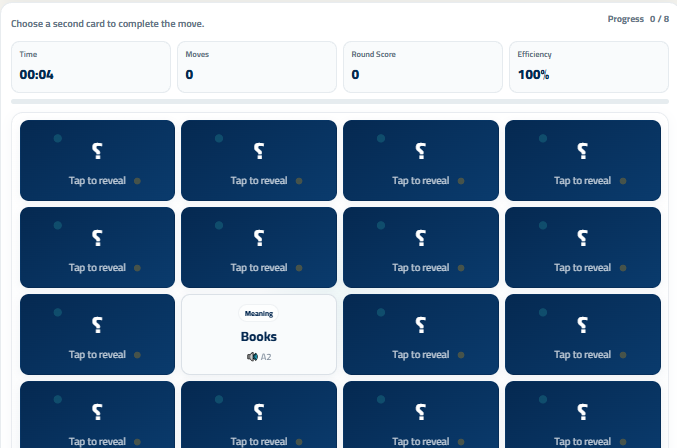
Play the digital version with Arabic Memory Game, which flips tiles to match Arabic words with their English meanings.
Start with 6 pairs, not 12. A full deck overwhelms a five-year-old and the session ends in frustration. Add two pairs a week.
2. Word Race
Set a one-minute timer. The child writes as many Arabic words as they can remember. Then review the list together, correcting spelling and extending one word into a sentence — بيت (bayt — house) becomes أنا في البيت (ana fi al-bayt — I am in the house).
The whole exercise takes five to ten minutes, which makes it the easiest game to squeeze into a school night, and it works from age 7 up to adult because speed of recall is the target, not vocabulary size.
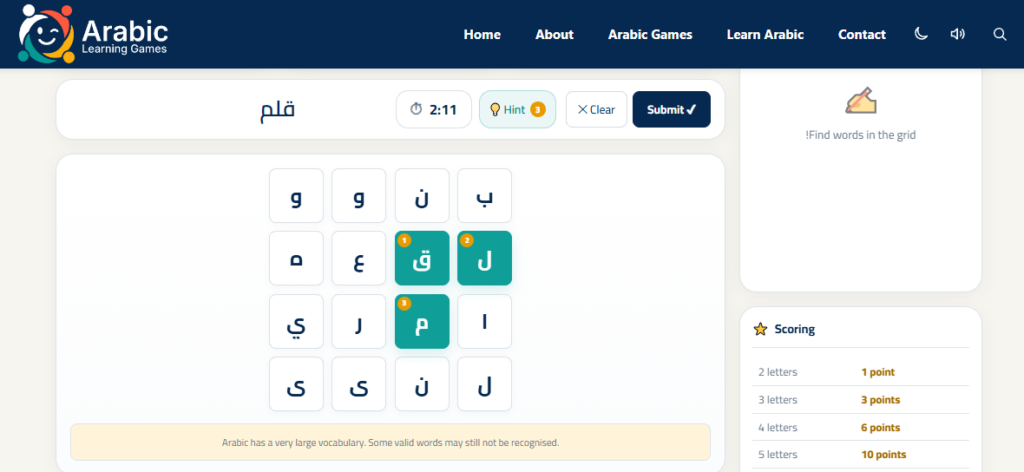
Arabic Word Hunt applies the same pressure digitally — race the clock to build Arabic words from a letter grid, scoring more points for longer words, which pushes learners past the same three safe words every round.
3. Treasure Hunt
Write each clue in simple Arabic and hide a small prize at the end. Reading is the only route to the treasure — for example, ابحث تحت الطاولة (ibhath taht al-tawila — look under the table).
Set aside twenty to forty minutes, since the setup and the hunt both take time. Children between 5 and 12 get the most from it, because the clues turn reading comprehension into something with a physical payoff.
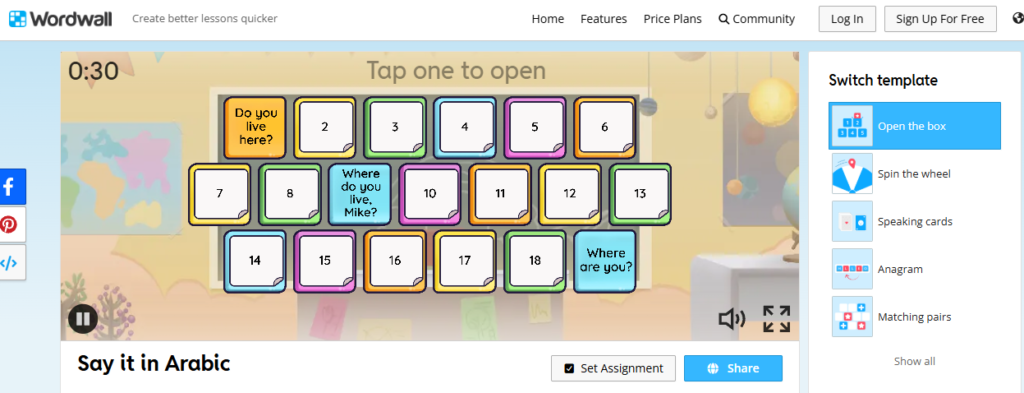
The reveal-and-discover format translates well to Say it in Arabic, an open-the-box game where each box hides a word the learner must read and say aloud.
Keep each clue inside vocabulary the child already owns. Clues written above their reading level leave a parent translating every one, and the challenge becomes decoding the sentence instead of finding the object.
4. Guessing Game
One player thinks of an Arabic word; the other guesses using yes/no questions in Arabic. For كلب (kalb — dog), the child might ask هل هو حيوان؟ (hal huwa hayawan? — is it an animal?). This forces question words into active use, which is where most learners stay passive.
Ten to twenty minutes per session is the sweet spot. It needs enough sentence control to form a question, so save it for ages 8 and above — including adult learners, who benefit from it just as much.
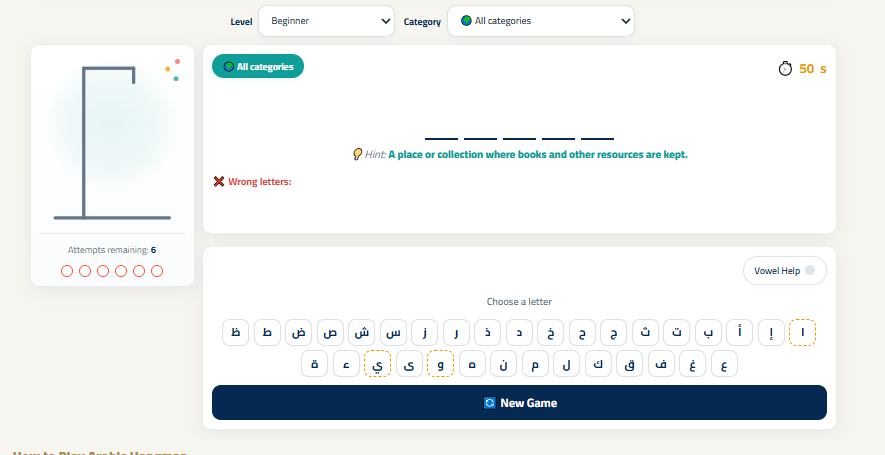
For a solo version, Arabic Hangman adds learner-friendly hints plus the meaning, transliteration, and vocalised form at the end of each round.
5. The Colors Game
Call out a color in Arabic and the child races to find a matching object. Say أحمر (ahmar — red) and they sprint for a red toy. The physical sprint is what fixes the word — children who hesitate to say a color in a formal exercise will shout it while racing a sibling.
Five to ten minutes is all it takes, which matches the attention span of the 3 to 8 age group this game is built for.
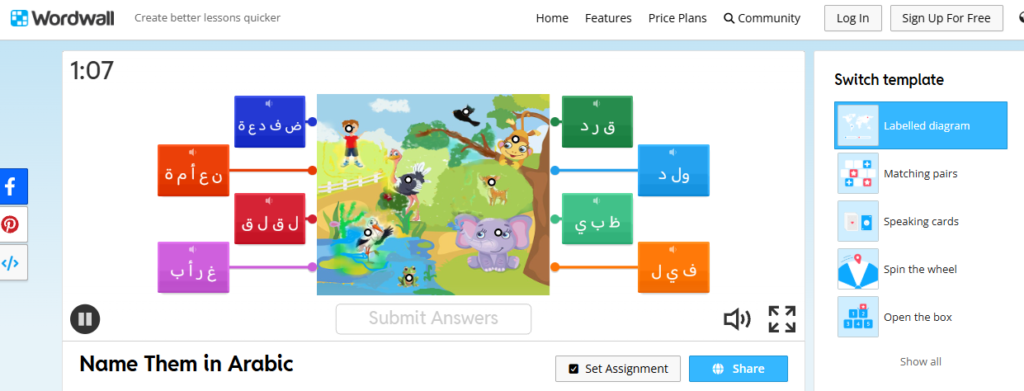
Reinforce the same vocabulary with Name Them in Arabic, where learners drag Arabic labels onto the right part of an image.
6. Arabic Alphabet Puzzles
Use wooden, foam, or printable alphabet puzzles. The child picks up a letter, names it, gives a word starting with it, then slots it in — picking up ب (bā’), saying بَاب (bāb — door), and placing it.
Combining shape, sound, and meaning in one action is why puzzles outperform tracing worksheets. Expect fifteen to thirty minutes of focused play from children aged 4 to 8, who are building letter recognition and fine motor control at the same time.
On screen, the Arabic Script Trainer drills recognising and joining letters — the exact point where self-taught learners stall, since Arabic letters change shape by position.
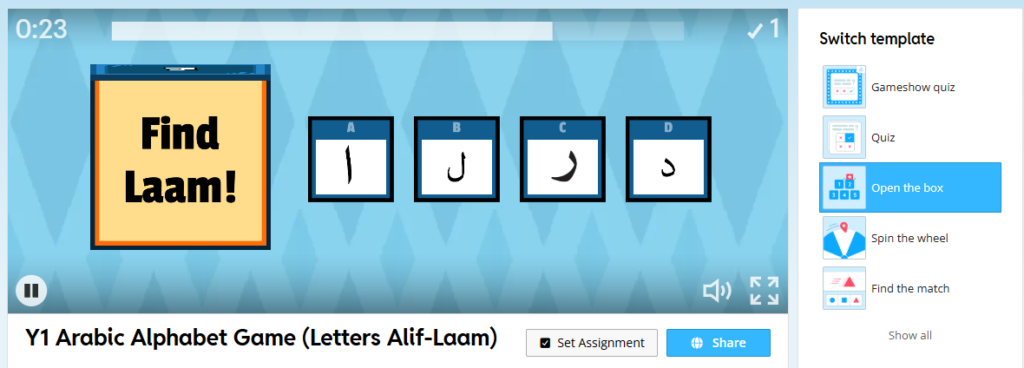
For early primary learners, the Y1 Arabic Alphabet Game (Letters Alif–Laam) covers the first half of the alphabet in a quiz-show format.
7. Arabic Charades
Write Arabic nouns and verbs on slips of paper. Players act out the word in silence while everyone else guesses in Arabic. A child draws يَرْكُض (yarkuḍ — he runs), runs in place, and the room shouts guesses.
Charades is the strongest game on this list for verbs, which flashcards handle badly because verbs describe motion, not objects. Anyone from age 6 upward can play, and a session of fifteen to thirty minutes usually produces more spoken Arabic than an hour of drilling.
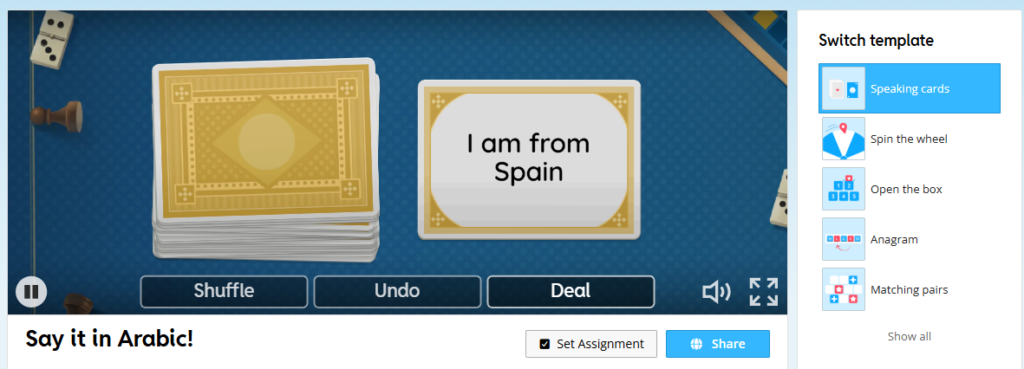
Reveal the Arabic Word keeps the speaking element on screen, prompting the learner to produce a full spoken response rather than click an answer.
8. Word Match
The fastest way to review a vocabulary list you studied earlier in the week. Word Match Game pairs Arabic words with their English meanings and gives instant feedback, which makes it ideal for the short daily layer underneath weekly hands-on play.
Five to fifteen minutes a day is the right dose from age 8 onward, since the difficulty rides on the word list rather than the format.
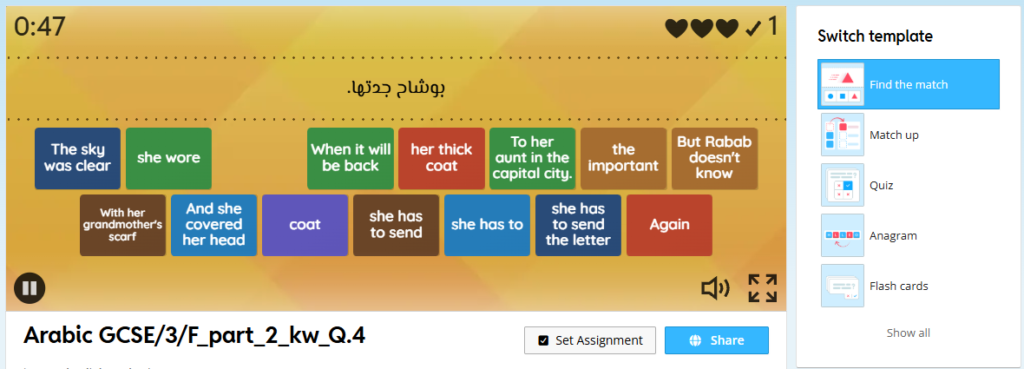
For a classroom-style variation, Arabic GCSE key words — find the match covers exam-level vocabulary for older students.
9. Arabic Word Search
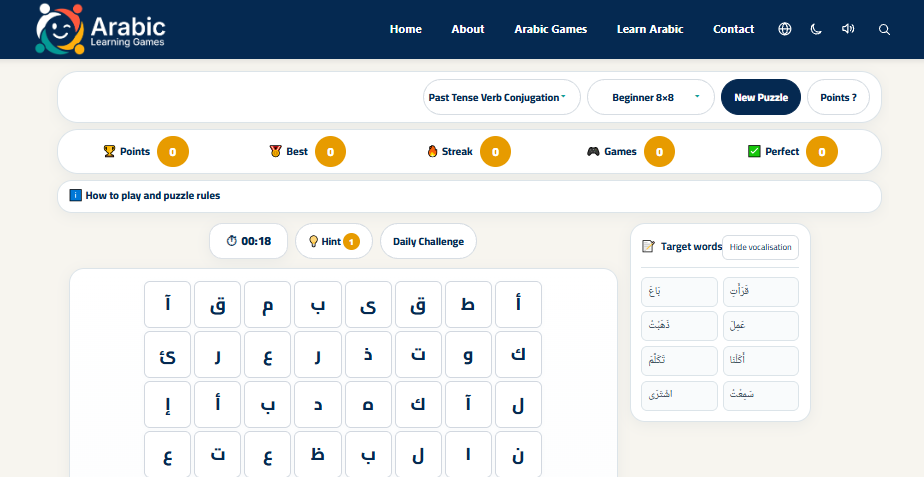
Word search trains the eye to spot words inside dense Arabic text — a skill that transfers directly to reading unvowelled script.
Play Arabic Word Search with topic and level selection plus hints, or work through graded sets like Arabic words — group 1 and Arabic words — group 2.
Step Inside Our Classrooms
Don’t just take our word for it—see our community in action. Click below to watch real, live snippets from our recent classes and experience our engaging teaching style firsthand!
Master Arabic in the UAE
Experience world-class Arabic language training designed for students and professionals in the Emirates.
Book Your Free Trial10. Arabic Crossword
Crosswords force exact spelling, because one wrong letter blocks the intersecting word. Start with the beginner Arabic crossword, move to the intermediate grid once clues stop slowing you down, then finish with the advanced crossword set.
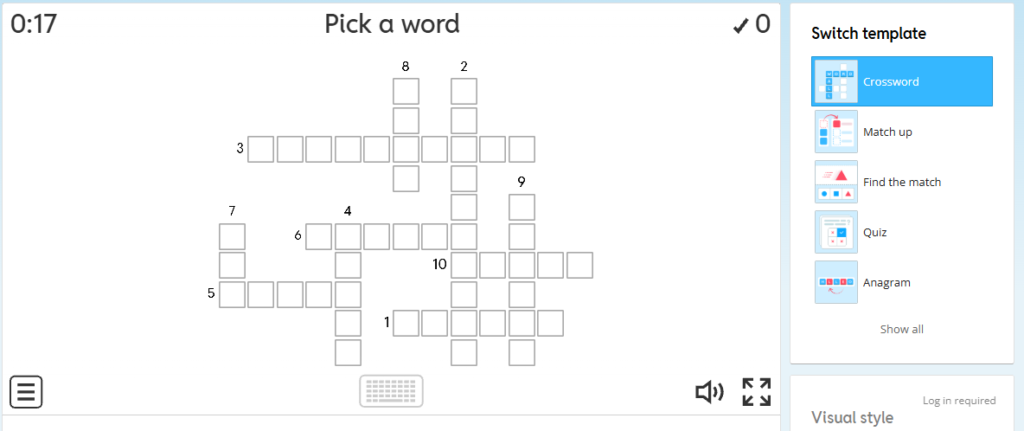
Allow fifteen to thirty minutes, and expect it to work from age 9 upward — younger children rarely have the spelling precision the grid demands.
Adult learners at B1 and above can graduate to the crosswords printed in Arabic newspapers, which test classical vocabulary that learner materials rarely cover.
Read also: Arabic Grammar For Beginners
11. Arabic Anagrams
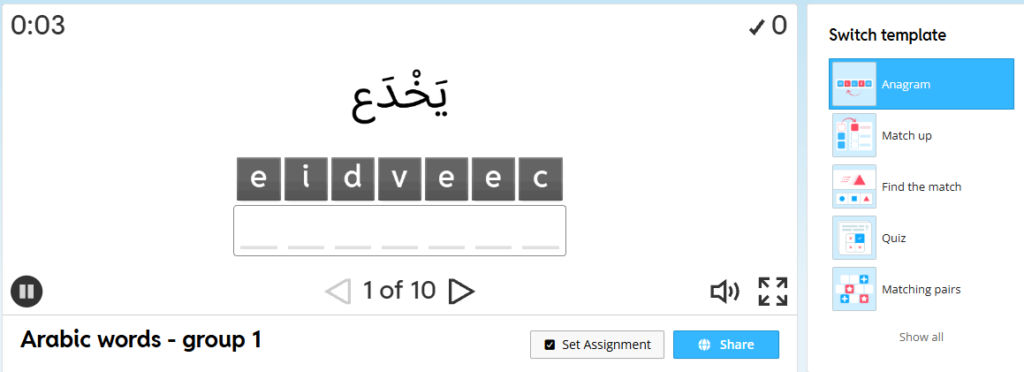
Anagram games scramble the letters of a known word and ask the learner to rebuild it. This targets a specific weakness: learners who recognise a word visually but cannot spell it. Work through Arabic words — group 1, group 2, and group 3 in order.
Ten to fifteen minutes is enough to work through a set, and the game suits learners from age 8 to adult who already read the script but misspell under pressure.
12. Sentence Builder
Knowing vocabulary and producing a sentence are two different skills, and most learners get stuck between them. Sentence Builder presents scrambled Arabic words to arrange into a correct sentence, which drills verb-subject order and agreement without a grammar lecture.
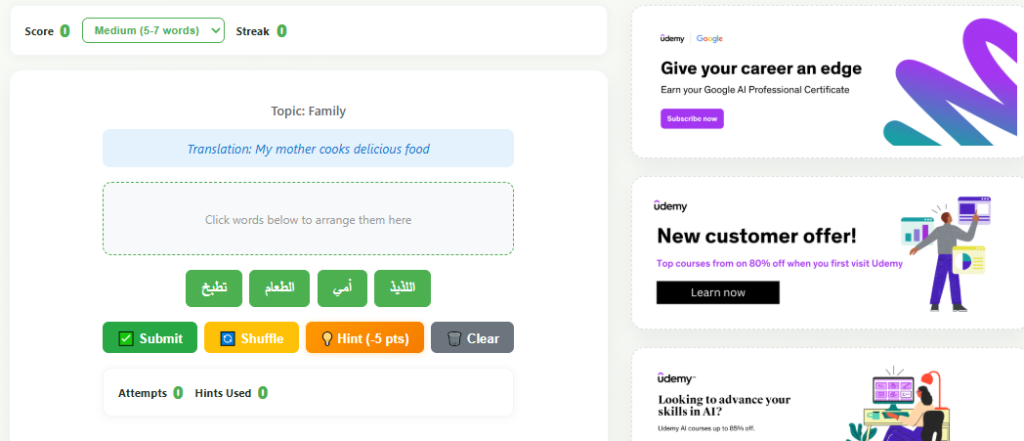
Ten to twenty minutes per session gives enough repetitions for the pattern to register, and it fits learners from age 9 upward who have a working vocabulary but no sentence confidence yet.
13. Count in Arabic
Numbers are high-frequency vocabulary that children use daily, which makes them the easiest category to carry from the game into real life.
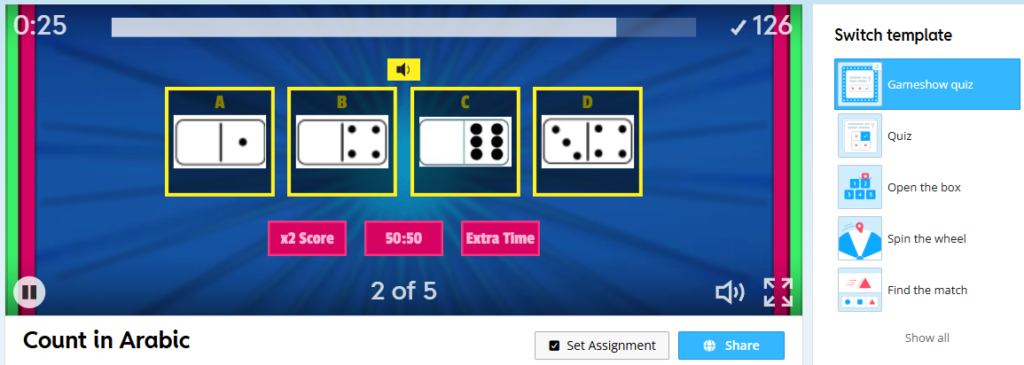
Play the quiz-show format of Count in Arabic, then switch to the find-the-match version to test recognition rather than recall. Both run in five to fifteen minutes and cover numbers 1 to 20 for children aged 5 to 11.
Carry it off the screen too: count stairs, plates, or cars in Arabic for one week after the game. Repetition in context beats another round of the same quiz.
14. Flags and Countries Challenge
Identify Arab country flags and learn their names in Arabic with the Flags and Countries Challenge.
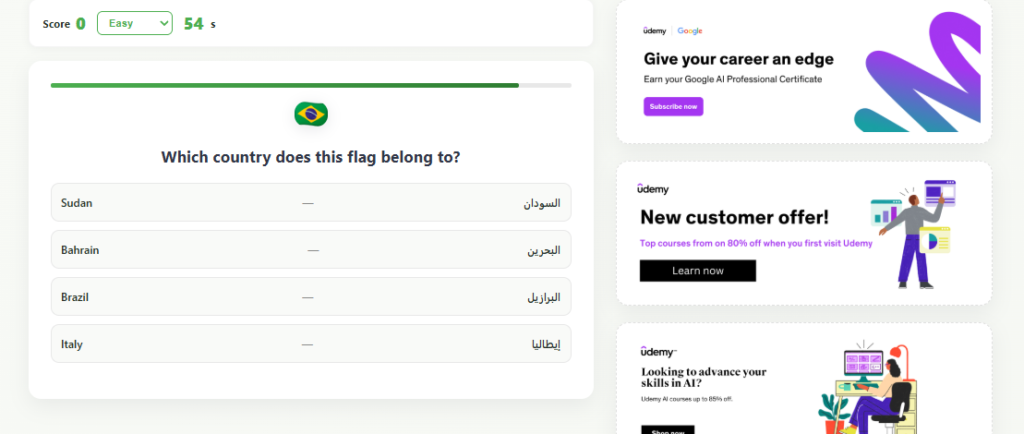
A ten to fifteen minute round covers a useful block of country names, and learners from age 8 upward can play it regardless of reading level, since the flags carry the recognition.
Country and city names carry useful vocabulary and give learners cultural grounding alongside the words — particularly relevant for families learning Arabic in the UAE, where the Gulf dialects and MSA sit side by side in daily life.
15. Arab World Explorer Quiz
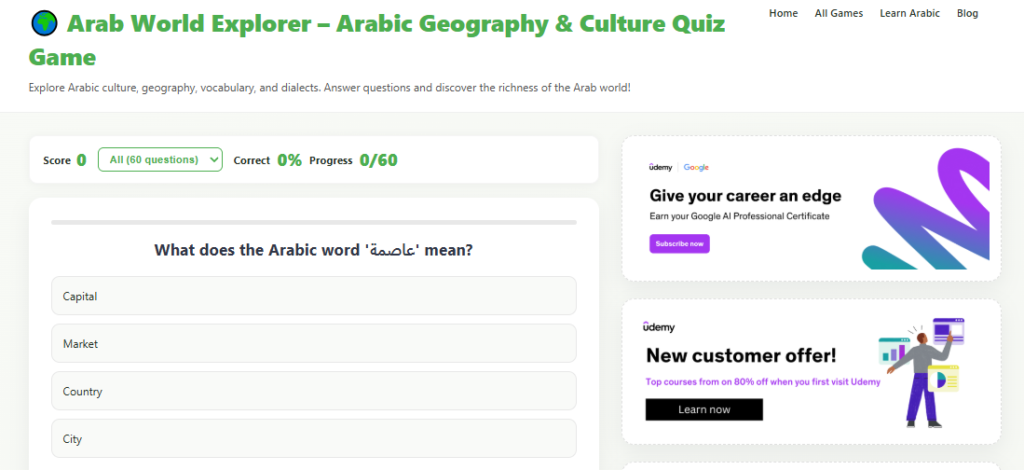
Intermediate learners need content to read, not more isolated word lists. The Arab World Explorer Quiz combines Arab geography, culture, and language in one interactive format, which makes it a natural step up once basic vocabulary is secure.
Budget fifteen to twenty-five minutes for a full run. It assumes a reader rather than a beginner, so it fits ages 10 and above once the alphabet is no longer an obstacle.
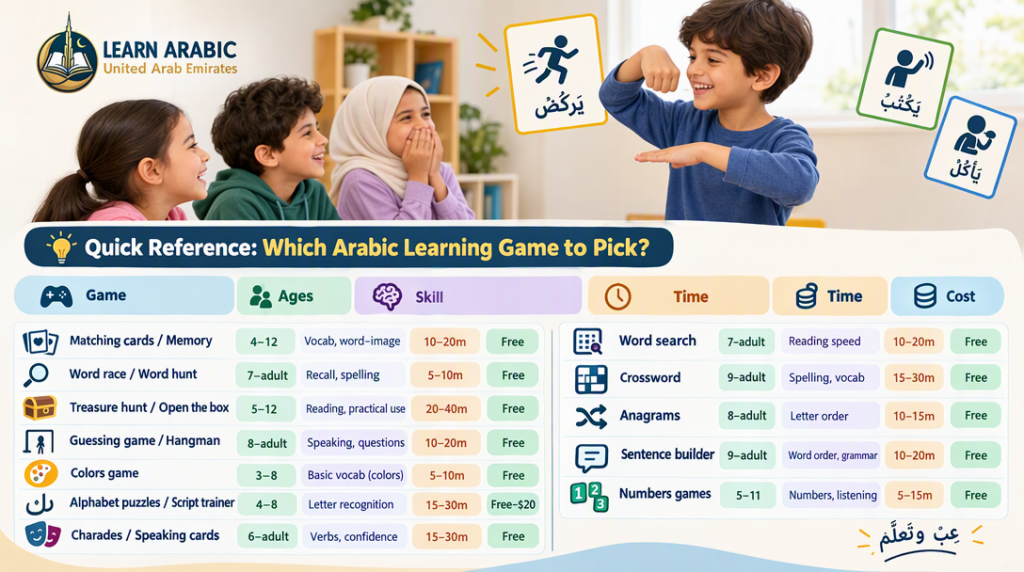
Quick reference: which Arabic learning game to pick
Match the learner’s age to the row first, then check the time column against how long you actually have. A game that fits the window gets finished — and a finished game is the one they ask to repeat.
| Game | Ages | Skill developed | Time needed | Cost |
| Matching cards / Memory | 4–12 | Vocabulary, word–image association | 10–20 min | Free |
| Word race / Word hunt | 7–adult | Vocabulary recall, spelling | 5–10 min | Free |
| Treasure hunt / Open the box | 5–12 | Reading comprehension, practical use | 20–40 min | Free |
| Guessing game / Hangman | 8–adult | Speaking, question formation | 10–20 min | Free |
| Colors game | 3–8 | Basic vocabulary (colors) | 5–10 min | Free |
| Alphabet puzzles / Script trainer | 4–8 | Letter recognition, joining letters | 15–30 min | Free–$20 |
| Charades / Speaking cards | 6–adult | Verbs, speaking confidence | 15–30 min | Free |
| Word search | 7–adult | Reading speed, pattern recognition | 10–20 min | Free |
| Crossword | 9–adult | Spelling accuracy, vocabulary breadth | 15–30 min | Free |
| Anagrams | 8–adult | Letter order, spelling | 10–15 min | Free |
| Sentence builder | 9–adult | Word order, grammar | 10–20 min | Free |
| Numbers games | 5–11 | Numbers, listening | 5–15 min | Free |
Running these games consistently is easier with a tutor setting the vocabulary list each week.
The kids’ Arabic classes at Learn Arabic In the UAE Academy are built around exactly this cycle — new words introduced in the live session, then reinforced through games at home within 48 hours, which is the window where most new vocabulary is otherwise lost.
Master Arabic in the UAE
Experience world-class Arabic language training designed for students and professionals in the Emirates.
Book Your Free Trial8 Arabic Learning Games for Adults
Adult learners respond to competition, intellectual challenge, and immediate practical application — not sticker charts. These Arabic games for adults are built around those drivers.
1. Arabic Wordle
Guess a five-letter Arabic word in six attempts, with each guess revealing correct letters and positions.
Five to ten minutes daily, and it builds spelling awareness without feeling like studying. Requires alphabet familiarity (A2+).
2. Flashcard Apps in Competitive Mode
Timed match and test modes turn vocabulary review into a race against your own previous score.
Thousands of user-created Arabic sets cover everything from greetings to Quranic vocabulary. Works at every level — the set you choose sets the difficulty.
3. Live Quiz Games
Real-time competitive quizzes create urgency that forces rapid Arabic recall under pressure. Most effective when a tutor builds the quiz around the exact vocabulary you studied that week.
4. Language Exchange Apps
Apps that connect you with native Arabic speakers for text and voice exchange, with built-in correction tools, streaks, and achievements.
The “game” here is a real conversation, which makes it the most authentic practice available. Needs basic conversational ability (A2+).
5. Arabic Crossword Puzzles — كلمات متقاطعة
Arabic newspapers publish daily crosswords that test vocabulary breadth and classical terms.
Intermediate to advanced (B1+), and one of the few native-audience resources learners can use productively.
6. Arabic Taboo — لعبة التابو
Describe an Arabic word without using four forbidden related words. Write your own cards.
Example: Word = مطبخ (kitchen). Forbidden: بيت, طبخ, أكل, غرفة.
This trains circumlocution — describing your way around a word you do not know — which is the single most useful survival skill in real Arabic conversation.
7. Competitive Word Building — بناء الكلمات
Write an Arabic root such as ك-ت-ب and race to list every derived word in two minutes: كتاب، كاتب، مكتبة، مكتوب، كتابة، مكتب.
This game leverages the Arabic root system, the most powerful vocabulary mechanism in the language.
Learn one root properly and you unlock eight to twelve words instead of one. Suitable A2–B2.
8. Arabic 20 Questions
One player thinks of a word; the other asks up to twenty yes/no questions in Arabic to identify it. Forces fluent use of question words — هل، ما، أين، متى، كيف — which textbooks introduce early and learners then rarely practice aloud.
Adults usually stall for one reason: no one is correcting them. The adult Arabic programs at Learn Arabic In the UAE Academy pair game-based practice with a tutor who catches the errors that silently calcify when you only practice alone.
Arabic Learning Games by Vocabulary Category
Organize each session around one vocabulary category rather than mixing randomly. Grouped vocabulary is retrieved faster because the brain stores it as a cluster.
| Vocabulary category | Arabic | Best games | Sample words |
| Colors | الألوان | Colors Game, Matching, Charades | أحمر، أزرق، أخضر |
| Numbers 1–20 | الأرقام | Count in Arabic, Word Race | واحد، اثنان، ثلاثة |
| Family members | أفراد العائلة | Matching Game, 20 Questions | أبي، أمي، أخي، أختي |
| Food and drink | الطعام والشراب | Treasure Hunt, Matching, Charades | خبز، ماء، تفاحة، قهوة |
| Body parts | أجزاء الجسم | Charades, Labelled diagram games | رأس، يد، عين، أنف |
| Animals | الحيوانات | Guessing Game, Charades, Matching | قطة، كلب، أسد، طائر |
| Daily verbs | أفعال يومية | Charades, Speaking cards | يأكل، يشرب، ينام، يجري |
| Home and furniture | المنزل والأثاث | Treasure Hunt, Matching | باب، نافذة، مطبخ، سرير |
| Weather and nature | الطقس والطبيعة | Word Search, Word Race | شمس، مطر، ريح، سحاب |
| School and work | المدرسة والعمل | Crossword, Word Search | مدرسة، كتاب، قلم، مكتب |
Read also: Arabic Long Vowels
Which Arabic Games Work for Which Age
Match the game to the attention span, not to the child’s reading ability. A game that runs past the span ends badly regardless of how well it is pitched.
| Age group | Attention span | Best game types | Specific games | Online options |
| 3–5 years | 5–10 min | Color-based, movement, repetition | Colors Game, Alphabet Puzzles | Script Trainer, alphabet games |
| 5–7 years | 10–15 min | Matching, physical, simple competition | Matching Game, simple Treasure Hunt | Arabic Memory Game, Word Match |
| 7–10 years | 15–25 min | Rule-based, mild competition | Word Race, Guessing Game, Charades | Word Search, Guess the Word, Count in Arabic |
| 10–13 years | 20–30 min | Competitive, social, challenge-based | Word Race, Charades, Treasure Hunt | Word Hunt, Hangman, Crossword |
| 13–17 years | 30+ min | Digital, competitive, self-directed | All above + adult games | Arabic Wordle, Sentence Builder, Arab World Explorer |
| Adults | 20–45 min | Intellectual challenge, real application | Taboo, Word Building, 20 Questions | Arabic Wordle, crosswords, exchange apps |
The golden rule: the game should feel effortless, not like disguised homework. If the learner starts watching the clock, the session is too long or the game is too hard. Step down one level or switch games.
See Our Classroom Environment in Action
Experience a sneak peek into our live sessions. Watch the video below to see our specialized instructors interacting with students, breakdown complex texts, and cultivate an engaging, respectful learning environment.
Master Arabic in the UAE
Experience world-class Arabic language training designed for students and professionals in the Emirates.
Book Your Free TrialStart Your Child’s Arabic Journey With Expert Guidance
Games build momentum. A structured curriculum turns that momentum into fluency.
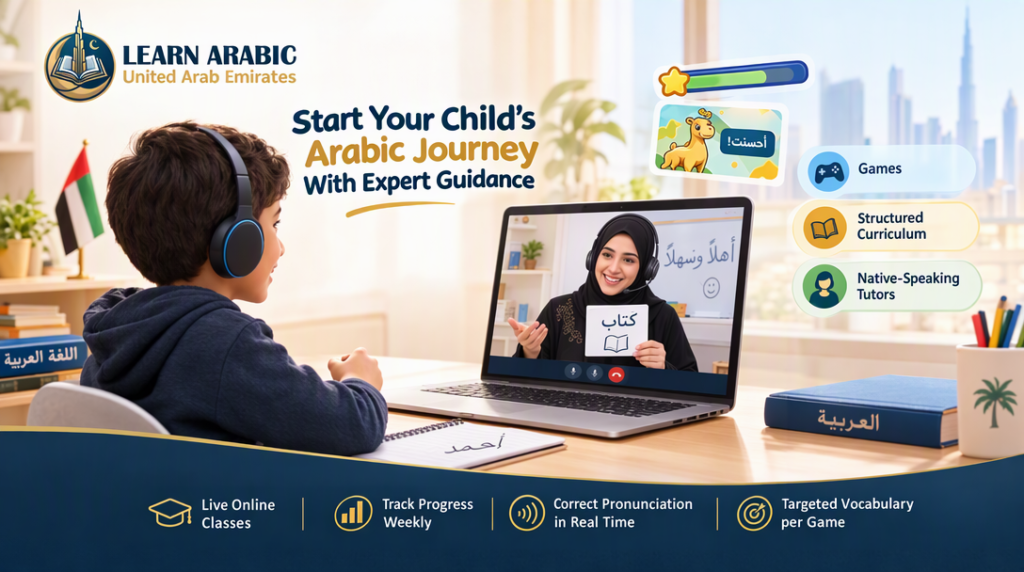
At Learn Arabic In the UAE Academy, live online classes for kids and adults combine the game-based methods in this guide with qualified native-speaking tutors who track progress week by week, correct pronunciation in real time, and set the exact vocabulary each game session should target.
No commute, flexible scheduling, and lessons shaped around your level — not a generic syllabus.
Our Arabic courses:
- Arabic Course in the UAE
- Arabic Intensive Course
- Arabic Classes for Beginners (Learn Arabic from Scratch)
- Madinah Arabic Course
- Arabic Classes for Adults
- Self-Paced Arabic Course
- Arabic Speaking Classes
- Learn to Write Arabic Course
- Arabic Grammar Course
- Learn Arabic Alphabet Course
- Modern Standard Arabic (MSA) Course
Conclusion
Arabic learning games work because they change the status of a word in the learner’s mind: from something to memorize into something you need.
Matching, treasure hunts, charades, and colors carry kids through their first few hundred words, while the free online versions linked above provide the short daily repetition that locks those words in.
Adult games built on competition, root-word building, and real conversation push past the plateau where most self-taught learners stop.
Pick three games, rotate them, keep every session shorter than the learner’s attention span, and apply the win-condition rule: if they could win without using the Arabic, redesign the game.
Pair that with structured instruction from Learn Arabic In the UAE Academy, and Arabic learning games stop being a distraction from study and become the study itself.

FAQs About Arabic Learning Games
Below are the questions parents and adult learners ask most often before starting with Arabic learning games — covering age suitability, screen time, effectiveness, and how games fit alongside formal lessons.
1. What are the best Arabic learning games for beginners?
The best Arabic learning games for beginners are matching games, the colors game, and alphabet puzzles for children, and Arabic Wordle or word match games for adults. All four require only first-level vocabulary and give immediate feedback, so beginners build confidence before tackling sentences.
2. At what age can children start Arabic learning games?
Children can start Arabic learning games from about age three, using color games, alphabet songs, and simple matching with large pictures. Keep sessions to five minutes at that age and focus on single words rather than phrases.
3. Can Arabic learning games replace formal Arabic lessons?
Arabic learning games cannot replace formal lessons, because games reinforce vocabulary but do not teach grammar structure, pronunciation correction, or reading fluency systematically. They work best as practice between lessons — which is how tutors at Learn Arabic In the UAE Academy structure them.
4. Which Arabic learning games build speaking confidence fastest?
Charades, the guessing game, Arabic Taboo, and 20 Questions build speaking confidence fastest because all four require the learner to produce Arabic out loud under light time pressure. Games that only involve matching or clicking build recognition, not speech.
5. Are free online Arabic games effective, or do I need paid apps?
Free online Arabic games are effective for vocabulary, spelling, and script recognition, which is where most learners need daily repetition. Paid apps mainly add structured curriculum and tracking. Free games plus a live tutor outperform a paid app used alone.



Leave a Reply