 Learn Arabic

Arabic letters change shape depending on their position inside a word. This is exactly where most beginners get confused.
Connecting Arabic letters practice is the skill of recognizing and writing a letter’s initial, medial, and final forms so that words read smoothly instead of as a string of disconnected symbols. Without this skill, a learner can know all 28 letters by heart and still struggle to read a simple sentence.
This article breaks the skill down into its real components: how letter shapes change, which letters refuse to connect forward, and a practical sequence for building the skill through repetition rather than memorization alone.
The Three Positions A Letter Can Take
Arabic is written in a cursive script, so most letters physically join to the letters beside them within the same word.
Connecting Arabic letters practice trains a learner to recognize that a single letter, like ب (ba), is not one fixed symbol, but a family of related shapes depending on its position in the word.
This is different from Latin scripts, where a letter like “b” looks the same whether it starts, sits in the middle of, or ends a word. In Arabic, the shape itself signals the letter’s role in the word structure.
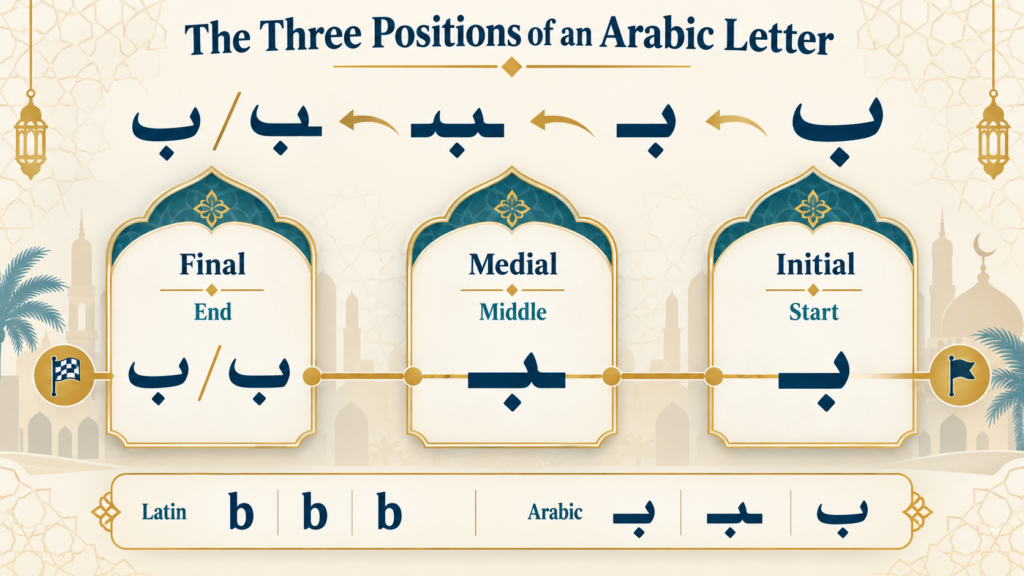
A connecting Arabic letter can appear in three positions, each with its own shape:
| Position | What happens to the letter | Example (ب) |
| Initial (start of word) | Loses part of its full shape to link forward | بـ |
| Medial (middle of word) | Connects on both sides | ـبـ |
| Final (end of word) | Returns to a fuller shape, connected or separate | ـب / ب |
The isolated form, the shape shown on an alphabet chart, is really just the “final, unconnected” version. Learners who only memorize the isolated shape often cannot recognize the same letter once it appears mid-word.
Why Letter Shapes Change When They Connect
A letter simplifies its shape at the start or middle of a word specifically to make room for a connecting stroke to the next letter.
The dots and the letter’s core body stay the same. Only the tail or connecting stroke changes. This is a mechanical writing rule, not a different letter: ب, ـبـ, and ـب are the same letter in three physical states.
Recognizing this pattern early prevents a common beginner error: treating each positional form as a new letter to memorize separately, which triples the learning load unnecessarily.
Learn Arabic UAE’s structured lessons introduce each letter alongside its connected forms from the very first session, so students build the pattern-recognition habit instead of relearning shapes later.
Read Also: Arabic Grammar For Quran
The Letters That Never Connect Forward
Arabic letters usually flow together within a word, but six important letters break this pattern. Learning where these breaks occur helps beginners recognize word shapes. It also helps them form connections correctly and avoid mistaking natural gaps for handwriting errors.
The Six Non-Connecting Letters
Six letters, أ (alef), د (dal), ذ (dhal), ر (ra), ز (zay), و (waw), only connect to the letter before them. They never extend a connecting stroke to the letter after them, even in the middle of a word.
This means these letters have only two shapes, not three: an initial/isolated form and a final-connected form. There is no true medial shape, because a medial shape requires connecting on both sides. These letters are called الحروف الرافسة or non-connecting letters.
How This Affects Word Reading
When one of these six letters appears inside a word, the next letter is forced to start a fresh, disconnected segment, even though the word is still read and written as one unit.
A word like ورد (rose) contains a non-connecting و at the start, so the entire word reads as separate visual chunks: و ر د, joined conceptually but not by connecting strokes.
Beginners who don’t know this rule often assume they’ve made a writing mistake when a word “breaks apart” mid-sequence. Applying and practicing this exception from the very beginning prevents that confusion entirely. It’s a rule to learn once, not a mistake to keep correcting.
Read Also: Arabic Grammar For Beginners
How To Practice Connecting Arabic Letters
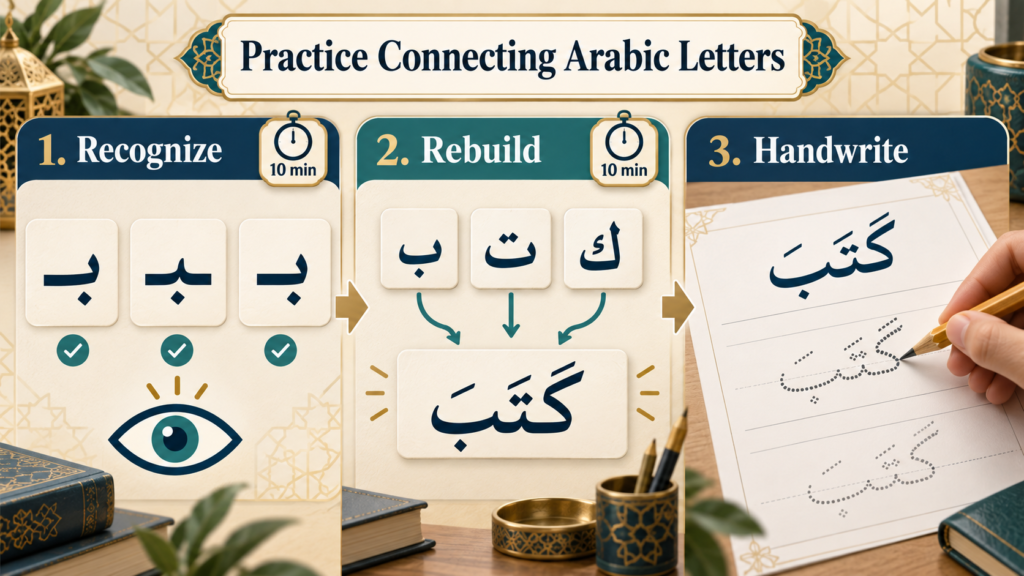
Effective connecting Arabic letters practice follows a specific sequence: recognition first, then reconstruction, then handwriting. Skipping straight to full-word reading before mastering shape recognition is the single biggest reason progress stalls.
1. Recognize Each Shape In Isolation
Before combining letters, a learner needs to instantly identify a letter regardless of which of its two or three shapes is shown.
Flashcard-style drills that show only the initial or only the medial form of a letter, without the isolated version as a hint, build this recognition faster than reading full words too early.
2. Break Words Apart And Rebuild Them
Take a simple word and split it into its separate letters, then have the learner reassemble it. For example, ك ت ب (three separate letters) should be reconstructed into كتب (wrote), with the learner choosing the correct connected form for each letter’s position.
This decompose-and-recombine method is one of the most reliable ways to cement the position-based shape changes, because it forces active shape selection rather than passive reading.
Reserve one 10-minute session for recognition, and a separate session for word reconstruction; combining both in one sitting usually causes fatigue before either skill is solid.
3. Practice Handwriting The Connections By Hand
Reading recognition and handwriting are separate skills, and connection practice only becomes durable once a learner has physically written the joins.
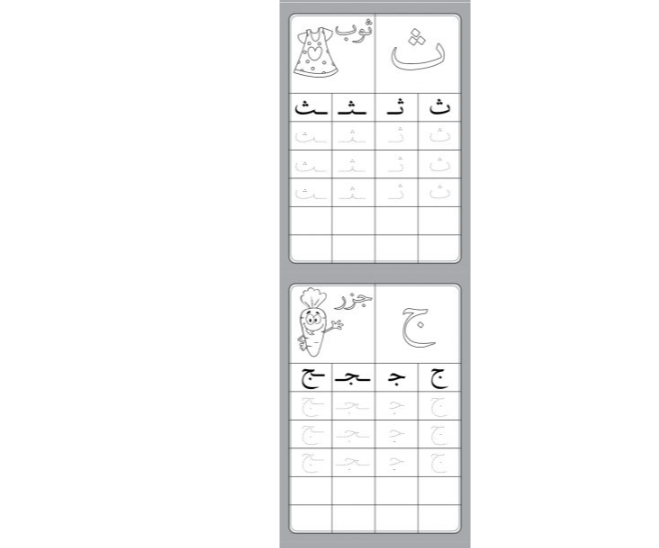
Tracing worksheets that show a full word with dotted outlines let a learner feel where one letter’s connecting stroke meets the next letter’s starting point. It is a detail that’s hard to internalize from reading alone.
Learn Arabic UAE pairs this kind of guided handwriting practice with live correction, so a learner isn’t left guessing whether a connecting stroke was written correctly or just close enough.
Read Also: Arabic Long Vowels – The Complete Guide To ا و ي
Common Mistakes In Connecting Arabic Letters Practice
Connecting Arabic letters becomes much easier when learners know which habits can slow their progress.
The following common mistakes often confuse in reading and handwriting, but recognizing them early helps learners build accurate letter-joining skills from the beginning.
1. Memorizing Isolated Shapes Only
The most frequent mistake is stopping at the alphabet-chart shape and assuming reading will follow automatically. It won’t; the isolated shape appears in real words far less often than the initial, medial, or final-connected forms.
2. Ignoring The Six Non-Connecting Letters As A Separate Rule
Learners who treat all 28 letters identically eventually hit a wall the first time a word contains alef, dal, dhal, ra, zay, or waw mid-word.
Teaching this exception explicitly, early, and separately from the general connection rule avoids that wall entirely.
3. Practicing Reading Without Ever Practicing Writing
Recognition and production reinforce each other. A learner who only reads printed Arabic, without tracing or writing the connections by hand, tends to recognize memorized whole words rather than genuinely reading new ones, which limits progress as vocabulary grows.
Structured, one-to-one instruction catches these three mistakes early. Self-study from printable sheets alone usually can’t do that.
The absence of an instructor to check whether a connecting stroke, a shape choice, or a non-connecting exception was actually applied correctly leads to this common mistake.
Read Also: Arabic Short Vowels
Step Inside Our Classrooms
Don’t just take our word for it—see our community in action. Click below to watch real, live snippets from our recent classes and experience our engaging teaching style firsthand!
Master Arabic in the UAE
Experience world-class Arabic language training designed for students and professionals in the Emirates.
Book Your Free TrialFree Worksheets For Practicing Connecting Arabic Letters
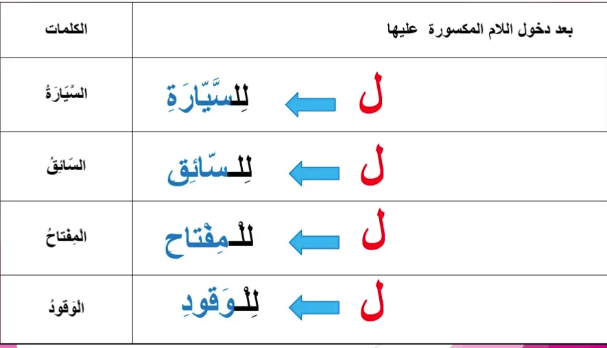
Free online worksheets give beginners a practical way to move beyond memorizing isolated Arabic letters and start joining them correctly within words. The following resources offer tracing exercises, positional-form practice, and word-building activities that learners can use to strengthen recognition and handwriting at their own pace.
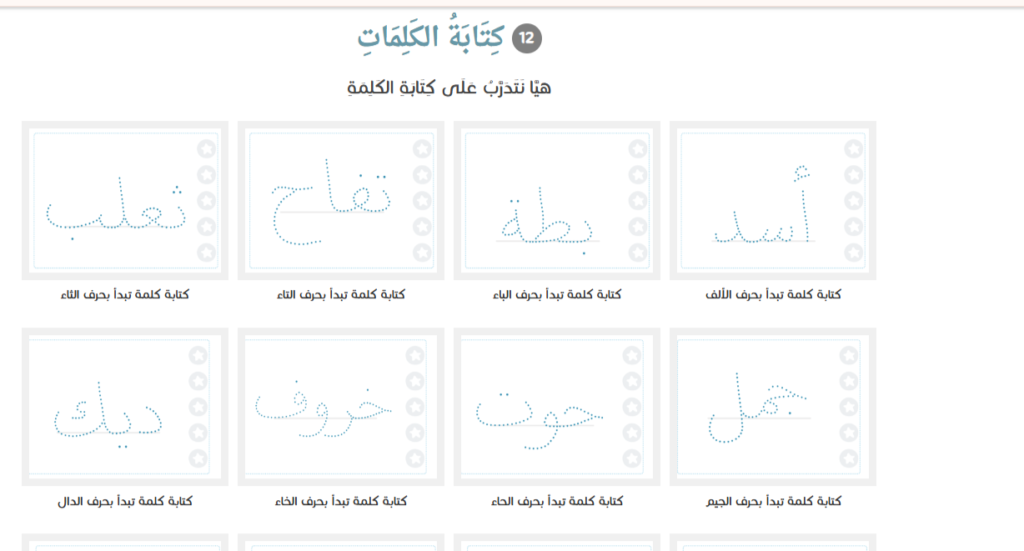
1. Alefbata Platform – Learn And Practice Easily
AlefBaTa platform provides guided worksheets for practising how Arabic letters connect within complete words. Its dotted tracing exercises help learners recognise positional letter forms, improve handwriting, and build confidence in joining letters correctly.
2. Scribd platform – Free Worksheets, Easy To Download
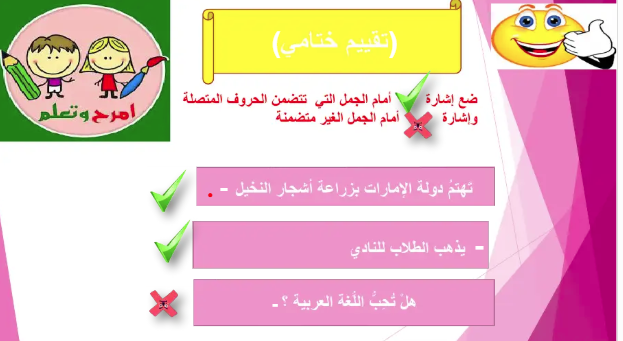
Scribd platform provides access to downloadable worksheets and classroom activities for practising connected Arabic letters.
The exercises use word-building, tables, and self-assessment tasks to help learners understand letter joins, apply them in complete words, and check their progress.
Read also: The Arabic Letter ت (Ta) – Pronunciation, Forms, and How to Master It
3. Arabic Worksheets – Learn And Practice For Free
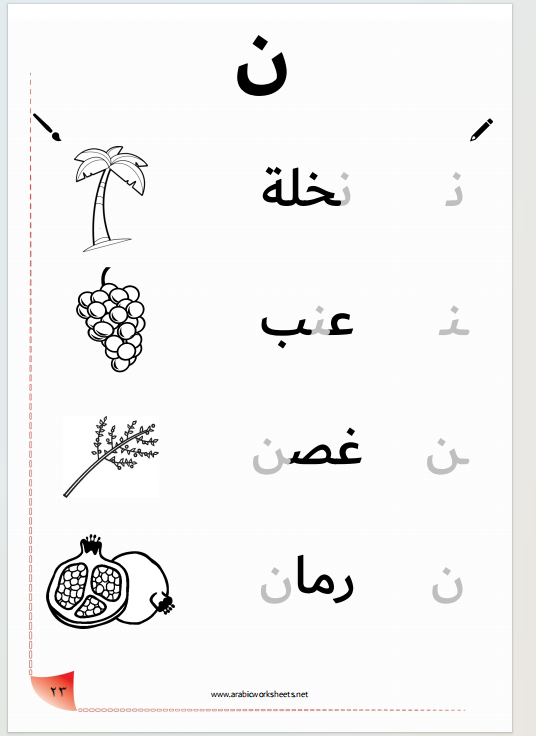
Arabic Worksheets offers free printable exercises for practising initial, medial, final, and isolated letter forms. Its picture-based worksheets help learners recognise connected shapes, complete words, strengthen handwriting, and practise offline at their own pace.
4. Twinkl platform – Read, Write, And Practice
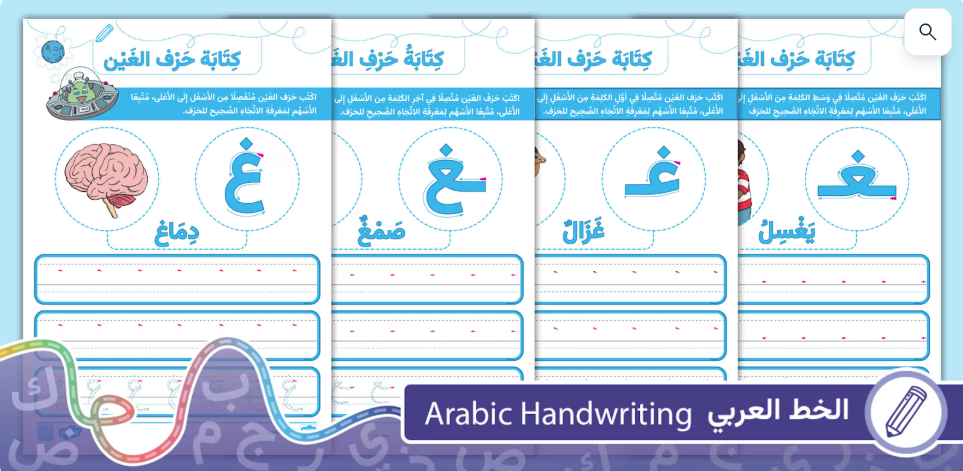
Twinkl platform offers free worksheets and handwriting activities covering all Arabic letters in both isolated and connected forms. Its tracing exercises, pictures, and word examples help learners recognise positional shapes, practise correct joins, and improve their Arabic handwriting.
5. Warq.net – Free Worksheets To Practice Easily
Warq.net offers free printable worksheets for practising every Arabic letter in its isolated and connected forms. Its tracing grids and picture-based examples help beginners recognise positional shapes, form accurate joins, and strengthen handwriting through repetition.
Read also: The Arabic Letter Tha ث – Pronunciation, Shape, Writing, & All Harakat
See Our Classroom Environment in Action
Experience a sneak peek into our live sessions. Watch the video below to see our specialized instructors interacting with students, breakdown complex texts, and cultivate an engaging, respectful learning environment.
Master Arabic in the UAE
Experience world-class Arabic language training designed for students and professionals in the Emirates.
Book Your Free TrialStart Connecting Arabic Letters with Confidence Today
Guessing at letter shapes slows down every stage of learning to read Arabic that comes after it. A short, guided course that corrects connection mistakes as they happen gets a learner reading real words in far less time than working through worksheets alone.
Learn Arabic UAE offers live, one-to-one Arabic reading and writing lessons built around exactly this recognize-reconstruct-write sequence, with an instructor checking every connection as the learner practices.
If you are ready to make Arabic letter connections feel more natural, consider beginning with a lesson suited to your current level. A guided practice with Learn Arabic UAE can help you develop clearer handwriting, stronger word recognition, and greater confidence in reading.
Our Arabic courses
- Arabic Course in the UAE
- Arabic Intensive Course
- Arabic Classes for Beginners (Learn Arabic from Scratch)
- Madinah Arabic Course
- Arabic Classes for Adults
- Self-Paced Arabic Course
- Arabic Speaking Classes
- Learn to Write Arabic Course
- Arabic Grammar Course
- Learn Arabic Alphabet Course
- Modern Standard Arabic (MSA) Course
- Quranic Arabic Course
- Fusha Arabic Course
- Classical Arabic Course
- Emirati Arabic Course
- Gulf Arabic Course
- Learn Saudi Arabic
- Business Arabic Course UAE
- Arabic Language Classes for Professionals in UAE
Our Arabic Courses for Kids
- Arabic Course for Kids
- Arabic Conversation Course for Kids
- Arabic Qaida Course for Kids
- Beginner Arabic Course for Kids
- Arabic Grammar Course for Kids
- Teen Arabic Summer Course
- UAE Kindergarten Arabic Classes
Conclusion
Connecting Arabic letters practice comes down to three things: recognizing that a letter changes shape based on its position, knowing which six letters break that pattern by refusing to connect forward, and practising the recognize, reconstruct, write sequence in that order.
Skipping any one of these steps is what usually causes reading to stall later, even for learners who know the alphabet well. With consistent, guided practice, joining letters stops being a puzzle and becomes automatic, just as it is for a native reader.
Regular tracing helps learners remember how each connecting stroke is formed. Rebuilding simple words strengthens the link between isolated and positional letter shapes. Over time, these skills lead to clearer handwriting, faster word recognition, and more fluent Arabic reading.
Frequently Asked Questions
What Does It Mean When Arabic Letters “Connect”?
It means a letter’s shape changes to link with the letter beside it inside the same word, forming one continuous cursive sequence instead of separate symbols. Most Arabic letters have up to three shapes: initial, medial, and final, depending on their position.
How Many Arabic Letters Don’t Connect To The Letter After Them?
Six letters,أ، د، ذ، ر، ز، و, only connect to the letter before them and never extend a connection to the next letter, even mid-word. This creates a visible “break” in the word even though it’s read as one unit.
What’s The Best Way To Practice Connecting Arabic Letters At Home?
Start by drilling each letter’s initial, medial, and final shapes separately, then practice breaking simple words apart and rebuilding them letter by letter. Follow this with handwriting worksheets that trace full connected words, not just isolated letters.
Can A Beginner Skip Shape Practice And Go Straight To Reading Full Words?
Skipping shape recognition usually causes learners to memorize whole words visually rather than genuinely read new ones, which breaks down as soon as vocabulary expands. Practicing positional shapes first builds a transferable reading skill instead.
How Long Does It Typically Take To Master Letter Connection?
With short, consistent daily practice, recognition, reconstruction, and handwriting combined, most learners become comfortable identifying and writing connected forms within a few weeks, though pace depends on practice frequency and whether mistakes are corrected early.



Leave a Reply