 Learn Arabic
If you’ve ever seen a Ramadan greeting dated “1 Ramadan 1447” and wondered how that connects to the Gregorian date on your phone, you’ve run into the Hijri calendar.
Knowing the Islamic months name in Arabic isn’t just useful for reading a calendar — it’s essential for understanding when Ramadan begins, when Hajj takes place, and why certain months carry extra weight in Muslim life.
This guide walks through all twelve Hijri months in order, their Arabic script, their meanings, and the historical events tied to each one. Whether you’re a student of Arabic, a new Muslim, or simply curious about how the Islamic calendar works, you’ll leave with a clear, practical reference you can return to.
What You’ll Learn in This Article
- The Arabic name, script, and meaning of all 12 Islamic months.
- Why the Hijri calendar is lunar and how that affects the dates each year.
- Which four months are considered sacred, and why.
- How the Hijri calendar differs from the Gregorian calendar.
- Answers to the most common questions about Islamic months in Arabic.
What Is the Hijri Calendar and Why Islamic Months Matter?
The Hijri calendar is the lunar calendar used to mark Islamic religious dates, and it begins from the year of the Prophet Muhammad’s migration (hijrah) from Mecca to Medina.
Every Islamic months name in Arabic corresponds to a lunar cycle rather than a fixed solar period, which is why the calendar behaves differently from the one on your wall.
The Qur’an itself explains the purpose behind these lunar cycles. As stated in Surah Yunus (10:5):
“He is the One Who made the sun a radiant source and the moon a reflected light, with precisely ordained phases, so that you may know the number of years and calculation of time.”
This verse is often cited as the scriptural basis for why Muslims track time through the moon rather than the sun.
How Many Islamic Months Are There?
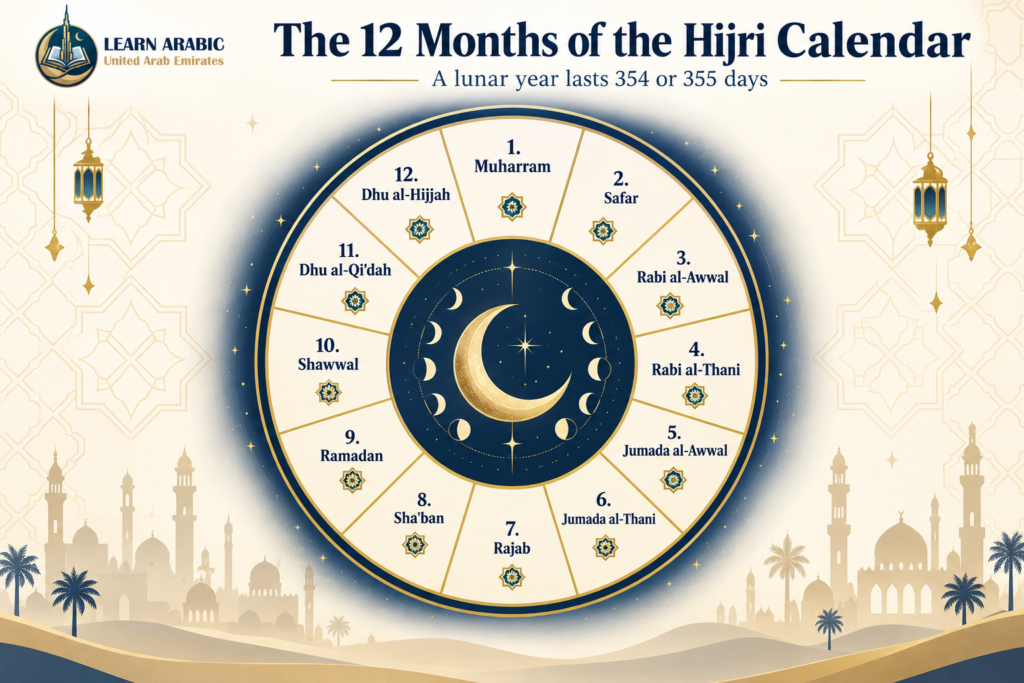
There are 12 months in the Hijri calendar, the same number as the Gregorian calendar, but the total year length is shorter at 354 or 355 days. This structure was set out in the Qur’an and has remained unchanged since the early Islamic period.
The 12 Islamic Months Name in Arabic (In Order)
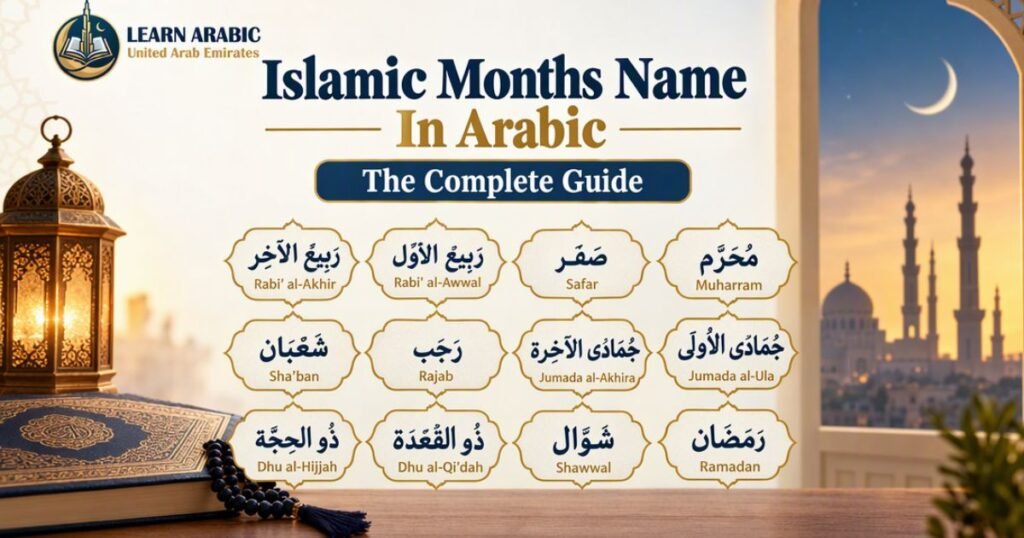
Here is the complete list of Islamic months’ names in Arabic, in order, with their pronunciation, meaning, and significance. Many learners at Learn Arabic In the UAE Academy start here before moving into reading full religious texts, since recognizing these twelve names by sight is a foundation for understanding Islamic dates.
| No. | Arabic | Transliteration | Meaning |
| 1 | مُحَرَّم | Muharram | Forbidden / sacred |
| 2 | صَفَر | Safar | Void / empty |
| 3 | رَبيع الأوَّل | Rabi’ al-Awwal | The first spring |
| 4 | رَبيع الثاني (الآخر) | Rabi’ al-Thani | The second spring |
| 5 | جُمادى الأولى | Jumada al-Ula | The first parched land |
| 6 | جُمادى الآخرة | Jumada al-Akhirah | The last parched land |
| 7 | رَجَب | Rajab | Respect / honor |
| 8 | شَعْبان | Sha’ban | Scattered |
| 9 | رَمَضَان | Ramadan | Burning heat |
| 10 | شَوَّال | Shawwal | Raised / lifted |
| 11 | ذُو القِعْدَة | Dhu al-Qi’dah | The one of truce |
| 12 | ذُو الحِجَّة | Dhu al-Hijjah | The one of pilgrimage |
1. Muharram (مُحَرَّم)
Muharram means “forbidden,” referring to the ban on fighting during this sacred month. It opens the Hijri year and includes the 10th day, Ashura, which marks the anniversary of Imam Hussein’s martyrdom at Karbala and, in another tradition, the parting of the sea for Prophet Musa.
2. Safar (صَفَر)
Safar means “void” or “empty,” a name most historians trace to pre-Islamic times when Arab homes emptied out as families traveled to gather food or trade. The month carries no fixed rituals today but marks the transition out of the sacred period that opened the year.
3. Rabi’ al-Awwal (رَبيع الأوَّل)
Rabi’ al-Awwal means “the first spring” and is significant as the month traditionally associated with the birth of the Prophet Muhammad (peace be upon him) in 570 CE. Many Muslims also mark his passing during this same month in 632 CE, which gives Rabi’ al-Awwal a dual emotional weight.
4. Rabi’ al-Thani (رَبيع الثاني)
Also written Rabi’ al-Akhir, this name means “the second spring.” It follows directly after Rabi’ al-Awwal and is generally observed as a quieter month without major fixed commemorations for most Muslims.
5. Jumada al-Ula (جُمادى الأولى)
Jumada al-Ula means “the first of the parched land,” a reference to the dry conditions or, in some accounts, the freezing water that characterized this period in the pre-Islamic Arabian calendar. It was during this month that the Battle of Mu’tah took place, in which a small Muslim force faced a far larger Roman army.
6. Jumada al-Akhirah (جُمادى الآخرة)
Jumada al-Akhirah, also called Jumada al-Thaniya, means “the last of the parched land” and follows Jumada al-Ula. It is remembered by some traditions as the month of both the birth and passing of Fatimah al-Zahra, the daughter of the Prophet.
7. Rajab (رَجَب)
Rajab means “to respect” or “revere,” and it is the second of the four sacred months in which fighting was traditionally forbidden. The 27th of Rajab is associated with Isra’ and Mi’raj, the night journey of the Prophet Muhammad from Mecca to Al-Aqsa Mosque and beyond.
8. Sha’ban (شَعْبان)
Sha’ban means “scattered,” reportedly because tribes dispersed to search for water or prepare for the coming season after Rajab. It sits directly before Ramadan and is traditionally treated as a preparation period, with increased fasting encouraged in its second half.
Step Inside Our Classrooms
Don’t just take our word for it—see our community in action. Click below to watch real, live snippets from our recent classes and experience our engaging teaching style firsthand!
Master Arabic in the UAE
Experience world-class Arabic language training designed for students and professionals in the Emirates.
Book Your Free Trial9. Ramadan (رَمَضَان)
Ramadan means “burning heat” and is the month in which Muslims observe fasting (sawm) from dawn to dusk. It is also the month associated with the revelation of the Qur’an, and it closes with the celebration of Eid al-Fitr.
10. Shawwal (شَوَّال)
Shawwal means “to raise” or “lift,” a name tied to the behavior of camels during this season. Eid al-Fitr falls at the start of Shawwal, and fasting six additional days in this month is a well-known Sunnah practice.
11. Dhu al-Qi’dah (ذُو القِعْدَة)
Dhu al-Qi’dah means “the one of sitting” or “truce,” named for the tradition of refraining from travel and conflict as people prepared for the pilgrimage season. It is the third of the four sacred months and functions as a lead-in to Dhu al-Hijjah.
12. Dhu al-Hijjah (ذُو الحِجَّة)
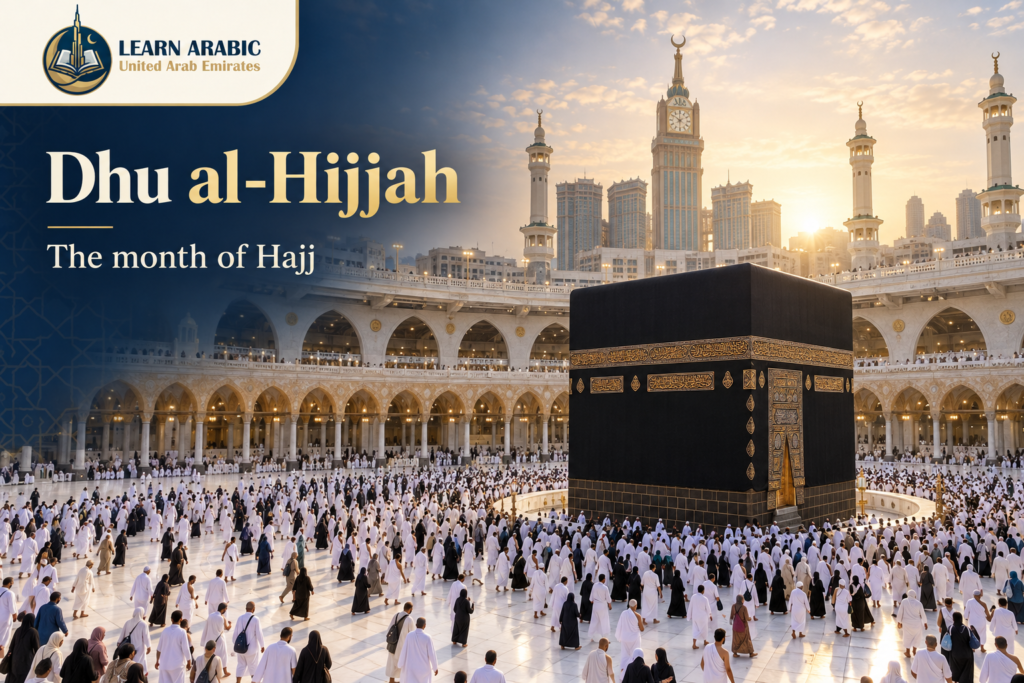
Dhu al-Hijjah means “the one of pilgrimage” and is the month in which Hajj takes place in Mecca.
The first ten days are considered especially significant, and the month includes Eid al-Adha, commemorating Prophet Ibrahim’s willingness to sacrifice his son.
A common mistake we see among Arabic learners is memorizing the English transliteration of a month’s name (like “Jumada al-Thani”) without ever learning its Arabic script or root meaning.
That gap makes it hard to recognize the month when it appears in a Quranic text, a hadith, or a mosque announcement written in Arabic.
Building that recognition from the script up is exactly what the Arabic Classes for Beginners at Learn Arabic In the UAE Academy are structured to fix.
Read Also: Arabic Names For Countries
The Four Sacred Months in Islam
Four of the twelve Islamic months carry special status: Muharram, Rajab, Dhu al-Qi’dah, and Dhu al-Hijjah. In Arabic these are known collectively as al-ashhur al-hurum (الأشهر الحرم), the sacred months.
Fighting was traditionally prohibited during the four sacred months, a practice that predates Islam and traces back to the era of Prophet Ibrahim, who is credited with establishing safe passage for pilgrims.
This protection allowed traders and travelers to move through Arabia without fear of conflict, particularly around the pilgrimage season.
How the Sacred Months Shape Muslim Life Today?
Three of the four sacred months — Dhu al-Qi’dah, Dhu al-Hijjah, and Muharram — fall consecutively, creating an extended season of reflection and reduced conflict around Hajj.
Rajab stands alone in the middle of the year, giving Muslims a second dedicated period of heightened worship roughly six months later.
Hijri Calendar vs. Gregorian Calendar: Key Differences
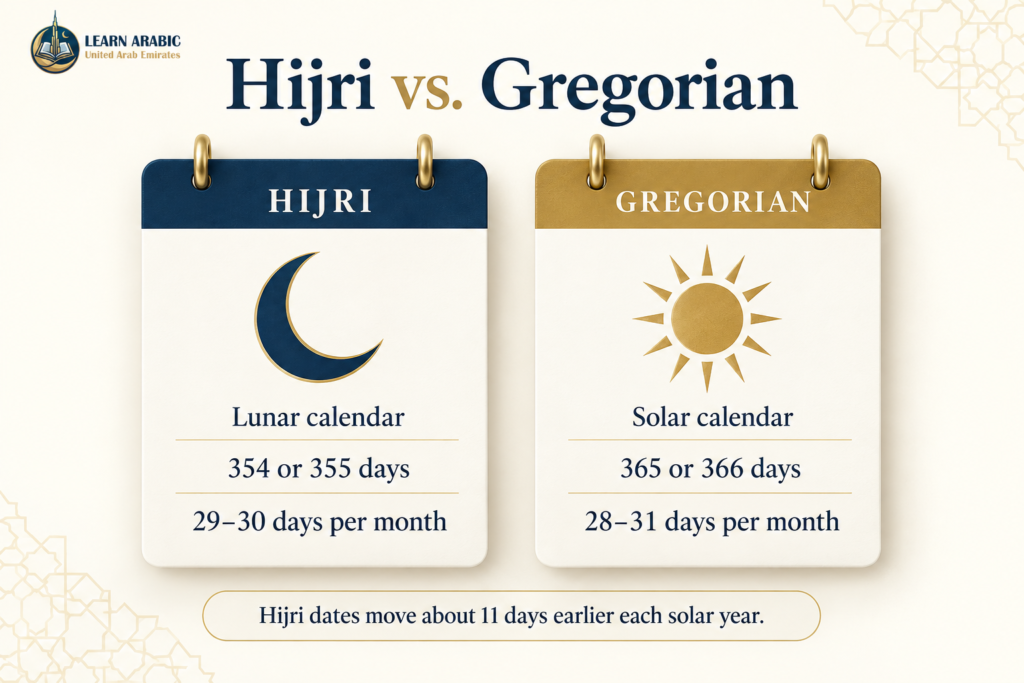
Understanding the difference between Hijri months in Arabic and the Gregorian calendar explains why Islamic dates never land on the same day twice.
The Gregorian calendar is solar, fixed to the Earth’s orbit around the sun, while the Hijri calendar is lunar, fixed to the moon’s phases.
Why Islamic Months Shift Every Year?
Because the lunar year is roughly 11 days shorter than the solar year, every Islamic month moves earlier by about 11 days each Gregorian year. Over a 33-year cycle, an Islamic month will pass through every season of the solar year once.
How to Track the Current Hijri Month?
Most smartphone calendar apps now display the Hijri date alongside the Gregorian one, and several dedicated Islamic calendar apps update automatically based on moon-sighting announcements.
Learning to read the Arabic month names directly, rather than relying on an app’s translation, is the more durable skill — one built through structured study rather than memorization alone.
If you’re working toward reading religious texts in their original language, the Madinah Arabic Course at Learn Arabic In the UAE Academy is designed around exactly this kind of classical, text-based fluency.
See Our Classroom Environment in Action
Experience a sneak peek into our live sessions. Watch the video below to see our specialized instructors interacting with students, breakdown complex texts, and cultivate an engaging, respectful learning environment.
Master Arabic in the UAE
Experience world-class Arabic language training designed for students and professionals in the Emirates.
Book Your Free TrialRead Also: How to Teach Kids Arabic in the UAE?
Start Learning Arabic and Islamic Studies Today
Recognizing the Islamic months name in Arabic is one small piece of a much larger skill: reading, understanding, and engaging directly with Arabic religious and cultural material without depending on translation.
That skill opens up the Qur’an, hadith literature, and everyday conversation with native speakers across the UAE and beyond.
Our Arabic courses:
- Madinah Arabic Course
- Arabic Classes for Adults
- Self-Paced Arabic Course
- Learn to Write Arabic Course
- Arabic Grammar Course
- Learn Arabic Alphabet Course
- Modern Standard Arabic (MSA) Course
- Quranic Arabic Course
- Fusha Arabic Course
- Classical Arabic Course

Conclusion
The Islamic month’s name in Arabic — from Muharram through Dhu al-Hijjah — form a lunar calendar that has guided Muslim religious life for over fourteen centuries. Each month carries its own meaning, its own history, and in four cases, a sacred status tied to peace and pilgrimage.
Whether you’re tracking Ramadan, planning around Hajj, or simply building your Arabic vocabulary, knowing these twelve names in both script and meaning gives you a working entry point into the Hijri calendar.
Learn Arabic In the UAE Academy builds exactly this kind of practical, text-based understanding into every level of its courses.

Frequently Asked Questions About Islamic Months in Arabic
Here are quick, direct answers to the questions learners most often ask about the Hijri calendar and the Islamic month’s name in Arabic.
1. What are the 12 Islamic months in Arabic in order?
The 12 Islamic months in order are Muharram, Safar, Rabi’ al-Awwal, Rabi’ al-Thani, Jumada al-Ula, Jumada al-Akhirah, Rajab, Sha’ban, Ramadan, Shawwal, Dhu al-Qi’dah, and Dhu al-Hijjah. Each month follows a lunar cycle of 29 or 30 days.
2. What are the four sacred months in Islam?
The four sacred months are Muharram, Rajab, Dhu al-Qi’dah, and Dhu al-Hijjah. Fighting was traditionally forbidden during these months to allow safe travel and pilgrimage.
3. How many days are in an Islamic year?
An Islamic year has 354 or 355 days, depending on the moon’s visibility each month. This is about 10 to 11 days shorter than a Gregorian solar year of 365 days.
4. Is Ramadan the same as Muharram?
No, Ramadan and Muharram are two different months. Ramadan is the ninth month and is the month of fasting, while Muharram is the first month of the Hijri year and one of the four sacred months.
5. Why does Ramadan fall on a different date every year?
Ramadan shifts because the Hijri calendar is lunar and runs about 11 days shorter than the solar Gregorian year. This causes every Islamic month, including Ramadan, to move earlier each year on the Gregorian calendar.
6. What does the word Hijri mean?
Hijri refers to the hijrah, the migration of the Prophet Muhammad from Mecca to Medina in 622 CE. The Islamic calendar counts its years from this event, so dates are written as “AH” (After Hijrah).


Leave a Reply