 Learn Arabic
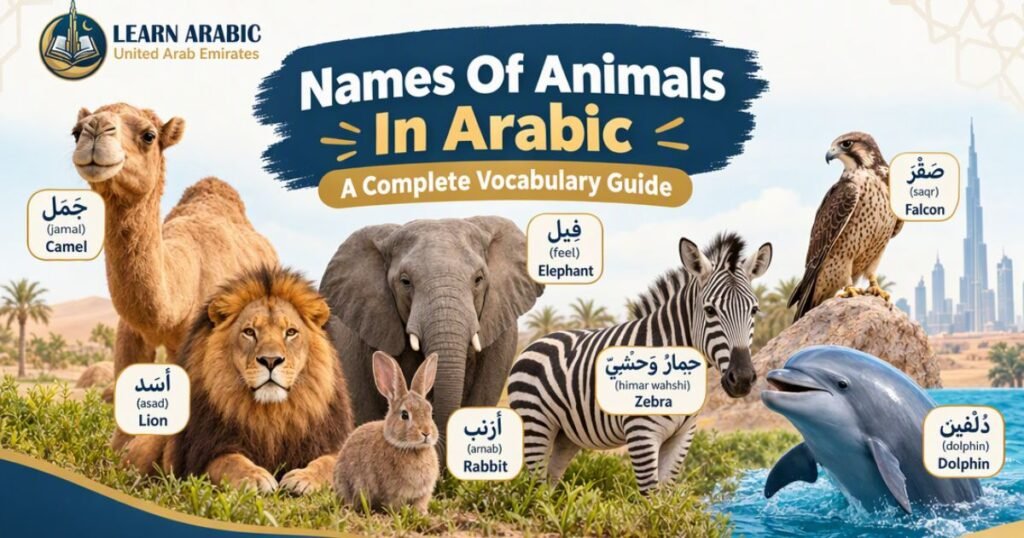
Learning the names of animals in Arabic is one of the fastest ways to build real vocabulary, because animals show up everywhere — in conversation, in children’s books, in proverbs, and in everyday Gulf life from the desert to the aquarium.
Whether you’re a complete beginner or brushing up before a trip to the UAE, this guide gives you a structured, practical path through the vocabulary rather than a random word dump.
At Learn Arabic In the UAE Academy, animal vocabulary is one of the first topics we teach new students, because it’s concrete, visual, and easy to practice in short sentences.
Below you’ll find the words organized by category, plus the grammar, pronunciation, and memory techniques that actually make the vocabulary stick.
What you’ll learn in this article:
- A complete list of names of animals in Arabic, organized by domestic, farm, wild, sea, and insect categories.
- The core Arabic words for animal, animals, pet, and zoo.
- Why Arabic animal nouns have gender — and how that changes the word you use.
- How to pronounce tricky Arabic letters correctly the first time.
- The most common mistakes beginners make with this vocabulary, and how to avoid them.
What Does Animal Mean in Arabic?
Animal in Arabic is hayawan (حيوان), and the plural, animals, is hayawanat (حيوانات). These two words are the foundation for every category below, because Arabic builds compound phrases from them: hayawan alif (حيوان أليف) means pet, literally “tame animal,” hayawan barri (حيوان بري) means wild animal, and hadiqat al-hayawanat (حديقة الحيوانات) means zoo, literally “the garden of animals.”
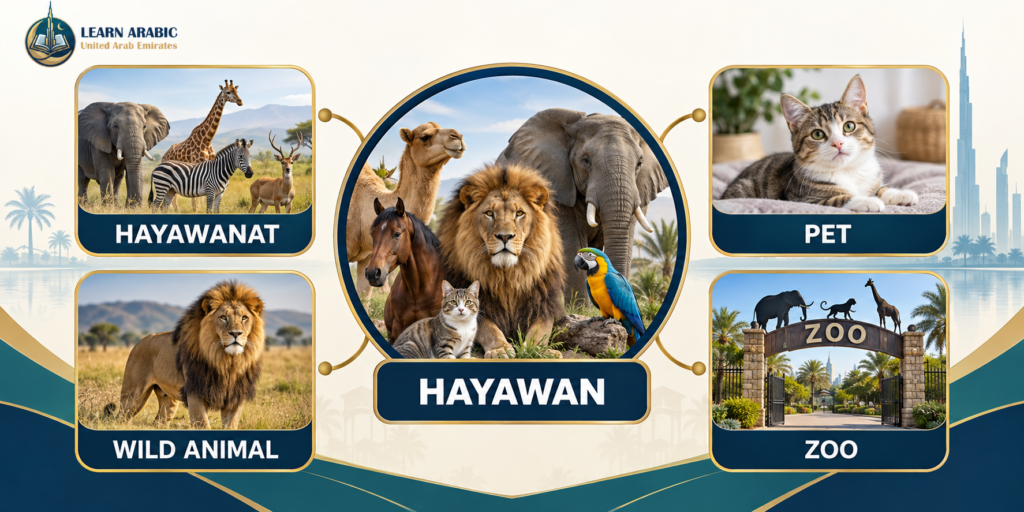
Knowing these four building blocks first means every category name that follows — domestic animals, farm animals, wild animals — will already make sense to you, because you’ll recognize the pattern instead of memorizing each phrase separately.
Domestic Animals And Pets In Arabic
Domestic animals, or hayawanat alifah (حيوانات أليفة), are usually the first entries in any list of names of animals in Arabic that new learners want, since pets come up constantly in daily conversation and children’s Arabic lessons alike.
The table below covers the most common pets you’ll encounter in an Arabic-speaking household or at Learn Arabic In the UAE Academy’s beginner lessons.
| Arabic | Transliteration | English |
| قِطّة | Qittah | Cat |
| كَلْب | Kalb | Dog |
| عُصْفُور | ‘Usfur | Bird |
| أَرْنَب | Arnab | Rabbit |
| حِصَان | Hisan | Horse |
| بَبْغَاء | Babagha’ | Parrot |
| سَمَكَة ذَهَبِيَّة | Samakah Dhahabiyyah | Goldfish |
| سُلَحْفَاة | Sulhufah | Tortoise |
| حَمَامَة | Hamamah | Dove |
| فَأْر | Fa’r | Mouse |
| قُنْفُذ | Qunfudh | Hedgehog |
| يَرْبُوع | Yarbu’ | Gerbil |
A useful sentence pattern to practice with these words: qittati hayawan alif (قطتي حيوان أليف) — “my cat is a pet.” Building short sentences like this from day one is what turns a vocabulary list into usable language, rather than words you recognize but can’t produce.
If you want to move from recognizing these words to using them confidently in real conversation, the Arabic Classes for Beginners at Learn Arabic In the UAE Academy are built around exactly this kind of practical, sentence-first approach.
Farm Animals in Arabic
Farm animals, hayawanat al-mazra’a (حيوانات المزرعة), are the second group in our names of animals in Arabic list, and they carry real weight in Arab culture beyond vocabulary — sheep and goats in particular are tied to religious and seasonal traditions such as Eid al-Adha, which gives learners a cultural hook that makes the words easier to remember.
| Arabic | Transliteration | English |
| بَقَرَة | Baqarah | Cow |
| مَاعِز | Ma’iz | Goat |
| خَرُوف | Kharuf | Sheep |
| حِمَار | Himar | Donkey |
| جَمَل | Jamal | Camel |
| ثَوْر | Thawr | Bull |
| دَجَاجَة | Dajajah | Chicken |
| دِيك | Deek | Rooster |
| بَطَّة | Battah | Duck |
| خِنْزِير | Khinzir | Pig |
| دِيك رُومِي | Deek Rumi | Turkey |
| إِوَزَّة | Iwazzah | Goose |
Notice that dajajah (دجاجة) means both “chicken” and “hen” — Arabic often uses one noun for both the animal and the female of the species, and marks the male separately (deek, ديك, for rooster).
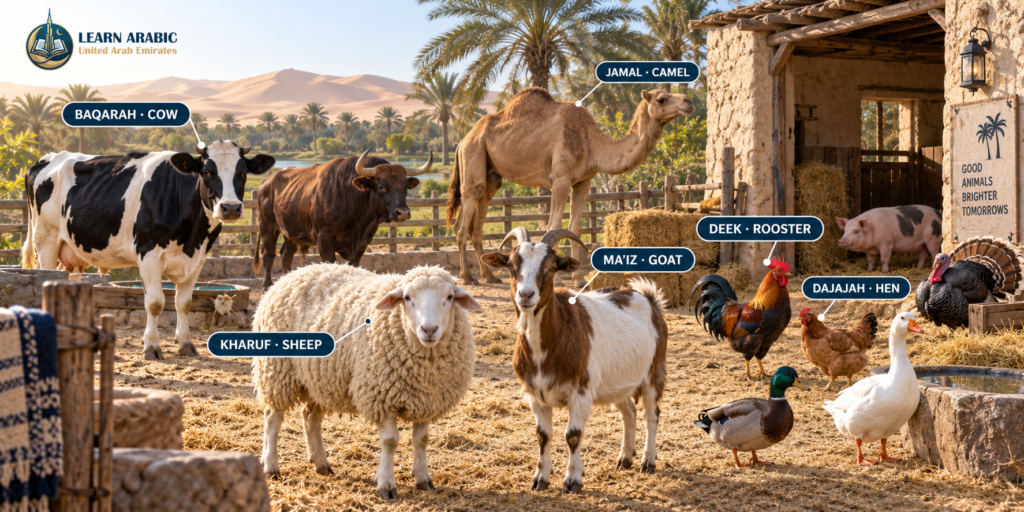
This pattern repeats across several categories, so recognizing it once saves you from memorizing it again for every animal.
Read Also: Flower Names In Arabic
Wild Animals in Arabic
Wild animal in Arabic is hayawan barri (حيوان بري), and these are the animals you’ll typically encounter at hadiqat al-hayawanat (حديقة الحيوانات), the zoo, or in Arabic nature documentaries and children’s stories.
| Arabic | Transliteration | English |
| أَسَد | Asad | Lion |
| نَمِر | Namir | Tiger |
| فَهْد | Fahd | Leopard / Cheetah |
| فِيل | Fil | Elephant |
| زَرَافَة | Zarafah | Giraffe |
| قِرْد | Qird | Monkey |
| غَزَال | Ghazal | Deer / Gazelle |
| ذِئْب | Dhi’b | Wolf |
| دُبّ | Dubb | Bear |
| ثَعْلَب | Tha’lab | Fox |
| حِمَار وَحْشِي | Himar Wahshi | Zebra |
| وَحِيد القَرْن | Wahid al-Qarn | Rhinoceros |
One detail worth flagging for anyone building sentences: fahd (فهد) is used for both leopard and cheetah in everyday Arabic, and Arabic speakers usually rely on context — desert versus savanna, speed versus stealth — rather than a separate word to distinguish the two.
This is the kind of nuance a wordlist alone won’t teach you, but a teacher will flag the first time it causes confusion.
Step Inside Our Classrooms
Don’t just take our word for it—see our community in action. Click below to watch real, live snippets from our recent classes and experience our engaging teaching style firsthand!
Master Arabic in the UAE
Experience world-class Arabic language training designed for students and professionals in the Emirates.
Book Your Free TrialSea Animals in Arabic
Sea animals, hayawanat bahriyya (حيوانات بحرية), round out the core names of animals in Arabic and are especially relevant if you live in or visit the UAE, where marine life — from the aquarium in Dubai Mall to dhow fishing trips — comes up often in daily conversation.
| Arabic | Transliteration | English |
| سَمَكَة | Samakah | Fish |
| قِرْش | Qirsh | Shark |
| حُوت | Hut | Whale |
| دُلْفِين | Dulfin | Dolphin |
| أُخْطُبُوط | Ukhtubut | Octopus |
| سَرَطَان | Sartan | Crab |
| قِنْدِيل البَحْر | Qindil al-Bahr | Jellyfish |
| سَلَحْفَاة بَحْرِيَّة | Sulhufah Bahriyyah | Sea Turtle |
| جَمْبَرِي | Jambari | Shrimp |
| مُرْجَان | Murjan | Coral |
| تِمْسَاح | Timsah | Crocodile |
| فَرَس البَحْر | Faras al-Bahr | Seahorse |
Sartan (سرطان) means both “crab” and, in medical Arabic, “cancer” — the word originally described the way a crab’s shell resembled the appearance of certain tumors. It’s a good example of how learning one Arabic root can unlock meaning in a completely different context later on.
Insects, Reptiles, and Birds in Arabic
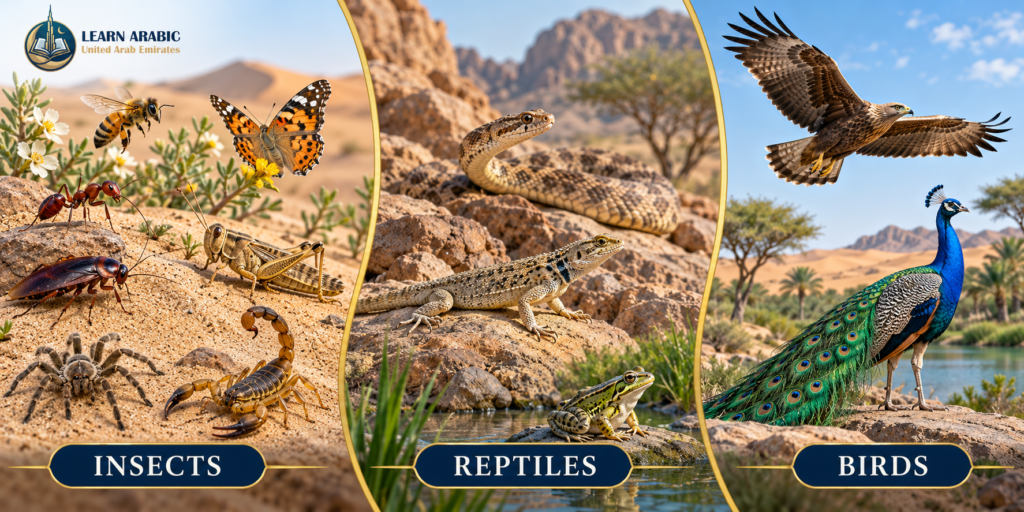
Insects are hasharat (حشرات) and reptiles are zawahif (زواحف). These two categories are usually taught together because many of the words share short, punchy syllables that are easy to mix up if you learn them in isolation.
| Arabic | Transliteration | English |
| نَمْلَة | Namlah | Ant |
| نَحْلَة | Nahlah | Bee |
| فَرَاشَة | Farashah | Butterfly |
| عَنْكَبُوت | ‘Ankabut | Spider |
| صَرْصَار | Sarsar | Cockroach |
| ثُعْبَان | Thu’ban | Snake |
| ضِفْدَع | Difda’ | Frog |
| عَقْرَب | ‘Aqrab | Scorpion |
| سِحْلِيَّة | Sihliyyah | Lizard |
| جَرَاد | Jarad | Locust / Grasshopper |
| نَسْر | Nasr | Eagle |
| طَاوُوس | Tawus | Peacock |
Because scorpions and snakes are genuinely part of desert life in this region, these two words in particular are worth learning early — they show up in safety instructions, hiking guides, and casual conversation far more often than a typical vocabulary course would suggest.
Why Do Arabic Animal Names Have Gender?
Every noun in Arabic is either masculine or feminine, and animal names are no exception. Most feminine animal nouns end in the taa marbuta (ة) — the same “-ah” sound you see in qittah (قطة, female or generic cat), baqarah (بقرة, cow), and dajajah (دجاجة, hen).
Where Arabic distinguishes the male and female of a species by name rather than by ending, you’ll see a completely separate word, such as deek (ديك, rooster) alongside dajajah (دجاجة, hen).
This matters practically because gender affects the rest of the sentence — the adjective, the verb, and the pronoun you use all have to agree with the noun’s gender.
A student who memorizes “cow” without knowing it’s feminine will consistently build the wrong sentence around it later, which is a mistake that’s much cheaper to fix at the vocabulary stage than after it’s become a habit.
Because animal nouns follow the exact same gender and plural rules that govern the rest of Arabic grammar, students who want to understand the pattern usually move into the Arabic Grammar Course, where gender agreement is taught as a system rather than case by case.
How to Pronounce Animal Names in Arabic Correctly?
Arabic includes several sounds that don’t exist in English, and animal vocabulary is a genuinely good place to practice them, because the words are short and the categories give you natural repetition.
Letters like ح (a deep, breathy “h,” as in hisan, horse), ع (a guttural sound with no English equivalent, as in ‘usfur, bird), and ص (an emphatic “s,” as in sarsar, cockroach) are formed further back in the throat or mouth than their English-sounding cousins.
The most reliable fix is not memorizing a phonetic rule — it’s repeating pairs of similar-sounding animal names aloud until your ear catches the difference, for example sarsar (صرصار, cockroach) against asad (أسد, lion).
Why do short vowels change the whole word?
Arabic marks short vowels with small marks called harakat, and skipping them is one of the most common reasons beginners mispronounce animal names even when they’ve spelled the word correctly.
Kharuf (خروف, sheep) and a similarly spelled word with different vowels can sound close enough to confuse a listener, so treating the vowel marks as part of the word — not an optional extra — is what separates readable Arabic from spoken fluency.
Common Mistakes When Learning Arabic Animal Vocabulary
Most of the errors below aren’t about memory — they’re about how the vocabulary was practiced in the first place.
1. Relying On Transliteration Instead Of The Arabic Script
Transliteration (writing Arabic sounds using English letters) is a useful crutch for the first week, but it can’t represent sounds like ع or ح accurately, which means a student who never graduates to the Arabic script tends to plateau at a pronunciation level that’s noticeably off.
The fix is simple: use transliteration to get started, then retire it deliberately once you recognize the word in Arabic script.
2. Memorizing words without their gender or category
A word learned in isolation — just “cow” with no note that it’s feminine, no sense of whether it’s a farm or wild animal — is harder to recall under pressure than one learned inside a category, because the brain has fewer hooks to retrieve it by.
Grouping vocabulary by domestic, farm, wild, sea, and insect categories, the way this guide does, gives you that retrieval structure for free.
3. Skipping speaking practice
Reading and writing animal names is not the same skill as producing them in a live conversation. Students who only study vocabulary lists silently often freeze the first time they need to say jamal (جمل, camel) or timsah (تمساح, crocodile) out loud, simply because they’ve never rehearsed the sound leaving their own mouth.
For learners who want to fix all three of these habits at once — script, gender, and live speaking practice — the Arabic Intensive Course at Learn Arabic In the UAE Academy is structured specifically to build spoken fluency alongside vocabulary, rather than treating them as separate stages.
Read Also: 10 Steps to Learning Arabic Numbers for Kids in the UAE
Tips To Memorize Animal Names In Arabic Faster
A method worth naming for memorizing the names of animals in Arabic, because it’s easy to apply on your own: the Category-Sound-Sentence approach.
Instead of memorizing animal names one at a time, work through three passes — first sort new words into their category (domestic, farm, wild, sea, insect), then say each one aloud focusing only on its hardest sound, and finally build one short sentence per word before moving to the next batch.
This mirrors how Learn Arabic In the UAE Academy sequences vocabulary in class, and it consistently outperforms flat memorization because each word gets reinforced three different ways before you move on.
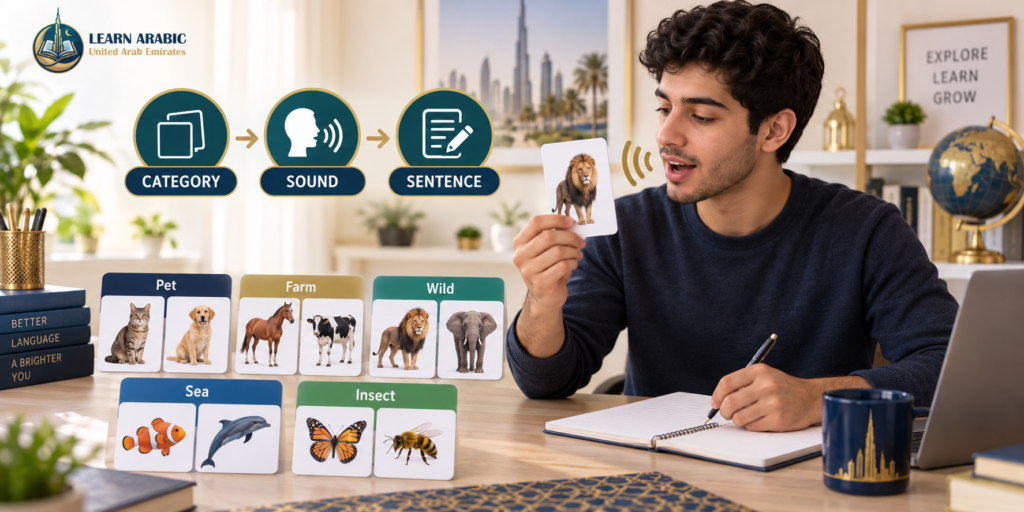
A few supporting habits make this method stick:
- Practice in short, daily sessions rather than long, infrequent ones — five minutes of Category-Sound-Sentence practice most days beats an hour once a week.
- Say the word aloud every time you see it written; silent reading alone under-trains pronunciation.
- Revisit yesterday’s category briefly before starting today’s new one, so earlier words don’t fade while you’re adding new ones.
See Our Classroom Environment in Action
Experience a sneak peek into our live sessions. Watch the video below to see our specialized instructors interacting with students, breakdown complex texts, and cultivate an engaging, respectful learning environment.
Master Arabic in the UAE
Experience world-class Arabic language training designed for students and professionals in the Emirates.
Book Your Free TrialStart Speaking Real Arabic Not Just Memorizing Word Lists
Vocabulary lists get you recognition. A structured course gets you conversation. If you’re ready to turn these names of animals in Arabic — and everything that comes after them — into real spoken confidence, explore the Arabic Course in the UAE and find the right starting point at Learn Arabic In the UAE Academy.
Our Arabic courses:
- Arabic Course in the UAE
- Arabic Intensive Course
- Arabic Classes for Beginners
- Madinah Arabic Course
- Arabic Classes for Adults
- Self-Paced Arabic Course
- Arabic Speaking Classes
- Learn to Write Arabic Course
- Arabic Grammar Course
- Learn Arabic Alphabet Course
- Modern Standard Arabic (MSA) Course
- Quranic Arabic Course
- Fusha Arabic Course

Conclusion
Learning the names of animals in Arabic gives you one of the most practical, high-frequency vocabulary sets in the entire language, precisely because these words show up in conversation, children’s stories, grammar lessons, and everyday UAE life all at once.
The categories in this guide — domestic, farm, wild, sea, insects, and reptiles — cover the words you’ll actually need, while the gender rules, pronunciation notes, and Category-Sound-Sentence method give you a way to make them stick rather than fade after one read-through.
The single takeaway worth carrying forward: vocabulary sticks when it’s organized, spoken aloud, and used in a sentence — not when it’s just read.
Whether you’re learning independently or studying with Learn Arabic In the UAE Academy, treating this list as a starting point for speaking practice, rather than a finish line, is what turns animal names in Arabic into vocabulary you actually use.

Frequently Asked Questions
The questions below cover what learners most often ask after working through this list of names of animals in Arabic for the first time — from grammar details to practical learning advice.
1. Is the word for “animal” in Arabic masculine or feminine?
Hayawan (حيوان), the general word for animal, is masculine. Its plural, hayawanat (حيوانات), takes a feminine sound plural ending, which is a common pattern in Arabic where a masculine singular noun still forms its plural with the feminine “-at” suffix.
2. Do Arabic animal names change between singular and plural?
Yes. Some animal names form a regular plural by adding an ending, such as hayawan → hayawanat (حيوان → حيوانات). Others use an irregular “broken plural,” where the internal vowel pattern of the word changes entirely rather than adding a suffix — this is common enough in Arabic that it’s worth learning plurals word by word rather than assuming a single rule applies everywhere.
3. Can children learn Arabic animal names as easily as adults?
Often more easily. Children respond well to visual, category-based learning — flashcards, pictures, and short repeated sentences — and animal vocabulary is naturally suited to that style because every word pairs with an image a child already recognizes.
4. What’s the fastest way to stop confusing similar-sounding Arabic letters?
Practice minimal pairs — two animal names that differ by only one sound, such as sarsar (صرصار, cockroach) versus a word using the plain “s” sound — and say them side by side until your ear and mouth both register the difference. This targeted repetition works faster than general listening practice because it isolates the exact sound causing confusion.
5. What’s the difference between “hayawan” and “hayawan alif”?
Hayawan (حيوان) simply means animal in general, while hayawan alif (حيوان أليف) specifically means pet, literally “tame animal.” The second phrase is always used when talking about a domestic companion animal rather than an animal in the wild or on a farm.
6. Are the domestic and farm animal categories the only ones beginners need?
For a solid foundation, yes — domestic and farm animals cover the vocabulary most learners use in daily conversation first. Wild, sea, and insect categories add depth and are especially useful for students who read Arabic children’s books, watch Arabic nature content, or plan to discuss travel and wildlife.



[…] Read Also: Names Of Animals In Arabic […]