 Learn Arabic
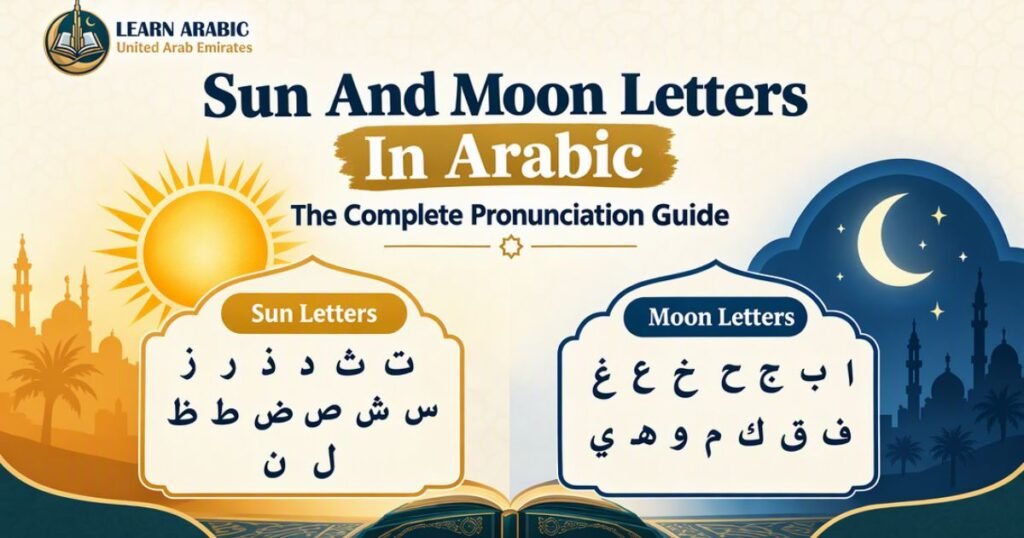
Sun and moon letters in Arabic decide how you pronounce the word “the” (ال) in front of almost every noun you will ever use. Say it the wrong way and you will still be understood, but you will sound unmistakably like a beginner. Get it right, and your Arabic starts sounding connected instead of choppy.
At Learn Arabic In the UAE Academy, this is one of the first pronunciation rules we teach, because a student who masters it early reads and speaks with far more confidence later on.
This guide walks through what sun letters and moon letters are, the full list of each, why the rule exists, and how to stop guessing and start applying it automatically.
What Are Sun And Moon Letters In Arabic?
Arabic sun and moon letters are the two groups the alphabet splits into based on how the definite article ال (“the”) is pronounced before them.
Every noun that becomes definite gets ال attached to its front, but the ل inside it behaves in one of two ways depending on which letter comes right after it. Before a sun letter, the ل is written but silent, and the following letter is pronounced doubled instead.
Before a moon letter, the ل is written and clearly pronounced, and the following letter stays single. Both groups contain exactly 14 letters, and together they cover the entire 28-letter Arabic alphabet.
The Arabic Definite Article “Al”
The definite article الـ (al-) attaches directly to the front of a noun, the way “the” comes before a noun in English.
كتاب (kitaab, “a book”) becomes الكتاب (al-kitaab, “the book”). In writing, the الـ never changes.
In speech, though, the ل carries a sukoon (no vowel of its own), and Arabic speakers naturally shift a silent consonant to match the sound directly beside it when the two are produced in nearly the same part of the mouth.
That single mechanical fact is the entire basis of the sun and moon letters arabic rules — nothing more mysterious than a tongue taking the shortest path between two close sounds.
Lam Shamsiyah (اللام الشمسية) and Lam Qamariyah (اللام القمرية) describe the exact same rule as sun letters and moon letters, moon and sun letters arabic, or solar and lunar letters arabic — they are different names for one concept, not different rules.
Shamsiyah comes from شمس (sun) and Qamariyah from قمر (moon), because those two words are the standard textbook example of the contrast: الشمس (ash-shams) hides its ل, while القمر (al-qamar) pronounces it in full.
If a teacher, app, or textbook uses one term and your course notes use another, you have not missed a separate topic. Once you see arabic sun moon letters as one system taught under several labels, switching between resources stops being confusing.
Read Also: The Future Tense In Arabic
The 14 Sun Letters in Arabic
Sun letters in Arabic are the 14 consonants that absorb the ل of الـ into themselves, so the letter that follows the article is pronounced as a doubled (geminated) sound instead of two separate ones
The 14 sun letters, in alphabetical order, are: ت (ta), ث (tha), د (dal), ذ (dhal), ر (ra), ز (zay), س (sin), ش (shin), ص (sad), ض (dad), ط (ta emphatic), ظ (dha), ل (lam), and ن (nun). Notice that ل itself is a sun letter — a word like الليل (the night) doubles its own ل rather than adding a second, separate one.
How Sun Letters Are Pronounced?
Say the article and the noun together as one flowing sound, and drop the ل entirely from your pronunciation — only the shadda (doubling mark) over the sun letter shows up in speech.
الشمس is written with a full لـ but said as “ash-shams,” not “al-shams.”
This is the single most common pronunciation error we correct at Learn Arabic In the UAE Academy: students read the writing literally and force the ل back in.

Sun Letters in Arabic: Examples With Meaning
Seeing the rule applied to real words is what makes it stick — the table below gives you sun letters arabic examples with meaning, pairing each sun letter with a common noun so you can hear the doubling effect instead of just reading about it.
| Sun letter | Word (indefinite) | Meaning | With “the” | Pronunciation |
| ش | شمس | sun | الشمس | ash-shams |
| د | درس | lesson | الدرس | ad-dars |
| ط | طالب | student | الطالب | at-taalib |
| ر | رجل | man | الرجل | ar-rajul |
| س | سماء | sky | السماء | as-samaa’ |
| ن | نور | light | النور | an-noor |
| ص | صف | classroom | الصف | as-saff |
The 14 Moon Letters in Arabic
Moon letters in Arabic are the remaining 14 consonants that do not absorb the ل — the article keeps its full sound, and the noun’s first letter is pronounced normally, without doubling.
The 14 moon letters are: أ (hamza), ب (ba), ج (jim), ح (ha), خ (kha), ع (ayn), غ (ghayn), ف (fa), ق (qaf), ك (kaf), م (mim), هـ (ha), و (waw), and ي (ya). Between the two lists, every letter of the Arabic alphabet is accounted for exactly once.

How Moon Letters Are Pronounced?
Pronounce the ل clearly and connect it to the following letter without any doubling.
القمر is said exactly as it looks: “al-qamar,” with a crisp ل audible before the ق. There is no merging, no dropped sound, and no shadda anywhere in the word.
Moon Letters in Arabic: Examples With Meaning
The same idea works in reverse here — each moon letter below keeps the ل fully audible, so read the “with the” column out loud and compare it to the sun-letter table above to hear the contrast clearly.
Together, these arabic sun and moon letters examples let you see both halves of the rule side by side instead of studying each list in isolation.
| Moon letter | Word (indefinite) | Meaning | With “the” | Pronunciation |
| ق | قمر | moon | القمر | al-qamar |
| ك | كتاب | book | الكتاب | al-kitaab |
| ب | بيت | house | البيت | al-bayt |
| م | ماء | water | الماء | al-maa’ |
| ه | هدية | gift | الهدية | al-hadiyyah |
| و | ورد | roses | الورد | al-ward |
| ج | جمل | camel | الجمل | al-jamal |
If you are building this kind of foundational pronunciation from the ground up, this is exactly the level of detail covered inside the Learn Arabic Alphabet Course at Learn Arabic In the UAE Academy, where every letter’s sound is drilled before grammar rules are layered on top.
Step Inside Our Classrooms
Don’t just take our word for it—see our community in action. Click below to watch real, live snippets from our recent classes and experience our engaging teaching style firsthand!
Master Arabic in the UAE
Experience world-class Arabic language training designed for students and professionals in the Emirates.
Book Your Free TrialSun And Moon Letters Arabic Rules: How The Assimilation Works?
Every rule above comes down to one mechanical fact about where each sound is produced inside the mouth, and understanding it means you stop memorizing two lists and start recognizing a pattern.
All 14 sun letters are articulated at or near the front of the mouth — with the tip or blade of the tongue touching the teeth, the gum ridge, or the area just behind it. That is the same region used to produce ل.
Because the two sounds are formed so close together, the tongue merges them into one longer, stronger sound rather than pronouncing both separately, which is why the result is written with a shadda.
Moon letters, by contrast, are produced further back in the throat (ح، خ، ع، غ، ق), with the lips (ب، م، و), or from a completely different point of articulation (ي، ك، ف، ه، أ). Since none of them share the ل’s articulation point, there is nothing for the tongue to merge, and the ل survives intact.
The Silent Lam Test
You do not need to memorize both lists forever if you use this three-step check on a new word:
Say the noun with الـ attached exactly as it is written, at normal speaking speed. Listen for whether the ل sound actually reaches your ear or gets swallowed into the next letter.
If it disappears and the next consonant sounds noticeably longer or stronger, you are hearing a sun letter; if the ل comes through clearly and the next letter sounds unchanged, it is a moon letter.
This test works because native pronunciation, not the written form, is what tells you which group a letter belongs to — the spelling never changes either way.
Common Mistakes Learners Make
The most frequent error is reading the ل literally in a sun-letter word, producing “al-shams” instead of “ash-shams” — a habit that comes from treating Arabic spelling the way English spelling works, where what is written is always said.
A second common mistake is under-doubling the sun letter, saying the consonant only once instead of holding it, which changes the rhythm of the word even when the ل is correctly dropped.
A third is assuming similar-sounding letters belong to the same group — ث and ذ are both sun letters, but خ and ح, which sound related to some new learners, are both moon letters.
How To Remember Sun And Moon Letters In Arabic?
Once the mechanism makes sense, retention comes down to repetition in context rather than flashcard memorization alone.

1. Memory Techniques That Work
Group the sun letters by their shared articulation zone instead of learning them as a random list — most are dental or alveolar sounds (ت ث د ذ ر ز س ش ص ض ط ظ ل ن), which is also why they assimilate.
Read sun-letter and moon-letter words out loud in pairs, such as الشمس next to القمر, so your ear learns the contrast rather than your eye learning two separate charts.
Mark new vocabulary with a small sun or moon symbol as you learn it, so the classification becomes part of how you store the word from day one.
2. Practice Method
Pick ten nouns you already know, attach الـ to each one, say them aloud, and check yourself against the two lists above before moving to new words.
A learner who does this daily for two weeks with immediate correction outperforms one who reviews the list occasionally for a month — pronunciation habits form through repetition with feedback, not through recognition alone.
Learners who want that immediate correction, rather than self-study alone, often join the Arabic Intensive Course at Learn Arabic In the UAE Academy, where every sun and moon letter mistake gets caught and fixed in the same session it happens, not weeks later.
Read Also: Arabic letter – ج
Sun And Moon Letters In The Quran
The rule applies identically inside Quranic recitation, which is where most learners first hear it enforced strictly, since a mispronounced ل changes the rhythm (and in Tajweed terms, the correctness) of a verse.

In verses such as:
وَالنَّجْمِ إِذَا هَوَى (n-Najm 53:1)
النجم (an-najm, “the star”) follows the sun-letter rule for ن, with the ل fully absorbed.
وَلَقَدْ جَاءَهُم مِّن رَّبِّهِمُ الْهُدَى (An-Najm 53:23)
الهدى (al-hudaa, “the guidance”) keeps its ل clearly audible because هـ is a moon letter.
Reciters are trained to apply this automatically, because in Tajweed the difference between a sun letter and a moon letter changes how a word is voiced, not just how it looks on the page.
If your goal is Quran recitation specifically rather than everyday conversation, the Quranic Arabic Course at Learn Arabic In the UAE Academy drills sun and moon letters inside real verses, not isolated word lists.
For students focused on formal reading and writing instead, the Modern Standard Arabic (MSA) Course applies the same rule to news articles and formal texts from the first lesson.
See Our Classroom Environment in Action
Experience a sneak peek into our live sessions. Watch the video below to see our specialized instructors interacting with students, breakdown complex texts, and cultivate an engaging, respectful learning environment.
Master Arabic in the UAE
Experience world-class Arabic language training designed for students and professionals in the Emirates.
Book Your Free TrialStart Applying These Rules With Live Correction Today
Reading about sun and moon letters gets you halfway there — the other half is having someone catch the mistake the moment you make it, before it becomes a habit that is hard to unlearn. That is the gap between knowing the rule and actually sounding fluent.
The Arabic Course in the UAE at Learn Arabic In the UAE Academy pairs you with instructors who correct pronunciation in real time, whether you are starting from the alphabet or refining conversational fluency you already have.
Our Arabic courses:
- Arabic Intensive Course
- Madinah Arabic Course
- Arabic Classes for Adults
- Self-Paced Arabic Course
- Arabic Speaking Classes
- Learn to Write Arabic Course
- Arabic Grammar Course
- Learn Arabic Alphabet Course
- Quranic Arabic Course
- Fusha Arabic Course
- Classical Arabic Course
- Emirati Arabic Course

Conclusion
Sun and moon letters in Arabic come down to one rule with two visible outcomes: before a sun letter, the ل in الـ is written but silent and the next letter doubles; before a moon letter, the ل is pronounced clearly and nothing doubles.
Both groups hold 14 letters each, the split is based on where each sound is produced in the mouth, and the spelling never changes even though the pronunciation does.
Once you can run the silent lam test on an unfamiliar word instead of relying on memory alone, the rule stops being something you look up and becomes something you simply hear.
That shift, more than any single practice session, is what separates a learner who reads Arabic from one who speaks it naturally.

Frequently Asked Questions
The questions below cover what learners ask most often once they have the core sun and moon letters arabic rules down and start applying them to real words.
1. Is alif a sun letter or a moon letter?
Alif (أ) is a moon letter. In a word like الأسد (al-asad, “the lion”), the ل is pronounced clearly and the أ that follows is not doubled.
2. Are Lam Shamsiyah and Lam Qamariyah the same as sun and moon letters?
Yes, Lam Shamsiyah and Lam Qamariyah are exactly the same concept as sun letters and moon letters, just named after the Arabic terms for “sun” and “moon.” Solar and lunar letters is a third label for the identical rule.
3. Do sun and moon letters change the spelling of a word?
No, sun and moon letters only affect pronunciation, never spelling.
الـ is always written the same way whether the following letter is a sun letter or a moon letter; only the shadda mark and the spoken sound change.
4. Why is ل itself classified as a sun letter?
ل is a sun letter because it shares the same point of articulation as the ل in الـ, so the two merge into one doubled ل sound rather than being pronounced as two separate letters, as in الليل (al-layl becomes “al-layl” with a doubled ل, heard as “allayl”).
5. How many sun and moon letters are there in Arabic?
There are 14 sun letters and 14 moon letters, for a total of 28 — every letter in the Arabic alphabet belongs to exactly one of the two groups.
6. What is the fastest way to check if a letter is a sun or moon letter?
Say the word with الـ attached at normal speed and listen for the ل — if it disappears and the next letter sounds doubled, it is a sun letter; if the ل stays clearly audible, it is a moon letter. This live pronunciation check works even on words you have never memorized.



[…] Read Also: Sun And Moon Letters In Arabic […]