 Learn Arabic
You’ve probably heard As-salamu alaykum dozens of times without knowing exactly what to say back — or when to say something different. Muslim greetings in Arabic are not interchangeable phrases. Each one carries a specific meaning, a proper response, and an appropriate context, and using them correctly signals genuine cultural and spiritual awareness.
This guide covers every major Muslim greeting in Arabic, how to respond, when to use which phrase, and the blessing expressions that go beyond a simple hello.
What You’ll Learn in This Article
- The most important Muslim greeting in Arabic and its correct response
- The full extended greeting used in formal and religious contexts
- Time-based greetings for morning and evening — with what to say back
- Arabic blessing phrases Muslims use in everyday life
- Common pronunciation mistakes English speakers make
- How greeting length in Islam is actually tied to Islamic teaching on reward
The Muslim Greeting in Arabic Every Learner Must Know First
Muslim greetings in Arabic form the foundation of Islamic social interaction. Before covering the full list, it helps to understand that Arabic greetings are not just pleasantries — they are active wishes and, in many cases, acts of worship.
Islamic teaching holds that initiating the salaam greeting earns reward, and responding with an equivalent or fuller greeting is an obligation. This means the greeting exchange has a directional structure: who says it, how they say it, and what the other person says back all carry specific meaning.
As-salamu alaykum — السلام عليكم
As-salamu alaykum is the primary Muslim greeting in Arabic, meaning “Peace be upon you.” It is used in both formal and informal settings and is recognized by Muslims worldwide, regardless of dialect.
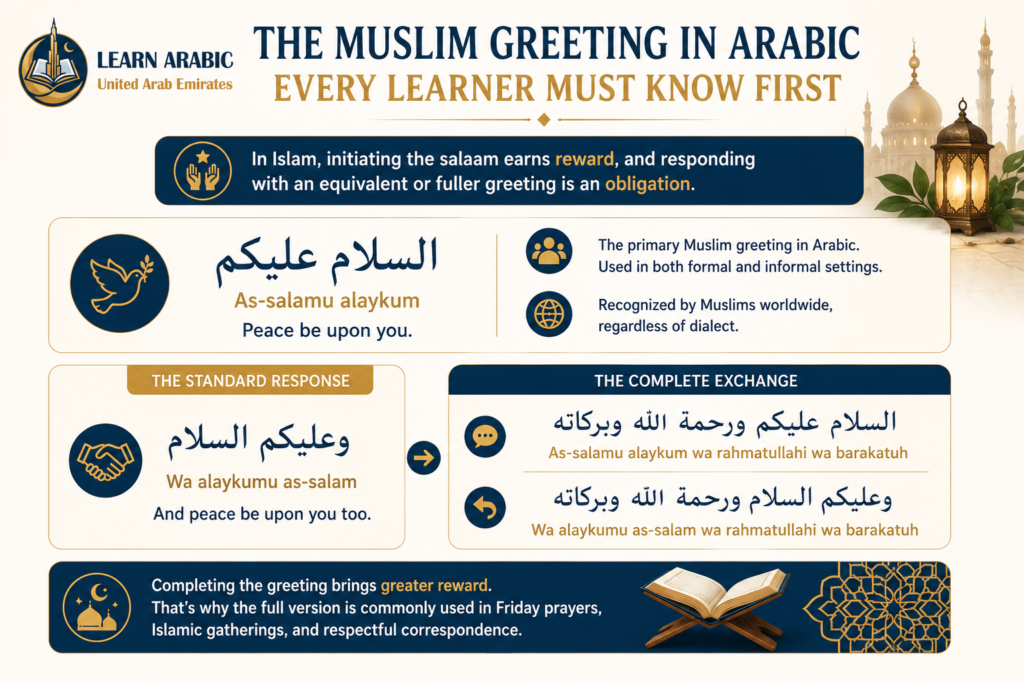
The standard response is Wa alaykumu as-salam (وعليكم السلام) — “And peace be upon you too.” A more complete exchange is As-salamu alaykum wa rahmatullahi wa barakatuh with the reply Wa alaykumu as-salam wa rahmatullahi wa barakatuh.
According to Islamic tradition, completing the greeting brings greater reward, which is why the full version is commonly used in Friday prayers, formal Islamic gatherings, and respectful written correspondence.
Time-Based Muslim Greetings in Arabic for Morning and Evening
Arabic has dedicated greetings for specific times of day, and knowing them shows genuine familiarity with the language beyond the basics.
1. Sabah al-khair — صباح الخير
Sabah al-khair means “Good morning.” The standard reply is Sabah al-noor (صباح النور) — “Morning of light.” This exchange is nearly universal across Arabic-speaking countries.
A more poetic alternative for the morning is Tabba sabahak (طاب صباحك), meaning “May your morning be pleasant.” It is less common in daily use but heard in more formal or literary contexts.
2. Masa’ al-khair — مساء الخير
Masa’ al-khair means “Good evening.” The reply is Masa’ al-noor (مساء النور). Use it from late afternoon onward.
The parallel poetic form is Tabba masa’ak (طاب مساؤك) — “May your evening be pleasant.” Like its morning counterpart, it signals a more elevated register.
If you’re working toward reading the Quran or deepening your Arabic, understanding these greetings is an early and rewarding step — Quranic Arabic courses often introduce them in the first few sessions as accessible vocabulary.
Join the Best Quranic Arabic Classes in the UAE with a FREE Trial

Read more: Vegetables in Arabic
Everyday Arabic Greetings That Are Not Exclusively Islamic
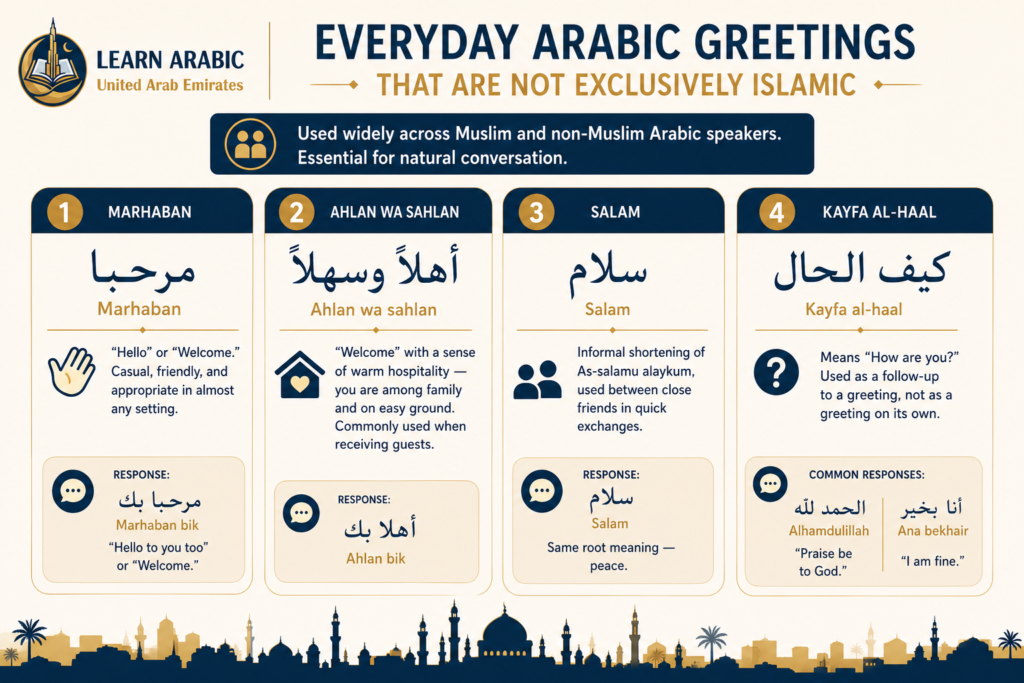
Not every Arabic greeting carries religious weight. These are used widely across Muslim and non-Muslim Arabic speakers and are essential for natural conversation.
1. Marhaban — مرحبا
Marhaban means “Hello” or “Welcome.” It is casual, friendly, and appropriate in almost any setting. The response is Marhaban bik (مرحبا بك) — “Hello to you too” or “Welcome.”
2. Ahlan wa sahlan — أهلاً وسهلاً
This phrase means “Welcome” with a sense of warm hospitality — literally, it implies “you are among family and on easy ground.” It is commonly used when receiving guests. The response is Ahlan bik (أهلاً بك).
3. Salam — سلام
Salam is an informal shortening of As-salamu alaykum, used between close friends in quick exchanges. You reply simply with “Salam.” It carries the same root meaning — peace — but without the full religious weight of the formal greeting.
4. Kayfa al-haal — كيف الحال
This phrase means “How are you?” and functions as a follow-up to a greeting rather than a greeting on its own. Common responses include Alhamdulillah (الحمد لله — “Praise be to God”) or Ana bekhair (أنا بخير — “I am fine”).
See Our Classroom Environment in Action
Experience a sneak peek into our live sessions. Watch the video below to see our specialized instructors interacting with students, breakdown complex texts, and cultivate an engaging, respectful learning environment.
Master Arabic in the UAE
Experience world-class Arabic language training designed for students and professionals in the Emirates.
Book Your Free TrialArabic Blessing Phrases Used by Muslims in Daily Life
Beyond greetings, Muslim Arabic speakers use specific blessing phrases in everyday exchanges. These are not greetings in the opening sense — they are responses to situations, expressions of goodwill, or reactions to news.
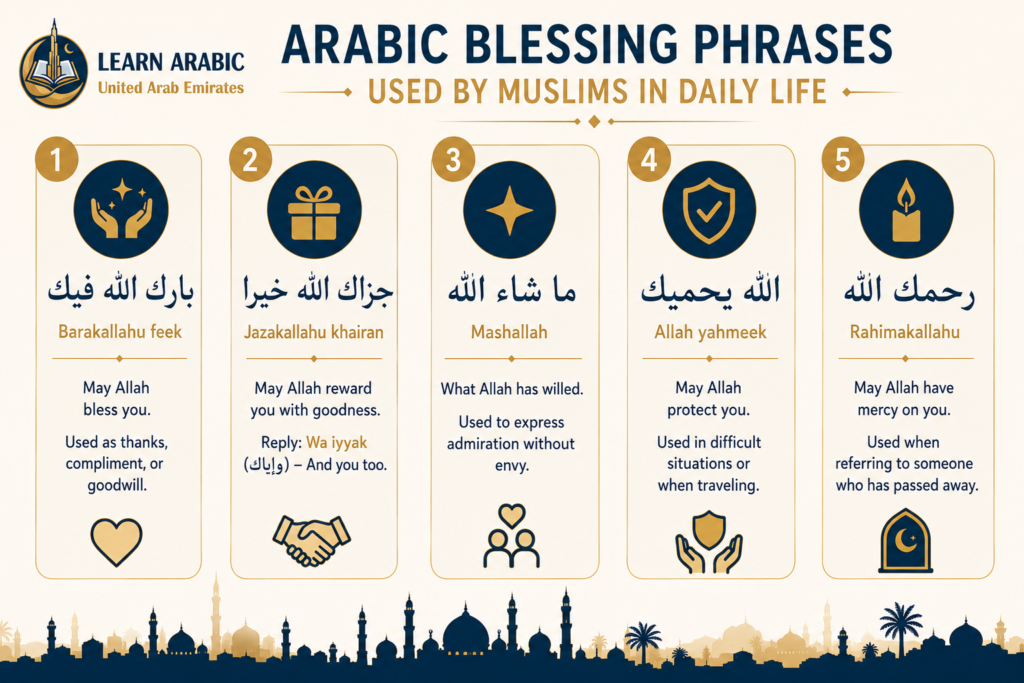
Learning these phrases is part of understanding how Arabic and Islamic values are woven together.
1. Barakallahu feek — بارك الله فيك
This means “May Allah bless you.” It is used as a thank-you response, a compliment, or a general expression of goodwill. One of the most commonly heard phrases in Islamic settings.
2. Jazakallahu khairan — جزاك الله خيرا
“May Allah reward you with goodness.” Said when someone has done you a favor. The standard reply is Wa iyyak (وإياك) — “And you too.”
3. Mashallah — ما شاء الله
Literally “What Allah has willed.” Used to express admiration for something without invoking envy. If a child does well or something beautiful is seen, a Muslim might say Mashallah to acknowledge Allah’s will in it.
4. Allah yahmeek — الله يحميك
“May Allah protect you.” A heartfelt blessing used when someone is facing a difficult situation or traveling.
5. Rahimakallahu — رحمك الله
“May Allah have mercy on you.” Used specifically when referring to someone who has passed away.
If you want to go deeper, an Arabic grammar course will help you understand how these phrases are structured linguistically, not just how to repeat them.
Begin Your Arabic Grammar Journey with a FREE Trial Class
Which Muslim Greeting Should You Use?
This is the framework most articles on this topic skip entirely. The choice of greeting depends on three variables: formality level, time of day, and religious context.
| Situation | Use This Greeting |
| Any Muslim-majority setting, any time | As-salamu alaykum |
| Religious gathering, formal correspondence | Full form with wa rahmatullahi wa barakatuh |
| Morning, casual or formal | Sabah al-khair |
| Evening, casual or formal | Masa’ al-khair |
| Quick exchange between close friends | Salam |
| Welcoming someone to your home | Ahlan wa sahlan |
| After someone helps you | Jazakallahu khairan |
| Greeting a non-Muslim | Marhaban or Sabah/Masa al-khair (these carry no religious exclusivity) |
A practitioner note: when greeting non-Muslims in a professional setting, Marhaban or Sabah al-khair is the smoother choice — As-salamu alaykum is not restricted to Muslims, but some non-Arabic speakers feel uncertain how to respond and may be put at ease by the more universal option.
Read more: 100 Beautiful Arabic Words With Meaning
Common Pronunciation Mistakes English Speakers Make
Most articles give you the transliteration and move on. These are the specific errors that mark a speaker as a beginner and are worth correcting early.
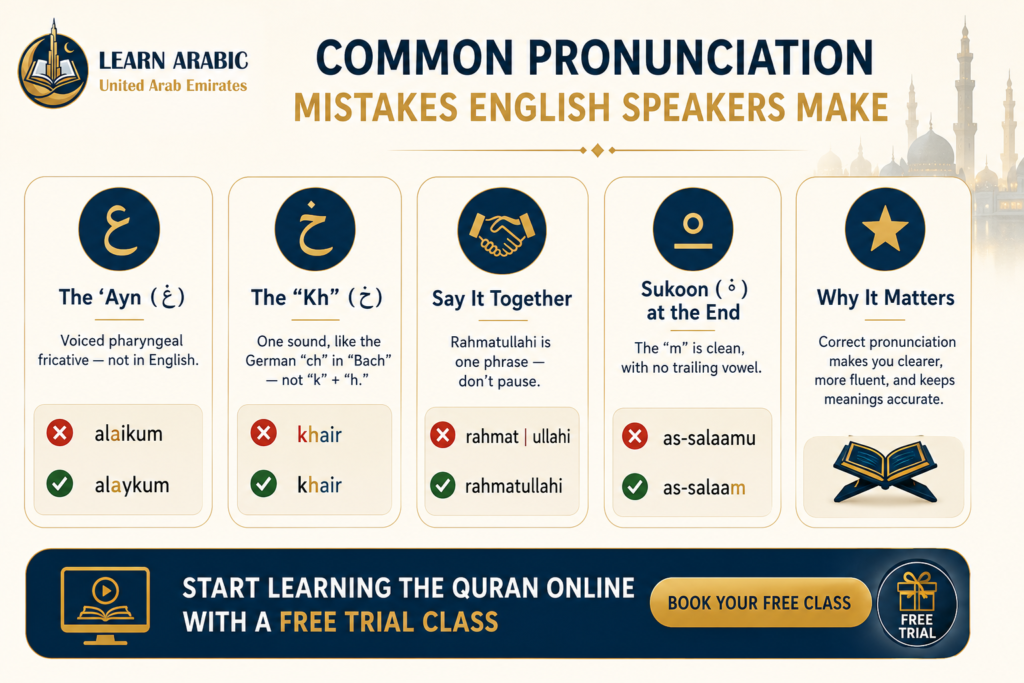
- The ‘ayn (ع) in alaykum is a consonant with no English equivalent — it is a voiced pharyngeal fricative. English speakers often drop it entirely, producing alaikum instead of the correct guttural alaykum.
- The kh in khair is a single sound (خ), like the German ch in “Bach” — not “k” followed by “h.”
- Rahmatullahi runs as one phrase — many English speakers pause between words, which disrupts the natural cadence of the full greeting.
- The sukoon on the final syllable of as-salam means the “m” is pronounced cleanly without a trailing vowel — as-salaam, not as-salaamu.
These distinctions matter more in Quranic recitation contexts where mispronunciation can alter meaning, but correcting them in conversational Arabic will also make you noticeably more fluent.
If you’re studying Quran courses that include recitation, this sound gets addressed directly.
Start Learning the Quran Online with a FREE Trial Class
Step Inside Our Classrooms
Don’t just take our word for it—see our community in action. Click below to watch real, live snippets from our recent classes and experience our engaging teaching style firsthand!
Master Arabic in the UAE
Experience world-class Arabic language training designed for students and professionals in the Emirates.
Book Your Free TrialStart Speaking Arabic with Confidence at Learn Arabic UAE
You now have the phrases, the responses, and the context. The next step is being able to produce them naturally in a real conversation — with correct pronunciation and the intuition to choose the right greeting for the moment.
At Learn Arabic UAE, expert instructors work with you in live online sessions to move from recognition to actual use. Whether your goal is conversational fluency, Quranic understanding, or both, the courses are structured to get you speaking from the first lesson.
Our Arabic courses
- Arabic Course in the UAE
- Arabic Intensive Course
- Arabic Classes for Beginners (Learn Arabic from Scratch)
- Madinah Arabic Course
- Arabic Classes for Adults
- Self-Paced Arabic Course
- Arabic Speaking Classes
- Learn to Write Arabic Course
- Arabic Grammar Course
- Learn Arabic Alphabet Course
- Modern Standard Arabic (MSA) Course
- Quranic Arabic Course
- Fusha Arabic Course
- Classical Arabic Course
- Emirati Arabic Course
- Gulf Arabic Course
- Learn Saudi Arabic
- Business Arabic Course UAE
- Arabic Language Classes for Professionals in UAE
Master Arabic in the UAE
Experience world-class Arabic language training designed for students and professionals in the Emirates.
Book Your Free TrialConclusion
Muslim greetings in Arabic carry meaning that goes well beyond politeness. As-salamu alaykum and its extended form are acts of goodwill encoded in Islamic teaching. Time-based greetings like Sabah al-khair and Masa’ al-khair show cultural fluency, while blessing phrases like Jazakallahu khairan and Mashallah reflect the values woven through everyday Muslim communication.
Knowing which greeting to use, and when, is what separates someone who has memorized a list from someone who actually speaks with people. Use the contextual decision guide in this article as a practical reference until the choices become instinctive — and invest in structured practice to make the pronunciation stick.
FAQs about Muslim Greeting in Arabic
The questions below address what most learners search for after discovering Muslim greetings in Arabic for the first time — from the meaning of individual phrases to practical guidance on using them naturally in real conversation.
What does As-salamu alaykum mean and how do you respond?
As-salamu alaykum means “Peace be upon you.” The correct response is Wa alaykumu as-salam (وعليكم السلام), meaning “And peace be upon you too.” Responding is considered an obligation in Islamic etiquette, not optional.
What is the full Muslim greeting in Arabic?
The complete form is As-salamu alaykum wa rahmatullahi wa barakatuh (السلام عليكم ورحمة الله وبركاته), meaning “Peace be upon you, and the mercy of Allah and His blessings.” It is used in formal religious settings and is considered the highest form of the Islamic greeting.
Can non-Muslims use the Islamic greeting in Arabic?
Yes. As-salamu alaykum is not exclusive to Muslims. However, in professional or intercultural settings, Marhaban (Hello) or Sabah al-khair (Good morning) are often more comfortable options for non-Muslims who are unfamiliar with the appropriate response.
What is the difference between Salam and As-salamu alaykum?
Salam is an informal shortening of As-salamu alaykum, used among close friends in quick, casual exchanges. The full form carries more religious weight and is appropriate in formal, professional, and Islamic contexts. Salam alone is generally not used with elders or in religious settings.
What does Barakallahu feek mean?
Barakallahu feek (بارك الله فيك) means “May Allah bless you.” It is commonly used as a response to thanks, a compliment to someone’s effort or character, or a general expression of goodwill. The feminine form is Barakallahu feeki.
How do you say good morning in Arabic?
Good morning in Arabic is Sabah al-khair (صباح الخير). The standard response is Sabah al-noor (صباح النور), meaning “Morning of light.” A more poetic alternative is Tabba sabahak (طاب صباحك), meaning “May your morning be pleasant.”


Leave a Reply