 Learn Arabic
You’re standing in a UAE supermarket, staring at a label you can’t read. The vegetable in your hand is obviously a carrot — but in Arabic? No idea. You put it back and move on.
That moment is more common than most Arabic learners admit, and it points to a real gap: vocabulary courses spend weeks on greetings and numbers, but skip the words you need every single day. Vegetables in Arabic are not a beginner topic you can defer — they appear on every menu, every grocery label, every recipe, and in every market conversation from Dubai to Cairo.
This guide fixes that gap in one read. You’ll get the full vocabulary list with transliteration and pronunciation, the grammar patterns that make the words stick permanently, real market phrases, regional dialect differences, and the most common errors learners make — so you walk away with language you can actually use, not just recognize.
Vegetables in Arabic — The Core Vocabulary List
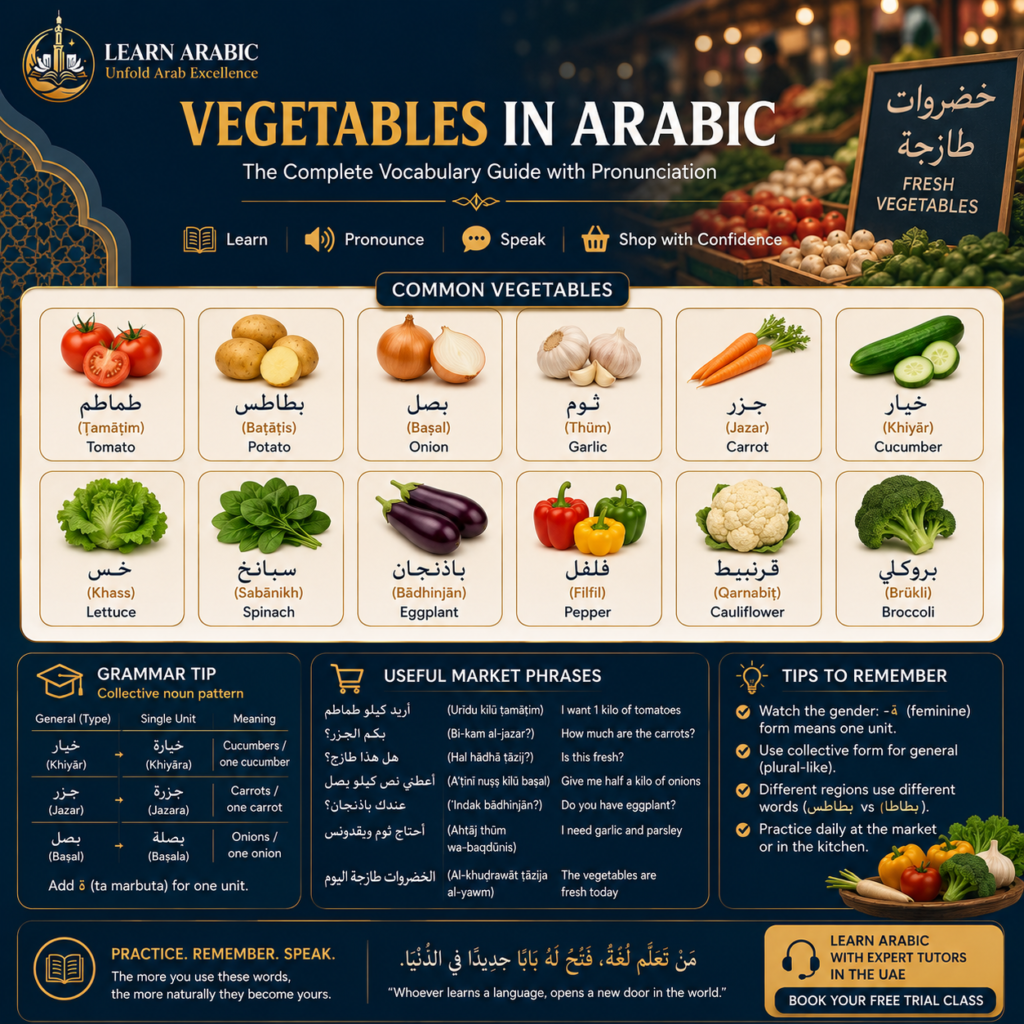
Arabic names for vegetables are part of everyday spoken and written Arabic, making them high-value vocabulary for any learner. The good news: most vegetable words in Arabic are nouns with recognizable patterns, so once you learn a few, others start to feel familiar.
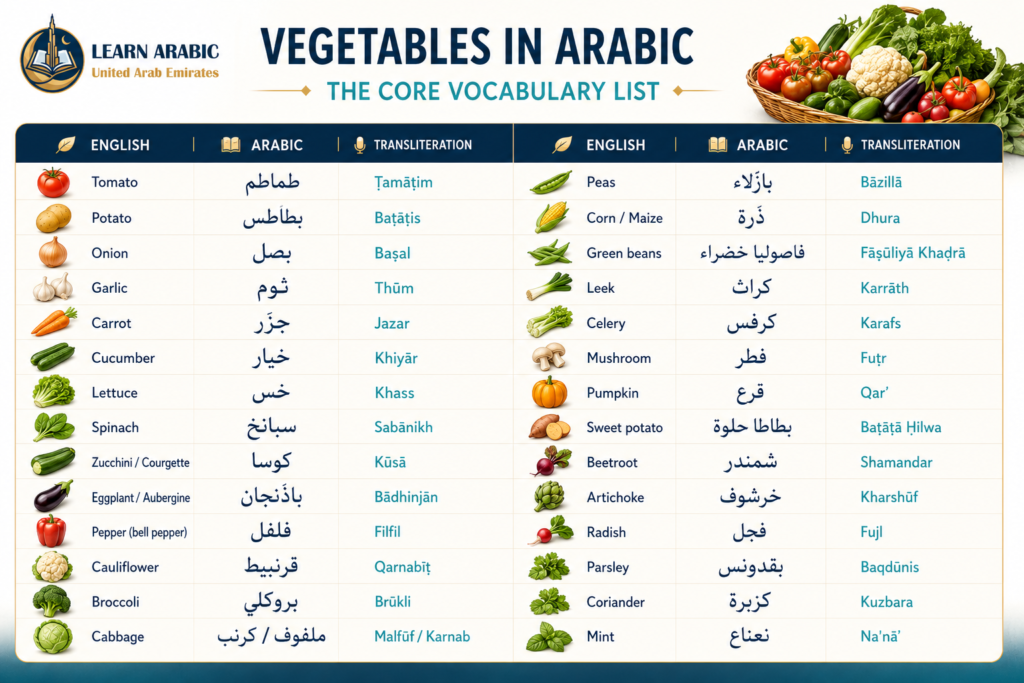
Here is a complete list of common vegetables in Arabic, with transliteration and English meaning:
| English | Arabic | Transliteration |
| Tomato | طماطم | Ṭamāṭim |
| Potato | بطاطس | Baṭāṭis |
| Onion | بصل | Baṣal |
| Garlic | ثوم | Thūm |
| Carrot | جزر | Jazar |
| Cucumber | خيار | Khiyār |
| Lettuce | خس | Khass |
| Spinach | سبانخ | Sabānikh |
| Zucchini / Courgette | كوسا | Kūsā |
| Eggplant / Aubergine | باذنجان | Bādhinjān |
| Pepper (bell pepper) | فلفل | Filfil |
| Cauliflower | قرنبيط | Qarnabīṭ |
| Broccoli | بروكلي | Brūkli |
| Cabbage | ملفوف / كرنب | Malfūf / Karnab |
| Peas | بازلاء | Bāzillā |
| Corn / Maize | ذرة | Dhura |
| Green beans | فاصوليا خضراء | Fāṣūliyā Khaḍrā |
| Leek | كراث | Karrāth |
| Celery | كرفس | Karafs |
| Mushroom | فطر | Fuṭr |
| Pumpkin | قرع | Qar’ |
| Sweet potato | بطاطا حلوة | Baṭāṭā Ḥilwa |
| Beetroot | شمندر | Shamandar |
| Artichoke | خرشوف | Kharshūf |
| Radish | فجل | Fujl |
| Parsley | بقدونس | Baqdūnis |
| Coriander | كزبرة | Kuzbara |
| Mint | نعناع | Na’nā’ |
Read More: How to Learn Arabic in the UAE?
Our Students Reviews
How Arabic Vegetable Names Work Grammatically?
Understanding the grammar behind vegetable names — not just memorizing them — is what separates learners who retain vocabulary from those who forget it in a week.
1. The Collective Noun Pattern — اسم الجنس
Arabic uses a system called collective nouns (اسم الجنس — ism al-jins) for most natural items, including vegetables. The rule works like this:
The base word refers to the vegetable type in general. Adding a ة (ta marbuta) at the end refers to a single unit.
| General (type) | Single unit | Meaning |
| بصل (Baṣal) | بصلة (Baṣala) | Onions / one onion |
| خيار (Khiyār) | خيارة (Khiyāra) | Cucumbers / one cucumber |
| جزر (Jazar) | جزرة (Jazara) | Carrots / one carrot |
| ثوم (Thūm) | ثومة (Thūma) | Garlic / one clove of garlic |
| طماطم (Ṭamāṭim) | طماطمة (Ṭamāṭima) | Tomatoes / one tomato |
| فجل (Fujl) | فجلة (Fujla) | Radishes / one radish |
Once you internalize this pattern, you can produce the singular and collective forms of most vegetable nouns without memorizing each one separately — a significant advantage when building vocabulary quickly.
2. Masculine, Feminine, and Agreement
In Arabic, all nouns are grammatically gendered. Most collective vegetable nouns (the base form) are masculine. The single-unit form ending in ة is feminine. This matters because adjectives, verbs, and demonstratives must agree with the noun’s gender.
Two examples of gender agreement in practice:
| Arabic | Transliteration | Meaning |
| الخيارة الطازجة | Al-khiyāra al-ṭāzija | The fresh cucumber (feminine agreement) |
| الخيار الطازج | Al-khiyār al-ṭāzij | Fresh cucumbers / cucumber (masculine agreement) |
If you’re serious about going further with Arabic grammar and structure, the Fusha Arabic Course at Learn Arabic UAE covers exactly this kind of pattern-based learning in depth.
Build Strong Fusha Arabic Skills with a FREE Trial Class

See Our Classroom Environment in Action
Experience a sneak peek into our live sessions. Watch the video below to see our specialized instructors interacting with students, breakdown complex texts, and cultivate an engaging, respectful learning environment.
Master Arabic in the UAE
Experience world-class Arabic language training designed for students and professionals in the Emirates.
Book Your Free TrialRead more: 100 Beautiful Arabic Words With Meaning
Vegetables in Arabic — Market and Kitchen Phrases
Vocabulary without context stays in your head but rarely comes out of your mouth. Here are practical phrases using vegetable vocabulary that Arabic speakers actually use at markets and in kitchens.
Here are the phrases:
| English Phrase | Arabic | Transliteration |
| I want one kilo of tomatoes | أريد كيلو طماطم | Urīdu kīlū ṭamāṭim |
| How much are the carrots? | بكم الجزر؟ | Bi-kam al-jazar? |
| Is this fresh? | هل هذا طازج؟ | Hal hādhā ṭāzij? |
| Give me half a kilo of onions | أعطني نص كيلو بصل | A’ṭinī nuṣṣ kīlū baṣal |
| Do you have eggplant? | عندك باذنجان؟ | ‘Indak bādhinjān? |
| I need garlic and parsley | أحتاج ثوم وبقدونس | Aḥtāj thūm wa-baqdūnis |
| The vegetables are fresh today | الخضروات طازجة اليوم | Al-khuḍrawāt ṭāzija al-yawm |
If you’re living in the UAE and want to navigate daily Arabic situations confidently — including conversations at the souq — the Emirati Arabic Course at Learn Arabic UAE is built specifically for that real-world context.
Build Real-Life Emirati Arabic Skills with a FREE Trial Lesson

Common Mistakes Arabic Learners Make with Vegetable Vocabulary
Most vocabulary guides stop at the list. What they don’t give you is the failure map — the predictable errors that mark a learner as a beginner. Knowing these in advance lets you skip past them entirely.
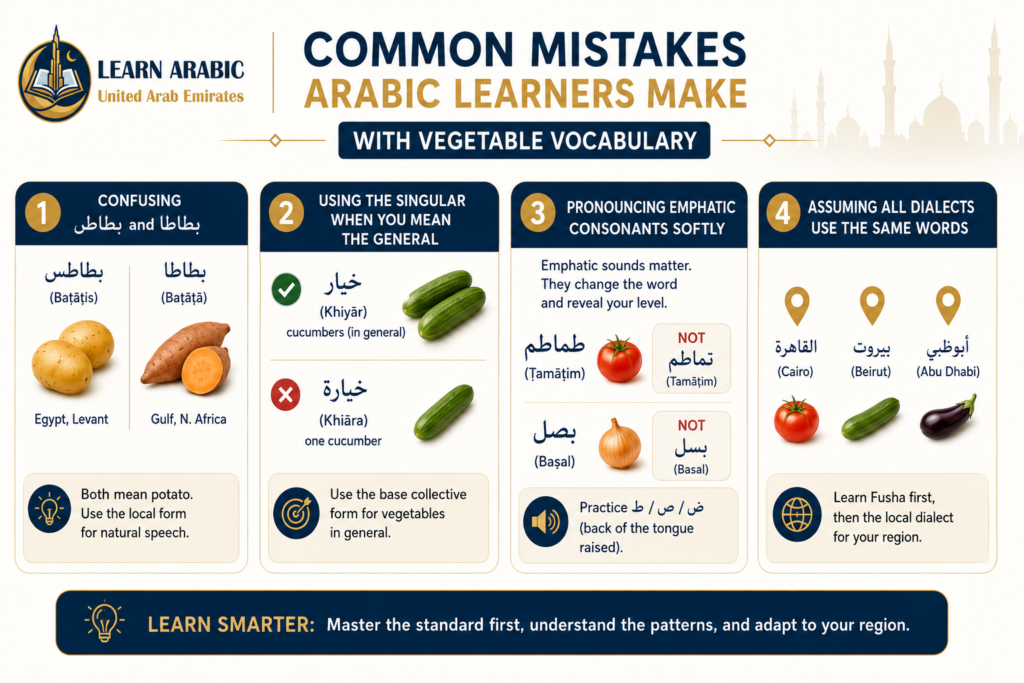
1. Confusing بطاطس and بطاطا
Both words mean potato, but which one you use reveals where you learned your Arabic.
بطاطس (Baṭāṭis) is standard in Egypt and the Levant; بطاطا (Baṭāṭā) is the norm in the Gulf and North Africa. Neither is wrong, and both will be understood across regions — but landing the local form signals genuine familiarity with the dialect, which matters in real conversations.
2. Using the singular when you mean the general
This one catches almost every English-speaking learner. Saying خيارة when you mean cucumbers in general puts the wrong grammatical frame on your request. The base collective form خيار is what Arabic uses for the vegetable as a category — خيارة means specifically one cucumber. English doesn’t make this distinction, so the error feels invisible until a native speaker corrects it.
3. Pronouncing emphatic consonants softly
Arabic emphatic consonants — ط (Ṭ), ص (Ṣ), ض (Ḍ) — appear in everyday words like طماطم and بصل. Softening them to their plain equivalents (ت and س) doesn’t just change the accent; it changes the phonetic identity of the word and marks you immediately as someone who hasn’t yet drilled these sounds. They require the back of the tongue to rise toward the soft palate — a position English never uses. Most structured Arabic courses cover this in the first few sessions, and it is worth prioritizing early rather than correcting a bad habit later.
4. Assuming all dialects use the same words
Modern Standard Arabic (Fusha) gives you a neutral baseline that educated speakers everywhere understand — but daily vegetable shopping in Cairo, Beirut, and Abu Dhabi will surface real differences. The most efficient learning sequence is Fusha first, then the local dialect variant for your region. Trying to learn three dialects simultaneously before mastering the standard form is the fastest way to end up confused in all of them.
If building a strong written Arabic foundation matters to you — including being able to read vegetable names on packaging, menus, and recipes — the Arabic Writing Course at Learn Arabic UAE is a focused way to get there.
Learn to Write Arabic Clearly and Confidently with a FREE Trial

Read more: Hard Arabic Words and Letters to Pronounce
The Word for “Vegetables” in Arabic
The general Arabic word for vegetables is خضروات (Khuḍrawāt). It comes from the root خ-ض-ر (Kh-Ḍ-R), which relates to the color green and to growth. This is why خضراء (Khaḍrā) means “green” — vegetables and greenness share the same linguistic root in Arabic.
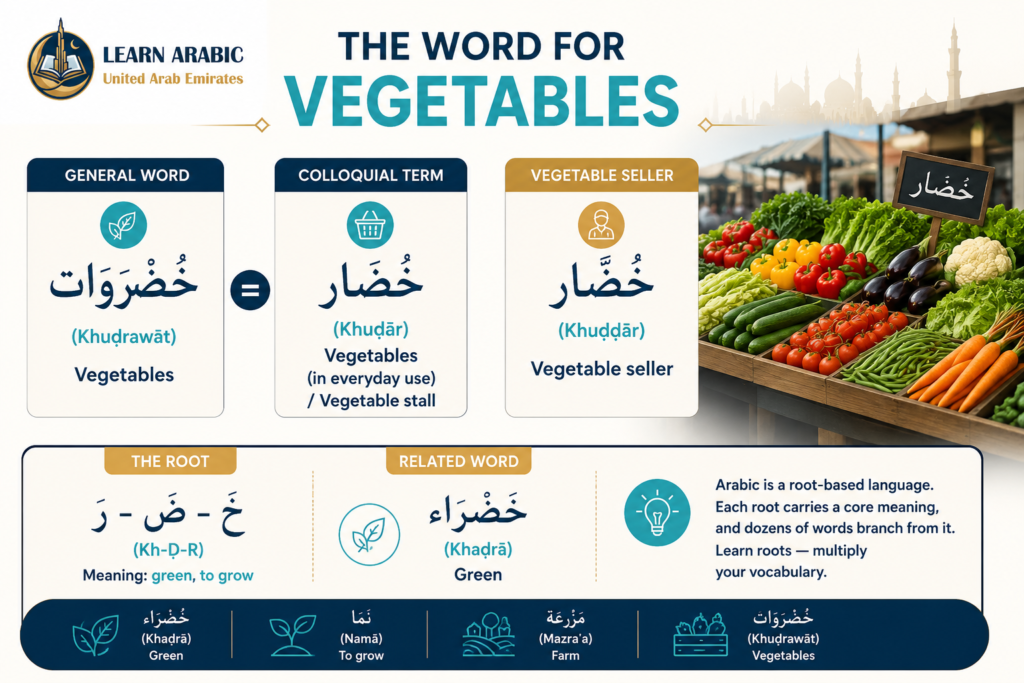
A related word you’ll hear in markets is خضار (Khuḍār), which is the colloquial term for vegetables (and often refers to the vegetable stall itself). A vegetable seller is called a خضّار (Khuḍḍār).
Understanding roots like خ-ض-ر is one of the most powerful tools in Arabic vocabulary learning. Arabic is a root-based language — each root carries a core meaning, and dozens of words branch from it. Learners who internalize roots multiply their vocabulary far faster than those who memorize word-by-word.
Step Inside Our Classrooms
Don’t just take our word for it—see our community in action. Click below to watch real, live snippets from our recent classes and experience our engaging teaching style firsthand!
Master Arabic in the UAE
Experience world-class Arabic language training designed for students and professionals in the Emirates.
Book Your Free TrialStart Speaking Arabic with Expert Teachers in the UAE
Building real Arabic fluency starts with the right structure beneath the vocabulary. At Learn Arabic UAE, learners of every level discover Arabic through structured, instructor-led courses taught by native Azhari-trained tutors — from your first vocabulary list all the way to confident conversation.
- Native Arab Azhari-trained tutors specializing in Arabic for English speakers
- Structured lessons that build grammar, vocabulary, and speaking skills together
- Practical courses covering Fusha, Emirati dialect, and Arabic writing
- Interactive sessions that move you from recognition to real communication
- Flexible online classes available across all UAE emirates
- Free trial lesson available
Book your free trial lesson today and start building Arabic that actually works in the real world.

Our Arabic courses
- Arabic Course in the UAE
- Arabic Intensive Course
- Arabic Classes for Beginners (Learn Arabic from Scratch)
- Madinah Arabic Course
- Arabic Classes for Adults
- Self-Paced Arabic Course
- Arabic Speaking Classes
- Learn to Write Arabic Course
- Arabic Grammar Course
- Learn Arabic Alphabet Course
- Modern Standard Arabic (MSA) Course
- Quranic Arabic Course
- Fusha Arabic Course
- Classical Arabic Course
- Emirati Arabic Course
- Gulf Arabic Course
- Learn Saudi Arabic
- Business Arabic Course UAE
- Arabic Language Classes for Professionals in UAE
Master Arabic in the UAE
Experience world-class Arabic language training designed for students and professionals in the Emirates.
Book Your Free TrialConclusion
Vegetables in Arabic are among the most immediately useful vocabulary any learner can acquire. The words appear on menus, in markets, in recipes, and in daily conversation — meaning every word you learn gets used quickly and repeatedly, which is exactly the condition that makes vocabulary stick.
The deeper win, however, comes from understanding the grammar patterns behind the words: the collective noun system, the gender agreement rules, and the root-based structure that connects خضروات (vegetables) to خضراء (green) to خضّار (greengrocer). That structural awareness is what turns vocabulary lists into genuine Arabic fluency.
Frequently Asked Questions About Vegetables in Arabic
Here are clear answers to the most common questions learners ask about this topic.
What is the Arabic word for vegetables?
The Arabic word for vegetables is خضروات (Khuḍrawāt). In colloquial Arabic, especially at markets, you will also hear خضار (Khuḍār). Both come from the same root خ-ض-ر, which is linked to the color green.
How do you say tomato in Arabic?
Tomato in Arabic is طماطم (Ṭamāṭim). It is one of the most widely used vegetable words across all Arabic-speaking countries and appears in both Modern Standard Arabic and most dialects with the same pronunciation.
What does باذنجان mean in Arabic?
باذنجان (Bādhinjān) means eggplant or aubergine in Arabic. It is used across the Arab world and appears in many well-known dishes, including the famous بابا غنوج (Bābā Ghannūj) dip made from roasted eggplant.
Is Arabic vegetable vocabulary the same in all Arab countries?
The core vocabulary is largely shared, but some dialect differences exist. For example, potato is بطاطس in Egypt and the Levant, but بطاطا in the Gulf. Modern Standard Arabic (Fusha) provides the neutral baseline understood across all regions.
How do you say “I want vegetables” in Arabic?
“I want vegetables” in Arabic is أريد خضروات (Urīdu Khuḍrawāt). In everyday spoken Arabic you might shorten it to أريد خضار (Urīdu Khuḍār), which is the more colloquial form.
Can learning food vocabulary help you learn Arabic faster?
Yes — food and market vocabulary is among the most effective early Arabic learning because it connects to real daily use. Learners who practice with words they encounter in shopping, cooking, and eating retain vocabulary more durably than those working from abstract lists alone.




Leave a Reply