 Learn Arabic
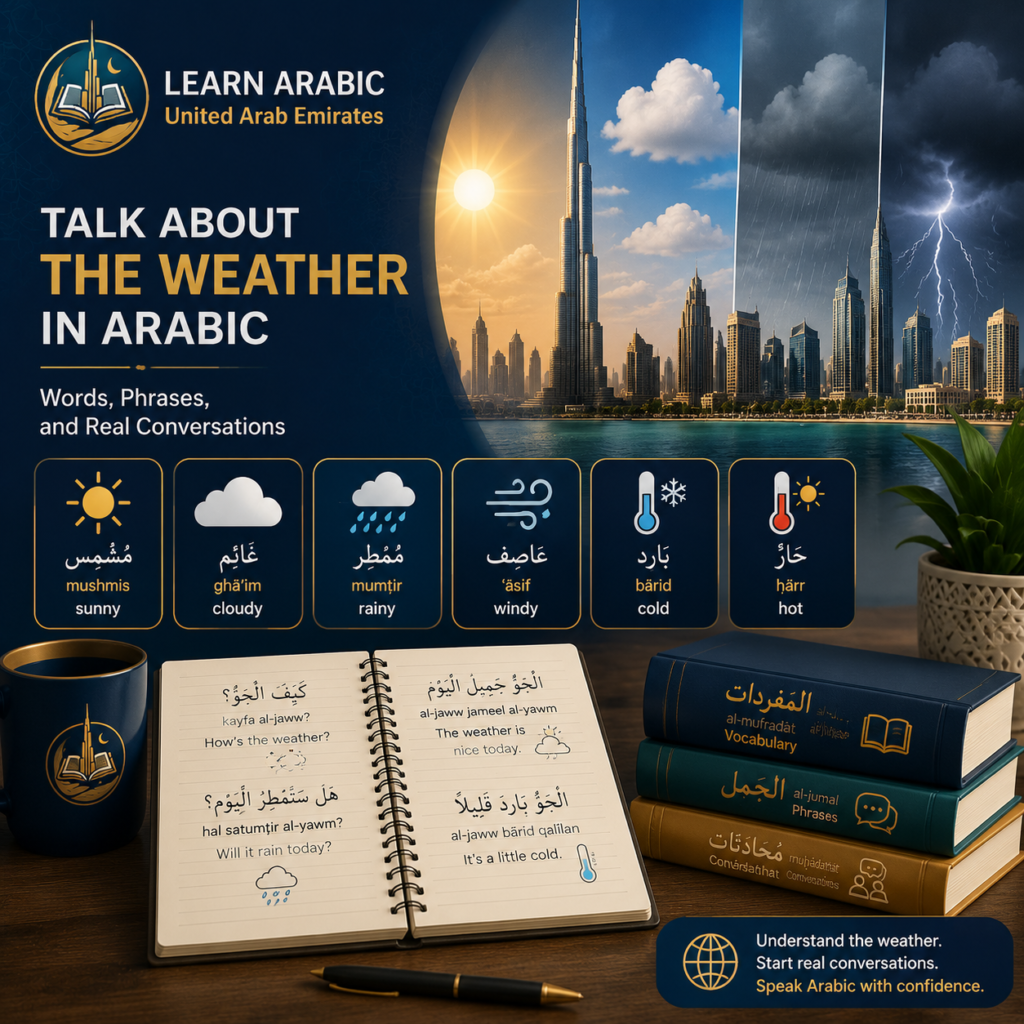
Picture this: you land in Cairo, Amman, or Dubai, step outside, and someone smiles and says something about the heat. You want to respond — but you freeze. Weather is the universal conversation starter, and in Arabic-speaking countries it comes up constantly. Learning to talk about it is not just vocabulary practice. It is your entry point into real human connection in a new language.
This guide walks you through everything you need — from the single most important Arabic word for weather to full conversations, forecast terminology, seasonal vocabulary, and the grammar traps that trip up almost every beginner.
The Real Meaning of the Arabic Word for Weather
Most Arabic courses introduce one word for weather: الطقس (at-taqs). It is the formal, standard term and the one you will hear on news broadcasts and read in weather reports.
| English | Arabic | Transliteration |
| Weather | الطقس | at-taqs |
| Today’s weather | الطقس اليوم | at-taqs al-yawm |
| Weather condition | حالة الطقس | haalat at-taqs |
| Weather forecast | النشرة الجوية | an-nashrah al-jawwiyyah |
| Climate | المناخ | al-munaakh |
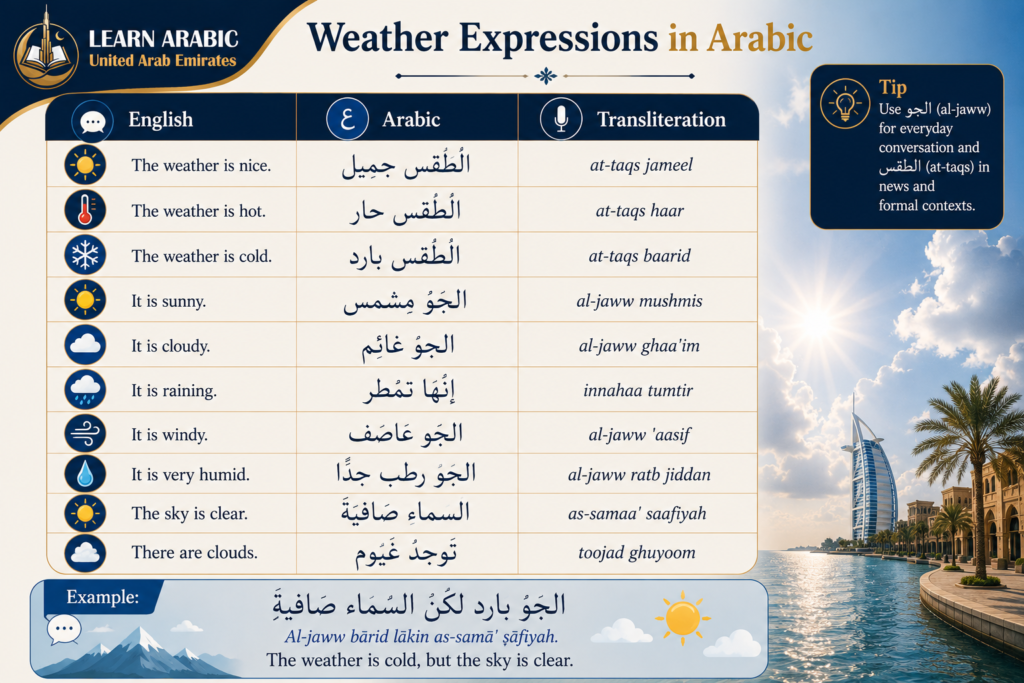
What most guides do not mention is that in daily speech across almost every Arabic-speaking country, people reach for a different word: الجو (al-jaww). It literally means “the atmosphere,” but functions as the everyday word for weather in casual conversation.
| Arabic | Register | Example Context |
| الطقس | Formal | News, weather reports, official communication |
| الجو | Casual | Street conversation, family talk, WhatsApp messages |
If you are building practical speaking skills alongside reading ability, our self-paced Arabic courses cover both registers so you sound natural whether you are reading a news article or chatting with a neighbor.
Book a Free Trial Lesson in Our Self-Paced Arabic Classes

Weather Adjectives: The Words That Do the Real Work
In Arabic, weather sentences follow a straightforward pattern: subject + adjective. That means adjectives carry most of the meaning. Master this list and you can describe almost any weather condition with a single sentence.
| English | Arabic | Transliteration |
| Hot | حار | haar |
| Cold | بارد | baarid |
| Warm | دافئ | daafi’ |
| Cool | لطيف / بارد قليلاً | lateef / baarid qaleelan |
| Sunny | مشمس | mushmis |
| Cloudy | غائم | ghaa’im |
| Rainy | ممطر | mumtir |
| Windy | عاصف | ‘aasif |
| Humid | رطب | ratb |
| Dry | جاف | jaaf |
| Foggy | ضبابي | dabaabi |
| Clear | صافي | saafi |
Example sentences:
- الجو غائم. — Al-jaww ghā’im. — It is cloudy.
- الجو جاف ومشمس. — Al-jaww jāf wa mushmis. — It is dry and sunny.
- الجو بارد. — Al-jaww bārid. — It is cold.
- الجو حار. — Al-jaww ḥārr. — It is hot.
- الجو ممطر. — Al-jaww mumṭir. — It is rainy.
- الجو معتدل اليوم. — Al-jaww muʿtadil al-yawm. — The weather is pleasant today.
Everyday Weather Phrases in Arabic
Beyond single adjectives, these are the ready-made phrases Arabic speakers actually use. Learning them as complete units — rather than building them word by word — is a faster path to natural speech.
Temperature Vocabulary in Arabic
When talking about the weather in Arabic, you’ll often need to mention the temperature. Whether you’re checking a forecast, planning a trip, or simply chatting with someone, these words will help you describe how hot or cold it is naturally.
| English | Arabic | Transliteration |
| Temperature | درجة الحرارة | darajat al-ḥarārah |
| Degree | درجة | darajah |
| Hot | حار | ḥārr |
| Cold | بارد | bārid |
| Warm | دافئ | dāfiʾ |
| Freezing | شديد البرودة | shadīd al-burūdah |
| High temperature | درجة حرارة عالية | darajat ḥarārah ʿāliyah |
| Low temperature | درجة حرارة منخفضة | darajat ḥarārah munkhafiḍah |
How to Talk About Temperature?
Unlike الجو, which describes how the weather feels, درجة الحرارة refers to the actual temperature shown in forecasts or on a thermometer. Native speakers use both depending on the situation, so learning the difference makes your Arabic sound much more natural.
Example sentences:
- درجة الحرارة وصلت إلى اثنتين وأربعين درجة اليوم. — Darajat al-ḥarārah waṣalat ilā ithnatayn wa arbaʿīn darajah al-yawm. — The temperature reached 42 degrees today.
- من المتوقع أن تنخفض درجة الحرارة الليلة. — Min al-mutawaqqaʿ an tankhafiḍ darajat al-ḥarārah al-laylah. — The temperature is expected to drop tonight.
- الصباح دافئ لكن المساء بارد. — Aṣ-ṣabāḥ dāfiʾ lākin al-masāʾ bārid. — The morning is warm, but the evening is cold.
- في الشتاء قد تصبح درجات الحرارة شديدة البرودة. — Fī ash-shitāʾ qad tuṣbiḥ darajāt al-ḥarārah shadīdat al-burūdah. — In winter, temperatures can become freezing.
Asking About the Weather in Arabic
Knowing weather vocabulary is useful, but asking the right questions is what helps you start real conversations. Whether you’re planning your day, traveling, or making small talk, these common questions will sound natural in everyday Arabic.
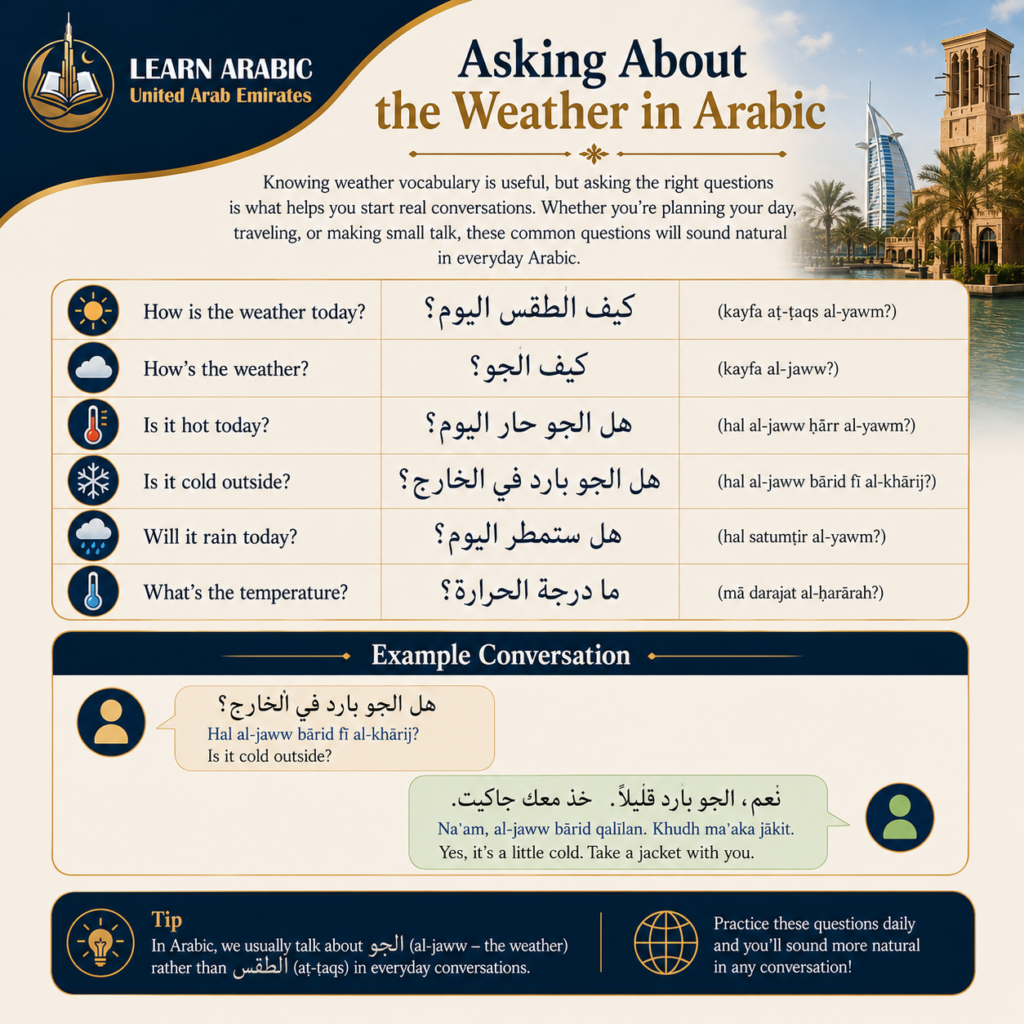
- How is the weather today? — كيف الطقس اليوم؟ (kayfa aṭ-ṭaqs al-yawm?)
- How’s the weather? — كيف الجو؟ (kayfa al-jaww?)
- Is it hot today? — هل الجو حار اليوم؟ (hal al-jaww ḥārr al-yawm?)
- Is it cold outside? — هل الجو بارد في الخارج؟ (hal al-jaww bārid fī al-khārij?)
- Will it rain today? — هل ستمطر اليوم؟ (hal satumṭir al-yawm?)
- What’s the temperature? — ما درجة الحرارة؟ (mā darajat al-ḥarārah?)
Example conversation
هل الجو بارد في الخارج؟
Hal al-jaww bārid fī al-khārij?
Is it cold outside?
نعم، الجو بارد قليلًا.
خذ معك جاكيت.
Naʿam, al-jaww bārid qalīlan. Khudh maʿaka jākit.
Yes, it’s a little cold. Take a jacket with you.
Step Inside Our Classrooms
Don’t just take our word for it—see our community in action. Click below to watch real, live snippets from our recent classes and experience our engaging teaching style firsthand!
Master Arabic in the UAE
Experience world-class Arabic language training designed for students and professionals in the Emirates.
Book Your Free TrialRain, Storms, and Extreme Weather in Arabic
This vocabulary set is essential for understanding Arabic weather forecasts, news reports, and any conversation about dramatic weather events.
| English | Arabic | Transliteration |
| Rain | مطر | matar |
| It rains | تمطر | tumtir |
| Heavy rain | مطر غزير | matar ghazeer |
| Light rain | مطر خفيف | matar khafeef |
| Cloud | غيمة | ghaymah |
| Clouds | غيوم | ghuyoom |
| Storm | عاصفة | ‘aasifah |
| Thunder | رعد | ra’d |
| Lightning | برق | barq |
| Hail | بَرَد | barad |
| Rainbow | قوس قزح | qaws quzah |
| Fog | ضباب | dabaab |
| Flood | فيضان | fayadaan |
Example sentences:
- هناك عاصفة قوية اليوم. — Hunāka ʿāṣifah qawiyyah al-yawm. — There is a strong storm today.
- تمطر بغزارة منذ الصباح. — Tumṭiru bighazārah mundhu aṣ-ṣabāḥ. — It has been raining heavily since this morning.
- ظهر قوس قزح بعد المطر. — Ẓahara qaws quzaḥ baʿda al-maṭar. — A rainbow appeared after the rain.
- الغيوم تغطي السماء. — Al-ghuyūm tughṭṭī as-samāʾ. — Clouds are covering the sky.
Arabic Words for the Four Seasons
Seasons give weather vocabulary its broader context. These words let you talk about what to expect climatically — not just what is happening right now.
| English | Arabic | Transliteration |
| Season | فصل | fasl |
| Seasons | فصول | fusool |
| Spring | الربيع | ar-rabee’ |
| Summer | الصيف | as-sayf |
| Autumn / Fall | الخريف | al-khareef |
| Winter | الشتاء | ash-shitaa’ |
Examples: الربيع في بلاد الشام من أجمل فصول السنة Ar-rabee’ fi bilaad ash-shaam min ajmal fusool as-sanah. Spring in the Levant is one of the most beautiful seasons of the year.
الخريف يجلب أمطاراً معتدلة ودرجات حرارة مريحة Al-khareef yajlib amtaaran mu’taadilah wa darajaat haraarah mureehah. Autumn brings moderate rain and comfortable temperatures.
When adjectives like معتدل (moderate) and مريح (comfortable) need to agree grammatically with the nouns they describe, the rules of Arabic grammar come into play. Our Modern Standard Arabic course covers noun-adjective agreement and the sentence structures that make these patterns consistent and learnable.
Join Our Modern Standard Arabic Classes with a FREE Trial Lesson
Weather Small Talk in Arabic
Small talk is where language becomes social. These phrases are short, natural, and immediately useful in any Arabic-speaking environment.Nice weather today, right? — الجو جميل اليوم، أليس كذلك؟ (Al-jaww jamīl al-yawm, alaysa kadhālik?)
- It is too hot today. — الجو حار جدًا اليوم. (Al-jaww ḥārr jiddan al-yawm.)
- The weather changed suddenly. — تغيّر الطقس فجأة. (Taghayyara aṭ-ṭaqs fajʾah.)
- I hope it doesn’t rain. — أتمنى ألّا تمطر. (Atamannā allā tumṭir.)
- The weather is perfect for walking. — الجو مناسب للمشي. (Al-jaww munāsib lil-mashy.)
- It is colder than yesterday. — الجو أبرد من أمس. (Al-jaww abrad min ams.)
Example conversation
تغيّر الطقس فجأة اليوم، أليس كذلك؟
Taghayyara aṭ-ṭaqs fajʾatan al-yawm, alaysa kadhālik?
The weather changed suddenly today, didn’t it?
نعم، كنت أتمنى ألّا تمطر، لدي مواعيد في الخارج.
Naʿam, kuntu atamannā allā tumṭir. Ladayya mawāʿīd fī al-khārij.
Yes, I was hoping it wouldn’t rain. I have appointments outside.
Four Mistakes Beginners Make When Talking About Weather in Arabic
Most beginners make the same mistakes when discussing the weather in Arabic. Avoiding these common errors will help your Arabic sound much more natural.
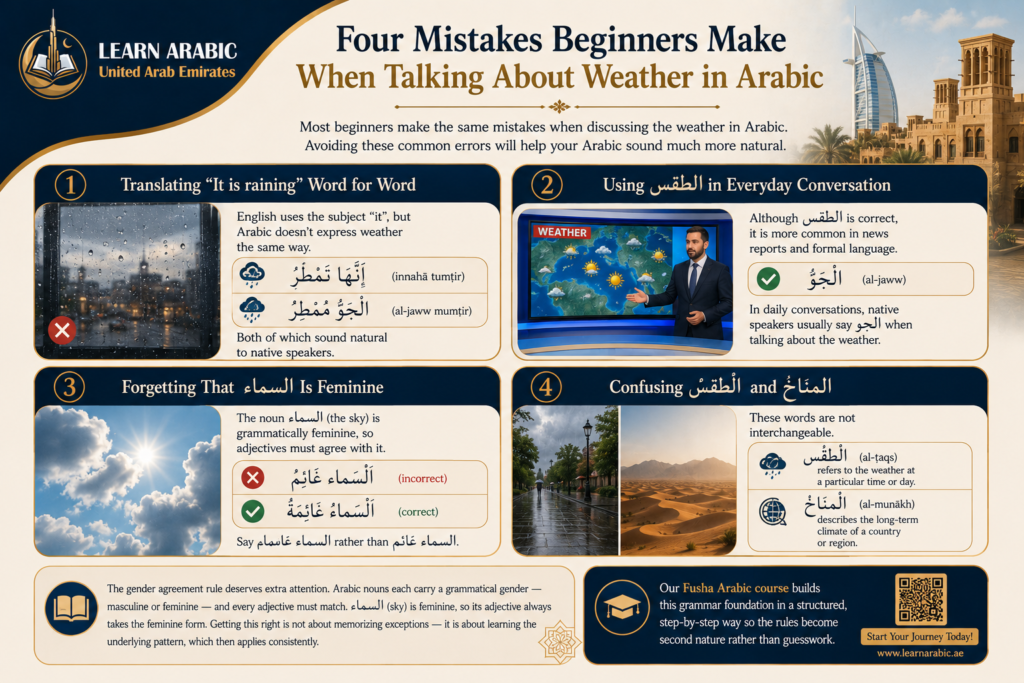
1. Translating “It is raining” Word for Word
English uses the subject “it”, but Arabic doesn’t express weather the same way. Instead, say إنها تمطر (innahā tumṭir) or الجو ممطر (al-jaww mumṭir), both of which sound natural to native speakers.
2. Using الطقس in Everyday Conversation
Although الطقس is correct, it is more common in news reports and formal language. In daily conversations, native speakers usually say الجو when talking about the weather.
3. Forgetting That السماء Is Feminine
The noun السماء (the sky) is grammatically feminine, so adjectives must agree with it. Say السماء غائمة rather than السماء غائم.
4. Confusing الطقس and المناخ
These words are not interchangeable.
الطقس refers to the weather at a particular time or day, while المناخ describes the long-term climate of a country or region.
The gender agreement rule deserves extra attention. Arabic nouns each carry a grammatical gender — masculine or feminine — and every adjective must match.
السماء (sky) is feminine, so its adjective always takes the feminine form. Getting this right is not about memorizing exceptions — it is about learning the underlying pattern, which then applies consistently. Our Fusha Arabic course builds this grammar foundation in a structured, step-by-step way so the rules become second nature rather than guesswork.
Build a Strong Foundation in Fusha Arabic with a FREE Trial Lesson

See Our Classroom Environment in Action
Experience a sneak peek into our live sessions. Watch the video below to see our specialized instructors interacting with students, breakdown complex texts, and cultivate an engaging, respectful learning environment.
Master Arabic in the UAE
Experience world-class Arabic language training designed for students and professionals in the Emirates.
Book Your Free TrialStart Speaking Arabic Naturally with Learn Arabic UAE
Mastering weather vocabulary is just one step toward becoming a confident Arabic speaker. The real progress comes from learning how native speakers use these words in everyday conversations, with expert guidance and consistent practice.
At Learn Arabic UAE, our structured online Arabic courses help learners develop practical communication skills through:
- Qualified native Arabic tutors — learn authentic Modern Standard Arabic with experienced instructors.
- Live one-on-one and small group classes — personalized lessons tailored to your goals and pace.
- Practical, conversation-focused curriculum — build vocabulary, grammar, pronunciation, and speaking confidence together.
- Courses for all ages and levels — from complete beginners to advanced learners looking to improve fluency.
- Free trial lesson available — experience our teaching approach before enrolling.
Book your free trial lesson with Learn Arabic UAE today and start building the Arabic skills you need to communicate confidently in real-life situations.

Our Arabic courses
- Arabic Course in the UAE
- Arabic Intensive Course
- Arabic Classes for Beginners (Learn Arabic from Scratch)
- Madinah Arabic Course
- Arabic Classes for Adults
- Self-Paced Arabic Course
- Arabic Speaking Classes
- Learn to Write Arabic Course
- Arabic Grammar Course
- Learn Arabic Alphabet Course
- Modern Standard Arabic (MSA) Course
- Quranic Arabic Course
- Fusha Arabic Course
- Classical Arabic Course
- Emirati Arabic Course
- Gulf Arabic Course
- Learn Saudi Arabic
- Business Arabic Course UAE
- Arabic Language Classes for Professionals in UAE
Master Arabic in the UAE
Experience world-class Arabic language training designed for students and professionals in the Emirates.
Book Your Free TrialConclusion
Arabic weather vocabulary is compact, practical, and immediately applicable. A handful of adjectives — حار، بارد، مشمس، غائم، ممطر — combined with the two key weather words الطقس and الجو will carry you through the vast majority of real-world weather conversations.
What separates learners who stay at the vocabulary stage from those who move into genuine fluency is grammar awareness — knowing that السماء takes a feminine adjective, that الجو belongs in casual speech while الطقس belongs in formal writing, and that Arabic sentence structure follows its own logic rather than English word order. Pay attention to those details early, and weather conversations will feel natural sooner than you expect.
Frequently Asked Questions
Understanding weather vocabulary involves more than memorizing words. The answers below explain the most common questions learners ask about weather expressions in Arabic, from everyday conversation to formal usage.
What is the Arabic word for weather?
The Arabic word for weather is الطقس (at-taqs), used in formal and written contexts. In everyday spoken Arabic, الجو (al-jaww) is the more natural choice. Both are correct and widely understood, but knowing when to use each one makes your Arabic sound more authentic.
What is the difference between الطقس and الجو in Arabic?
الطقس (at-taqs) is the formal, standard Arabic word for weather — used in news reports, weather forecasts, and official writing. الجو (al-jaww) means “atmosphere” but functions as the everyday word for weather in casual speech. Most native speakers use الجو when talking with friends and family.
How do you say it is raining in Arabic?
Two correct options: إنها تمطر (innahaa tumtir) or الجو ممطر (al-jaww mumtir). The first is a verbal sentence meaning “it is raining.” The second — “the weather is rainy” — is often more natural in everyday Arabic conversation.
How do you ask about the weather in Arabic?
The most common question is كيف الطقس اليوم؟ (Kayfa at-taqs al-yawm?) — “How is the weather today?” In casual conversation, كيف الجو؟ (Kayfa al-jaww?) flows more naturally. Both are grammatically correct and widely understood across the Arab world.
What is climate called in Arabic?
Climate in Arabic is المناخ (al-munaakh). It refers to the long-term atmospheric conditions of a region — as distinct from الطقس (at-taqs), which describes current or daily weather. The two words are not interchangeable, and mixing them up is a common beginner mistake.
What is a weather forecast called in Arabic?
A weather forecast in Arabic is النشرة الجوية (an-nashrah al-jawwiyyah) — the term used in television and radio broadcasts. In written and digital contexts, توقعات الطقس (tawaqqu’aat at-taqs) is also widely used and means the same thing.
Related Articles
Learn Arabic



Leave a Reply