 Learn Arabic
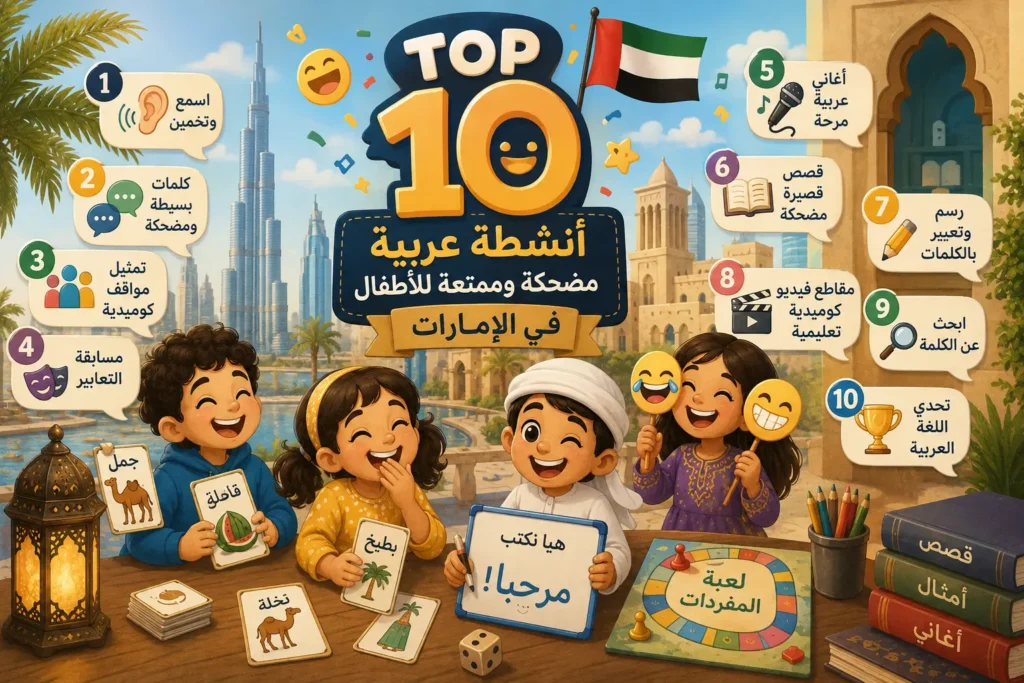
Finding the right Arabic activity for kids in the UAE can feel overwhelming — especially when parents want something that actually sticks beyond a single session. The UAE is one of the most linguistically diverse environments in the world, which makes intentional Arabic learning all the more important for children growing up here.
Whether your child attends a British curriculum school, an international school, or a local Arabic-medium school, structured and playful Arabic activities help them build confidence, vocabulary, and a genuine connection to the language.
This guide covers ten proven activity types — from hands-on printable worksheets to interactive centres and online platforms — so you can choose the right fit based on your child’s age, learning style, and schedule.
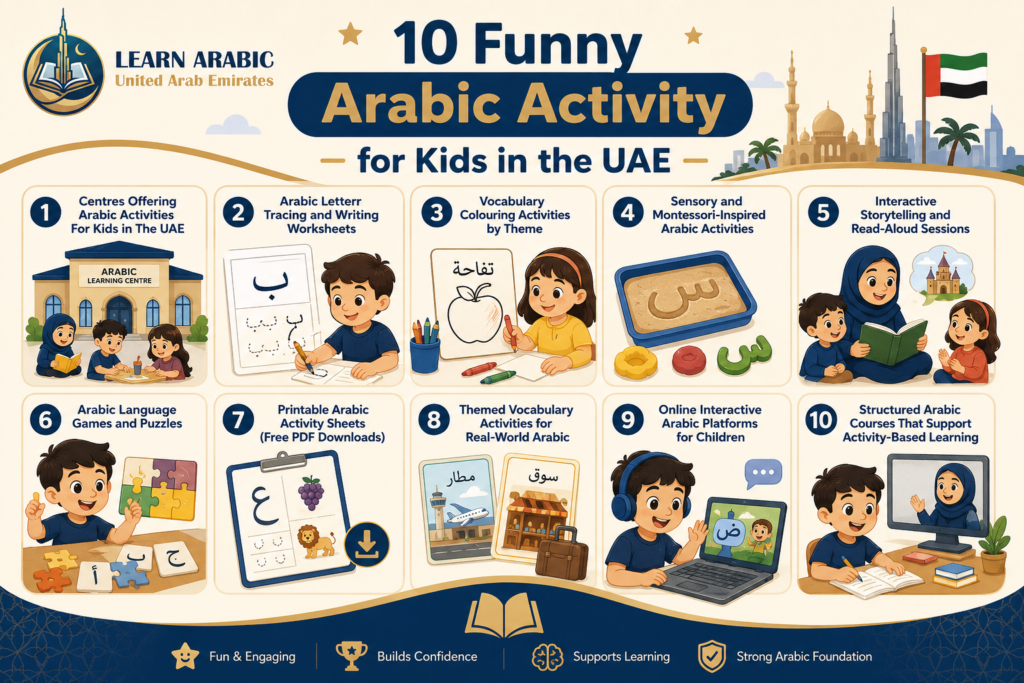
1. Centres Offering Arabic Activities For Kids in The UAE
In-person Arabic activity programmes in the UAE provide something digital platforms cannot: a social learning environment where children hear and speak Arabic with peers. This peer-to-peer exposure is one of the most effective accelerators for spoken Arabic development. The following centers are recommended:
- My First Gym (Dubai): Includes language integration across its structured children’s programmes.
- Abu Dhabi Arabic Language Centre: Runs public events including “Al Tifl Yaqra'” with storytelling stations, parent workshops, and early literacy guidance from education specialists.
A distinguishing feature of the Abu Dhabi Arabic Language Centre’s approach is its use of physical book stations (seven per event) where trained education students guide small groups of five children at a time — a ratio that allows for personalised language interaction rarely achievable in classroom settings.
2. Arabic Letter Tracing and Writing Worksheets
Letter recognition and correct pencil grip are the first milestones in Arabic literacy, and tracing worksheets remain one of the most reliable tools for both. Each worksheet typically presents a letter in its isolated, initial, medial, and final forms.
The best worksheets include clear dotted guidelines that demonstrate the correct stroke direction, helping children develop proper handwriting habits from the beginning rather than memorizing letter shapes alone.
They also connect each letter to a familiar word through a simple coloring activity, reinforcing vocabulary and strengthening letter–sound recognition in an engaging way.
You can find online platforms that offer Arabic activity for kids free downloads organised by letter and provide sequenced workbooks with a four-part structure — grip training, letter shapes, word practice, and positional forms.
Join Our Arabic Course in the UAE with a FREE Trial

3. Vocabulary Colouring Activities by Theme
Themed vocabulary activities work because they cluster related words into a memorable context. Instead of memorising a random list, a child colours a food market scene and labels each item — building a connected web of knowledge rather than isolated words.
Popular themes for this age group include food in Arabic language (fruit, vegetables, dairy), clothing, daily routines, animals, and weather. Each theme maps naturally onto the child’s real life, which increases the chance they will use the vocabulary outside the activity.
A common practitioner observation: children who complete themed vocabulary colouring pages perform noticeably better on oral recall tasks than those who practise through repetition alone. The visual-spatial connection reinforces the phonological memory of the word.
You can practice these activity ideas by theme with your kids like Colouring a market scene and label items using Arabic food vocabulary or drawing a self-portrait and label body parts in Arabic — رأس، يد، عين، أذن. Also you can colour a rainbow and write the Arabic word for each of the colors in Arabic beneath it
Step Inside Our Classrooms
Don’t just take our word for it—see our community in action. Click below to watch real, live snippets from our recent classes and experience our engaging teaching style firsthand!
Master Arabic in the UAE
Experience world-class Arabic language training designed for students and professionals in the Emirates.
Book Your Free Trial4. Sensory and Montessori-Inspired Arabic Activities
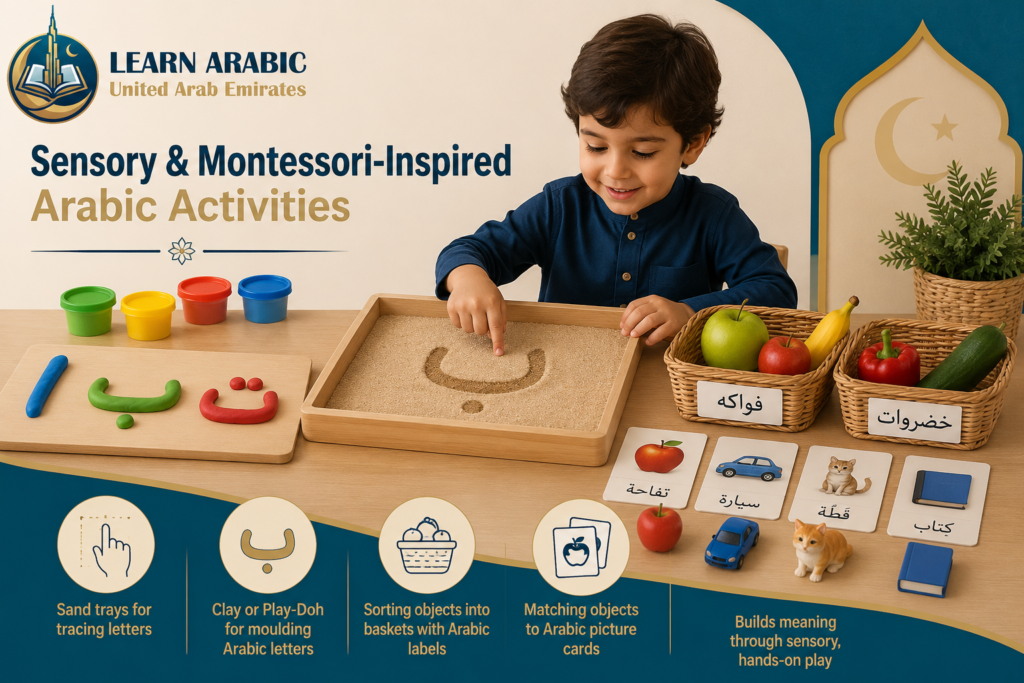
Montessori methodology aligns well with Arabic literacy development because it emphasises hands-on, self-paced discovery. For children aged two to five, sensory activities remove the pressure of sitting and writing — replacing it with tactile engagement that still builds language.
Here is practical montessori Arabic activity ideas:
- Sand trays for tracing letter shapes with a finger
- Clay or Play-Doh for moulding Arabic letters (matches what is described in the Twinkl Arabic clay alphabet activity mentioned in the source materials)
- Sorting objects into baskets labelled with the Arabic name of each category
- Matching physical objects to picture cards with Arabic labels
Sensory play is especially useful for children who struggle with fine motor control. A child who cannot yet hold a pencil properly can still learn that “تفاحة” means apple by placing real fruit in a labelled basket — building meaning before mechanics.
5. Interactive Storytelling and Read-Aloud Sessions
Stories are the most powerful vehicle for vocabulary acquisition in any language. For Arabic specifically, read-aloud sessions expose children to sentence structure, grammar patterns, and cultural context simultaneously — none of which a worksheet can replicate alone.
In the UAE, Abu Dhabi Arabic Language Centre’s “Al Tifl Yaqra'” (The Child Reads) events — offers structured storytelling sessions with 70+ children, using seven curated Arabic stories at separate themed stations, each lasting 45 minutes
For home use, the Asafeer platform provides Arabic picture books in five graded reading levels, with comprehension activities after each story. This makes it practical for parents who want to replicate the structure of a classroom read-aloud at home.
Begin Your Child’s Arabic Learning Journey with a FREE Trial Class

6. Arabic Language Games and Puzzles
Language games develop listening, vocabulary, and pattern recognition without the child registering that they are studying. The competitive and play-based format also sustains attention for longer than a standard worksheet session. These are effective Arabic game formats for children:
- Word-matching card games: Match the Arabic word card to the picture card
- Alphabet puzzles: Assemble the letter from pieces, which reinforces shape recognition
- Missing word fill-ins: Simple sentences with one word removed, chosen from a picture bank
- Shadow matching: Match the silhouette of an object to its image and label it in Arabic
The Asafeer platform offers several free Arabic games including letter recognition games (حروف زيزو), word-building activities, and puzzle-style comprehension exercises.
The Arabic For All language games series — Al-Alaabu Al-Lughawiyya — is another structured resource used in UAE classrooms, containing over 100 language games per volume and covering listening, speaking, reading, and writing skills.
7. Printable Arabic Activity Sheets (Free PDF Downloads)
Free Printable Arabic activities for kids remain one of the most practical options for parents and teachers in the UAE because they require no screen time, no subscription, and no preparation beyond printing. The quality of free Arabic activity for kidsresources has improved significantly, with several platforms now offering professionally designed PDF packs.
When downloading, prioritise sheets that include both a visual cue (image) and an audio prompt suggestion for parents — research on early literacy consistently shows that pairing written Arabic with spoken Arabic doubles retention speed.
Canva website includes customizable Arabic worksheet templates that teachers and parents can edit and print for personal educational use. These templates are particularly useful for creating personalized handwriting and vocabulary practice.
Read also: How to Learn Arabic for Kids in the UAE?
8. Themed Vocabulary Activities for Real-World Arabic
One of the most overlooked strategies in Arabic learning for children is building vocabulary around themes the child actually encounters. A child in the UAE who visits a clinic will benefit enormously from knowing even basic hospital vocabulary in Arabic — كيف تشعر؟، أين يؤلمك؟، الطبيب، الممرضة — because it connects the language to a setting they recognise.
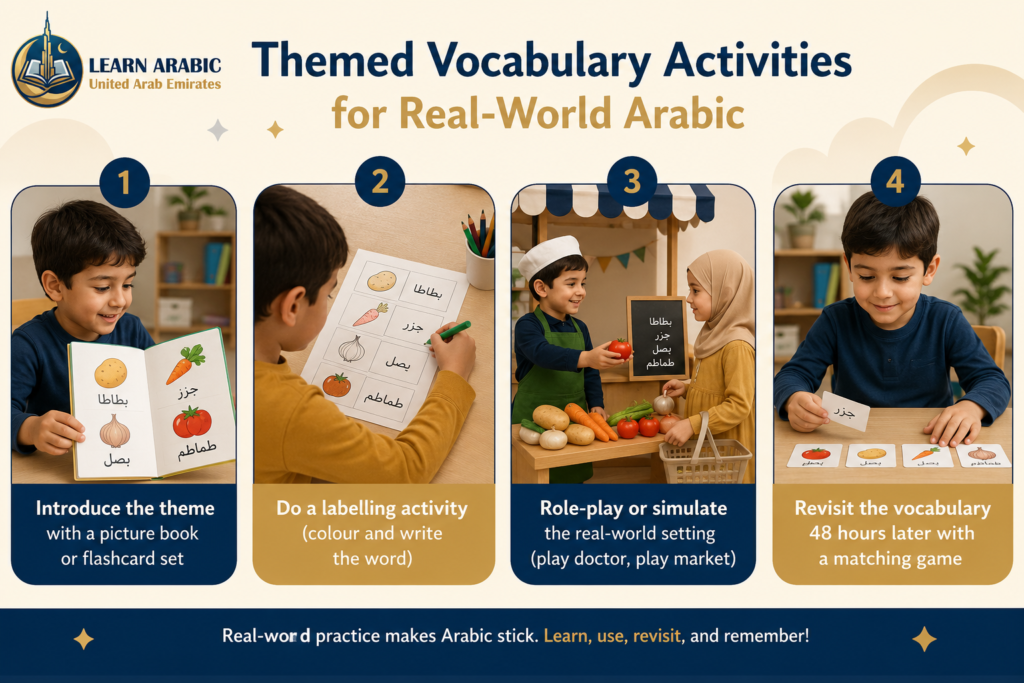
Similarly, a trip to a supermarket becomes a productive vocabulary session when the child can read Arabic labels for vegetables in Arabic — بطاطا، جزر، بصل، طماطم — rather than relying on the English translation. Hereafter a framework sample for themed Arabic vocabulary activities:
- Introduce the theme with a picture book or flashcard set
- Do a labelling activity (colour and write the word)
- Role-play or simulate the real-world setting (play doctor, play market)
- Revisit the vocabulary 48 hours later with a matching game
This sequence — introduce, label, simulate, revisit — moves vocabulary from passive recognition into active use far faster than repetitive writing exercises alone.
Read Also: Essential Arabic Vocabulary for Kids
9. Online Interactive Arabic Platforms for Children
Digital platforms can provide the consistency and variety that makes Arabic learning sustainable across a school year. The best platforms for children in the UAE combine audio, animation, and interactive exercises — removing dependence on a parent’s ability to pronounce Arabic correctly. These are the top-rated platforms for Arabic activities for kids online:
- Asafeer (3asafeer.com): Free graded stories, vocabulary games, and Arabic activity for kids printable worksheets. Includes games like “Lost Letters” (أضعت حروفي) and the interactive puppet game (اصنع دميتك) that develop both literacy and creativity.
- Alef Bata (alefbata.com): Designed for ages 4–10, covers letters, sight words, grammar exercises, and listening activities. School accounts available with progress tracking.
- Arabee: Arabic language learning app covers all four language skills — listening, speaking, reading, and writing
Platforms that combine audio narration with written text are significantly more effective for children than text-only activities — particularly for those whose home language is not Arabic and who therefore lack natural Arabic phonological input.
Read Also: How to Teach Kids Arabic in the UAE?
See Our Classroom Environment in Action
Experience a sneak peek into our live sessions. Watch the video below to see our specialized instructors interacting with students, breakdown complex texts, and cultivate an engaging, respectful learning environment.
Master Arabic in the UAE
Experience world-class Arabic language training designed for students and professionals in the Emirates.
Book Your Free TrialRead Also: 10 Steps To Learn Egyptian Arabic for Kids
10. Structured Arabic Courses That Support Activity-Based Learning
Activities work best when they are embedded within a structured learning sequence. Without grammatical scaffolding and progressive vocabulary building, even the most engaging activity remains an isolated event rather than a language-building step.
For children in the UAE whose Arabic needs to progress beyond worksheets and games, a structured Arabic course provides the connective tissue — the grammar framework, phonological system, and vocabulary sequencing — that makes every activity more productive.
As children advance, moving from learning Arabic phrases for daily conversation toward understanding sentence structure and basic grammar, structured tuition becomes essential. Learn Arabic UAE offers courses designed specifically for this progression, from complete beginners through to advanced speakers.
Read Also: The Best 10 Arabic Books For Kids
Learn Arabic UAE Offers Structured Courses That Deliver Results
Learn Arabic UAE has helped hundreds of students across the Emirates develop genuine Arabic language skills — not just familiarity with the alphabet. Our courses are structured, flexible, and designed to meet learners at their current level and take them further, faster.
Whether you are a parent enrolling a child, an adult returning to your roots, or a professional who needs Arabic for work and daily life in the UAE, there is a course designed for your exact starting point.
Explore Learn Arabic UAE’s courses for children:
- Arabic course for beginners
- Kids’ Arabic Grammar Course
- Arabic Beginner Course for Kids
- Arabic Conversation for Kids
- Arabic alphabet course
- Arabic grammar course
- Arabic writing course
- Arabic speaking course
Students who learn Quranic vocabulary alongside modern Arabic make faster progress overall — the classical root system reinforces Modern Standard Arabic vocabulary, which in turn makes everyday conversation easier.
Book your child’s free trial lesson today and help them build a strong Arabic vocabulary from the very beginning.

Conclusion
Finding the right Arabic activity for kids in the UAE is not about choosing the most elaborate resource — it is about matching the activity type to how your child learns, and making it consistent.
The ten activity types in this guide cover every major learning style: visual learners benefit from colouring and labelling activities, kinaesthetic learners thrive with Montessori-inspired hands-on tasks, auditory learners need storytelling and platform-based audio input, and social learners develop fastest in group settings like those offered by cultural centres across Dubai and Abu Dhabi.
The most important practitioner insight from working with children in multilingual environments is this: frequency beats intensity. A child who does fifteen minutes of Arabic vocabulary activity four times a week will outperform a child who does a single two-hour session per week.
Regardless of which specific activity is used. Pair that daily consistency with a structured course at the right level, and progress becomes visible within weeks rather than months.
Frequently Asked Questions
What is the best Arabic activity for kids aged 3 to 5 in the UAE?
Sensory and Montessori-inspired activities work best for this age group — sand trays for letter tracing, object-sorting with Arabic labels, and clay modelling of letter shapes. These activities build letter recognition and vocabulary without requiring a pencil, which most children under five are not yet ready to control accurately.
How do Arabic activity centres in Dubai and Abu Dhabi differ from online platforms?
Online platforms like Asafeer and Alef Bata offer greater flexibility, audio support, and progress tracking. The most effective approach for most children combines both — structured screen-based learning at home plus occasional in-person sessions for spoken fluency.
At what age should children start structured Arabic language activities?
Most language development specialists recommend introducing Arabic literacy activities from age four, with a focus on oral vocabulary and letter recognition before age six. Formal writing practice becomes productive from around age five to six, when fine motor skills are sufficiently developed for consistent pencil control.
Can themed Arabic vocabulary activities help children in international schools?
Yes — themed vocabulary activities are particularly effective for children in international schools whose Arabic instruction is limited to a few hours per week. Pairing school Arabic lessons with home-based thematic activities (food, animals, body parts, colours) reinforces what is taught in class and closes the gap caused by limited classroom time.
How long does it take a child to become conversational in Arabic with consistent activity-based learning?
With consistent daily engagement of 15 to 20 minutes, most children aged five to eight develop basic conversational ability in Modern Standard Arabic or Gulf Arabic within 12 to 18 months. Progress accelerates significantly when activity-based learning is combined with a structured course that provides grammatical scaffolding and speaking practice.



Leave a Reply