 Learn Arabic
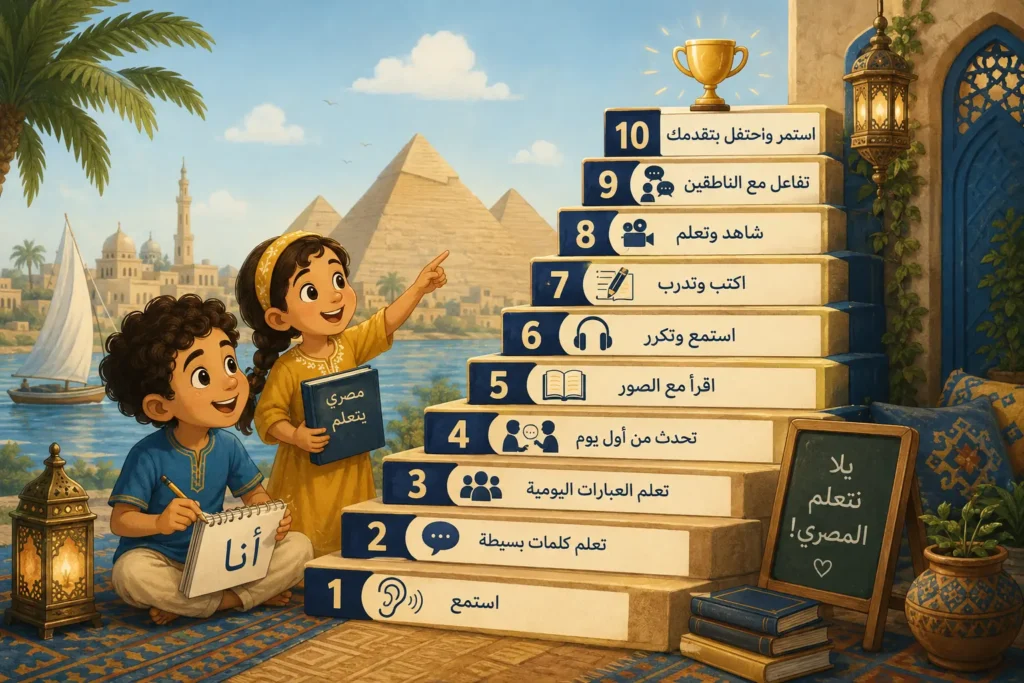
Egyptian Arabic — the dialect spoken by over 100 million people — holds a unique place in the Arab world. Thanks to decades of Egyptian cinema, music, and television, it is the most widely understood spoken Arabic dialect from Morocco to the Gulf.
For families in the UAE raising children with Egyptian heritage, or parents who simply want their children to grow up with real conversational Arabic skills, to learn Egyptian Arabic for kids is one of the most practical starting points imaginable.
Yet learning a dialect with children is fundamentally different from teaching a formal language. Children don’t absorb language through grammar charts. They need rhythm, repetition, stories, play, and — most importantly — emotional connection to the words they hear.
The ten steps below are grounded in both linguistic research and real-world experience with Arabic-speaking children.
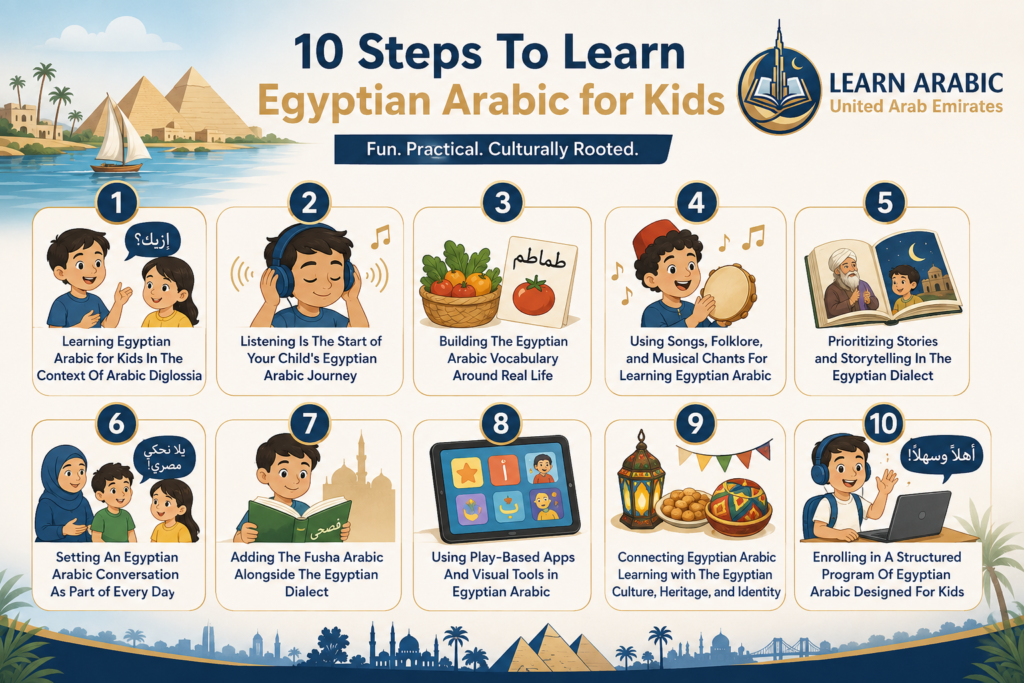
1. Learning Egyptian Arabic for Kids In The Context Of Arabic Diglossia
Before choosing resources or methods, parents and educators need to understand a fundamental feature of Arabic that affects every child’s learning journey. Arabic has two distinct levels — Modern Standard Arabic (Fusha), the formal written form used in education, media, and official contexts, and Ammiya (colloquial dialect), the living spoken form children actually use in daily life.
Linguists call this phenomenon “diglossia”: two versions of a language coexisting, each with its own domain. Research by Arabic literacy specialists, including Dr. Riham Shandy of the Tuta-Tuta initiative, has documented what she calls “the silent suffering” of young children forced to read and learn exclusively in a formal written language that differs significantly from how they speak at home.
For Egyptian Arabic specifically, the gap is pronounced. A child who says “ana gaw’an” (I’m hungry) at home encounters a completely different structure in a formal Arabic textbook. Understanding this from the start helps parents make smarter, more compassionate choices about which resources to use — and when.
Read also: Arabic Writing Practice In The UAE
2. Listening Is The Start of Your Child’s Egyptian Arabic Journey
The ear comes before the mouth. Before a child can speak Egyptian Arabic comfortably, they need hours of passive exposure to how the dialect actually sounds — its soft “g” (جيم) that replaces the classical “j,” its dropped syllables, its distinctive rising intonation in questions, its warmth.
Play Egyptian Arabic audio content during everyday moments: car rides, meals, quiet play. YouTube channels like “KorKor Toon”, “Nononteelly”, and the “Shamsena” initiative offer songs and short content specifically developed for children in Egyptian Arabic.
The “Alam Simsim” (Egyptian Sesame Street) revival, relaunched after viewer numbers dropped when the show switched to formal Arabic, is a testament to how critical dialect-based content is for young children’s engagement and comprehension.
Twenty to thirty minutes of daily listening builds an internal sense of how the dialect flows — before any vocabulary drilling begins.
Help Your Child Speak Arabic Confidently with a FREE Trial Class
3. Building The Egyptian Arabic Vocabulary Around Real Life
Children remember words that matter to them. The first vocabulary clusters for any young learner of Egyptian Arabic should come directly from their world: family members (mama, baba, gedo, teta), animals (otta, batta, samaka), food they eat daily, feelings they experience, and simple directional words (fow’, taht, hena, henak).
Greetings carry particular weight in Egyptian culture and make excellent early anchors: “Izzayak?” (How are you?), “Sabah el kheir” (Good morning), “Tisbah ‘ala kheir” (Good night). These phrases have immediate emotional and social value — children feel the language working in real interactions.
Avoid long abstract word lists. Label objects around the house with sticky notes in Arabic script and transliteration. Make it a game rather than a test. When vocabulary connects to something a child cares about, retention happens naturally.
Structured vocabulary-building approaches that complement this conversational foundation are covered in resources like the best way to Learn Arabic vocabulary guide, which pairs well with dialect-based home practice.
Step Inside Our Classrooms
Don’t just take our word for it—see our community in action. Click below to watch real, live snippets from our recent classes and experience our engaging teaching style firsthand!
Master Arabic in the UAE
Experience world-class Arabic language training designed for students and professionals in the Emirates.
Book Your Free Trial4. Using Songs, Folklore, and Musical Chants For Learning Egyptian Arabic
Egyptian folk music and children’s songs are among the richest in the Arab world — and they are among the most powerful language-learning tools available. Music activates different neural pathways than ordinary speech, making memorized phrases stick far longer.
The “Shamsena” initiative developed children’s songs specifically for skill development alongside traditional folklore. Dar El Shorouk’s classic collection “Zaman w Kol Zaman”, illustrated by Helmy El Touni, features beloved songs like “Baba Gay Emta?” and “Yahya Abu El Fasad” offers rich Egyptian dialect content for different ages.
More recently, Egyptian artist Leila Sami launched “Dandana”, a project producing rhyming musical stories in Egyptian Arabic. Singing along — even imperfectly — is how children internalize rhythm, pronunciation, and vocabulary simultaneously.
Build Your Child’s Arabic Grammar Skills with a FREE Trial Class
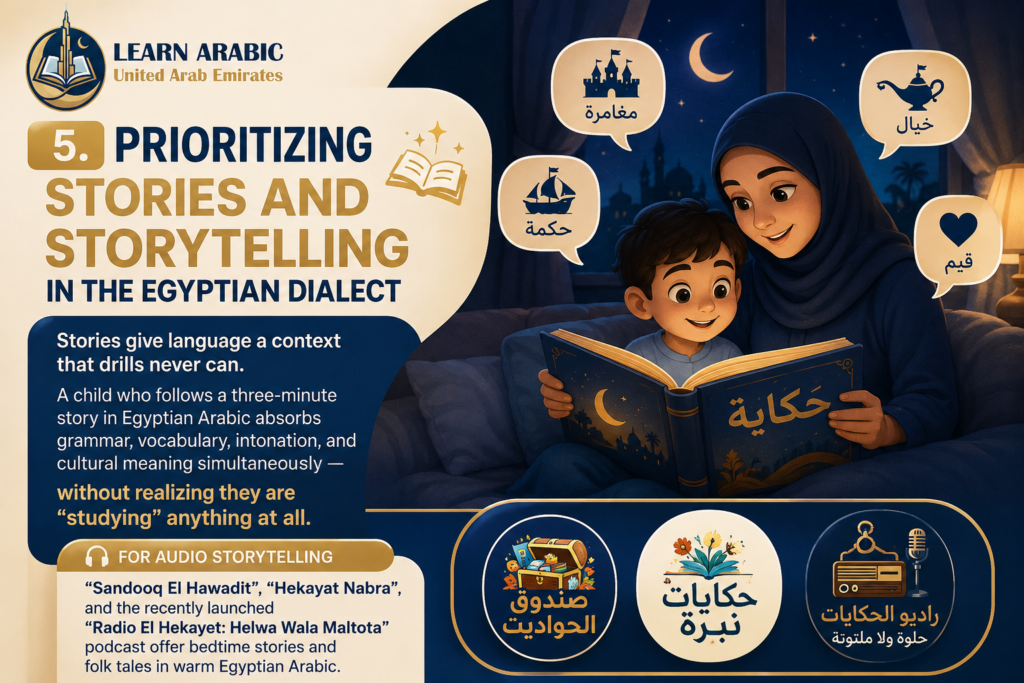
5. Prioritizing Stories and Storytelling In The Egyptian Dialect
Stories give language a context that drills never can. A child who follows a three-minute story in Egyptian Arabic absorbs grammar, vocabulary, intonation, and cultural meaning simultaneously — without realizing they are “studying” anything at all.
Several initiatives have done critical work in this area. The “Tuta-Tuta” initiative, has produced translated stories in Egyptian Arabic and made them freely available on YouTube, alongside research on the challenges children face with formal-only Arabic literacy.
For audio storytelling, “Sandooq El Hawadit”, “Hekayat Nabra”, and the recently launched “Radio El Hekayet: Helwa Wala Maltota” podcast offer bedtime stories and folk tales in warm Egyptian Arabic.
Let children retell stories in their own words. Ask what they understood. The act of speaking about a story — even imperfectly — is where language production begins.
6. Setting An Egyptian Arabic Conversation As Part of Every Day
A child who can recite fifty vocabulary words but cannot say “mafhamtesh, momken te’ed tani?” (I didn’t understand, can you repeat?) is not yet a language user. From the earliest stages, prioritize actual conversation over memorization performance.
Set up small daily conversation rituals entirely in Egyptian Arabic. At breakfast: “‘ayiz eh?” (What do you want?). During play: “da bta’ak walla bta’ti?” (Is this yours or mine?). At bedtime: “tisbah ‘ala kheir” and wait for the response. Create a short daily window — even ten minutes — where both parent and child attempt to communicate only in Egyptian Arabic, mistakes and all.
The goal at this stage is communicative confidence, not grammatical accuracy. Children who feel safe making mistakes speak more, and speaking more is exactly how fluency develops.
Start Your Child’s Journey With Our Experienced Teachers
7. Adding The Fusha Arabic Alongside The Egyptian Dialect
Egyptian Arabic is a spoken dialect — it has no standardized written form. A child who will eventually need to read Arabic books, street signs, or religious texts needs some exposure to Fusha Arabic course as a literacy foundation.
The good news is that children who learn Egyptian Arabic conversationally first often pick up MSA literacy more quickly later, because they already have an intuitive feel for Arabic’s grammatical logic.
This doesn’t mean imposing grammar rules on a five-year-old. The “Kalamna” curriculum offers a thoughtful model: it teaches reading and writing through shared vocabulary between Fusha and the Egyptian dialect, presenting words from the child’s daily life and using phonics to build literacy progressively across five levels.
For families ready to add structured literacy alongside dialect conversation, Modern Standard Arabic Classes provide the formal framework that dialect learning alone cannot — preparing children to read, write, and eventually move fluidly between spoken and written Arabic.
8. Using Play-Based Apps And Visual Tools in Egyptian Arabic
Children between three and ten learn through play above all else. The range of Arabic-language apps and interactive content in Egyptian Arabic has grown considerably, and the best tools engage children through animation, rewards, and short tasks calibrated to their attention spans.
There are many apps that offer Arabic educational content in formats young learners respond to. The “Zallouma” channel by Aisha Sami features drawn stories starring Sina and Zain alongside simple educational videos. “Hawadit Bonbouna” presents world tales in Egyptian Arabic with activities and bedtime stories.
Begin The Course of Arabic for Beginners in the UAE with a Free Trial Class

Read Also: Essential Arabic Vocabulary for Kids
9. Connecting Egyptian Arabic Learning with the Egyptian Culture, Heritage, and Identity
Connecting Egyptian Arabic to culture and identity enriches the learning experience in many ways. The following sections explore the key elements that help children develop a deeper and more lasting connection with the language.
Culture Is A Key Part of Learning Arabic
Language without culture is just a code. Egyptian Arabic carries centuries of humor, warmth, hospitality, and folk wisdom. When a child understands why Egyptians say “ahlan wa sahlan” with such genuine feeling, or why “ibn balad” is among the highest compliments one can offer, the words stop being foreign sounds and become part of how they see themselves and the world.
Bring Egyptian Culture into Everyday Life
Cook Egyptian food together and name the dishes in Arabic. Share traditional Egyptian folk tales from series like Mekook’s “Qesasna El Sha’bia”. Introduce the poetry of Salah Jahin — whose “Ruba’iyyat” were published for children. Discuss Egyptian artists, scientists, and cultural figures your child might find interesting.
The Egyptian Dialect Strengthens The Engagement Of Children
Disney‘s decision to reverse its 2010 switch from Egyptian Arabic to formal Arabic dubbing — after viewership dropped significantly — is itself a telling cultural data point. When children’s content was returned to the Egyptian dialect in 2017, audiences came back. That is how strongly dialect connects to engagement, identity, and comprehension for young viewers.
Read Also: How to Teach Kids Arabic in the UAE?
Master Arabic in the UAE
Experience world-class Arabic language training designed for students and professionals in the Emirates.
Book Your Free TrialRead Also: Top 10 Funny Arabic Activity for Kids in the UAE
10. Enrolling in A Structured Program Of Egyptian Arabic Designed For Kids
Home exposure, apps, and stories can take a child remarkably far. But a qualified teacher brings what no algorithm or playlist can: real-time correction delivered with warmth, structured progression appropriate to the child’s age, and the social dimension of learning alongside other children who share the same journey.
Structured programs also provide accountability — which matters when the initial novelty of a new language begins to fade. For younger learners just starting out, Arabic classes for kindergarten offer an age-appropriate, child-centered environment where Arabic is introduced through the same channels that work at home — games, songs, and stories — guided by teachers experienced in child language acquisition and holding young attention through every lesson.
The decision to pair home immersion with professional instruction is often what separates children who plateau from children who keep growing.
Read Also: The Best 10 Arabic Books For Kids
See Our Classroom Environment in Action
Experience a sneak peek into our live sessions. Watch the video below to see our specialized instructors interacting with students, breakdown complex texts, and cultivate an engaging, respectful learning environment.
Master Arabic in the UAE
Experience world-class Arabic language training designed for students and professionals in the Emirates.
Book Your Free TrialWhy Learn Arabic UAE Gets Results?
Learn Arabic UAE was built on a straightforward conviction: that expert-guided, structured Arabic learning produces faster, deeper, and more lasting outcomes than self-study or passive exposure alone.
The platform serves learners across the UAE — from families with young children taking their first Arabic steps to heritage speakers reconnecting with roots they partly lost — through courses designed for real-world outcomes rather than textbook performance.
For children, the teaching philosophy prioritizes confidence before correctness. Instructors with genuine experience in child language acquisition know how to pace a lesson so a six-year-old stays engaged, how to frame mistakes as steps forward, and how to make a child “want” to speak Arabic — not merely perform it.
Book your free trial class today and start practicing Arabic writing with confidence alongside expert instructors.
Our Arabic courses
- Arabic Course in the UAE
- Arabic Intensive Course
- Arabic Classes for Beginners (Learn Arabic from Scratch)
- Madinah Arabic Course
- Arabic Classes for Adults
- Self-Paced Arabic Course
- Arabic Speaking Classes
- Learn to Write Arabic Course
- Arabic Grammar Course
- Learn Arabic Alphabet Course
- Modern Standard Arabic (MSA) Course
- Quranic Arabic Course
- Fusha Arabic Course
- Classical Arabic Course
- Emirati Arabic Course
- Gulf Arabic Course
- Learn Saudi Arabic
- Business Arabic Course UAE
- Arabic Language Classes for Professionals in UAE
Conclusion
The ten steps above are not a rigid protocol — they are a toolkit. Every child learns differently, and every family’s circumstances are unique. Some children thrive with apps and structured lessons from the start; others absorb language almost entirely through music and stories for months before they begin speaking. Both paths are valid.
What the research and the experience of Arabic educators consistently agree on: consistency and emotional warmth matter more than any single method. Egyptian Arabic, in particular, rewards investment.
Its reach across the entire Arab-speaking world, its richness in expression, its living connection to art, humor, and folk tradition — these make it one of the most rewarding spoken dialects a child can grow up with.
Frequently Asked Questions
At what age should a child start learning Egyptian Arabic?
Children absorb language from infancy through listening and song. Structured learning works well from age three or four onward. Earlier passive exposure — through music and stories — always helps, even before a child can actively engage with lessons.
Is Egyptian Arabic hard for children to learn?
Children are remarkable language learners, especially before age ten when the brain’s language acquisition window is wide open. Egyptian Arabic’s relatively relaxed spoken grammar — compared to classical Arabic — makes it an accessible entry point as a first dialect. The challenge is maintaining consistent exposure, not the complexity of the dialect itself.
Should my child learn Egyptian Arabic or Modern Standard Arabic first?
For conversational fluency with real people, Egyptian Arabic is immediately practical. For reading, writing, and formal education, Modern Standard Arabic is essential. Most families benefit from a blended approach: dialect for speaking and daily communication, Fusha for literacy. Many Arabic educators recommend building conversational comfort first, then adding formal literacy.
How long does it take a child to become conversational in Egyptian Arabic?
With consistent daily exposure of 20–30 minutes, many children reach basic conversational ability within six to twelve months. Full fluency is a longer journey, shaped significantly by how much Arabic the child encounters outside of dedicated learning time — family conversations, media, social interaction.
Can a child learn Egyptian Arabic if neither parent speaks it?
Absolutely. Qualified teachers, rich dialect-specific content, and structured programs can compensate for what isn’t available at home. The parent’s role in this situation is to create the environment and opportunity — sourcing content, keeping the habit consistent, and showing genuine interest in the language themselves.
What is the difference between Egyptian Arabic and Fusha?
Fusha (Modern Standard Arabic or Classical Arabic) is the formal, written form used across the Arab world in education, official media, and religious texts.
Egyptian Arabic is the everyday spoken dialect of Egypt — living, fluid, and shaped by centuries of cultural influence including Coptic, Turkish, French, and Italian. They share vocabulary and grammatical roots but differ substantially in pronunciation, informal structure, and everyday expression.



Leave a Reply