 Learn Arabic
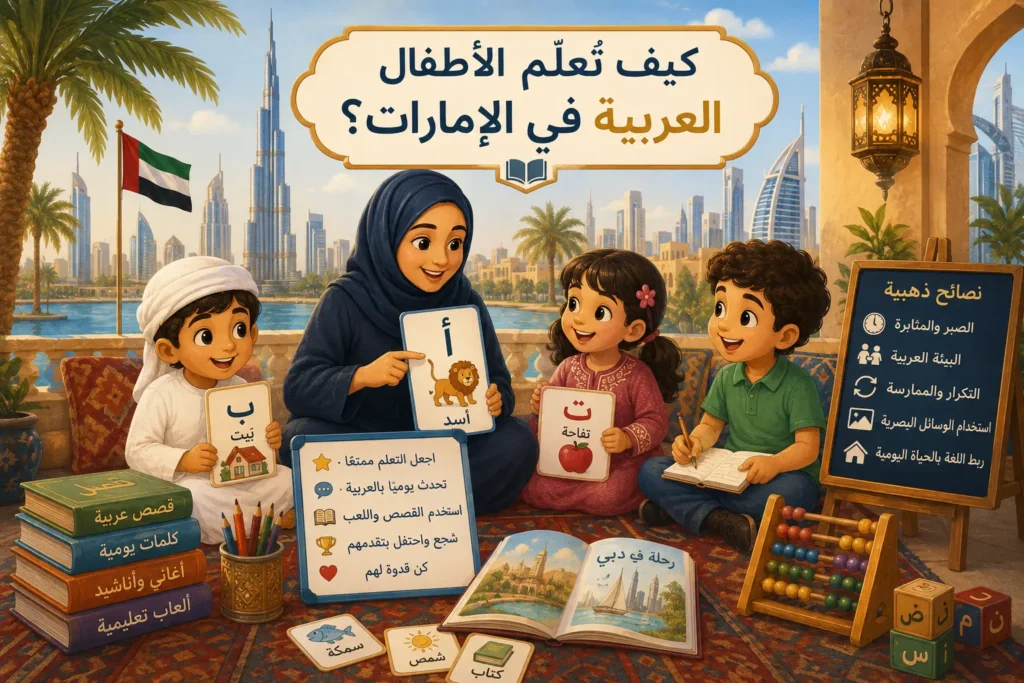
Teaching a child Arabic in the UAE is one of the most rewarding decisions a parent can make — and one of the most misunderstood. Many families start with high hopes, buy a workbook or two, and then quietly abandon the effort when their child loses interest after two weeks. The issue is rarely the child. It is almost always the method.
The UAE is genuinely one of the best environments in the world for children to acquire Arabic. The language is embedded in daily life, government policy mandates Arabic instruction even in private schools and early childhood centres, and a growing ecosystem of structured courses, apps, and community resources supports families at every level.
What children need is a clear, stage-by-stage approach — not a collection of random activities. This guide covers ten concrete, field-tested methods that explain how to teach kids Arabic in the UAE, from building phonemic awareness in toddlers to structured reading fluency for school-age learners.
1. Building Phonemic Awareness Is The First Step Of How To Teach Kids Arabic In The Uae
The single most common mistake parents make is rushing to the alphabet before a child can hear Arabic sounds clearly. Phonemic awareness — the ability to identify, isolate, and manipulate individual sounds in words — is the invisible foundation under every reading skill.
Before your child ever sees a letter, spend two to four weeks on pure sound work. Clap syllables in Arabic words. Play “what sound does this word start with?” using objects around the house.
Sing Arabic alphabet songs that emphasise the sound of each letter, not just its name. Children who can hear the difference between بَ (ba) and پَ before seeing either letter learn to read Arabic three to six months faster than those who jump straight into written characters.
This approach is particularly important in the UAE, where children often grow up in multilingual homes — English, Hindi, Tagalog, or Urdu alongside Arabic. The more sound discrimination practice a child gets early, the faster Arabic letters click into place.
Read also: Hard Arabic Words and Letters to Pronounce: The Advanced Learner’s Complete Guide
2. Teaching Letter Sounds of Arabic, Not Just Letter Names To Your Child
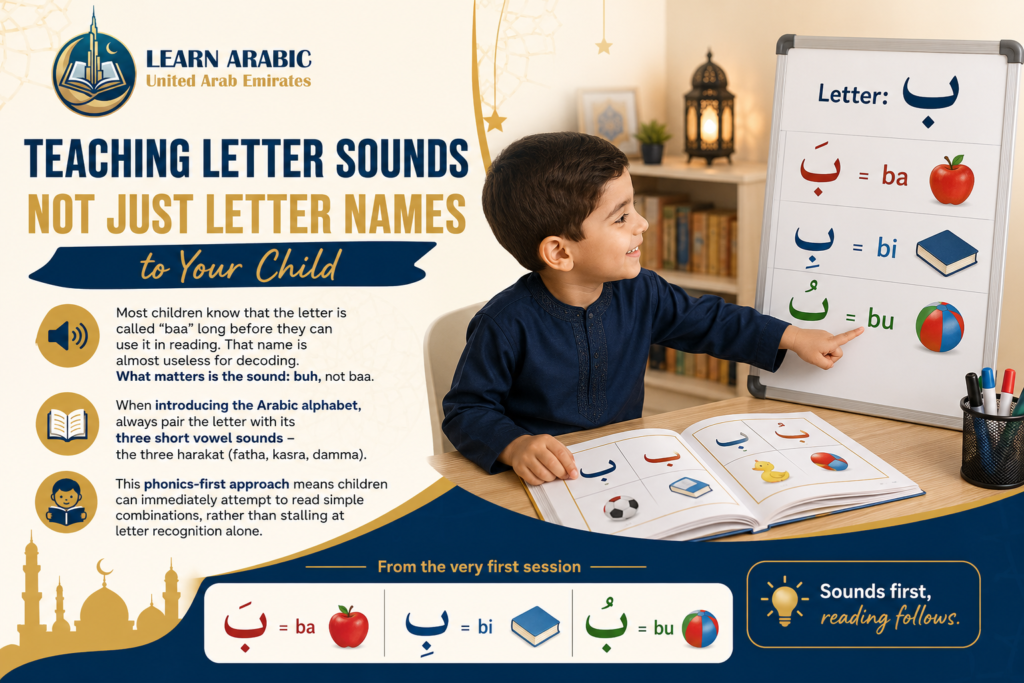
Most children know that the letter is called “baa” long before they can use it in reading. That name is almost useless for decoding. What matters is the sound: buh, not baa.
When introducing the Arabic alphabet, always pair the letter with its short vowel sounds — the three harakat (fatha, kasra, damma). So “baa” becomes بَ بِ بُ (ba, bi, bu) from the very first session. This phonics-first approach means children can immediately attempt to read simple combinations, rather than stalling at letter recognition alone.
A practical technique: use three coloured markers when writing. Red for fatha (ـَ), blue for kasra (ـِ), green for damma (ـُ). The visual distinction reduces confusion significantly for children aged five to eight. Run 10-minute daily drills on combinations like بَ، بِ، بُ — short, consistent, and always ending before the child loses focus.
3. Creating An Arabic Language Environment At Home
Language acquisition happens through environmental saturation, not just scheduled lessons. Children who live surrounded by a language absorb it differently from those who encounter it only during study time.
You do not need to speak Arabic fluently to create this environment. Label household objects with Arabic words on sticky notes: باب (door), كتاب (book), ماء (water), تفاحة (apple). Point to them naturally during the day. Put an Arabic alphabet chart at eye level in the kitchen or bathroom.
Let Arabic songs play during car journeys or meal preparation. These low-effort, high-exposure habits compound over weeks into genuine familiarity.
For families where English is the dominant home language, building a small dedicated education vocabulary in Arabic — words like درس (lesson), كتب (wrote), فهم (understood), سأل (asked) — gives children the academic Arabic they need to engage with school content, not just conversational phrases.
Join Our Fusha Arabic Classes in the UAE with a FREE Trial

4. Connecting Arabic Letters To Words That Children Already Care About
Once your child can recognise most letters and their basic sounds, move to word associations. The goal is to make each letter feel meaningful rather than abstract. Children retain vocabulary three times faster when a letter is attached to a word they can picture and a concept they already love.
Build a personal word wall with your child. Ask them to choose their favourite animal, food, or toy, then find the Arabic word for it. A child who loves cats will remember قِطَّة (qitta) immediately — and with it, the letters ق and ط become memorable anchors.
This stage is also where exposure to beautiful Arabic words can spark genuine curiosity. Words like نُور (light), سَلام (peace), or حُب (love) are short, phonetically clear, and carry meaning that resonates with young children. When Arabic feels like a language of beauty rather than a subject to endure, motivation sustains itself.
Step Inside Our Classrooms
Don’t just take our word for it—see our community in action. Click below to watch real, live snippets from our recent classes and experience our engaging teaching style firsthand!
Master Arabic in the UAE
Experience world-class Arabic language training designed for students and professionals in the Emirates.
Book Your Free Trial5. Using The Syllable-Building Method In Arabic To Move From Letters To Words
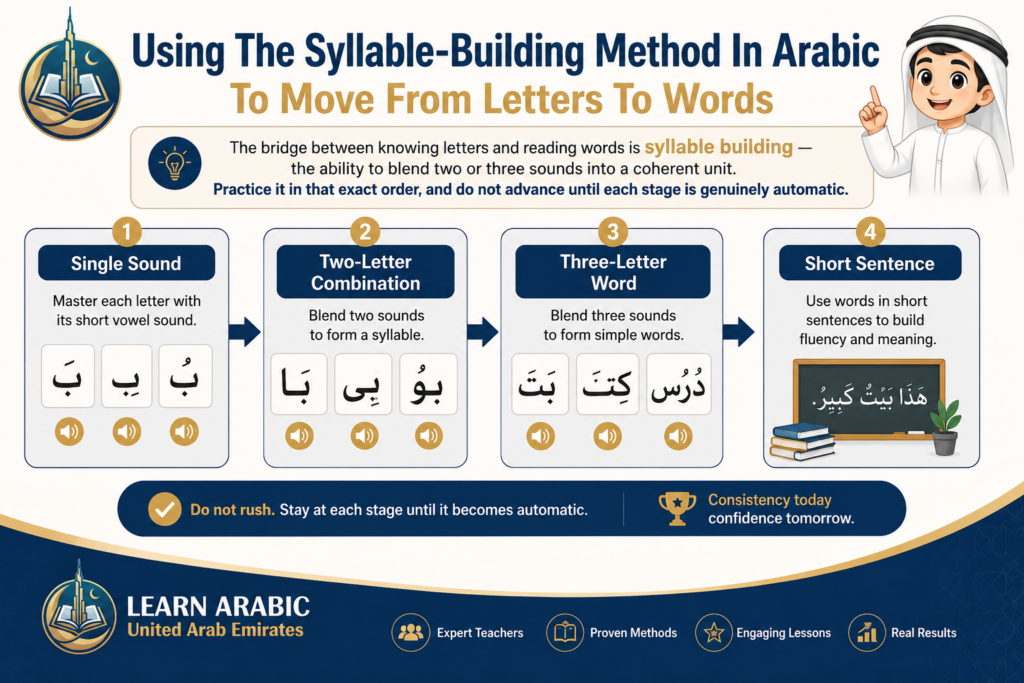
The bridge between knowing letters and reading words is syllable building — the ability to blend two or three sounds into a coherent unit. This is where many home-teaching efforts stall, because parents either skip this stage or rush through it.
The sequence is: single sound → two-letter combination → three-letter word → short sentence. Practice it in that exact order, and do not advance until each stage is genuinely automatic.
Start with simple three-letter words with short vowels: كَتَبَ (he wrote), دَرَسَ (he studied), فَتَحَ (he opened). These verb forms are perfect for beginners because every letter is pronounced and the vowel marks are written. Avoid unvowelled text entirely until your child reads vowelled Arabic fluently — typically 12 to 18 months into consistent instruction.
6. Reading Arabic Picture Books With Child Every Day
Ten minutes of daily shared reading with a vowelled Arabic picture book does more for reading development than an hour of worksheets once a week.
The research across multiple languages is consistent on this point — daily read-alouds build vocabulary, develop listening comprehension, and create positive emotional associations with books that sustain long-term reading habits.
In the UAE, Arabic picture books are widely available in bookshops across Dubai and Abu Dhabi, and online libraries like Noorani Qaida series and graded readers from I Love Arabic give families structured progression paths.
Take turns reading. When your child is ready, let them read a word, then a sentence, then a paragraph. Ask questions mid-story: “What do you think happens next?” “Why did the character do that?” This oral comprehension practice runs ahead of formal reading skills and gives children something to read toward, not just through.
Parents who want to support their children in also beginning to learn Quranic vocabulary alongside general Arabic reading find that familiar short surahs — Al-Ikhlas, Al-Falaq, An-Nas — serve as ideal phonics practice texts. They are fully vowelled, short, and words the child already knows by sound.
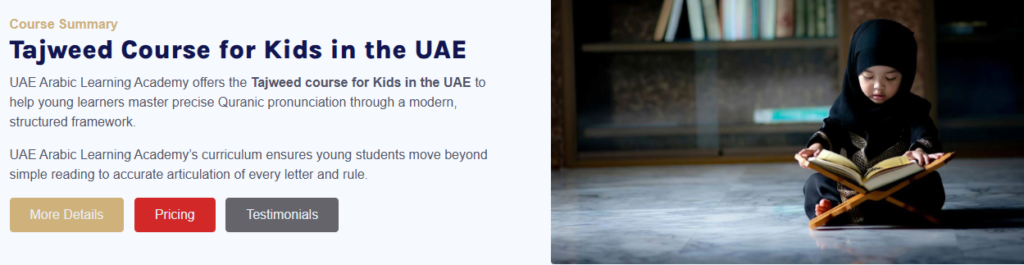
Let your child start his journey with Tajweed Course for Kids in the UAE
7. Gamifying Arabic Learning To Keep Your Child Motivated
Children do not disengage from Arabic because Arabic is hard. They disengage because practice starts to feel like a test. Games solve this problem by maintaining exposure while removing the performance anxiety that blocks acquisition. Effective games do not require special materials:
A. Letter Hunt
Open any vowelled Arabic text, call out a letter sound, and race to find it. Works from age four.
B. Syllable Build
Write letter-vowel combinations on separate cards and ask your child to arrange them into a word.
C. Read and Draw
Child reads a vowelled word and draws its meaning. Best with concrete nouns like كَلْب (dog) or بَيْت (house).
D. Arabic Memory
Match game with letter cards on one side and picture cards on the other. Keep game sessions under ten minutes and always follow a short structured lesson rather than replace it. Games reinforce; they do not introduce new material effectively.
Build a Strong Foundation in Classical Arabic with a FREE Trial Class

Read Also: Daily Routine In Arabic For Kids
8. Using Structured Digital Arabic Platforms
The UAE’s digital infrastructure makes it genuinely easy to supplement home learning with high-quality Arabic apps and online platforms. The key word is supplement — no app replaces a qualified teacher, but several do an excellent job reinforcing what has been taught.
Platforms worth considering for children aged four to nine include Arabic phonics apps that use the letter-sound approach, interactive alphabet tracing programmes, and animated YouTube channels that map to you how to teach a child to read Arabic free through story and song rather than drilling.
The platform أ ب ت (Alefbata), launched in 2026, offers over a thousand graded exercises for children aged four to nine, with games, stories, and interactive worksheets covering everything from letter recognition to basic grammar — and it is structured for teachers as well as parents.
When evaluating any digital tool for your child, check three things: Does it teach sounds or just names? Does it use full vowel marks on text? Does it progress systematically, or jump randomly between topics.
Read Also: 10 Interesting Easy Arabic Stories For Kids
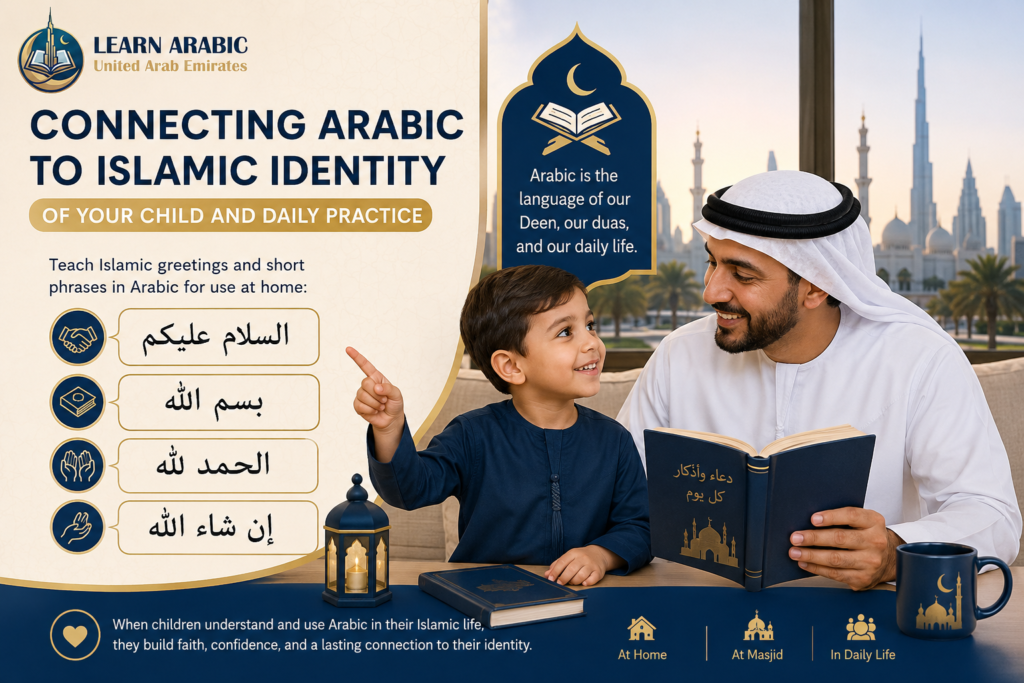
9. Connecting Arabic To Islamic Identity Of Your Child And Daily Practice
In the UAE context, Arabic and Islam are deeply intertwined for Muslim families. This connection is one of the most powerful motivational forces available — and one of the most underused in structured Arabic teaching.
A child who understands that the Quran was revealed in Arabic, that the daily prayer is performed in Arabic, and that the Prophet Muhammad ﷺ spoke Arabic develops an intrinsic reason to learn that no external reward can match. Frame Arabic learning in this context from the beginning.
Teach Islamic greetings and short phrases in Arabic for use at home: السلام عليكم, بسم الله, الحمد لله, إن شاء الله. These high-frequency phrases appear constantly in UAE daily life, so children encounter them outside the home and begin to recognise their written forms naturally.
For families looking to go deeper, learning Quranic vocabulary early gives children meaningful comprehension of surahs they already recite — which transforms rote memorisation into genuine understanding.
Read Also: Essential Arabic Vocabulary for Kids
Read Also: Top 10 Funny Arabic Activity for Kids in the UAE
10. Enrolling In A Structured Arabic Course with Qualified Instructor
Home practice and digital tools take children a considerable distance. But the single most common reason children plateau or develop bad pronunciation habits is the absence of a qualified teacher who can hear mistakes in real time and correct them before they become ingrained.
Arabic has phonemes that do not exist in English, French, Hindi, or most other languages — ع, غ, خ, ح, ص, ض, ط, ظ. These are not learned by watching videos. They are learned through imitation of a qualified native speaker who models the correct articulation and gives immediate feedback. A child who mispronounces خ as “k” for six months will need active remediation to correct it. A child who is corrected in session three never forms the habit.
Structured courses also provide something else no app can: curriculum sequence. A good Arabic course for kids maps exactly how to teach a child to read Arabic, when, and in what order — so parents are not guessing whether their child is ready to move from letters to syllables, or from syllables to short sentences.
Read Also: 10 Steps To Learn Egyptian Arabic for Kids
See Our Classroom Environment in Action
Experience a sneak peek into our live sessions. Watch the video below to see our specialized instructors interacting with students, breakdown complex texts, and cultivate an engaging, respectful learning environment.
Master Arabic in the UAE
Experience world-class Arabic language training designed for students and professionals in the Emirates.
Book Your Free TrialRead Also: The Best 10 Arabic Books For Kids
How Learn Arabic UAE Helps Families Teach Their Children Arabic?
Learn Arabic UAE offers a structured range of Arabic courses designed for learners at every stage — from children taking their first steps with the alphabet to adults pursuing professional or Quranic fluency. For families in the UAE specifically, the curriculum is built around the real challenges of Arabic acquisition in a multilingual environment, with qualified instructors who understand what children at each age genuinely need.
Whether your child is four years old and just discovering the alphabet, or nine years old and ready to read simple Arabic sentences, the structured pathway at Learn Arabic UAE removes the guesswork from the teaching process.
Courses available for children and families include:
- Arabic Classes for Kids in the UAE
- Arabic Classes for Beginners — Learn Arabic from Scratch
- Learn Arabic Alphabet Course
- Emirati Arabic Course
- Arabic Grammar Course
- Modern Standard Arabic (MSA) Course
- Learn to Write Arabic Course
- Arabic Grammar Course
- Arabic Course in the UAE
- Arabic Intensive Course
- Madinah Arabic Course
- Learn Arabic Alphabet Course
- Fusha Arabic Course
Book your child’s first free trial Arabic session with Learn Arabic UAE and put the ten methods in this article into the hands of a qualified instructor who will apply them systematically, correct pronunciation from day one, and build the foundation that home practice alone cannot fully establish.

Conclusion
Teaching children Arabic in the UAE is more achievable than most parents initially believe — and more consequential than many realise. Arabic is not just a school subject in this country. It is the language of the Quran, the language of the culture your child lives in, and a lifelong cognitive and professional asset.
The ten methods in this guide follow a deliberate sequence: sound awareness first, then letters, then syllables, then words, then sentences, then fluent reading. Rushing that sequence is the most common reason children plateau. Following it — even imperfectly, even slowly — produces real, durable results.
Two things matter more than any specific method: consistency and quality correction. Ten minutes of Arabic every day outperforms an hour once a week. A qualified teacher who hears pronunciation errors outperforms any app that cannot.
When you combine a structured daily habit at home with expert instruction from a qualified course, children in the UAE have every advantage they need to become confident, capable Arabic readers.
Frequently Asked Questions
What is the right age to start teaching a child Arabic in the UAE?
Children can begin Arabic exposure as early as birth through songs, rhymes, and daily phrases. Structured letter instruction works best from age four to five, when children have the attention span and fine motor skills to engage consistently.
How long does it take a child to learn to read Arabic?
Most children with 10–15 minutes of daily structured practice reach fluent vowelled Arabic reading within 12 to 18 months of starting from zero. Progress depends on three factors: regularity of practice, quality of instruction, and prior exposure to Arabic sounds at home.
Can I teach my child Arabic at home if I don’t speak Arabic myself?
Yes — with limits. Parents can build a strong Arabic environment, support daily practice with flashcards and picture books, and reinforce what a teacher has taught. However, pronunciation correction requires a qualified native speaker. Children who learn sounds incorrectly at home often need remediation later.
Is Modern Standard Arabic (MSA) or dialect better for children in the UAE?
For children in the UAE, Modern Standard Arabic is the correct starting point. It is the language of school instruction, the Quran, and formal communication. Emirati Arabic dialect is a valuable addition — especially for social integration — but it builds more naturally through daily life exposure rather than formal instruction. Start with MSA, add dialect exposure through the environment.
What is the biggest mistake parents make when teaching children Arabic?
Teaching letter names without letter sounds. A child who can recite “alif, baa, taa” from memory but cannot blend بَ + يْ + ت into بَيْت (bayt) cannot read. The phonics-first approach — teaching each letter with its short vowel sounds from the very first session — is the single most important structural shift parents can make.
How do I keep my child motivated to learn Arabic long-term?
Connect Arabic to what your child already loves. Quranic recognition thrills Muslim children who already memorise surahs. Games and competition sustain younger children. For older learners, showing them how to understand how to introduce yourself in Arabic or decode signs they see every day in the UAE gives Arabic immediate, visible usefulness. Celebrate every milestone — a new letter mastered, a first word read, a first sentence decoded — because momentum is motivation.
Related Articles
Learn Arabic




Leave a Reply