 Learn Arabic

Have you ever stared at an Arabic word, confidently read every letter, and still walked away completely unsure if you pronounced it correctly? You’re not alone. Arabic pronunciation is one of the most underestimated challenges for learners at every level — not because Arabic is unpredictable, but because it contains sounds that simply do not exist in English, combined with word structures that can pack an entire sentence into a single written form.
The hard Arabic words to pronounce aren’t just long words. They are phonetically demanding, morphologically complex, and often carry significant weight in formal, literary, or academic contexts. Mastering them is the difference between functional Arabic and genuinely fluent Arabic.
This guide breaks down exactly which words advanced learners struggle with most, why they’re difficult, and the practical techniques that help you get them right.
What you’ll learn in this article:
- Why certain Arabic words are harder to pronounce than others — and the linguistic reason behind it
- The hardest Arabic sounds for English speakers, with practical guidance for each
- Curated tables of advanced vocabulary that advanced learners consistently find difficult
- What the longest Arabic word is — and how to actually read it
- How to build a pronunciation habit that makes these words feel natural
Why Are Hard Arabic Words to Pronounce So Difficult for English Speakers?
Arabic pronunciation difficulty doesn’t come from randomness — it comes from articulation points that English never trained your mouth to use.
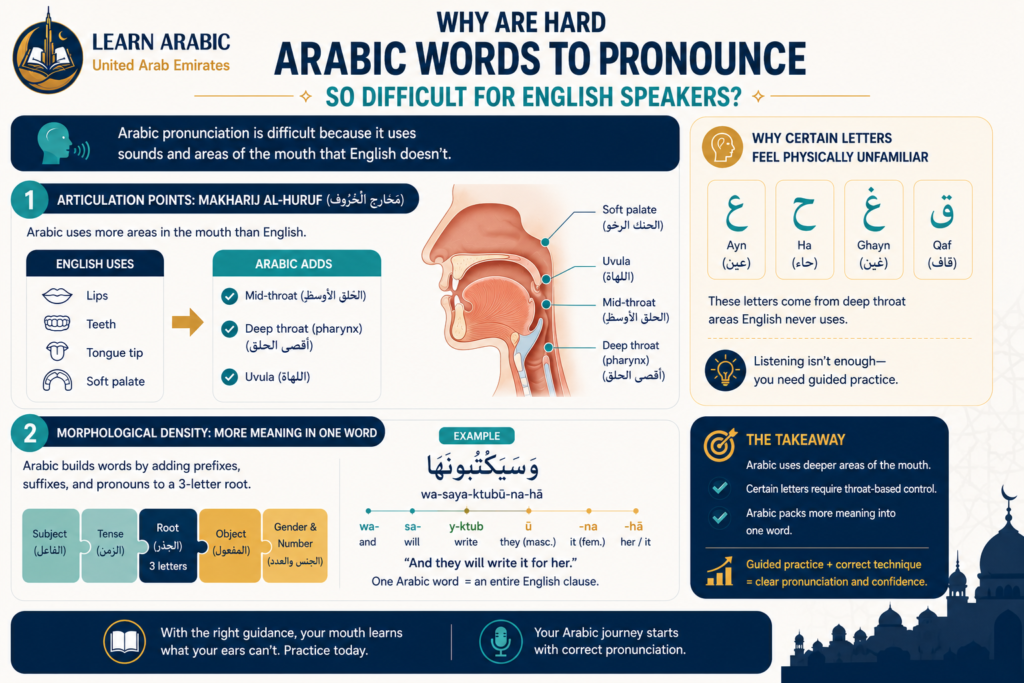
Every Arabic letter is produced at a specific point in the vocal tract, a system known as makharij al-huruf (مَخَارِج الْحُرُوف). English uses the lips, teeth, tongue tip, and soft palate. Arabic adds the mid-throat, the deep throat (pharynx), and the uvula — zones that English speakers literally never engage when speaking their native language.
This is why words containing ع (Ayn), ح (Ha), غ (Ghayn), or ق (Qaf) feel physically unfamiliar, not just aurally strange. The mouth is being asked to move in ways it has never moved before. No amount of listening alone fixes this — it requires deliberate, guided articulation practice.
The second layer of difficulty is morphological density. Arabic builds long, complex words by stacking prefixes, suffixes, and pronoun attachments onto a three-letter root. A single word can encode subject, object, tense, gender, and number simultaneously — which is why some Arabic words translate as entire English sentences.
The Hardest Arabic Sounds for English Speakers
Before tackling hard words, you need a clear picture of which individual letters cause the most pronunciation problems. These are the sounds that make otherwise readable words fall apart in practice.
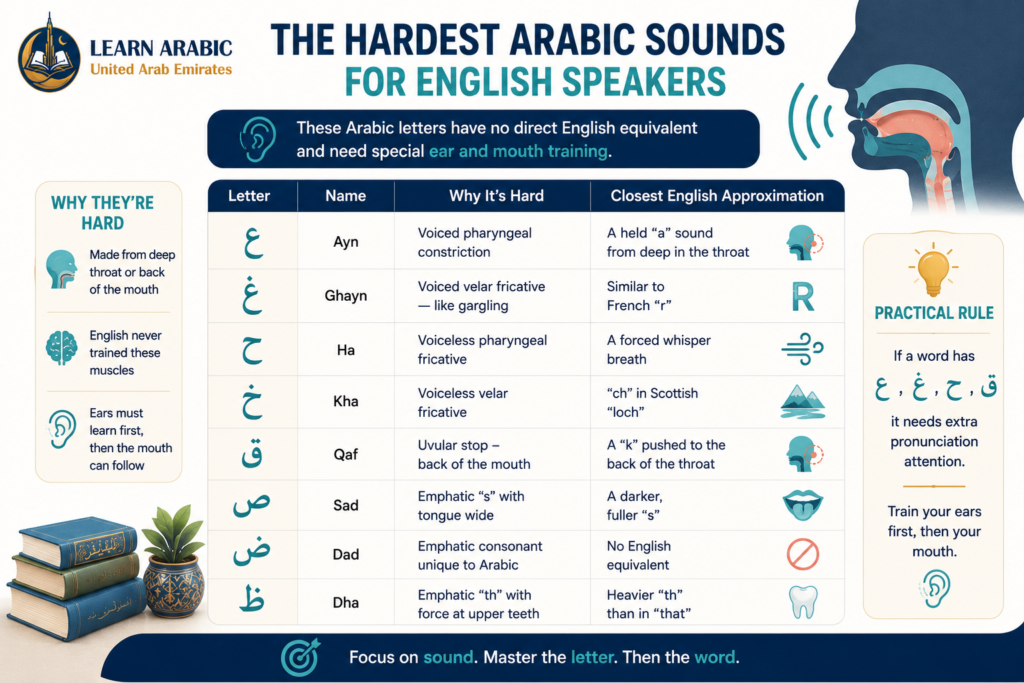
The following letters have no direct English equivalent and require active ear and mouth training:
| Letter | Name | Why It’s Hard | Closest English Approximation |
| ع | Ayn | Voiced pharyngeal constriction — no English equivalent | A held “a” sound produced deep in the throat |
| غ | Ghayn | Voiced velar fricative — like gargling | Similar to French “r” |
| ح | Ha | Voiceless pharyngeal fricative | A forced whisper breath, deeper than English “h” |
| خ | Kha | Voiceless velar fricative | “ch” in Scottish “loch” |
| ق | Qaf | Uvular stop — produced at the very back of the mouth | A “k” sound pushed to the back of the throat |
| ص | Sad | Emphatic “s” with tongue pressed wide | A darker, fuller “s” |
| ض | Dad | Emphatic consonant unique to Arabic | No English equivalent exists |
| ظ | Dha | Emphatic “th” with force at the upper teeth | Heavier than “th” in “that” |
A practical rule: if a word contains ع, غ, ح, or ق, assume it will require dedicated pronunciation attention — not just reading practice. The ears must train before the mouth can follow.
If you want structured pronunciation guidance from qualified Arabic instructors, the Arabic tutors offer live one-on-one sessions specifically built around sound correction.
Start Learning with the Best Online Arabic Tutors in the UAE

Read more: Body Parts in Arabic for Kids
Hard Arabic Words to Pronounce: Intermediate to Advanced Vocabulary
These words appear frequently in formal Arabic conversations, literature, and media. They are tricky not just because of length, but because of the phonetic sounds embedded within them and the complexity of their root-based structure.
The following vocabulary is particularly valuable for advanced learners aiming to move beyond everyday conversation:
| Arabic Script | Transliteration | English Translation |
| مُتَسَلْسِل | mutasalsil | sequential |
| مُتَنَاقِض | mutanaqiḍ | contradictory |
| مُتَضَامِن | mutaḍamin | solidarity |
| مُتَطَوِّر | mutatawwir | developed |
| مُتَجَانِس | mutajānis | homogenous |
| مُتَشَابِه | mutashabih | similar |
| مُتَكامِل | mutakāmil | integrated |
| مُسْتَقِلّ | mustaqill | independent |
| مُؤَثِّر | mu’athirr | influential |
| مُعْتَدِل | mu’tadil | moderate |
| مُرْتَفِع | murtafi’ | high |
| مُنْخَفِض | munkhafiḍ | low |
Notice how many of these begin with the prefix مُ (mu-) — this is the ism al-fā’il (active participle) pattern, one of the most productive patterns in Arabic morphology. Learning to recognize it unlocks dozens of words at once.
Read more: Learn Quranic Vocabulary
See Our Classroom Environment in Action
Experience a sneak peek into our live sessions. Watch the video below to see our specialized instructors interacting with students, breakdown complex texts, and cultivate an engaging, respectful learning environment.
Master Arabic in the UAE
Experience world-class Arabic language training designed for students and professionals in the Emirates.
Book Your Free TrialAdvanced Arabic Vocabulary Most Learners Struggle to Pronounce
The next tier of hard Arabic words to pronounce includes terms from academic, political, legal, and analytical contexts. These words appear in news media, university discourse, and formal writing — and they demand precise pronunciation to be understood correctly.
These are 30 words that consistently challenge advanced learners, organized here with full transliteration for pronunciation reference:
| Arabic Script | Transliteration | English Translation |
| استمتاع | Istimtā’ | Enjoyment |
| استغلال | Istighlāl | Exploitation |
| مصطلحات | Muṣṭalaḥāt | Terminologies |
| استكشافية | Istikshāfiyyah | Exploratory |
| استثنائية | Istithnā’iyyah | Exceptional |
| استقلالية | Istiqlāliyya | Independence |
| إحصائية | Iḥṣā’iyya | Statistical |
| استيعابية | Isti’ābiyya | Comprehensive |
| استمرارية | Istimrāriyya | Continuity |
| مستعصية | Musta’ṣiya | Intractable |
| متشظية | Mutashaẓẓiyya | Fragmented |
| استفسار | Istifsār | Inquiry |
| استقراء | Istiqrā’ | Induction |
| تضارب | Taḍārub | Conflict (of information) |
| مسايرة | Musāyara | Conformity |
| التزام | Iltizām | Commitment |
| تمويه | Tamwīh | Camouflage |
| تقنيني | Taqnīnī | Legislative |
| تصفيق | Taṣfīq | Applause |
| استفزاز | Istifzāz | Provocation |
| انتهازية | Intihāziyya | Opportunism |
| استحقاق | Istiḥqāq | Deserving |
| انعكاس | In’ikās | Reflection |
| استدراك | Istidrāk | Correction |
| ارتباك | Irtibāk | Confusion |
| استعلاء | Isti’lā’ | Arrogance |
| استنساخ | Istinsākh | Cloning |
| استشفاء | Istishfā’ | Healing |
| انسجام | Insijām | Harmony |
| استحالة | Istihāla | Impossibility |
A pattern worth noting: many of the most difficult words in this list begin with استـ (Ista-), the Form X verb pattern. This pattern consistently produces long, complex words because it encodes the meaning of “seeking” or “requesting” — and it appears across every domain of formal Arabic. Mastering the Form X sound pattern alone will make many of these words feel immediately more manageable.
If your goal is to read and understand Modern Standard Arabic at this level, the MSA course provides structured instruction in formal vocabulary and grammar with qualified instructors.
Begin Your Modern Standard Arabic Journey with a FREE Trial Class

A Second Set of High-Difficulty Words for Advanced Practice
Here are an additional 30 words that advanced learners encounter in professional and academic Arabic, each presenting its own phonetic or structural challenge:
| Arabic Script | Transliteration | English Translation |
| استطراد | Istitrād | Digression |
| مستهجن | Mustahjan | Abhorrent |
| استيراد | Istirād | Import |
| استفهام | Istifhām | Questioning |
| استعانة | Isti’āna | Seeking help |
| انطواء | Inṭiwā’ | Isolation |
| انقسام | Inqiṣām | Division |
| احترافية | Iḥtirāfiyya | Professionalism |
| استجابة | Istijāba | Response |
| اعتزاز | I’tizāz | Pride |
| استدراك | Istidrāk | Correction |
| استكانة | Istikāna | Submission |
| استثمار | Istithmār | Investment |
| استيلاء | Isti’lā’ | Seizure |
| استحداث | Istiḥdāth | Innovation |
| اكتشاف | Iktishāf | Discovery |
| اقتحام | Iqtiḥām | Invasion |
| استعراض | Isti’rāḍ | Review |
| استيعاب | Isti’āb | Absorption |
| استدلال | Istidlāl | Reasoning |
| مشروطية | Mashrūṭiyya | Conditionality |
| انبعاثية | Inbi’āthiyya | Emission |
| تطهير | Taṭhīr | Purification |
| مبادرة | Mubādara | Initiative |
| مفاوضات | Mufāwaḍāt | Negotiations |
| مشاركة | Mushāraka | Participation |
| مقاومة | Muqāwama | Resistance |
| معالجة | Mu’ālaja | Treatment |
| محاولة | Muḥāwala | Attempt |
| مساهمة | Musāhama | Contribution |
For learners in the UAE specifically targeting spoken fluency alongside formal vocabulary, the Saudi Arabic course bridges the gap between formal MSA and regionally spoken Arabic — a combination that matters significantly in Gulf professional environments.
Start Learning Saudi Arabic in the UAE with a FREE Trial Class

Read more: Famous Arabic Quotes About Life and Success
What Is the Hardest Word in Arabic?
The single hardest word in Arabic to pronounce — by both length and phonetic density — is a matter of genuine debate among Arabic linguists, but the longest word in the Arabic dictionary is well established.
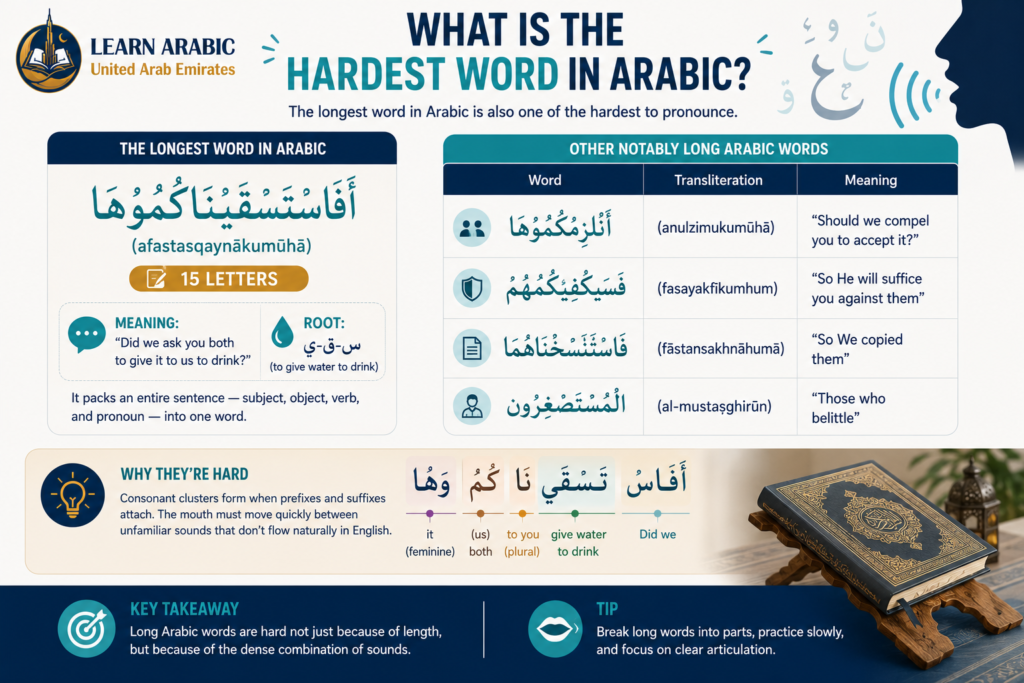
The longest word in Arabic is أَفَاسْتَسْقَيْنَاكُمُوهَا (afastasqaynākumūhā), composed of 15 letters. It translates to: “Did we ask you both to give it to us to drink?” The word is built on the root س-ق-ي (to give water to drink) and packages an entire sentence — subject, object, verb, and pronoun — into a single morphological unit.
Other notably long Arabic words that demonstrate this same sentence-in-a-word phenomenon include the following:
- أَنُلْزِمُكُمُوهَا (anulzimukumūhā) — “Should we compel you to accept it?”
- فَسَيَكْفِيكُمُهُمْ (fasayakfīkumhum) — “So He will suffice you against them”
- فَاسْتَنْسَخْنَاهُمَا (fāstansakhnāhumā) — “So We copied them”
- الْمُسْتَصْغِرُون (al-mustaṣghirūn) — “Those who belittle”
What makes these words genuinely hard to pronounce — beyond length — is the consonant clusters that form where prefixes and suffixes attach. When كُمُ (you, plural) and وهَا (it, feminine) stack onto an already-long verb, the mouth must transition rapidly through sounds that don’t naturally flow from one to the next in English phonology.
Step Inside Our Classrooms
Don’t just take our word for it—see our community in action. Click below to watch real, live snippets from our recent classes and experience our engaging teaching style firsthand!
Master Arabic in the UAE
Experience world-class Arabic language training designed for students and professionals in the Emirates.
Book Your Free TrialBegin Mastering Hard Arabic Words with Expert Instruction in the UAE
UAE Arabic Learning Academy helps children master difficult Arabic pronunciation through structured online lessons taught by native Azhari-trained tutors. Instead of simply memorizing vocabulary, students develop accurate pronunciation through guided practice, personalized feedback, and engaging activities that make learning Arabic enjoyable and effective from the very first lesson.
- Native Arab Azhari-trained tutors with expertise in teaching children
- Step-by-step pronunciation practice for difficult Arabic words and sounds
- Interactive online lessons that build speaking confidence
- Personalized feedback in every class
- Flexible schedules for families across all UAE emirates
- Free trial lesson available
Book your child’s free trial lesson today and start building clear, confident Arabic pronunciation.

Our Arabic courses
- Arabic Course in the UAE
- Arabic Intensive Course
- Arabic Classes for Beginners (Learn Arabic from Scratch)
- Madinah Arabic Course
- Arabic Classes for Adults
- Self-Paced Arabic Course
- Arabic Speaking Classes
- Learn to Write Arabic Course
- Arabic Grammar Course
- Learn Arabic Alphabet Course
- Modern Standard Arabic (MSA) Course
- Quranic Arabic Course
- Fusha Arabic Course
- Classical Arabic Course
- Emirati Arabic Course
- Gulf Arabic Course
- Learn Saudi Arabic
- Business Arabic Course UAE
- Arabic Language Classes for Professionals in UAE
Master Arabic in the UAE
Experience world-class Arabic language training designed for students and professionals in the Emirates.
Book Your Free TrialConclusion
Hard Arabic words to pronounce are hard for specific, explainable reasons: sounds that require new articulation points, morphological patterns that compress entire sentences into single words, and formal vocabulary that doesn’t appear in casual daily conversation. None of these challenges are permanent — they respond to structured practice.
The key takeaway is this: pronunciation difficulty in Arabic is almost always a phonetic muscle problem, not an intelligence problem. The sounds ع, ح, غ, and ق simply don’t exist in English, so your vocal tract has never been trained to produce them. Targeted, guided practice with a qualified instructor — not just more listening — is what bridges that gap.
Advanced Arabic is genuinely within reach. The words in this article are the proof: concrete, learnable, and enormously rewarding once they sit naturally in your speech.
FAQs About Hard Arabic Words to Pronounce
Mastering difficult Arabic pronunciation takes time, but understanding the reasons behind these challenges makes the learning process much easier. Below are answers to the most common questions learners ask about hard Arabic words to pronounce and how to practice them effectively.
What makes Arabic words hard to pronounce for English speakers?
Arabic contains sounds produced in the throat and at the back of the mouth — specifically ع (Ayn), ح (Ha), غ (Ghayn), and ق (Qaf) — that have no equivalent in English. These sounds require articulation from zones English speakers never use in daily speech. Without deliberate phonetic training, these sounds are substituted with the nearest English approximation, which distorts both pronunciation and meaning.
What is the hardest Arabic sound to pronounce?
Most English-speaking learners find ع (Ayn) the hardest Arabic sound to master. It is a voiced pharyngeal constriction produced deep in the throat with no English counterpart whatsoever.
ح (Ha) and غ (Ghayn) follow closely, for the same reason — both require throat-based articulation that feels entirely unnatural for English speakers until the muscle memory is built deliberately.
Why are long Arabic words structured differently from long English words?
Arabic builds long words through a root-and-pattern system rather than compounding separate words. A three-letter root carries a core meaning, and prefixes, suffixes, and verb patterns stack onto it — encoding tense, subject, object, and more into a single word. This is why أَفَاسْتَسْقَيْنَاكُمُوهَا translates as an entire English sentence rather than simply a “long noun.”
How can I practice hard Arabic words without reinforcing bad pronunciation habits?
The most effective method is audio-first: hear the correct pronunciation from a qualified native instructor before attempting the word yourself. Practicing from written transliteration alone often reinforces mispronunciation because English letter combinations don’t map cleanly onto Arabic sounds. Regular sessions with a live instructor who can correct errors in real time is significantly more effective than independent listening practice.
Are hard Arabic words more common in formal or spoken Arabic?
The most phonetically complex and structurally dense Arabic words appear primarily in Modern Standard Arabic (MSA) — used in formal writing, news media, academic texts, and official settings. Spoken dialects tend toward shorter, simpler word forms. This is why learners who focus exclusively on colloquial Arabic sometimes find formal Arabic texts surprisingly difficult even after years of study.
How long does it take to pronounce hard Arabic words accurately?
For sounds like ع and ح, most English-speaking adults see measurable improvement within four to eight weeks of consistent, corrected practice — meaning three to five sessions per week with real-time feedback. Full naturalization of these sounds into spontaneous speech typically takes three to six months of regular use. The timeline shortens considerably with live instructor correction versus self-study.



Leave a Reply