 Learn Arabic

Quranic vocabulary is learnable systematically, and faster than most UAE students expect. The Quran uses a relatively compact core vocabulary — around 1,750 unique root words — with heavy repetition of a much smaller high-frequency set.
A focused learner who prioritizes the right words in the right sequence can read and understand large portions of the Quran within months, not years.
This guide gives you a concrete, sequenced method for building Quranic vocabulary — covering frequency-first selection, root-based learning, spaced repetition, contextual immersion, and the structured instruction that makes all of it stick faster.
1. Start with the Highest-Frequency Quranic Words First
The single most effective decision you can make when learning Quranic vocabulary is to begin with the words that appear most often — not the most interesting, not the first words in Al-Fatiha, but the most statistically frequent across the entire Quran.
A small set of Quranic words carries an outsized share of the Quran’s total word count. Mastering the top 100–150 most frequently occurring words gives a learner the ability to recognize familiar anchors in almost every Ayah they encounter.
That recognition is what makes listening and reading feel achievable rather than overwhelming.
The Core High-Frequency Quranic Word List
Here are the foundational high-frequency words every Quranic Arabic student should prioritize:
- اللَّه (Allāh) — God; most frequent proper noun in the Quran
- رَبّ (Rabb) — Lord, Sustainer
- قَالَ (qāla) — he said; one of the most common narrative verbs
- إِنَّ (inna) — indeed, verily; introduces emphasis
- الَّذِينَ (alladhīna) — those who; introduces relative clauses
- آمَنَ / يُؤْمِنُ (āmana / yu’minu) — to believe / he believes
- عَمِلَ (ʿamila) — to do, to act
- الصَّالِحَاتِ (al-ṣāliḥāt) — righteous deeds
- يَوْم (yawm) — day
- كَانَ (kāna) — he was; the most common past-tense verb in Arabic
At UAE Arabic Learning Academy, our Quranic Arabic course is structured around exactly this frequency-first logic — students build from the most recurrent vocabulary downward, so that every lesson immediately increases their comprehension of actual Quranic text.
Book a Free Trial Lesson in our Quranic Arabic Course

2. Build Arabic Vocabulary Fast Using the Root Letter System
Quranic vocabulary grows fastest when learners study root letters (الجذر — al-jidhr) rather than individual words in isolation. Arabic is a root-based language: most words derive from three-letter roots, and mastering one root often unlocks five to fifteen related Quranic words simultaneously.
This is the structural insight that separates efficient Quranic vocabulary acquisition from inefficient memorization.
Learning the root ك-ت-ب (k-t-b) — connected to the concept of writing — gives a learner access to كَتَبَ (he wrote), كِتَاب (book), كُتِبَ (it was written/ordained), مَكْتُوب (written/destined), and كَاتِب (writer, scribe). All five appear in the Quran. One root, five words learned together.
How Root-Based Learning Works in Practice
| Root | Core Meaning | Quranic Words Derived |
| ع-ل-م | Knowledge | عِلْم، عَلِيم، عَالِم، يَعْلَمُ، أَعْلَمُ |
| ر-ح-م | Mercy | رَحْمَة، رَحِيم، رَحْمَن، أَرْحَم |
| ك-ف-ر | Disbelief/ingratitude | كَفَرَ، كَافِر، كُفْر، كَفَّارَة |
| ص-ل-و | Prayer/connection | صَلَاة، صَلَّى، مُصَلَّى |
| ح-م-د | Praise | حَمْد، حَمِيد، حامد، محمد، أَحْمَد |
At UAE Arabic Learning Academy, our instructors consistently observe that students who learn through the root system retain vocabulary at roughly twice the rate of students using word-list memorization alone.
The root acts as a semantic anchor — when students encounter an unfamiliar Quranic word, they can often infer its meaning from a root they already know.
3. Use Spaced Repetition to Learn Arabic Words That Actually Stick
Spaced repetition is the most evidence-backed method for long-term vocabulary retention. It works by reviewing a word just before your memory of it fades — progressively extending the intervals between reviews as the word becomes more firmly encoded.
For Quranic vocabulary specifically, spaced repetition addresses a challenge our UAE students frequently raise: they learn words in a lesson, feel confident, then find them unrecognizable two weeks later in a Surah. That forgetting curve is predictable — and spaced repetition is designed precisely to override it.
Practical Spaced Repetition for Quranic Vocabulary
- Days 1–2: Introduce 10–15 new Quranic words with their root, meaning, and one Quranic sentence
- Day 4: First review — recall meaning without looking, then verify
- Day 7: Second review — focus on any words missed in the first review
- Day 14: Third review — test within a short Ayah context
- Day 30: Fourth review — read the relevant Ayah and confirm comprehension
Apps such as Anki support this method well for Quranic vocabulary decks. However, UAE Arabic Learning Academy’s instructors recommend combining app-based review with live instructor sessions — digital tools track recall, but they cannot teach a student why a word carries a particular shade of meaning in a specific Quranic context.
Shots Videos from Our Courses
Master Arabic in the UAE
Experience world-class Arabic language training designed for students and professionals in the Emirates.
Book Your Free Trial4. Learn Quranic Vocabulary in Context, Not Just from Lists
Isolated word memorization is the least effective route to genuine Quranic comprehension. Words learned without their Quranic context are fragile — they stay in short-term memory but rarely transfer to real recognition during recitation or listening.
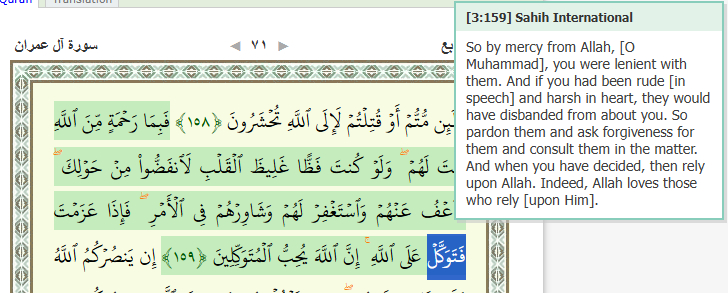
The Quran’s vocabulary is not merely linguistic — it carries theological weight, grammatical function, and contextual resonance that a flashcard cannot convey. When a student learns تَوَكَّلَ (tawakkala — to rely on Allah) alongside Surah Al-Imran 3:159, they absorb not just the word’s definition but its force and placement in divine address.
The Quran states in Surah Al-Qamar 54:17:
وَلَقَدْ يَسَّرْنَا الْقُرْآنَ لِلذِّكْرِ فَهَلْ مِن مُّدَّكِرٍ
Wa laqad yassarnā l-qur’āna li-l-dhikri fa-hal min muddakir
“And We have certainly made the Quran easy for remembrance, so is there any who will remember?”
This divine facilitation is not passive — it means learners who engage with vocabulary inside the Quran’s actual text are working with the very medium designed for retention.
Practical Methods for Contextual Quranic Vocabulary Learning
- Read the Tafsir of short Surahs (Al-Fatiha, Al-Ikhlas, Al-Falaq, Al-Nas) and identify each word’s meaning within the Ayah
- Listen to a slow recitation (Tarteel pace) while following a word-for-word translation
- After each vocabulary lesson, locate the learned word in two or three Quranic Ayat using a searchable Quran tool
- Keep a personal vocabulary notebook organized by Surah, not alphabetically
Master Arabic in the UAE
Experience world-class Arabic language training designed for students and professionals in the Emirates.
Book Your Free Trial5. Focus on Thematic Quranic Vocabulary Clusters to Build Arabic Fast
Grouping Quranic vocabulary by theme — rather than by Surah order or alphabetical sequence — allows learners to build functional comprehension in specific semantic fields before moving to others.
This mirrors how language acquisition works: humans learn language through conceptual domains, not random word lists.
The Quran itself organizes meaning thematically — discussions of divine attributes, Day of Judgment, prophethood, and moral conduct recur across Surahs.
Learning the vocabulary of each theme allows a student to follow those recurring discussions across the entire Quran.
High-Value Quranic Vocabulary Themes
Divine Attributes:
- الرَّحْمَن (Al-Raḥmān) — The Most Merciful
- الرَّحِيم (Al-Raḥīm) — The Especially Merciful
- الْعَلِيم (Al-ʿAlīm) — The All-Knowing
- الْحَكِيم (Al-Ḥakīm) — The All-Wise
- الْقَدِير (Al-Qadīr) — The All-Powerful
Day of Judgment:
- الْحِسَاب (al-ḥisāb) — the reckoning/account
- الْمِيزَان (al-mīzān) — the Scale
- الْجَنَّة (al-janna) — Paradise
- النَّار (al-nār) — the Fire
- الصِّرَاط (al-ṣirāṭ) — the Path
Human Conduct:
- الصَّبْر (al-ṣabr) — patience
- الشُّكْر (al-shukr) — gratitude
- التَّوْبَة (al-tawba) — repentance
- الإِيمَان (al-īmān) — faith
- الْعَدْل (al-ʿadl) — justice
At UAE Arabic Learning Academy, our instructors note that UAE-based students — particularly professionals from South Asian communities who have been reciting the Quran since childhood — often recognize the sounds of these words without knowing their meanings. Thematic vocabulary study is the fastest way to bridge that gap.
Our Quran courses at UAE Arabic Learning Academy integrate vocabulary instruction directly into recitation sessions — students are not just learning to pronounce, they are learning to understand what they pronounce.
Book a Free Trial Lesson in our Quran Course

6. Use Grammar Anchors to Learn Arabic Words More Efficiently
Quranic grammar (النحو — al-naḥw) is not an obstacle to vocabulary learning — it is a multiplier. Understanding a small number of core grammatical patterns allows a student to decode unfamiliar words by their form, not just their root.
Specifically, knowing the core Arabic verbal noun patterns (المصدر — al-maṣdar) and broken plural forms allows a learner to recognize new Quranic words on sight.
For UAE learners exploring how to learn Arabic in the UAE more broadly, this grammar-vocabulary integration is consistently where progress accelerates. Students who learn the Quran’s grammatical skeleton alongside its vocabulary begin reading with comprehension rather than word-by-word translation dependence.
7. Review Quranic Vocabulary Through Daily Salah for Lasting Retention
The single most underused review method for Quranic vocabulary is the one every Muslim in the UAE performs five times daily: Salah. Every Muslim who prays already recites Al-Fatiha seventeen times per day, along with multiple shorter Surahs. That built-in repetition is a powerful retention engine — if the learner knows what they are saying.
Attaching vocabulary study directly to Salah transforms daily prayer into a revision session. When a student learns that
صِرَاطَ الَّذِينَ أَنْعَمْتَ عَلَيْهِمْ means “the path of those upon whom You have bestowed favor,”
every recitation of Al-Fatiha reinforces that vocabulary without any additional study time.
This is a method our instructors recommend strongly to adult learners across Dubai and Abu Dhabi — especially those with demanding professional schedules. Rather than carving out additional hours for Arabic study, they leverage the time they are already spending in worship.
Read Also: Learn Arabic Phrases
8. Work with a Qualified Instructor to Build Quranic Vocabulary Accurately
Self-study tools — apps, word lists, YouTube translations — have genuine value, but they cannot replace the role of a qualified Arabic instructor in Quranic vocabulary acquisition. A trained teacher corrects pronunciation errors before they solidify, explains grammatical function alongside meaning, and sequences vocabulary study according to each student’s actual comprehension gaps.
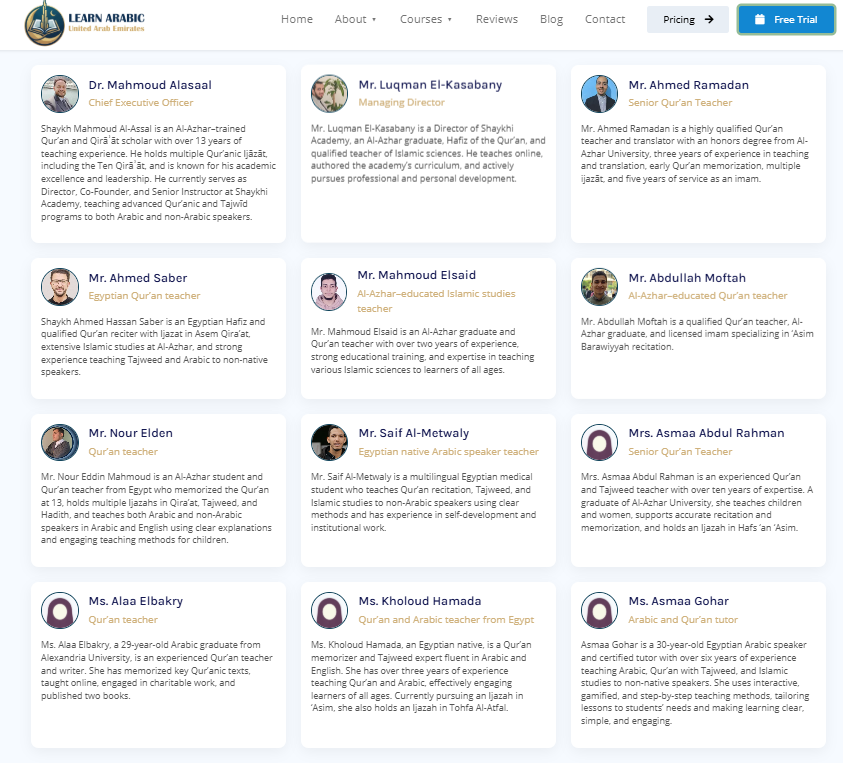
At UAE Arabic Learning Academy, our Azhari-trained instructors teach Quranic vocabulary within a structured progression that accounts for a student’s existing Arabic exposure, whether they are a heritage Arabic speaker who never formally studied the language, an expatriate child attending an MOE school, or an adult professional in Dubai approaching the Quran for the first time.
Meet our Azhari-trained instructors
For families considering Quranic education for their children, our Arabic learning resources for kids in the UAE show how structured Quranic vocabulary instruction is adapted specifically for younger learners — combining age-appropriate engagement with the same root-based, contextual methodology used for adults.
Read Also: Arabic Sentences for Kids
Our Students Reviews
Master Arabic in the UAE
Experience world-class Arabic language training designed for students and professionals in the Emirates.
Book Your Free TrialRead Also: Family Members in Arabic
Begin Your Quranic Arabic Journey with UAE Arabic Learning Academy
Building a strong Quranic vocabulary foundation requires the right sequence, the right method, and the right instructor — not just more study hours.
UAE Arabic Learning Academy offers structured Quranic and Arabic instruction that delivers measurable vocabulary progress:
- Expert native Arab Azhari tutors — authentic, scholarly instruction in Quranic Arabic
- Flexible online sessions — scheduling designed for UAE families and professionals
- UAE-specific curriculum — built for the diverse linguistic backgrounds of UAE residents
- All ages and levels welcomed — from children beginning Noorani Qaida to adults seeking Quranic comprehension
- Free trial session available — experience the instruction before committing
Book your free trial session at UAE Arabic Learning Academy and begin building the Quranic vocabulary that makes the Quran comprehensible, not just recitable.
Check out our top Arabic courses for UAE residents:
- Arabic alphabet course
- Arabic grammar course
- Arabic writing course
- Arabic speaking course
- Arabic course for beginners
- Kids’ Arabic Grammar Course
- Arabic Beginner Course for Kids
- Arabic Conversation for Kids
Book your free trial session today

Conclusion
Quranic vocabulary acquisition accelerates dramatically when learners prioritize frequency, organize study by root letters, and review words inside actual Quranic text rather than isolated lists. These three practices together create a compounding effect — each new word unlocks recognition of related words, and each Ayah encountered with comprehension deepens retention of the vocabulary within it.
The UAE’s diverse learning environment — multilingual households, Gulf Arabic exposure, varied school curricula — presents both challenges and advantages for Quranic Arabic study. Students who leverage their existing exposure to Arabic sounds while filling the meaning gap through structured vocabulary instruction make the fastest progress.
Master Arabic in the UAE
Experience world-class Arabic language training designed for students and professionals in the Emirates.
Book Your Free TrialRead Also: Colors in Arabic
Frequently Asked Questions About Learning Quranic Vocabulary
What Is the Difference Between Quranic Arabic and Modern Standard Arabic Vocabulary?
Quranic Arabic (Classical Arabic) shares significant vocabulary with Modern Standard Arabic (Fusha) but contains words, grammatical constructions, and usages that do not appear in contemporary MSA. Quranic vocabulary prioritizes theological and ethical concepts, and many terms carry specific meanings established by Tafsir scholarship that differ from their modern Arabic dictionary definitions. Studying Quranic Arabic specifically — rather than MSA alone — is necessary for genuine comprehension.
Can Children in UAE Schools Learn Quranic Vocabulary Effectively Online?
Children in UAE schools — whether attending MOE, British, or international curricula — can build strong Quranic vocabulary through structured online instruction adapted for their age and Arabic exposure level. At UAE Arabic Learning Academy, our Quran Classes for Kids UAE program uses age-appropriate methods that connect Quranic vocabulary to children’s existing Arabic knowledge, whether they are native speakers, heritage speakers, or complete beginners.
How Long Does It Take an Adult Beginner to Build Functional Quranic Vocabulary?
Adult beginners in the UAE who commit to two structured sessions per week, combined with daily Salah-based review, typically achieve functional recognition of high-frequency Quranic vocabulary within four to six months. Our instructors’ tracking at UAE Arabic Learning Academy indicates that students who integrate vocabulary study with Tajweed instruction and contextual Ayah review reach this milestone faster than those studying vocabulary in isolation.



Leave a Reply