 Learn Arabic

Key Takeaways
| Arabic learning for UAE kids works best when structured around the four core language skills in sequence. |
| Listening comprehension must be developed before speaking production — this mirrors how children acquire any language naturally. |
| Reading Arabic requires mastering the alphabet and short vowel system before moving to connected text and full sentences. |
| Writing in Arabic builds on reading fluency; children need solid letter recognition before formal writing instruction begins. |
| Structured, expert-guided instruction accelerates progress far faster than casual exposure or app-based self-study alone. |
Teaching kids Arabic in the UAE follows a clear, sequential path: build listening comprehension first, activate speaking second, introduce reading through the alphabet, then develop writing as the final formal skill. Children who follow this four-skill sequence consistently outperform peers who jump straight to reading or writing before their oral foundation is solid.
The UAE’s linguistic environment gives children a head start — Gulf Arabic is all around them. But bridging the gap between passive exposure and genuine fluency in Modern Standard Arabic requires structured, age-appropriate instruction that respects how children actually acquire language. This guide breaks that process into six practical steps any parent or educator can follow.
Step 1: Build Arabic Listening Comprehension Before Anything Else
Listening is the entry point to Arabic for children, and it must come before speaking, reading, or writing. Children absorb phonological patterns — the sounds, rhythms, and intonation of Arabic — through sustained, comprehensible listening input. Without this foundation, everything built later is structurally weaker.
At UAE Arabic Learning Academy, our instructors consistently observe that children who receive two to three weeks of focused listening input before being asked to produce any Arabic words develop noticeably cleaner pronunciation and more natural sentence rhythm than children who are pushed into speaking immediately.
What Effective Arabic Listening Input Looks Like for UAE Kids
Effective listening input for children is comprehensible — it operates just above the child’s current level, using context, gesture, and visual support to make meaning accessible. In practice, this means:
- Narrated daily routines in Arabic — labeling classroom and home objects in Fusha (Modern Standard Arabic) so children connect sound to meaning naturally
- Structured read-alouds by a native Arabic-speaking instructor, with deliberate pacing and expressive intonation
- Arabic songs and rhymes built around high-frequency vocabulary — particularly effective for children under eight, whose phonological memory is at its peak
Gulf Arabic exposure children receive in UAE daily life is valuable, but it should not replace structured Fusha listening input.
The two dialects co-exist productively — Gulf Arabic builds familiarity, while Fusha listening builds the formal language base children need for literacy and academic Arabic.
Shots Videos from Our Courses
Master Arabic in the UAE
Experience world-class Arabic language training designed for students and professionals in the Emirates.
Book Your Free TrialStep 2: Activate Arabic Speaking Through Structured Oral Practice
Once a child has built listening comprehension in Arabic, speaking production should be activated through structured, low-pressure oral activities.
Speaking is not about memorizing vocabulary lists — it is about training the child to retrieve and produce Arabic sounds, words, and simple sentence structures in real communicative contexts.
Our instructors at UAE Arabic Learning Academy find that children between the ages of five and ten respond best to speaking activities embedded in play and storytelling.
A child who is asked to describe a picture, complete a sentence, or respond to a simple Arabic question in a game format produces far more natural output than one asked to repeat isolated vocabulary in drill format.
Developing Arabic Makhraj Awareness in Young Learners
Makhraj al-huruf — the precise articulation points of Arabic sounds — is the most technically demanding element of Arabic speaking for children, particularly for non-Arab expat families in the UAE.
Sounds like ع (ayn), غ (ghayn), ح (ha), and خ (kha) have no equivalents in English, Urdu, Hindi, or Tagalog — the most common first languages in UAE expat households.
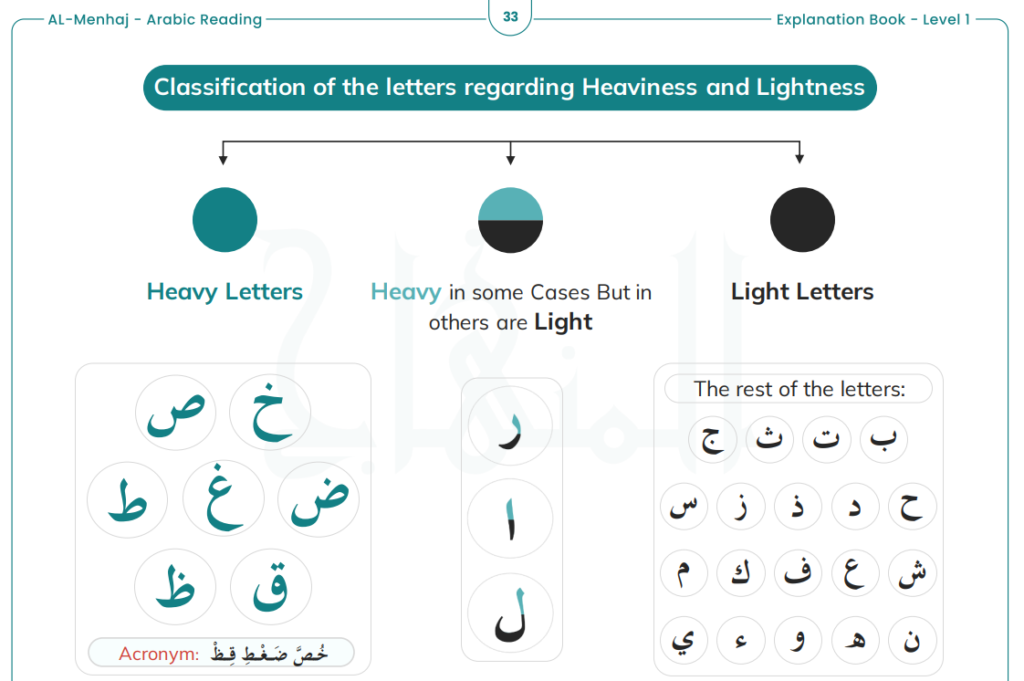
Children can master these sounds when they are introduced through ear-training and mouth-awareness games before formal reading begins. Attempting to teach these sounds through reading — pointing to a letter and asking a child to produce it — reverses the correct order. The sound must live in the child’s ear and mouth before it connects to a written symbol.
UAE Arabic Learning Academy’s Arabic for Kids Conversation Course is designed precisely for this stage — building oral production through structured, age-appropriate interaction with native Arab Azhari-trained instructors who correct Makhraj gently and consistently.
Enroll your kids in our conversation course in the UAE
Step 3: Introduce the Arabic Alphabet with Phonics-First Methodology
Reading Arabic begins with the alphabet — but the way the alphabet is taught determines whether a child develops genuine reading fluency or merely letter-recognition without decoding ability.
Phonics-first methodology teaches children the sound each letter produces in its three positional forms (initial, medial, final) before asking them to read connected text.
The Arabic alphabet contains 28 letters. Each letter changes shape depending on its position within a word — a reality that distinguishes Arabic literacy from learning most other alphabets.
Children need dedicated, systematic instruction to internalize these positional forms, and rushing this stage produces slow, inaccurate readers later.
How UAE Arabic Learning Academy Sequences Alphabet Instruction
Our approach to the Arabic alphabet follows a structured phonics pathway:
| Stage | Content | Typical Duration |
| Stage 1 | Isolated letter recognition — all 28 letters, isolated form | 1 week |
| Stage 2 | Positional forms — initial, medial, final shapes | 1–2 weeks |
| Stage 3 | Short vowels (Harakat) — Fatha, Kasra, Dhamma | 1 week |
| Stage 4 | Tanwin, Sukun, Shadda | 2 weeks |
| Stage 5 | Connected letters — simple two- and three-letter words | Ongoing |
The short vowel system (Harakat) is the most commonly under-taught element at this stage. Many children are taught letter names without being taught how Fatha, Kasra, and Dhamma change pronunciation — producing children who can identify Arabic letters but cannot read Arabic words aloud accurately.
Our Arabic Alphabet Course andArabic Beginner Course for Kids walk children through this exact sequence with native instructors and structured reading drills built for the UAE learning context.
Begin your kid’s Arabic learning path with a FREE trial class

Step 4: Build Arabic Reading Fluency Through Connected Text
Once a child has internalized the alphabet and short vowel system, reading instruction moves to connected text — words, then sentences, then short paragraphs.
This stage is where many UAE children plateau if instruction is not correctly sequenced, because moving from letter recognition to fluent word reading requires decoding automaticity — the ability to process letter-sound correspondences fast enough to build comprehension while reading.
Children who read slowly at the word level — sounding out each letter laboriously — cannot hold sentence meaning in working memory.
Fluency practice must be built deliberately, through repeated reading of short, controlled texts at the child’s current level.
Connecting Arabic Reading to Meaning in UAE School Contexts
UAE children in MOE-curriculum schools encounter Modern Standard Arabic as a formal school subject from KG2 onward. Children in British and American international schools have far less structured Fusha exposure in their school day.
At UAE Arabic Learning Academy, our instructors calibrate reading instruction based on each child’s school system context — because a child attending an Arabic-medium MOE school needs very different support from a child attending an English-medium international school.
For children in international school contexts, we recommend two to three structured Arabic reading sessions per week with a native instructor alongside any school-based Arabic classes.
This frequency is what produces measurable reading level progression within a single academic term, based on our instructors’ tracking of student outcomes.
Master Arabic in the UAE
Experience world-class Arabic language training designed for students and professionals in the Emirates.
Book Your Free TrialStep 5: Develop Arabic Writing Skills on a Solid Reading Foundation
Arabic writing instruction should begin only after a child can read connected text with reasonable accuracy.
Writing in Arabic is a motor, visual, and linguistic skill simultaneously — children must produce letter shapes correctly, connect them according to positional rules, and apply accurate voweling and spelling.
Attempting to teach writing before reading is fluent overloads the child’s cognitive resources and produces frustration rather than progress.
Handwriting in Arabic requires specific attention to letter directionality (right to left), the connecting and non-connecting letter groups, and correct proportions within a line. These are not intuitive for children whose other written language is left-to-right (English, Urdu in Roman script, etc.).
A Practical Arabic Writing Sequence for Children
Effective Arabic writing instruction for children progresses as follows:
- Tracing stage: Children trace correctly proportioned letter forms before producing them independently — building motor memory for each letter’s shape and directionality
- Isolated letter writing: Independent production of all 28 letters in isolated form, with instructor correction of stroke order and proportion
- Positional form writing: Writing letters in initial, medial, and final positions within words
- Word-level writing: Dictation of familiar words to build spelling accuracy alongside motor fluency
- Sentence-level writing: Guided composition of short sentences using the child’s known vocabulary
Our Arabic Writing Course provides exactly this structured progression, with native instructors who correct both handwriting form and linguistic accuracy in every session.
Start reading and writing Arabic with a FREE trial class

Step 6: Integrate All Four Skills Through Communicative Arabic Activities
The final step is not a new skill — it is integration. Listening, speaking, reading, and writing must be woven together through communicative activities that use Arabic for real purposes, not just classroom exercises.
This is the stage where children move from learning Arabic as a subject to using Arabic as a language.
Effective integration activities for UAE children include:
- Listening and responding: A child hears an Arabic story, then answers comprehension questions orally or in writing
- Read-aloud and discussion: A child reads a short text and discusses its content with their instructor in Arabic
- Guided written composition: A child writes a short paragraph about a topic they have discussed orally, applying grammar and vocabulary from previous lessons
- Arabic conversation practice: Structured dialogues with an instructor simulating real-life UAE contexts — at a shop, describing a family member, discussing school
At UAE Arabic Learning Academy, our Kids’ Arabic Grammar Course supports this integration stage by formalizing the grammatical structures children have been using orally — giving them the linguistic tools to produce accurate, coherent Arabic at an age-appropriate level.
Enroll your child in our Arabic grammar course for kids in the UAE
The Knowledge and Human Development Authority (KHDA) recognizes Arabic language proficiency as a core competency within UAE educational standards — making structured, measurable Arabic instruction an investment with direct academic value for UAE school-age children.
Our Students Reviews
Master Arabic in the UAE
Experience world-class Arabic language training designed for students and professionals in the Emirates.
Book Your Free TrialRead Also: How to Learn Arabic in the UAE?
Start Your Child’s Arabic Learning at UAE Arabic Learning Academy
Expert Arabic instruction, built for UAE children, delivered by native Azhari-trained tutors.
UAE Arabic Learning Academy offers structured, age-appropriate Arabic and Quran programs for children across Dubai, Abu Dhabi, Sharjah, and all UAE emirates — online, with flexible scheduling that fits UAE family life.
- Expert native Arab Azhari tutors — authentic linguistic and Quranic instruction
- UAE-specific curriculum — aligned with MOE, British, and international school contexts
- Four-skill sequential approach — listening, speaking, reading, and writing developed in the right order
- All ages and levels welcomed — from complete beginners to children needing academic reinforcement
- Free trial session available — see the difference structured instruction makes
Book your child’s free trial session today at UAE Arabic Learning Academy.
Check out our top Arabic courses for UAE residents:
- Arabic alphabet course
- Arabic grammar course
- Arabic writing course
- Arabic speaking course
- Arabic course for beginners
- Kids’ Arabic Grammar Course
- Arabic Beginner Course for Kids
- Arabic Conversation for Kids
Book your free trial session today and begin with a structured assessment and your first live lesson.

Frequently Asked Questions About Arabic Learning for Kids in the UAE
At What Age Should Children in the UAE Start Learning Arabic?
Children can begin structured Arabic listening and speaking activities from age four. Formal reading instruction is most effective from age five to six, when phonological awareness and fine motor skills are sufficiently developed. Starting early with oral skills — before formal literacy — gives children the strongest long-term foundation for Arabic fluency.
How Long Does It Take for a Child to Become Fluent in Arabic in the UAE?
Children receiving two to three structured Arabic sessions per week typically reach functional conversational fluency within 18 to 24 months. Reading fluency at a basic level is achievable within 6 to 9 months of consistent phonics-based instruction. Timelines vary based on the child’s age, existing Arabic exposure at home, and session consistency.
What Is the Difference Between Gulf Arabic and Modern Standard Arabic for Kids?
Gulf Arabic (Khaleeji) is the spoken dialect children encounter daily in the UAE. Modern Standard Arabic (Fusha) is the formal written and broadcast language used in schools, books, and official contexts. Children in the UAE benefit from learning both — but formal literacy instruction should focus on Fusha, which is the academic and written standard across all UAE curricula.
Can Non-Arabic-Speaking Children Learn Arabic in the UAE?
Yes — non-Arabic-speaking children learn Arabic effectively when instruction begins with listening and oral production before reading and writing. Children from South Asian, Western, and East Asian expat backgrounds in the UAE successfully reach solid Arabic literacy levels with structured, phonics-based instruction from native instructors who understand their specific phonological starting points.
Should Arabic Grammar Be Taught Explicitly to Kids?
Basic Arabic grammar should be introduced gradually from around age seven to eight, embedded within communicative activities rather than taught as abstract rules. Children at this age can begin understanding simple concepts like gender agreement (Mudhakkar and Muannath) and basic nominal sentence structure (Jumlah Ismiyya) when taught through meaningful examples connected to vocabulary they already know.
Related Articles
Learn Arabic



Leave a Reply