 Learn Arabic

Some lines stay with you long after you read them. A short sentence about failure, patience, or self-belief can carry more weight than a full page of advice. This is exactly why famous Arabic quotes are shared so often — they compress a hard-won lesson into a few words that are easy to remember and even easier to repeat.
If you’re learning Arabic, these quotes do double duty. You get the meaning, and you get real sentence structure to study — verb placement, connectors, and vocabulary you’ll actually use in conversation, not just in a textbook drill.
This article collects well-known quotes about success and life, gives you the Arabic script, a transliteration so you can sound them out, and the English meaning side by side. Along the way, it breaks down the grammar each quote teaches, so you walk away with more than a list to admire.
Famous Arabic Quotes About Life
A quote about life, in this context, is a short statement that reflects a lesson learned through experience rather than a rule taught in a classroom. That’s part of why these lines travel so well between languages — the idea behind them is universal, even when the wording is not.

Many of the most-shared Arabic quotes about life are translations of well-known English sayings. Reading them in Arabic gives you a second way to absorb the same idea, which reinforces both the vocabulary and the grammar pattern used to express it. It also exposes you to sentence structures you won’t find in a typical beginner textbook, since quotes are written for impact, not for teaching grammar in a linear order.
1. Quotes That Reframe Failure
Failure sounds different when you read it in Arabic. These quotes introduce useful sentence patterns and everyday expressions while offering a new perspective on setbacks and resilience.
النجاح ليس النهاية، والفشل ليس قاتلاً: المهم هو الشجاعة للمواصلة.
al-najāḥu laysa al-nihāyah, wal-fashalu laysa qātilan: al-muhimmu huwa al-shajā’ah lil-muwāṣalah.
“Success is not final, failure is not fatal: it is the courage to continue that counts.”
Notice the sentence structure here: two negations (ليس, “is not”) followed by a positive statement introduced by المهم هو (“what matters is”). This pattern — negate, negate, then state the real point — shows up constantly in Arabic argumentative writing, not just in quotes. Once you can spot it here, you’ll start noticing it in opinion articles and speeches too.
لقد فشلت مراراً وتكراراً في حياتي وهو سبب نجاحي.
laqad fashiltu mirāran wa tikrāran fī ḥayātī wa huwa sababu najāḥī.
“I’ve failed over and over again in my life, and that is why I succeed.”
The phrase مراراً وتكراراً (“over and over again”) is a fixed expression worth memorizing on its own — it appears in spoken Arabic far more often than a direct word-for-word translation of “repeatedly” would. Fixed expressions like this one are a shortcut: learn the phrase as a unit, and you skip the step of building it word by word every time you need it.
2. Quotes About Effort and Perseverance
Success in Arabic is often described through patience, consistency, and hard work. The quotes below help you learn natural vocabulary and sentence structures that appear in both formal writing and everyday conversations.
الصبر والمثابرة والعرق هو مزيج لا مثيل له للنجاح.
al-ṣabru wal-muthābarah wal-‘araq huwa mazījun lā mathīla lahu lil-najāḥ.
“Patience, persistence, and perspiration make an unbeatable combination for success.”
This one is a good study sentence because it lists three nouns joined by و (“and”) before the main verb — a structure you’ll see in formal Arabic writing, speeches, and even news reporting. The phrase لا مثيل له (“unmatched,” literally “it has no equal”) is another reusable building block; swap the subject and you can describe almost anything as one-of-a-kind.
للنجاح في الحياة، تحتاج إلى أمرين: الجهل والثقة.
lil-najāḥi fī al-ḥayāti, taḥtāju ilā amrayn: al-jahl wal-thiqah.
“To succeed in life, you need two things: ignorance and confidence.”
This quote uses أمرين (“two things”) followed by a colon and a list — a clean, simple way to introduce exactly two items in Arabic. It’s a useful pattern for learners because it’s far more compact than trying to translate “there are two things you need” word for word.
If you want to get comfortable reading full sentences like this instead of memorizing them by sound alone, a structured Modern Standard Arabic course is the fastest way to connect the script you’re seeing here to the grammar rules behind it.
Join Our Fusha Arabic Classes in the UAE with a FREE Trial

See Our Classroom Environment in Action
Experience a sneak peek into our live sessions. Watch the video below to see our specialized instructors interacting with students, breakdown complex texts, and cultivate an engaging, respectful learning environment.
Master Arabic in the UAE
Experience world-class Arabic language training designed for students and professionals in the Emirates.
Book Your Free TrialRead more: Food in Arabic Language
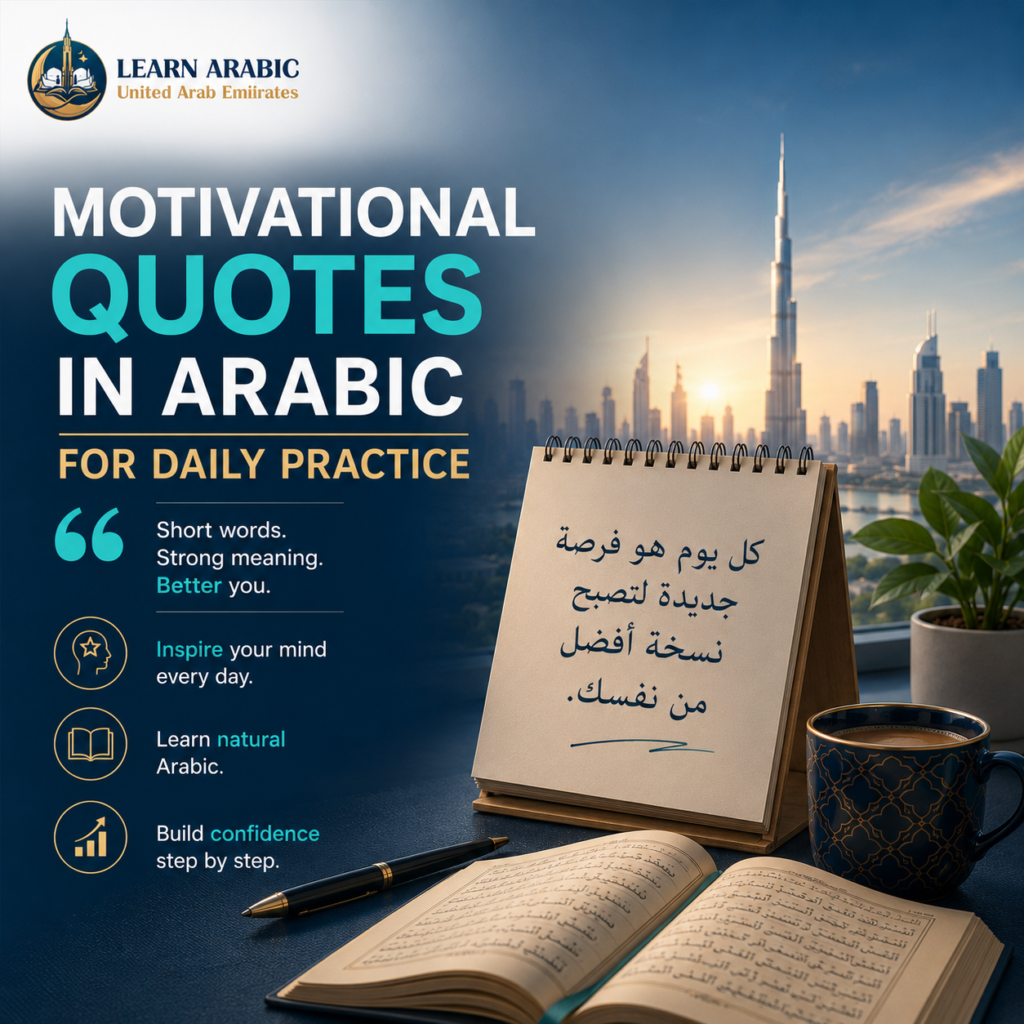
Motivational Quotes in Arabic for Daily Practice
A motivational quote works differently from a life quote — it’s meant to be repeated, often out loud, as a kind of daily reminder. That repetition is useful for a language learner too: saying the same short sentence every day trains your mouth to produce Arabic sounds automatically, instead of translating word by word in your head first.
1. Quotes About Self-Belief
Confidence starts with the way you speak to yourself. These Arabic quotes introduce practical imperative verbs and encouraging expressions you can reuse in everyday conversations.
كن نفسك دائماً، عبر عن نفسك، تحل بالثقة في نفسك، لا تخرج وتبحث عن شخصية ناجحة وتنسخها.
kun nafsaka dā’iman, ‘abbir ‘an nafsak, taḥallā bil-thiqah fī nafsik, lā takhruj wa tabḥath ‘an shakhṣiyyah nājiḥah wa tansakhhā.
“Always be yourself, express yourself, have faith in yourself. Do not go out and look for a successful personality and duplicate it.”
This quote strings together four short commands in a row — كن, عبر, تحل, لا تخرج. Command form (the imperative) is one of the first verb forms Arabic learners study, and seeing it used four times in one sentence makes the pattern easier to internalize than seeing it once in a grammar table. Pay attention to لا تخرج: the negative command (don’t do X) is formed differently from the positive one, and this quote gives you both side by side for comparison.
2. Quotes About Perspective
A change in perspective often changes the meaning of success. The following quotes highlight natural comparison patterns and connectors that are common in both spoken and written Arabic.
أنا لا أقيس نجاح الرجل بمدى ارتفاع ما صعده ولكن بمدى ارتفاع ارتداده عندما يضرب القاع.
anā lā aqīsu najāḥa al-rajuli bimadā irtifā’i mā ṣa’idahu wa lākin bimadā irtifā’ irtidādihi ‘indamā yaḍribu al-qā’.
“I don’t measure a man’s success by how high he climbs but by how high he bounces when he hits bottom.”
Long comparative sentences like this one lean on لكن (“but”) to pivot between two ideas — a connector worth learning early, because it shows up in nearly every piece of Arabic writing longer than two sentences. The repeated structure بمدى ارتفاع (“by how high”) appearing twice in one sentence is also worth noting: repeating a phrase for rhetorical balance is common in Arabic in a way that can feel unusual to English speakers, who are often taught to avoid repetition.
القدوم معاً هو البداية؛ البقاء معاً هو التقدم.
العمل معاً هو النجاح.
al-qudūmu ma’an huwa al-bidāyah; al-baqā’u ma’an huwa al-taqaddum. al-‘amalu ma’an huwa al-najāḥ.
“Coming together is a beginning; keeping together is progress; working together is success.”
This quote is built almost like a formula: [noun] + معاً + هو + [outcome], repeated three times. Once you recognize the pattern, you can build your own sentences on the same template, which is a practical way to move from reading Arabic to producing it.
Reading a sentence is one thing; producing it in a real conversation is another. If you can follow the script above but freeze up trying to say it aloud, that gap is exactly what a speaking-focused Arabic course is built to close.
Take Your First Arabic Speaking Class for FREE

Short Quotes short quotes in arabic You Can Memorize in Minutes
Not every quote needs to be a full sentence to carry weight. Short Arabic quotes — one clause, no subordinate structure — are the easiest entry point for beginners, because there’s less grammar standing between you and the meaning.
يقاس حجم نجاحك بقوة رغبتك.
yuqāsu ḥajmu najāḥika biquwwati raghbatik.
“The size of your success is measured by the strength of your desire.”
الرجل الناجح هو الذي بإمكانه بناء أساس متين من الطوب الذي رماه الآخرون عليه.
al-rajulu al-nājiḥ huwa alladhī bi-imkānihi binā’ asāsan matīn min al-ṭūb alladhī ramāhu al-ākharūn ‘alayh.
“A successful man is one who can lay a firm foundation with the bricks others have thrown at him.”
This second one is longer than the others in this section, but it’s included here because the core idea — turning obstacles into material you build with — fits naturally with the shorter quotes around it. Notice الذي appearing twice, once for “the man who” and once for “the bricks that.” Relative pronouns like this are one of the more common sticking points for learners, and seeing the same word used twice in different contexts within one sentence is a useful way to study it.
لا تهدف للنجاح إذا كنت تريد ذلك.
فقط إفعل ما تحب وتؤمن به، وسوف يأتي بشكل طبيعي.
lā tahduf lil-najāḥ idhā kunta turīdu dhālika. faqaṭ if’al mā tuḥibb wa tu’min bih, wa sawfa ya’tī bishaklin ṭabī’ī.
“Don’t aim for success if you want it; just do what you love and believe in, and it will come naturally.”
Short quotes like these are ideal for a daily habit: read one out loud in the morning, write it out by hand once, and try to recall it without looking at the end of the day. That single-sentence repetition is a small habit, but it’s one of the most reliable ways to move vocabulary from recognition into active recall.
Read More: Learn Arabic Phrases
Working through short quotes like these with a tutor who can correct your pronunciation letter by letter closes that gap quickly — something private Arabic tutors are especially useful for, since they can adjust the pace to exactly where you’re stuck, rather than moving through a fixed curriculum regardless of your level.
Book a FREE Trial Class with the Best Online Arabic Tutors in the UAE
Step Inside Our Classrooms
Don’t just take our word for it—see our community in action. Click below to watch real, live snippets from our recent classes and experience our engaging teaching style firsthand!
Master Arabic in the UAE
Experience world-class Arabic language training designed for students and professionals in the Emirates.
Book Your Free TrialRead more: How to Greet People in Arabic
Learn to Read Famous Arabic Quotes With UAE Arabic Learning Academy
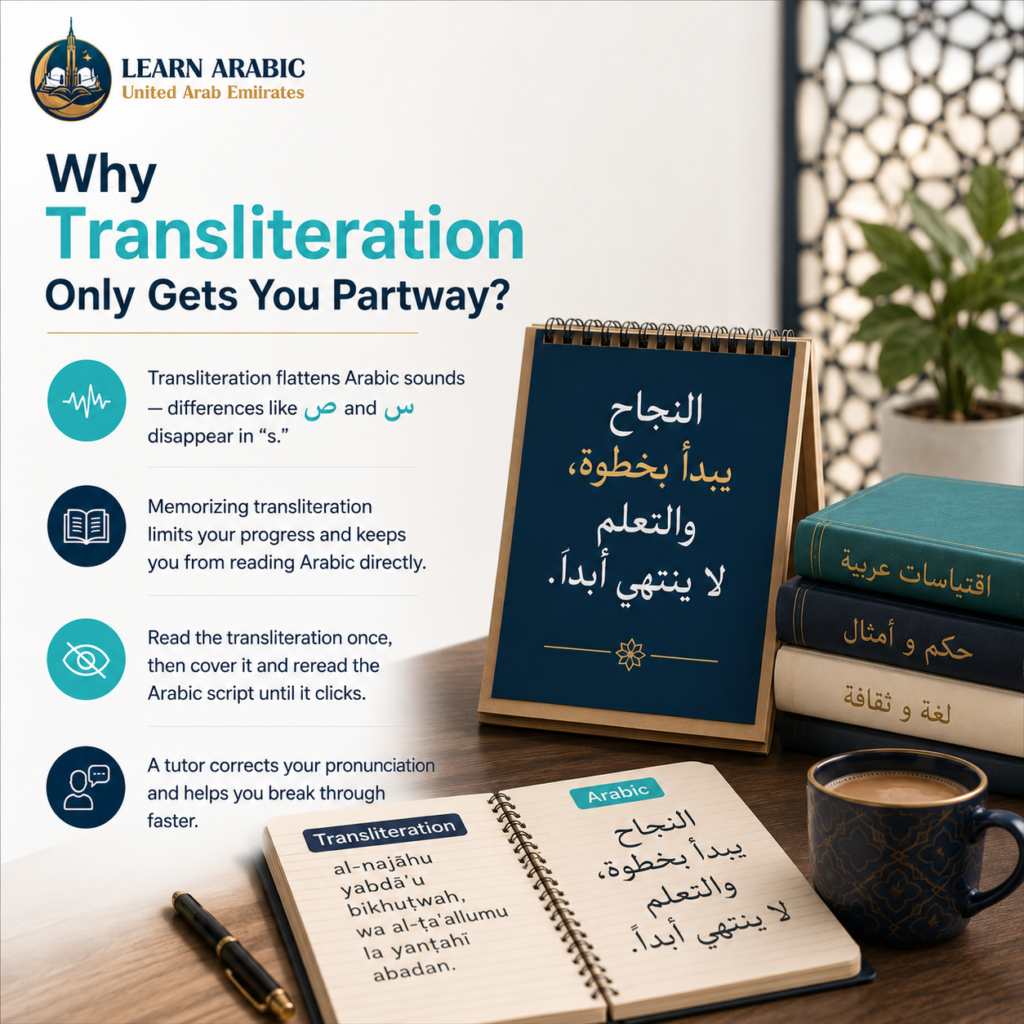
Reading famous Arabic quotes is an excellent way to expand your vocabulary and discover authentic Arabic sentence patterns, but understanding them without relying on transliteration requires structured learning.
At UAE Arabic Learning Academy, our expert native Arab tutors help learners build strong reading, grammar, pronunciation, and comprehension skills so they can confidently understand Arabic quotes, literature, and everyday texts.
- Expert native Arab Azhari tutors — personalized guidance in Modern Standard Arabic, reading, and pronunciation.
- Structured Arabic curriculum — build vocabulary, grammar, reading, speaking, and writing step by step.
- Practical learning approach — understand authentic Arabic quotes instead of simply memorizing them.
- Courses for all ages and levels — from complete beginners to advanced Arabic learners.
- Free trial lesson available — experience our structured Arabic program before you enroll.
Book your free trial lesson today at UAE Arabic Learning Academy.

Our Arabic courses
- Arabic Course in the UAE
- Arabic Intensive Course
- Arabic Classes for Beginners (Learn Arabic from Scratch)
- Madinah Arabic Course
- Arabic Classes for Adults
- Self-Paced Arabic Course
- Arabic Speaking Classes
- Learn to Write Arabic Course
- Arabic Grammar Course
- Learn Arabic Alphabet Course
- Modern Standard Arabic (MSA) Course
- Quranic Arabic Course
- Fusha Arabic Course
- Classical Arabic Course
- Emirati Arabic Course
- Gulf Arabic Course
- Learn Saudi Arabic
- Business Arabic Course UAE
- Arabic Language Classes for Professionals in UAE
Master Arabic in the UAE
Experience world-class Arabic language training designed for students and professionals in the Emirates.
Book Your Free TrialConclusion
Famous Arabic quotes about life and success work on two levels: they carry a message worth remembering, and they give language learners real, natural sentences to study instead of isolated vocabulary. The quotes above range from short one-liners to longer, structured sentences, which makes them useful at almost any stage of learning Arabic — beginners can start with a single clause, while more advanced readers can dig into the connectors and relative clauses in the longer examples.
The next step is turning passive reading into active use. Reading a quote is a start, but saying it out loud, writing it by hand, and recognizing its grammar pattern in a completely different sentence later on is what actually builds the language. Treat the quotes here as a starting set, not a finished list — the more of them you can read without transliteration, the closer you are to reading Arabic on your own.
FAQs
Find quick answers to the most common questions about Arabic quotes, their meanings, pronunciation, and how to use them as part of your Arabic learning journey.
What is a famous Arabic quote about life?
One widely shared example is “النجاح ليس النهاية، والفشل ليس قاتلاً: المهم هو الشجاعة للمواصلة” (“Success is not final, failure is not fatal: it is the courage to continue that counts”). It’s popular because the sentence structure is simple enough for intermediate readers while carrying a message that applies broadly.
Are most famous Arabic quotes originally written in Arabic?
Not always. Many popular Arabic quotes shared online are translations of well-known English or other-language sayings, adapted into Arabic for readers and learners. Others come directly from classical Arab poets, scholars, and writers. Both types are useful for learning, but it’s worth knowing which is which before quoting one as a source.
How do I memorize a short Arabic quote quickly?
Start with one short, single-clause quote rather than a long sentence. Read it aloud daily using the transliteration at first, then shift to reading the Arabic script directly once you recognize the letters. Writing it out by hand once tends to speed up recall more than repeated silent reading.
Do I need to learn Arabic script to understand these quotes, or is transliteration enough?
Transliteration works for a first read, but it can’t represent every Arabic sound accurately, which limits how far it can take you. Reading the actual script is necessary if you want to progress beyond a handful of memorized phrases.
What’s a good short Arabic quote for beginners?
“يقاس حجم نجاحك بقوة رغبتك” (“The size of your success is measured by the strength of your desire”) is a good starting point — it’s one clause, uses common vocabulary, and doesn’t require advanced grammar to follow.
Why do some Arabic quotes repeat the same phrase within one sentence?
Repetition for rhetorical balance, as seen in quotes like “القدوم معاً هو البداية؛ البقاء معاً هو التقدم” (“Coming together is a beginning; keeping together is progress”), is a common stylistic feature in Arabic. It’s used deliberately for emphasis and rhythm, unlike in English writing, where repeating a phrase is often treated as something to avoid.



Leave a Reply