 Learn Arabic
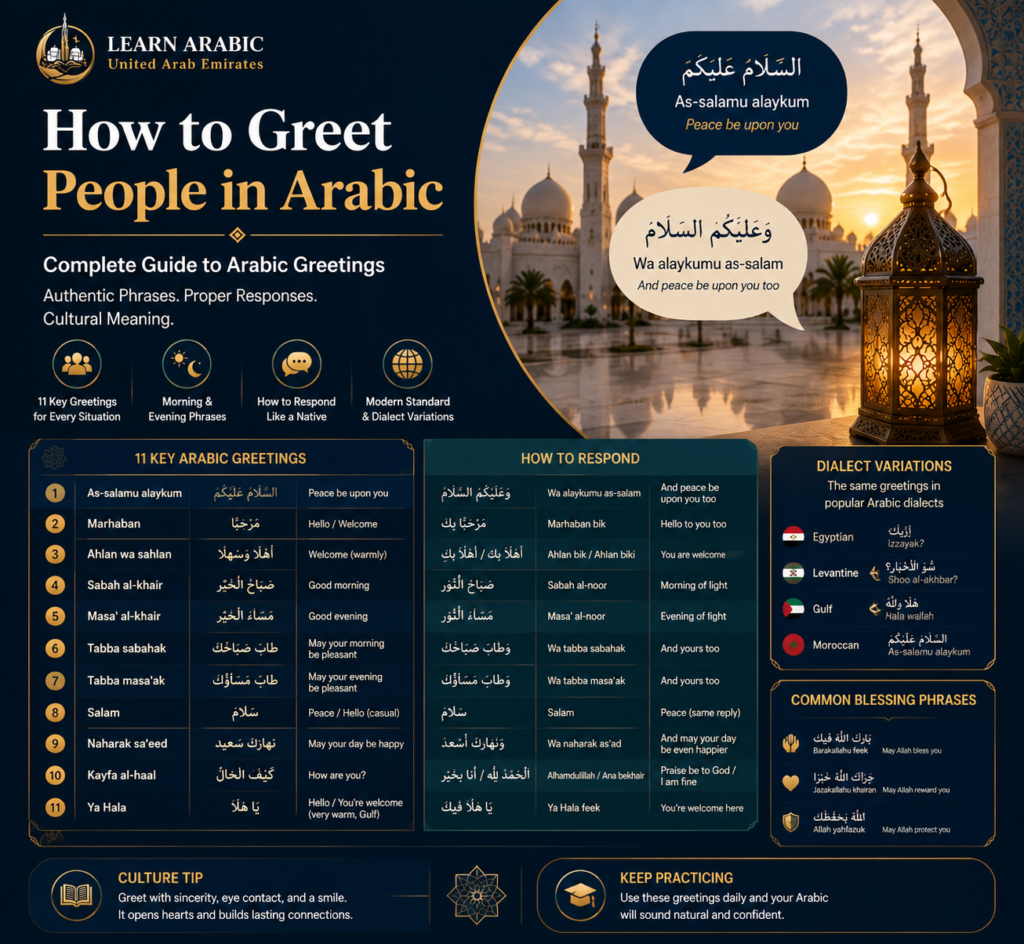
If you’ve ever wanted to connect with an Arabic speaker on a deeper level, greetings are where it all begins. Arabic greetings are not simple pleasantries — they carry blessings, reflect cultural values, and can turn a brief hello into a warm, meaningful exchange.
Whether you’re a beginner learner, a traveler, or someone looking to connect with Arabic-speaking family and friends, knowing how to greet people in Arabic — and how to respond — opens doors that vocabulary lists alone never will.
This guide covers everything: universal greetings, dialect variations, the full Muslim greeting, Arabic blessing phrases, and the cultural context that makes each one land naturally.
How Do You Greet Someone in Arabic?
Arabic greetings are rich in culture and meaning. Unlike English, where “hello” works in almost every situation, Arabic greetings shift depending on the time of day, your relationship with the person, the region you’re in, and the level of formality. Each greeting offers something distinct — sometimes a blessing, sometimes a gesture of warmth and welcome.
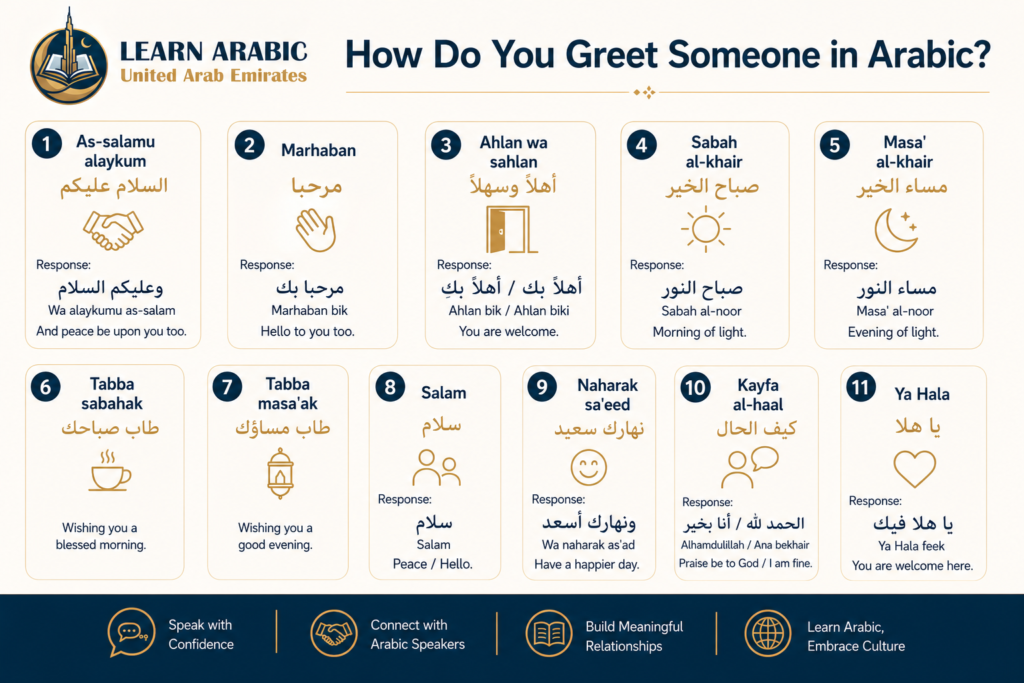
Here are 11 key Arabic greetings, how to use them, and how to respond when someone greets you first.
1. As-salamu alaykum — السلام عليكم
As-salamu alaykum is the most widely used greeting among Muslims and Arabic speakers worldwide. It means “Peace be upon you” and works in every setting — formal, informal, with friends, family, or complete strangers.
Response: Wa alaykumu as-salam (وعليكم السلام) — “And peace be upon you too.”
This greeting is used globally, not just in Arab countries. It’s a cornerstone of Islamic culture and signals respect, goodwill, and community connection the moment it’s spoken.
2. Marhaban — مرحبا
Marhaban means “Hello” or “Welcome.” It sits between formal and informal — polite enough for a first meeting, casual enough for daily use with colleagues and acquaintances.
Response: Marhaban bik (مرحبا بك) — “Hello to you too.”
If you’re just starting out learning Arabic and want one versatile greeting to use confidently, Marhaban is an excellent choice. It’s understood everywhere.
3. Ahlan wa sahlan — أهلاً وسهلاً
Ahlan wa sahlan means “Welcome” in the fullest sense — it signals warmth and hospitality. Use it when welcoming guests into your home, meeting someone at an event, or receiving visitors at work.
Response: Ahlan bik / Ahlan biki (أهلاً بك / أهلاً بكِ) — “You are welcome too.” (M/F)
4. Sabah al-khair — صباح الخير
Sabah al-khair means “Good morning.” It’s the standard morning greeting across all Arabic-speaking countries and is appropriate in any setting.
Response: Sabah al-noor (صباح النور) — “Morning of light.”
The poetic quality of the response — light for morning — reflects how Arabic greetings often go beyond functional exchange into something genuinely beautiful.
5. Masa’ al-khair — مساء الخير
Masa’ al-khair means “Good evening” and is used from late afternoon onward.
Response: Masa’ al-noor (مساء النور) — “Evening of light.”
6. Tabba sabahak — طاب صباحك
Tabba sabahak is a more formal, poetic alternative to Sabah al-khair. It wishes someone a pleasant, blessed morning and is less commonly used in casual settings — but when it is used, it stands out as warm and thoughtful.
Use this when you want your morning greeting to carry extra sincerity, especially with elders or in formal contexts.
7. Tabba masa’ak — طاب مساؤك
The evening equivalent of Tabba sabahak. More formal and literary, it’s a graceful way to wish someone a good evening with an elevated tone.
8. Salam — سلام
Salam is the shortened, informal version of As-salamu alaykum. It simply means “Peace” or “Hello” and is used between close friends in quick, casual exchanges.
Response: Salam (سلام) — reply with the same word.
9. Naharak sa’eed — نهارك سعيد
Naharak sa’eed means “May your day be happy.” It’s a cheerful, uplifting greeting used in the morning or afternoon when you want to go beyond a standard “good day.”
Response: Wa naharak as’ad (ونهارك أسعد) — “And may your day be even happier.”
If you’re learning Arabic and want to make a genuinely positive impression, this greeting shows thoughtfulness that native speakers notice and appreciate.
10. Kayfa al-haal — كيف الحال
Kayfa al-haal means “How are you?” and functions both as a standalone greeting and as a natural follow-up after another greeting. It works in formal and casual settings alike.
Response: Alhamdulillah (الحمد لله) — “Praise be to God” — or Ana bekhair (أنا بخير) — “I am fine.”
One cultural note worth knowing: in Arabic-speaking culture, responding with Alhamdulillah is common even when someone isn’t feeling their best. It expresses gratitude to God regardless of circumstances — not evasion, but genuine faith.
11. Ya Hala — يا هلا
Ya Hala is an informal, warm greeting used primarily in Gulf countries (Saudi Arabia, UAE, Kuwait, Qatar). It means “You are welcome” or “Hello” and carries a tone of genuine pleasure at seeing someone.
Response: Ya Hala feek (يا هلا فيك) — “You are welcome here.”
Children learning Arabic often pick up Ya Hala quickly because of its friendly, musical sound — it’s a great early addition to any young learner’s greeting vocabulary.
Begin Your Child’s Arabic Learning Journey with a FREE Trial Class
Read more: How to Introduce Yourself in Arabic?
How Do You Say Greetings in Arabic for Morning and Evening?
Time-specific greetings are among the most-used phrases in daily Arabic conversation. Here is the full picture:
| Time of Day | Greeting | Meaning | Response | Meaning |
| Morning | Sabah al-khair (صباح الخير) | Good morning | Sabah al-noor (صباح النور) | Morning of light |
| Morning (formal) | Tabba sabahak (طاب صباحك) | May your morning be pleasant | Wa tabba sabahak | And yours too |
| Evening | Masa’ al-khair (مساء الخير) | Good evening | Masa’ al-noor (مساء النور) | Evening of light |
| Evening (formal) | Tabba masa’ak (طاب مساؤك) | May your evening be pleasant | Wa tabba masa’ak | And yours too |
| Daytime | Naharak sa’eed (نهارك سعيد) | Have a happy day | Wa naharak as’ad | And an even happier one |
The response pattern you’ll notice — morning of light, evening of light — is not accidental. Arabic naturally reaches for warmth and blessing even in the most routine exchanges.
How Do Muslims Say Hello?
Muslims use As-salamu alaykum as the primary greeting. This phrase goes far beyond a casual hello — it expresses a sincere wish for peace, safety, and wellbeing for the person being greeted.
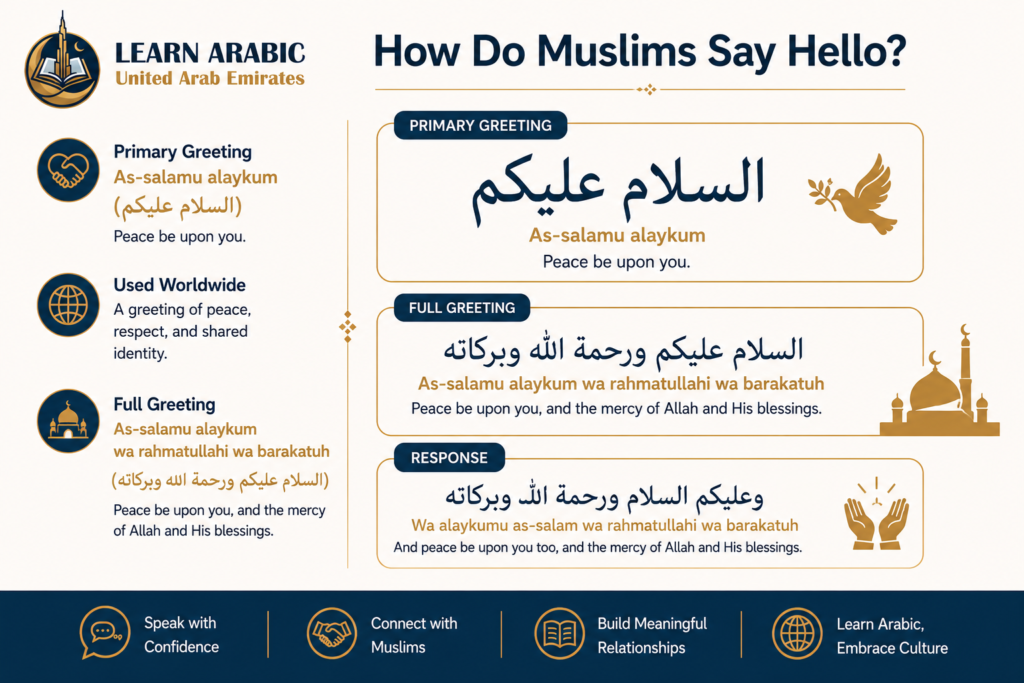
It is used by Muslims worldwide, not only in Arabic-speaking countries. In communities from Indonesia to Nigeria to the UK, As-salamu alaykum functions as an immediate signal of shared identity and mutual respect.
The complete version of the Muslim greeting is:
As-salamu alaykum wa rahmatullahi wa barakatuh (السلام عليكم ورحمة الله وبركاته)
This translates to: “Peace be upon you, and the mercy of Allah and His blessings.”
Full response: Wa alaykumu as-salam wa rahmatullahi wa barakatuh — “And peace be upon you too, and the mercy of Allah and His blessings.”
The extended greeting is typically used in formal settings, religious gatherings, and written communication such as Islamic lectures and Friday khutbahs. It layers three distinct gifts — peace, mercy, and blessings — into a single exchange.
See Our Classroom Environment in Action
Experience a sneak peek into our live sessions. Watch the video below to see our specialized instructors interacting with students, breakdown complex texts, and cultivate an engaging, respectful learning environment.
Master Arabic in the UAE
Experience world-class Arabic language training designed for students and professionals in the Emirates.
Book Your Free TrialHow to Say Greetings in Arabic by Dialect?
Standard Arabic greetings like As-salamu alaykum are understood everywhere. But each major Arabic dialect adds its own flavor, and knowing local variations makes a significant difference when you’re connecting with people from specific regions.
1. Greeting Someone in Egyptian Arabic
Egyptian Arabic is the most widely understood dialect globally, largely due to Egypt’s massive media output. Some Egyptian-specific greetings include:
- Izayyak (إزيك) — “How are you?” (male) / Izayyik (female)
- Sabah el-full (صباح الفل) — A playful “Good morning” that literally means “morning of flowers” — warmer and more affectionate than the standard version
- ‘Amil eih? (عامل إيه؟) — “How are you doing?” (very casual, close friends)
Egyptian greetings often reflect the country’s legendary warmth and humor — don’t be surprised if a simple greeting leads to an extended, cheerful conversation.
2. Gulf Arabic Greetings — Saudi Arabia, UAE, Kuwait, Qatar
Gulf Arabic carries its own distinct expressions:
- Ya Hala (يا هلا) — Casual welcome / hello
- Keef ḥālak / Keef ḥālik (كيف حالك) — “How are you?” (M/F)
- Arhibu (ارحبوا) — “Welcome” (formal, used in gatherings)
- Shu ‘uloomek — “How are you?” (informal)
Adults studying Arabic for professional purposes — especially those with business connections in the Gulf — will find these phrases immediately useful.
3. Levantine Arabic Greetings — Syria, Lebanon, Jordan, Palestine
The Levantine dialect is known for its melodic quality and is widely spoken in media and diaspora communities:
- Ahlayn (أهلين) — A warmer, more enthusiastic “Hello” than standard Ahlan
- Shu l-akhbar (شو الأخبار) — “What’s the news?” (general casual greeting)
- Keef il-hhal (كيف الحال) — “How are you?” / Keef hallak (M) / Keef hallik (F)
- Shu fi ma fi (شو في ما في) — “What’s up?”
Adult Arabic courses that cover dialectal variation alongside Modern Standard Arabic prepare learners for both formal and real-world settings.
Join the Best Arabic Course for Adults in the UAE with a FREE Trial
Read more: The Best Way to Learn Arabic Vocabulary
What Are Arabic Blessing Phrases?
Arabic blessings go beyond ordinary greetings. They are phrases that actively invoke divine protection, reward, or favor upon another person — and they appear constantly in daily Arabic conversation, not just in religious settings.
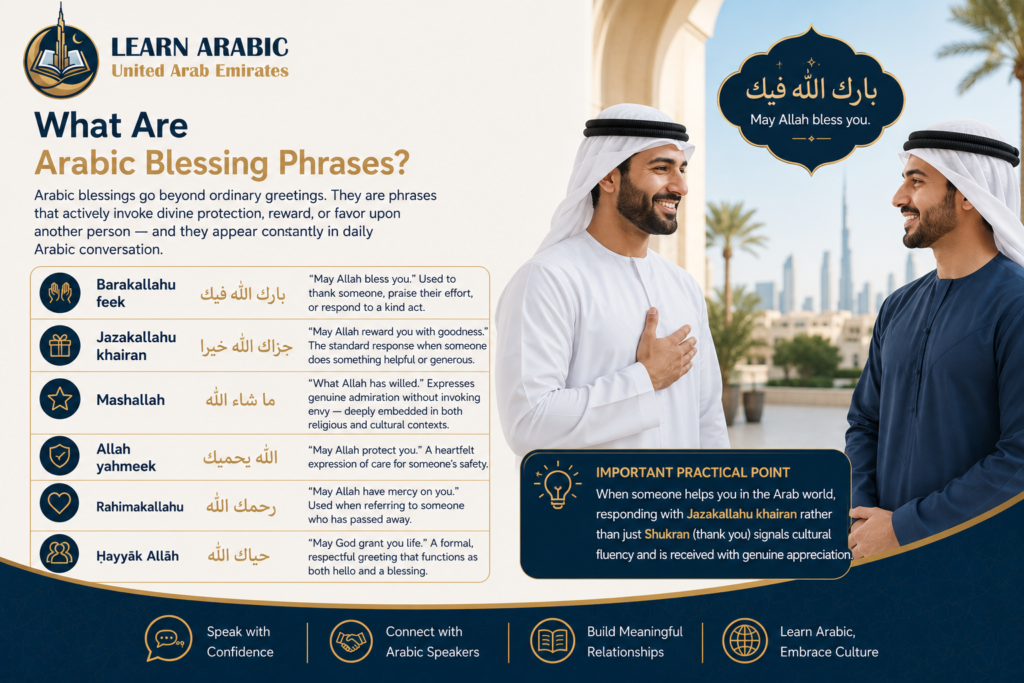
- Barakallahu feek (بارك الله فيك) — “May Allah bless you.” Used to thank someone, praise their effort, or respond to a kind act.
- Jazakallahu khairan (جزاك الله خيرا) — “May Allah reward you with goodness.” The standard response when someone does something helpful or generous.
- Mashallah (ما شاء الله) — “What Allah has willed.” Expresses genuine admiration without invoking envy — deeply embedded in both religious and cultural contexts.
- Allah yahmeek (الله يحميك) — “May Allah protect you.” A heartfelt expression of care for someone’s safety.
- Rahimakallahu (رحمك الله) — “May Allah have mercy on you.” Used when referring to someone who has passed away.
- Ḥayyāk Allāh (حياك الله) — “May God grant you life.” A formal, respectful greeting that functions as both hello and a blessing.
An important practical point: when someone helps you in the Arab world, responding with Jazakallahu khairan rather than just Shukran (thank you) signals cultural fluency and is received with genuine appreciation.
See Our Classroom Environment in Action
Experience a sneak peek into our live sessions. Watch the video below to see our specialized instructors interacting with students, breakdown complex texts, and cultivate an engaging, respectful learning environment.
Master Arabic in the UAE
Experience world-class Arabic language training designed for students and professionals in the Emirates.
Book Your Free TrialStart Speaking Arabic with Confidence at UAE Arabic Learning Academy
Learning Arabic greetings is only the first step. Real confidence comes from practicing them in conversations, using the right pronunciation, understanding cultural context, and knowing which expressions fit each situation. With expert guidance, you’ll develop the skills to communicate naturally from your very first lesson.
UAE Arabic Learning Academy offers:
- Native Arab instructors — learn authentic pronunciation, natural greetings, and real-life conversation skills
- Modern Standard Arabic and dialect options — including practical spoken Arabic for everyday communication
- Interactive, conversation-focused lessons — build confidence through guided speaking practice from day one
- Courses for children and adults — suitable for complete beginners and advanced learners alike
- Free trial lesson available — experience structured Arabic learning before you enroll
Book your free trial lesson today at UAE Arabic Learning Academy and start speaking Arabic with confidence.
Our Arabic courses
- Arabic Course in the UAE
- Arabic Intensive Course
- Arabic Classes for Beginners (Learn Arabic from Scratch)
- Madinah Arabic Course
- Arabic Classes for Adults
- Self-Paced Arabic Course
- Arabic Speaking Classes
- Learn to Write Arabic Course
- Arabic Grammar Course
- Learn Arabic Alphabet Course
- Modern Standard Arabic (MSA) Course
- Quranic Arabic Course
- Fusha Arabic Course
- Classical Arabic Course
- Emirati Arabic Course
- Gulf Arabic Course
- Learn Saudi Arabic
- Business Arabic Course UAE
- Arabic Language Classes for Professionals in UAE
Master Arabic in the UAE
Experience world-class Arabic language training designed for students and professionals in the Emirates.
Book Your Free TrialConclusion
Arabic greetings are one of the most rewarding things to learn early in your Arabic journey. They are culturally loaded in the best sense — every phrase reflects respect, warmth, and often a genuine wish for the other person’s wellbeing.
This guide covered how to say greetings in Arabic across universal phrases and regional dialects, how to respond correctly in each context, the full Muslim greeting and its extended form, Arabic blessing phrases for everyday and religious use, and the body language that accompanies the words.
The phrases that will serve you most immediately: As-salamu alaykum for any Muslim context, Sabah al-khair and Masa’ al-khair for time-specific greetings, and Kayfa al-haal to show genuine interest in the person you’re speaking with. Master the responses alongside the greetings — in Arabic culture, knowing how to reply is just as important as knowing how to greet.
Frequently Asked Questions
Arabic greetings are simple to learn, but many learners still have questions about when to use certain expressions, how to respond correctly, and how greetings differ across dialects. Below are answers to the most frequently asked questions about greeting people in Arabic.
How do you greet people in Arabic?
The most common way to greet people in Arabic is As-salamu alaykum (السلام عليكم), meaning “Peace be upon you.” It works in any setting — formal or informal — and the correct response is Wa alaykumu as-salam. For a casual hello, Marhaban or Salam are also widely used.
How do you say greetings in Arabic for morning and evening?
Good morning in Arabic is Sabah al-khair (صباح الخير), responded to with Sabah al-noor (صباح النور — “morning of light”). Good evening is Masa’ al-khair (مساء الخير), with the response Masa’ al-noor (مساء النور — “evening of light”).
How do you say greetings in Arabic in the Egyptian dialect?
In Egyptian Arabic, a common greeting is Izayyak (إزيك) for “How are you?” when speaking to a man, or Izayyik for a woman. Egyptians also use Sabah el-full (صباح الفل) — “morning of flowers” — as a warm, affectionate alternative to the standard good morning.
What is the full Muslim greeting in Arabic?
The most common way to greet people in Arabic is As-salamu alaykum (السلام عليكم), meaning “Peace be upon you.” It works in any setting — formal or informal — and the correct response is Wa alaykumu as-salam. For a casual hello, Marhaban or Salam are also widely used.
What are common Arabic blessing phrases?
Common Arabic blessings include Barakallahu feek (“May Allah bless you”), Jazakallahu khairan (“May Allah reward you with goodness”), Mashallah (“What Allah has willed” — said in admiration), and Allah yahmeek (“May Allah protect you”). These phrases appear constantly in everyday Arabic conversation, not just religious settings.
How do you greet in Arabic in Gulf countries?
In Gulf Arabic, common greetings include Ya Hala (يا هلا) for a casual welcome or hello, and Keef ḥālak / Keef ḥālik (كيف حالك) for “How are you?” (male/female). The formal welcome Arhibu is used in gatherings. Gulf greetings often carry a particularly warm, hospitable tone that reflects the region’s culture.


Leave a Reply