 Learn Arabic
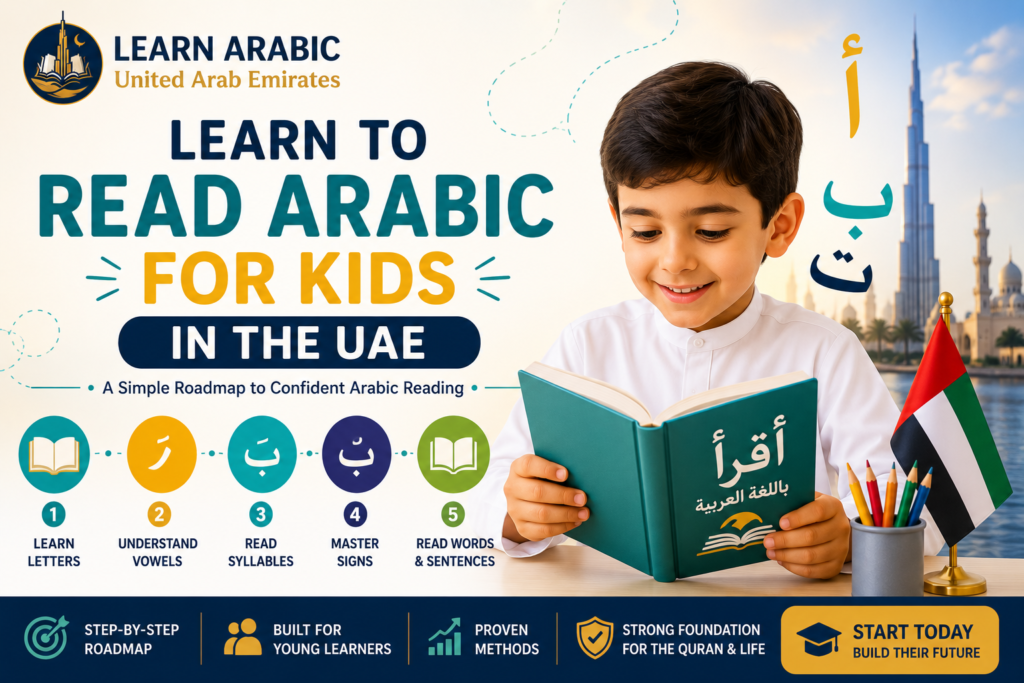
Many parents in the UAE know their child needs to learn Arabic reading — whether for school, for the Quran, or for cultural identity — but do not know where to start.
The UAE’s multilingual environment makes this both more urgent and more challenging: English dominates daily life, and learning to read Arabic for kids in the UAE requires a completely different script, a phonics system invisible to the eye, and a sound set that does not exist in English.
The good news is that Arabic reading follows a logical, teachable sequence. When children move through the right steps in the right order, progress is steady and confidence builds naturally.
The plan below gives you a clear roadmap — ten steps from the very first letter to fluent, independent reading.
1. The Starting Point Of Learning To Read Arabic For Kids in The UAE
Before introducing a single letter, understand where your child actually is. Many UAE parents underestimate this step because they assume their child is either a complete beginner or already knows more than they do.
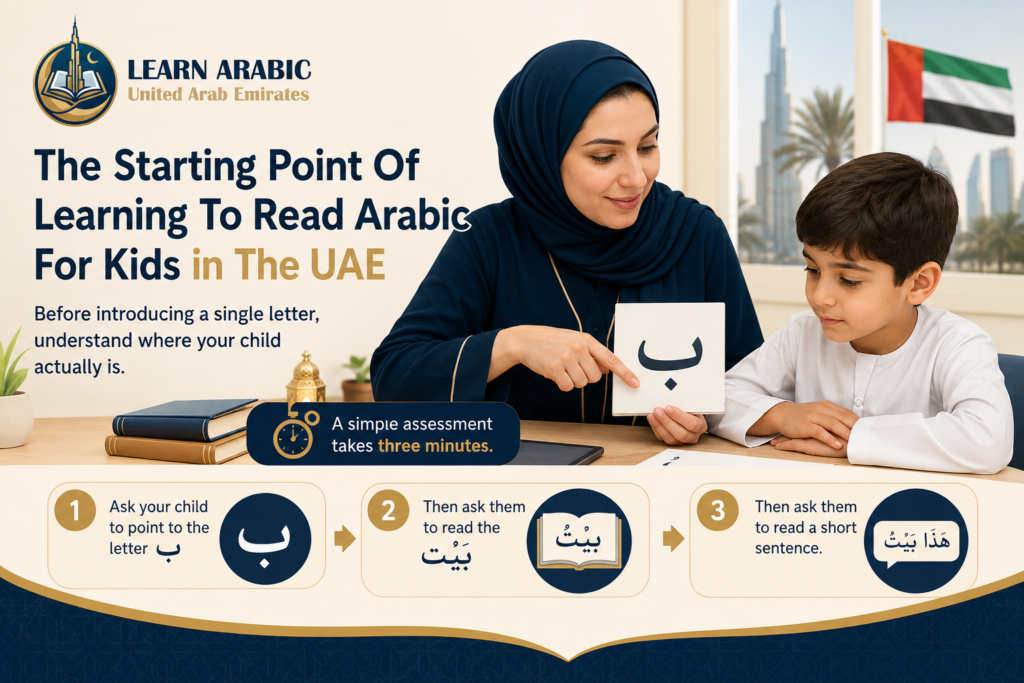
A simple assessment takes three minutes. Ask your child to point to the letter ب on any Arabic text. Then ask them to read the word بَيْت. Then ask them to read a short sentence.
Each task tests a different layer — letter recognition, voweled word decoding, and connected reading — and tells you exactly which step below is the right starting point.
This matters especially in the UAE, where children in Arabic-medium schools may have passive exposure to letters without having been explicitly taught to decode them. Exposure and instruction are not the same thing, and placing a child at the wrong level is the most common reason home Arabic study stalls early.
Read also: How to Learn Arabic in the UAE?
2. Teach The 28 Arabic Letters To Your Child in Visual Batches
The foundation of Arabic reading is letter recognition — being able to identify each of the 28 letters as a distinct visual unit, including its sound. This is the non-negotiable first stage, and it should never be rushed.
The most effective approach is to introduce letters in groups based on visual similarity rather than alphabetical order. Letters like ب، ت، ث share the same base body and differ only in dots, so learning them together means children grasp three letters for the price of one visual shape.
| Letter Group | Letters | Shared Feature |
| Group 1 | ب ت ث | Same base, different dots |
| Group 2 | ج ح خ | Similar body, different dots |
| Group 3 | د ذ | Nearly identical shape |
| Group 4 | ر ز | Curved, dot difference only |
| Group 5 | س ش | Wavy base, dots differ |
After each group, test recognition through flashcard games and letter-finding exercises, not written quizzes. Visual recall develops before motor skill in most children under eight, so reading the letter correctly matters more at this stage than writing it perfectly.
In UAE schools, the Arabic curriculum introduces letters from KG1 onward, but the classroom pace is not always fast enough to build solid individual letter recognition.
Reinforcing this at home — even five minutes per evening — closes that gap significantly. For families starting younger, Arabic Classes for Kindergarten in the UAE build this foundation in a structured, age-appropriate environment.
Read also: Best 10 Arabic Cartoons for Kids
3. Explain The Short Vowel Marks (Harakat) of Arabic Language
This is the step where most self-taught attempts fall apart. Parents teach letters, then hand the child an Arabic text — and the child cannot read a word. The reason is almost always the same: harakat were never explained.
Arabic is written without visible short vowels in most everyday text. But children learning to read must start with fully vowelled text (tashkeel), where every letter carries a mark showing how it is pronounced. The three short vowels are fatha (َ — an “a” sound), kasra (ِ — an “i” sound), and damma (ُ — a “u” sound).
A child who understands that بَ = “ba”, بِ = “bi”, and بُ = “bu” has unlocked the entire Arabic reading system. The same logic applies to every letter — the pattern is completely consistent.
This is Arabic’s great advantage over English phonics: once the vowel system clicks, it works without exceptions.
Use colour-coding to make the three marks memorable during early practice. Red for fatha, blue for kasra, green for damma. Visual association at this stage accelerates recognition to the point where children stop needing the colours within a few weeks.
Begin your kid’s Arabic learning path with a FREE trial class

4. Improve Your Child’s Ability To Decode A Syllable In Two Seconds
Knowing what بَ sounds like is not the same as reading it automatically. Automaticity — the ability to decode a syllable in under two seconds without consciously thinking about it — is the real goal of this stage, and it only comes through repetition.
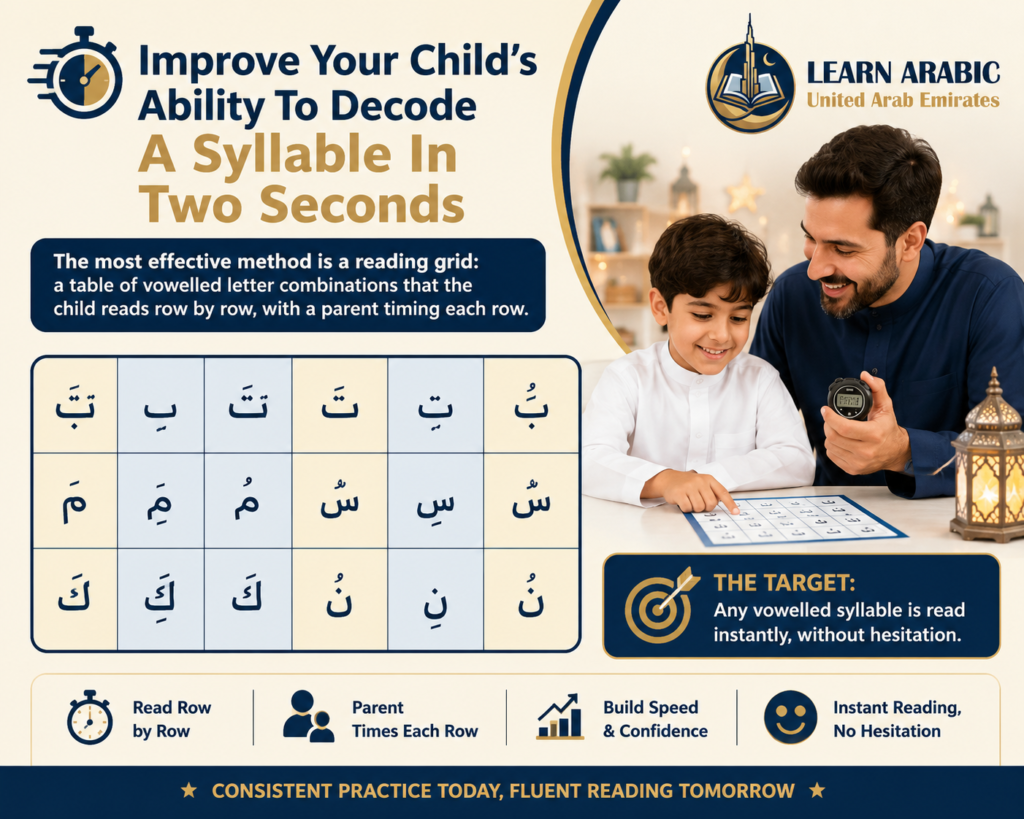
The most effective method is a reading grid: a table of vowelled letter combinations that the child reads row by row, with a parent timing each row. The target is that any vowelled syllable is read instantly, without hesitation.
| بَ | بِ | بُ | تَ | تِ | تُ |
| مَ | مِ | مُ | سَ | سِ | سُ |
| كَ | كِ | كُ | نَ | نِ | نُ |
Start with five letters the child knows well. Add new letters once each existing one is automatic.
Ten minutes of this kind of focused drilling every day produces measurable fluency gains within three to four weeks — far faster than reading full words without first securing the syllable level.
Step Inside Our Classrooms
Don’t just take our word for it—see our community in action. Click below to watch real, live snippets from our recent classes and experience our engaging teaching style firsthand!
Master Arabic in the UAE
Experience world-class Arabic language training designed for students and professionals in the Emirates.
Book Your Free TrialRead More: Learn Arabic for Kids Online For Free in the UAE
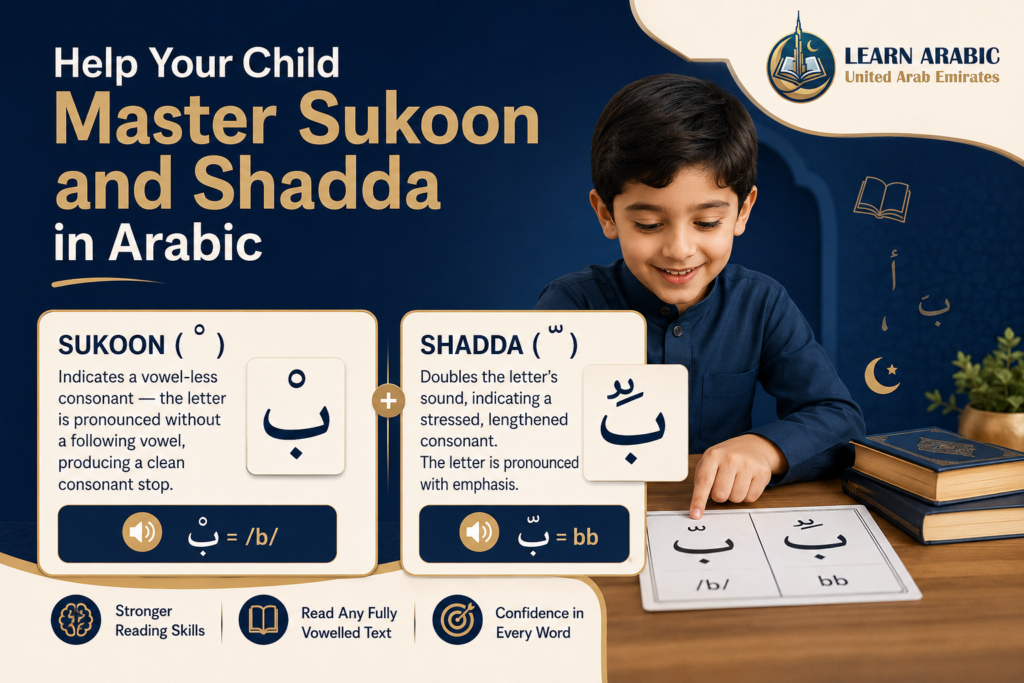
5. Help Your Child Master Sukoon and Shadda in Arabic
Once a child reads vowelled syllables confidently, two additional marks complete their ability to read any fully vowelled Arabic text.
Sukoon (ْ) indicates a vowel-less consonant — the letter is pronounced without a following vowel, producing a clean consonant stop. The syllable بْ produces just the sound /b/. Shadda (ّ) doubles the letter’s sound, indicating a stressed, lengthened consonant — بّ is pronounced as “bb”, a geminate.
These two marks appear constantly in the Quran and in school Arabic texts. Children who skip this stage can read simple vowelled words but stumble every time sukoon or shadda appear — which is constantly. Mastering them here prevents that recurring frustration.
6. Letter Joining Rules Help Your Child Read Connected Script
Children who have mastered isolated letters often hit a wall when they see a real Arabic word. The reason is that Arabic letters change shape depending on their position in a word — beginning, middle, or end — and an isolated letter that a child knows perfectly may look completely different when joined to its neighbours.
Every Arabic letter has up to four positional forms. Teaching these is not about memorising four sets of shapes separately — it is about showing children the pattern: most letters change only slightly, and the changes follow predictable rules.
| Letter | Isolated | Initial | Medial | Final |
| ب | ب | بـ | ـبـ | ـب |
| ع | ع | عـ | ـعـ | ـع |
| م | م | مـ | ـمـ | ـم |
The most effective method is to use real words — not invented examples — and ask children to identify each letter within the connected form. Start with three-letter words using letters they already know well. The child who can spot the ب inside the word كِتَاب has understood positional forms better than any drill can teach.
This is also the stage where vocabulary learning and reading instruction begin to reinforce each other. Understanding that كِتَاب means “book” while decoding it builds the meaning-sound-script triangle that produces genuine literate comprehension. The best way to learn Arabic vocabulary explains how vocabulary acquisition and reading development work together rather than in sequence.
Read More: Arabic Worksheets for Kids
7. Build Your Child’s Reading Fluency Through Short Vowelled Texts and Repetition
Reading individual syllables correctly is one skill. Reading fluently across a full line of text — without losing pace, accuracy, or meaning — is a different skill entirely. Fluency only comes from repeated reading of short, fully vowelled passages.
At this stage, introduce short vowelled texts — short Quranic surahs, simple children’s Arabic passages, or school reading materials with full tashkeel. The Quran’s final juz (Juz Amma) is ideal for UAE families: the surahs are short, the text is always fully vowelled, and most children already recognise the sounds from hearing them in prayer.
The three-read fluency structure works well for children aged 6–12:
- First read — accuracy focus: read slowly, correct every decoding error before continuing
- Second read — pace focus: read the same passage at a natural pace without stopping
- Third read — fluency target: read smoothly and continuously, as if telling a story
Repeating the same passage within one session builds neural pathways faster than reading new material every day. Children who follow this structure consistently show measurable fluency gains within three weeks — the progress is visible to parents and motivating for children.
Read also: Hard Arabic Words and Letters to Pronounce: The Advanced Learner’s Complete Guide
8. Reinforce Your Child’s Arabic Reading Skills Through Fun Games and Home Activities
Structured reading sessions build the skill. Games build the confidence and motivation that make children want to keep practising. Both are necessary, and the UAE home environment offers plenty of opportunities to make Arabic reading feel like play rather than study.
Several simple activities work immediately without any preparation:
- Letter Hunt — open any vowelled Arabic text, call out a letter sound, and the child finds every instance in 60 seconds
- Read and Draw — the child reads a short vowelled word, then draws what it means (works best with concrete nouns: كَلْب = dog, بَيْت = house)
- Echo Reading — a parent reads a sentence aloud, the child immediately repeats it, then reads it independently
- Syllable Build — write three letter-vowel combinations on separate cards, and the child arranges them into a word and reads it aloud
Games work best when introduced after a focused reading session — they reinforce what was just taught rather than introducing new content. Keep activity sessions under ten minutes to maintain energy and prevent the kind of fatigue that makes children resist the next day’s session.
UAE families can also take advantage of the digital platforms available locally. The عصافير (3asafeer) platform offers over 1,000 interactive exercises in Modern Standard Arabic — from letter colouring through grammar games to graded comprehension stories — all designed for the Gulf region specifically.
Begin your Arabic learning path with a FREE trial class

9. Establish a Daily Micro-Practice Routine Of Arabic Reading
Consistency at small scale outperforms intensity at large scale for Arabic reading in children. A ten-minute daily session maintained for four months produces more durable progress than weekend hour-long sessions interrupted by weeks of nothing.
The most effective daily structure for children aged 5–10 runs in three short parts:
- Review (2 minutes) — revisit one thing from the previous session: a letter group, a vowel mark, or three words
- New content (5 minutes) — one new concept, passage, or exercise from whichever step the child is currently on
- Reinforcement (3 minutes) — one game or activity that uses what was just learned
This ten-minute structure fits between homework and dinner without creating pressure. The key discipline is doing it every day — not making it perfect, not making it long, just making it daily. In the UAE’s busy school-week schedule, attaching Arabic practice to an existing daily routine (after breakfast, before bed, after Maghreb prayer) makes it far more likely to actually happen.
10. Introduce Writing Alongside Reading to Accelerate Your Child’s Progress in Both Skills
Reading and writing Arabic reinforce each other more directly than they do in English, because the physical act of forming letters builds letter recognition at the same time. Children who write letters regularly recognise them faster in text — the motor memory and the visual memory work together.
Once a child can read short vowelled words confidently (typically by the end of Step 6), introduce writing practice for the same letters and words they are reading. This does not need to be formal handwriting — tracing, copying, and forming letters from memory all count.
In the UAE context, the school Arabic curriculum already includes handwriting from KG1. Aligning home writing practice with what the child is reading at home prevents the common disconnect where a child reads reasonably well but writes with obvious hesitation because the letter shapes were never properly internalised. Arabic Writing Classes provide structured handwriting and composition instruction that keeps reading and writing developing in sync.

Read More: 10 Arabic Games For Kids
When to Bring in a Qualified Arabic Tutor for Kids in the UAE?
Home practice takes children a significant way through the steps above — but there are two specific situations where a qualified tutor accelerates progress more than any home strategy can.
The first is pronunciation. Arabic contains sounds that do not exist in English, and mispronounced letters left uncorrected at the early stages become habits that are difficult to undo. A qualified tutor hears the error immediately and corrects it before it sets. Parents without an Arabic reading background simply cannot do this, regardless of effort.
The second is plateaus. Most children stall at one of three points: when vowels are introduced, when letter-joining rules are taught, or when moving to unvowelled text. A tutor recognises which specific skill is blocking progress and addresses it directly, rather than repeating the same exercises that already are not working.
Working with dedicated Arabic Tutors for Kids means your child gets structured progression, real-time pronunciation correction, and a qualified teacher who understands how children learn Arabic as a second or heritage language — the combination that turns a capable reader into a confident one.

See Our Classroom Environment in Action
Experience a sneak peek into our live sessions. Watch the video below to see our specialized instructors interacting with students, breakdown complex texts, and cultivate an engaging, respectful learning environment.
Master Arabic in the UAE
Experience world-class Arabic language training designed for students and professionals in the Emirates.
Book Your Free TrialHow Learn Arabic UAE Supports Children’s Arabic Reading in the UAE
Learn Arabic UAE provides qualified Arabic tutors and structured courses specifically designed for children at every stage of the reading journey above — from recognising the first letters through to reading connected text fluently and independently.
Children working with Learn Arabic UAE receive:
- Qualified tutors experienced with non-native speakers and heritage learners in the UAE
- Structured lesson plans aligned with both the UAE Ministry of Education Arabic curriculum and internationally proven reading progressions
- Personalised placement assessments to identify the exact starting step, not just the age-appropriate one
- Flexible scheduling that fits around UAE school hours, after-school activities, and family routines
Parents consistently find that children who were resistant to Arabic practice at home — treating it as a chore — respond differently within a few sessions when working with a tutor who knows how to make each stage feel achievable. That shift in attitude is often the most significant outcome of the first month of structured instruction.
Learn Arabic for Kids in the UAE covers more on how structured learning environments across the Emirates support children’s Arabic development at every stage.
Book a session with a qualified Arabic tutor from Learn Arabic UAE and give your child the structured foundation that makes Arabic reading feel achievable — not overwhelming.
Our Arabic Courses
- Arabic Course in the UAE
- Arabic Intensive Course
- Self-Paced Arabic Course
- Arabic Speaking Classes
- Arabic Grammar Course
- Learn Arabic Alphabet Course
- Modern Standard Arabic (MSA) Course
- Quranic Arabic Course
- Fusha Arabic Course
- Classical Arabic Course
- Emirati Arabic Course
Book your free trial session today and begin with a structured assessment and your first live lesson.

Master Arabic in the UAE
Experience world-class Arabic language training designed for students and professionals in the Emirates.
Book Your Free TrialConclusion
Teaching a child to learn to read Arabic in the UAE is entirely achievable — but only when the steps happen in the right order. Letter recognition, harakat, syllable automaticity, positional forms, connected script, and fluency through repetition: each stage is specific, teachable, and measurable.
The families who succeed are not those who work the hardest — they are the ones who follow the sequence and practise consistently, even for just ten minutes a day.
The UAE gives children real motivation to read Arabic: it is the language of school, of the Quran, of official life, and of a culture many families are actively trying to preserve for the next generation.
That motivation is powerful. What it needs alongside it is a clear plan. For more on navigating the broader Arabic learning environment in the Emirates, the guide on How to Learn Arabic in the UAE is a useful companion to everything covered above.
Frequently Asked Questions
What age should a child start learning to read Arabic in the UAE?
Most children are ready to begin recognising Arabic letters from age four. Formal reading instruction — connecting letters, adding vowel marks, and reading short words — typically works best from age five onward.
UAE schools introduce Arabic script in KG1, so beginning at home a year earlier means your child arrives familiar with letter shapes and learns to read them faster in class.
Can a child learn to read Arabic at home without knowing the language?
Yes — reading Arabic and speaking Arabic are separate skills. Many children in the UAE learn to decode Arabic script accurately without conversational fluency, because the phonics system is rule-based and consistent once the letters and harakat are understood.
How long does it take a child to learn to read Arabic?
A child practising 10–15 minutes daily with a structured progression typically reads short, fully vowelled words within three to four months and reads vowelled passages with reasonable fluency within six to eight months.
Should my child learn to read Modern Standard Arabic or Emirati dialect?
Reading instruction is always in Modern Standard Arabic (Fusha), regardless of the dialect spoken at home. This is true in UAE schools, mosque classes, and Quranic study. Emirati dialect and written Fusha follow different conventions, but children switch naturally between them — the two do not conflict.
What is the most common mistake parents make when teaching Arabic reading at home?
Skipping the harakat stage. Parents teach letters, then hand the child an Arabic text without vowel marks — and the child cannot read anything. The solution is always to use fully vowelled text until the child can read it with fluency, and to spend specific, dedicated time on the three short vowels before attempting any real words.
How do I know if my child needs a tutor rather than just home practice?
Two clear signals: consistent mispronunciation of specific letters that does not improve with correction, and stalling at the same point in practice for more than two to three weeks without any visible progress.
Both indicate a gap that structured tutoring addresses far more efficiently than continued home drilling. Arabic Tutors for Kids can identify the exact sticking point and resolve it in a way that self-directed practice typically cannot.



Leave a Reply