 Learn Arabic
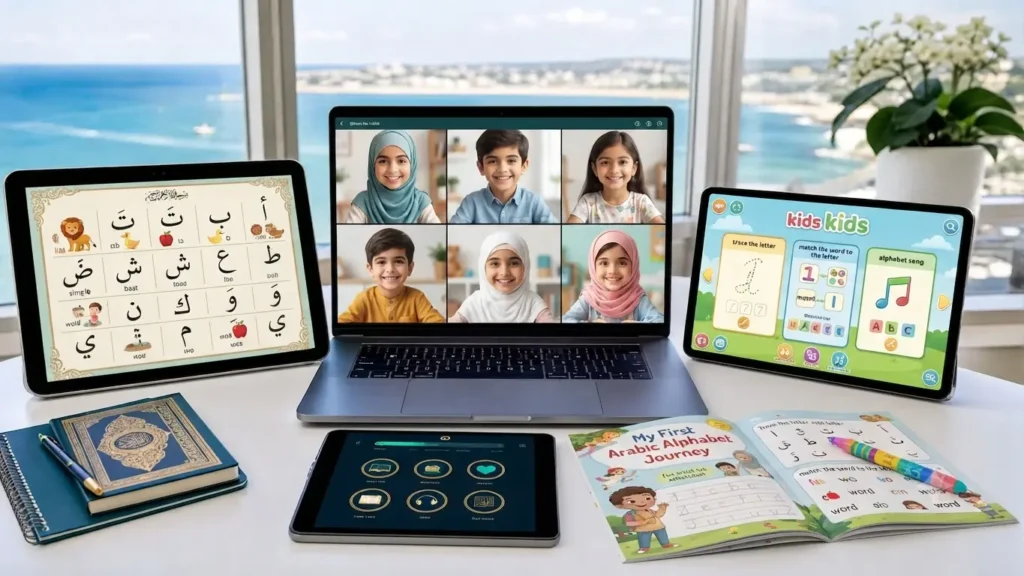
Teaching the arabic alphabet for kids is the first step toward helping children read, write, and eventually understand Arabic. While many parents start by asking children to memorize the 28 letters, research and classroom experience show that children learn faster when every letter is connected to a meaningful word, correct pronunciation, and a familiar object.
If you’re homeschooling or introducing Arabic for the first time, this guide gives you everything you need in one place—from the complete Arabic alphabet chart to practical teaching strategies you can use every week.
What Is the Arabic Alphabet?
The arabic alphabet for kids consists of 28 letters, beginning with Alif (ا) and ending with Ya (ي). Unlike English, Arabic is written from right to left, and every letter represents a sound. There are no uppercase or lowercase letters, but each letter changes its shape depending on where it appears in a word.
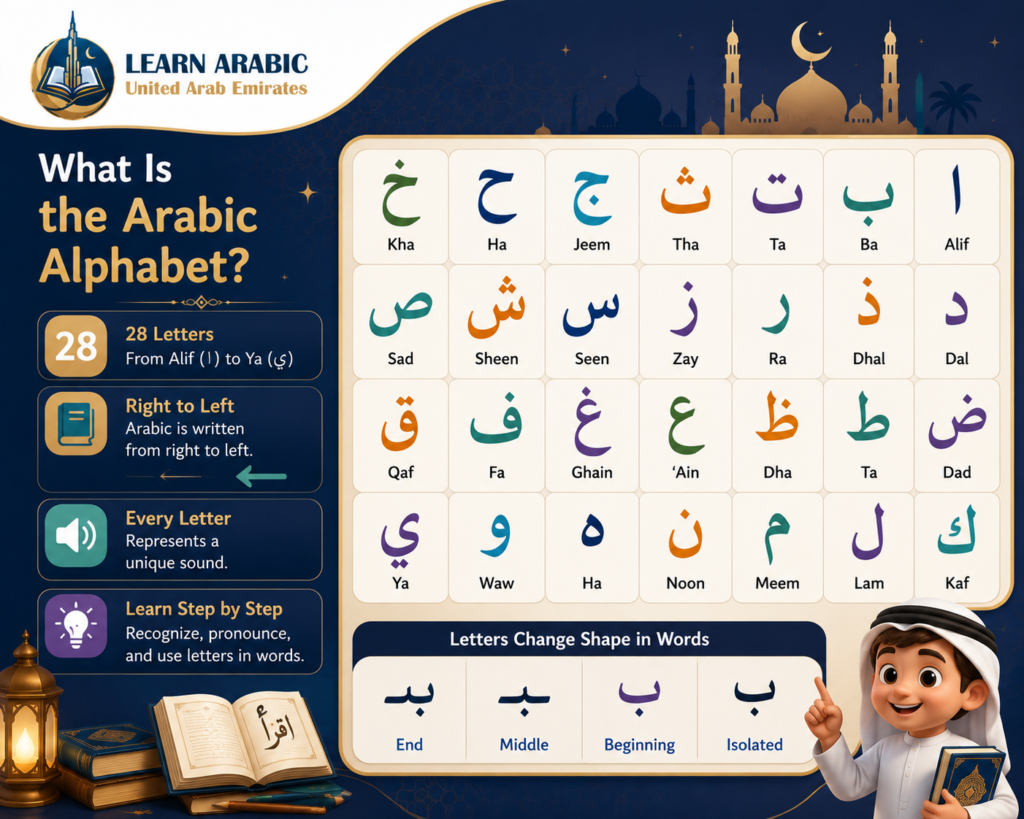
Children do not need to memorize every letter form immediately. The goal is to recognize the letter, pronounce it correctly, and gradually learn how it appears inside words.
Arabic Alphabet Chart for Kids
The table below introduces every Arabic letter in order with its pronunciation and an approximate English sound.
| Arabic Letter | Name | Approximate Sound |
| ا | Alif | A as in apple |
| ب | Baa | B as in bat |
| ت | Taa | T as in top |
| ث | Thaa | Th as in think |
| ج | Jeem | J as in jam |
| ح | Haa | Deep H |
| خ | Khaa | Kh |
| د | Daal | D |
| ذ | Dhaal | Th as in this |
| ر | Raa | Rolled R |
| ز | Zay | Z |
| س | Seen | S |
| ش | Sheen | Sh |
| ص | Saad | Heavy S |
| ض | Daad | Heavy D |
| ط | Taa | Heavy T |
| ظ | Zaa | Heavy Z |
| ع | Ayn | Throat sound |
| غ | Ghayn | Gh |
| ف | Faa | F |
| ق | Qaaf | Deep K |
| ك | Kaaf | K |
| ل | Laam | L |
| م | Meem | M |
| ن | Noon | N |
| هـ | Haa | H |
| و | Waw | W |
| ي | Ya | Y |
Learning this chart is much easier when children connect every letter with an actual Arabic word instead of memorizing isolated symbols.
If your child is just starting, our Arabic Alphabet Course introduces every letter through interactive lessons, pronunciation practice, and engaging activities designed for beginners.
Learn Arabic Letters in the UAE with a FREE Trial Class
Read also: How to Learn Khaleeji Arabic in the UAE? – Practical Steps for Real-Life Fluency

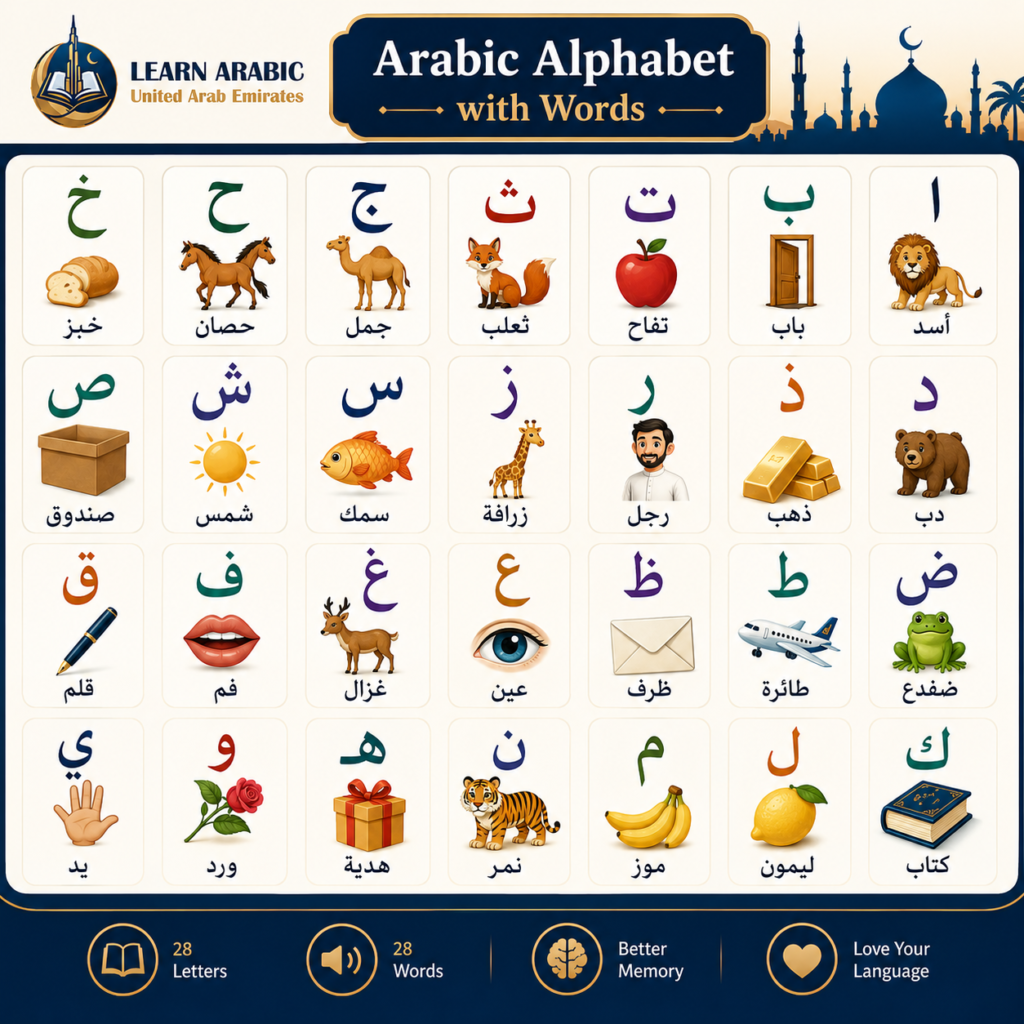
Arabic Alphabet with Words (Alif to Ya)
Instead of teaching letters alone, pair each one with a simple word children can recognize and remember.
Alif (ا)
Word: أسد
Transliteration: Asad
Meaning: Lion
Children often remember Alif quickly because lions are familiar animals in children’s books.
Baa (ب)
Word: باب
Transliteration: Bab
Meaning: Door
Using a real door inside your home makes this lesson memorable.
Taa (ت)
Word: تفاح
Transliteration: Tuffah
Meaning: Apple
Use a real apple during the lesson whenever possible.
Thaa (ث)
Word: ثعلب
Transliteration: Tha’lab
Meaning: Fox
Storybooks featuring animals make this word easier to remember.
Jeem (ج)
Word: جمل
Transliteration: Jamal
Meaning: Camel
A camel is one of the most recognizable animals in Arabic culture.
Haa (ح)
Word: حصان
Transliteration: Hisan
Meaning: Horse
Children naturally connect with animals, making this letter easier to retain.
Khaa (خ)
Word: خبز
Transliteration: Khubz
Meaning: Bread
Show real bread during the lesson to strengthen word association.
Daal (د)
Word: دب
Transliteration: Dubb
Meaning: Bear
Animal vocabulary keeps lessons engaging for younger learners.
Dhaal (ذ)
Word: ذهب
Transliteration: Dhahab
Meaning: Gold
Use pictures of jewelry or gold-colored objects to reinforce the lesson.
Raa (ر)
Word: رجل
Transliteration: Rajul
Meaning: Man
This simple everyday word expands children’s vocabulary while reinforcing pronunciation.
Zay (ز)
Word: زرافة
Transliteration: Zarafa
Meaning: Giraffe
Zoo-themed lessons are excellent for practicing this letter.
Seen (س)
Word: سمك
Transliteration: Samak
Meaning: Fish
Pictures, toys, or storybooks help children remember the word naturally.
Sheen (ش)
Word: شمس
Transliteration: Shams
Meaning: Sun
The sun is one of the easiest words for children to recognize. Go outside and point to the sun while saying Shams to create a real-world connection.
Saad (ص)
Word: صندوق
Transliteration: Sundooq
Meaning: Box
Hide small toys inside a box and let your child open it after saying the word aloud. Activities like this make learning memorable.
Daad (ض)
Word: ضفدع
Transliteration: Dafda’
Meaning: Frog
Children usually enjoy animal vocabulary because they can associate the word with stories and pictures.
Taa (ط)
Word: طائرة
Transliteration: Tayyarah
Meaning: Airplane
Toy airplanes or paper airplanes make this lesson much more engaging.
Zaa (ظ)
Word: ظرف
Transliteration: Zarf
Meaning: Envelope
Show your child a real envelope so they immediately connect the letter with an everyday object.
Read also: Letter Ḍād (ض) in Arabic – The Letter That Defines a Language
Ayn (ع)
Word: عين
Transliteration: Ayn
Meaning: Eye
Point to your own eyes while saying the word. Physical actions help children remember vocabulary faster.
Ghayn (غ)
Word: غزال
Transliteration: Ghazal
Meaning: Deer
Nature books and animal cards make this letter much easier to remember.
Faa (ف)
Word: فم
Transliteration: Fam
Meaning: Mouth
Ask your child to point to their mouth while repeating the word.
Qaaf (ق)
Word: قلم
Transliteration: Qalam
Meaning: Pen
Most children already use pencils and pens every day, making this one of the easiest Arabic words to learn.
Kaaf (ك)
Word: كتاب
Transliteration: Kitaab
Meaning: Book
Reading together immediately reinforces this vocabulary.
Laam (ل)
Word: ليمون
Transliteration: Laymoon
Meaning: Lemon
Use real fruit whenever possible instead of pictures.
Meem (م)
Word: موز
Transliteration: Mawz
Meaning: Banana
Food vocabulary is among the easiest for preschool children to retain.
Noon (ن)
Word: نمر
Transliteration: Namir
Meaning: Tiger
Animal-themed lessons continue to build vocabulary naturally.
Haa (هـ)
Word: هدية
Transliteration: Hadiyah
Meaning: Gift
Wrap a small object as a surprise gift while introducing this letter.
Waw (و)
Word: ورد
Transliteration: Wardah
Meaning: Rose
Flowers are excellent visual aids because children immediately recognize them.
Ya (ي)
Word: يد
Transliteration: Yad
Meaning: Hand
Ask your child to raise their hand while saying the word aloud.
By the time children reach Ya, they will have learned 28 letters, 28 vocabulary words, and dozens of sounds they can begin combining into simple reading practice.
If your child is ready to move beyond individual letters and begin reading simple Arabic words, our Beginner Arabic Course for Kids introduces reading step by step with live teachers and interactive lessons.
Read also: How to Learn Arabic in 7 Days in the UAE? – A Practical Day-by-Day Plan
Step Inside Our Classrooms
Don’t just take our word for it—see our community in action. Click below to watch real, live snippets from our recent classes and experience our engaging teaching style firsthand!
Master Arabic in the UAE
Experience world-class Arabic language training designed for students and professionals in the Emirates.
Book Your Free TrialHelp Your Child Start Learning Arabic with a FREE Trial in the UAE
How to Teach the Arabic Alphabet to Kids in 10 Simple Steps?
Now that your child knows the letters, the next question is: How do you help them remember everything?
The following ten steps create a simple learning system that works particularly well for homeschooling families.
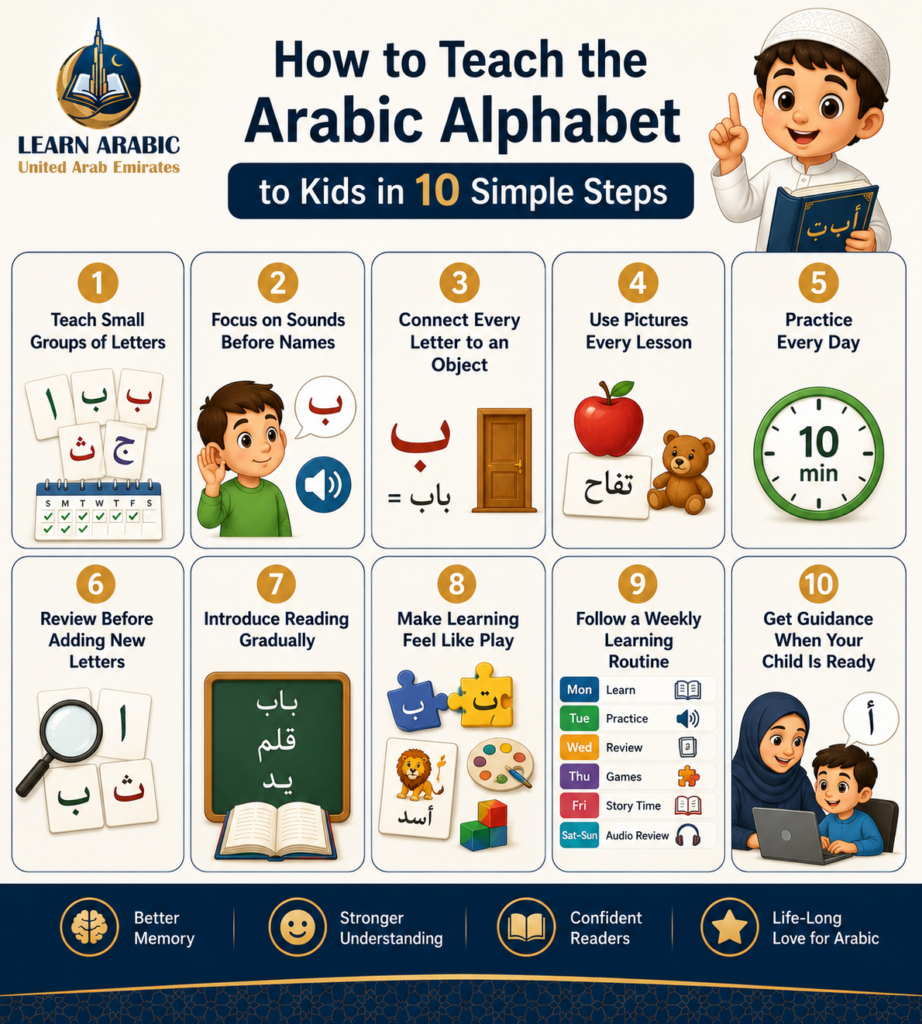
1. Teach Small Groups of Letters
Avoid introducing all 28 letters together Teach five or six letters each week and spend the remaining days reviewing them.
Children remember smaller lessons far better than long sessions.
2. Focus on Sounds Before Letter Names
Children learn language through listening Let them hear each letter several times before asking them to identify it on paper.
Correct pronunciation from the beginning prevents difficult habits later.
3. Connect Every Letter to a Real Object
Don’t simply say:
ب = Baa
Instead say:
ب = باب (Door)
Then point to the door This simple connection strengthens long-term memory.
4. Use Pictures Every Lesson
Young learners process images much faster than written text.
Pair every Arabic word with:
- a photograph
- an illustration
- a toy
- or the real object.
5. Practice Every Day
Ten minutes daily is usually more effective than one long lesson each weekend Consistency builds confidence.
6. Review Before Adding New Letters
Most children forget because parents continue introducing new material too quickly Spend at least one review lesson before teaching additional letters.
7. Introduce Reading Gradually
Once children know several letters, begin reading very short words like:
- باب
- قلم
- يد
Avoid rushing into grammar.
8. Make Learning Feel Like Play
Simple activities include:
- Flashcards
- Matching games
- Coloring sheets
- Letter hunts
- Storytelling
- Vocabulary cards
Children rarely realize they’re studying when lessons are enjoyable.
9. Follow a Weekly Learning Routine
A simple weekly plan might look like this:
- Monday: Learn two new letters.
- Tuesday: Practice pronunciation.
- Wednesday: Flashcard review.
- Thursday: Vocabulary games.
- Friday: Storytelling using the week’s words.
- Weekend: Audio review and revision.
A predictable routine helps children learn without feeling overwhelmed.
10. Get Guidance When Your Child Is Ready
Teaching Arabic at home is rewarding, but many parents eventually need support with pronunciation, reading, and structured progression.
Working with experienced Arabic Tutors for Kids gives children live feedback while keeping lessons engaging through games, conversation, and age-appropriate activities.
Learn with the Best Arabic Tutors for Kids in the UAE with a FREE Trial
Why Teaching the Arabic Alphabet with Words Works Better?
Many parents teach children to memorize the Arabic letters first and introduce vocabulary much later. While this approach can work, it often makes learning feel repetitive because children are memorizing symbols without understanding how they are used.
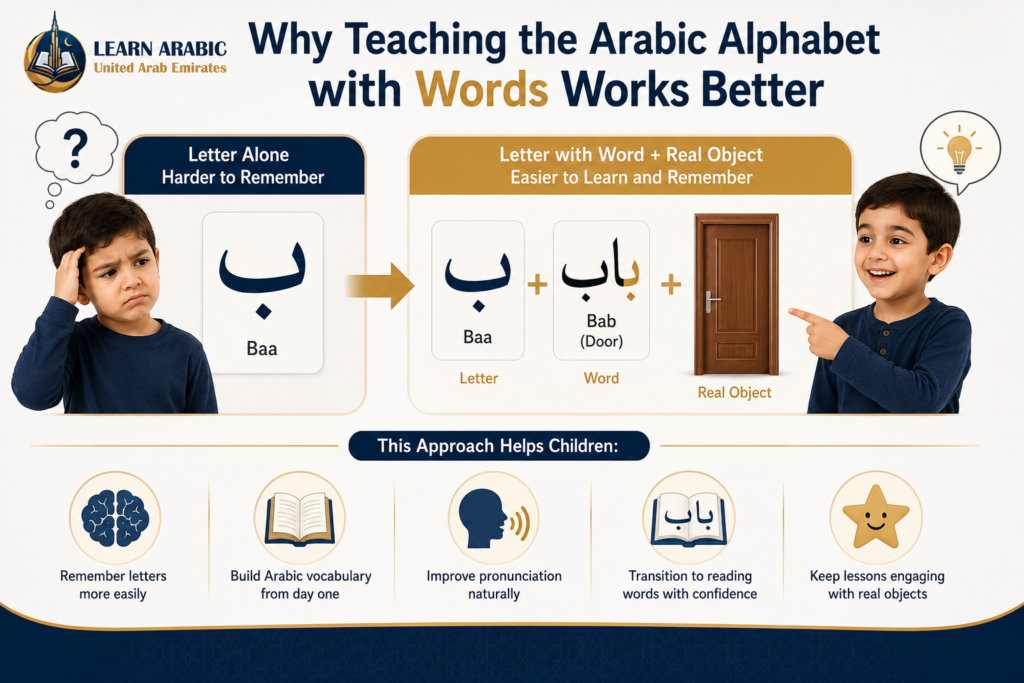
A more effective method is to teach every letter alongside a simple Arabic word. For example, instead of introducing ب (Baa) on its own, pair it with باب (Bab – Door) and point to an actual door. This creates three connections at once: the letter, its sound, and its meaning.
This approach helps children:
- Remember letters more easily.
- Build Arabic vocabulary from day one.
- Improve pronunciation naturally.
- Transition from recognizing letters to reading words with greater confidence.
It also keeps lessons more engaging because children interact with real objects instead of memorizing abstract symbols.
Understanding the Four Forms of Arabic Letters
One of the biggest questions parents ask is:
“Why does the same Arabic letter look different in words?”
Unlike English letters, Arabic letters change their appearance depending on where they appear in a word.
Every letter may have four forms:
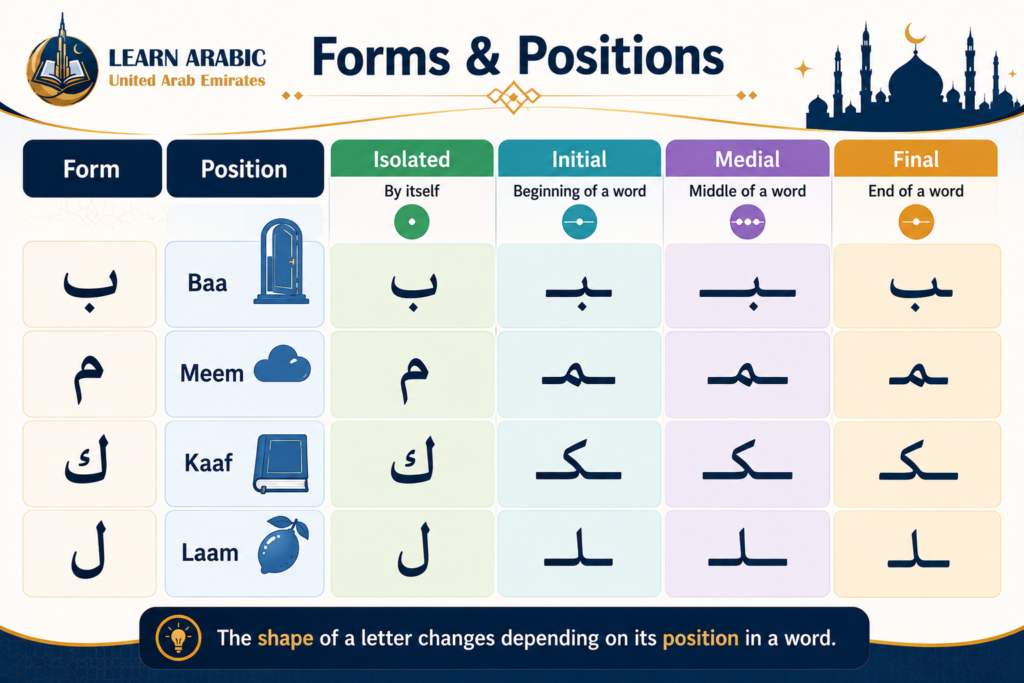
The important thing to remember is that although the shape changes, it is still the same letter with the same sound.
Children do not need to memorize every form during the first week. As they begin reading simple words, these different forms become familiar naturally.
Common Mistakes Parents Make When Teaching the Arabic Alphabet
Many children struggle with Arabic not because the language is difficult, but because of the teaching approach.
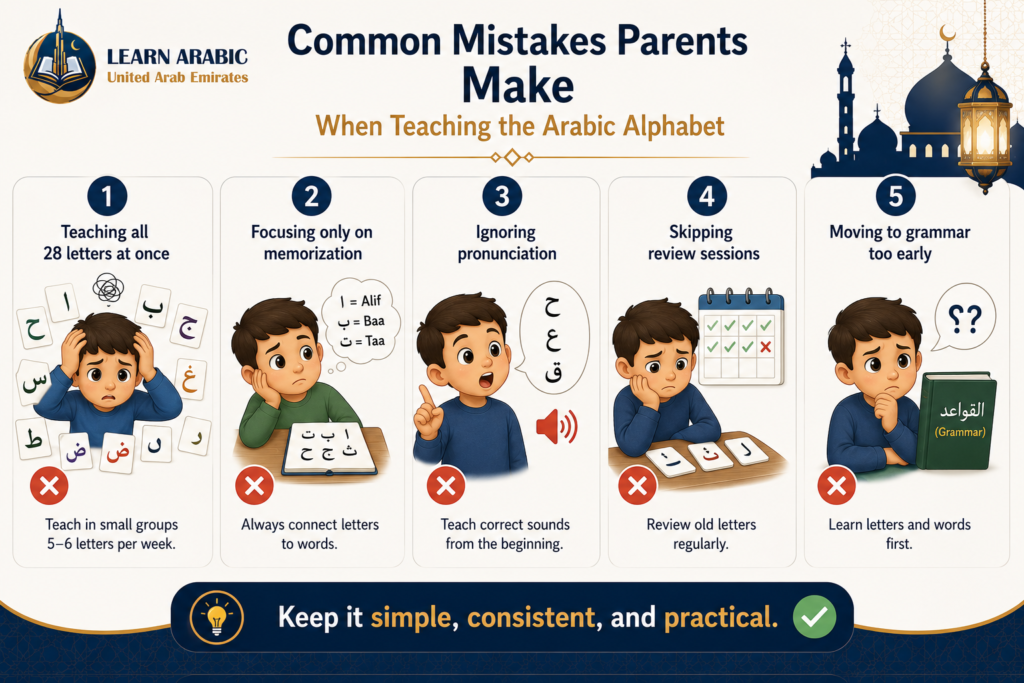
Here are the most common mistakes to avoid.
1. Teaching all 28 letters at once
Children learn much faster in small groups. Five or six letters per week is usually enough.
2. Focusing only on memorization
Memorizing letter names without using words makes lessons harder to remember Always connect letters to vocabulary.
3. Ignoring pronunciation
Some Arabic sounds, such as ح, ع, and ق, do not exist in English Teaching the correct pronunciation from the beginning prevents difficult habits later.
4. Skipping review sessions
Children need repetition Spend as much time reviewing old letters as introducing new ones.
5. Moving to grammar too early
Grammar becomes much easier after children can confidently recognize letters and read simple words.
Once your child begins reading short Arabic words comfortably, introducing basic sentence structure becomes much more enjoyable. Our Arabic Grammar for Kids program helps young learners make that transition gradually through interactive lessons and age-appropriate activities.
Join Our Arabic Grammar Course for Kids in the UAE with a FREE Trial
Read Also: Essential Khaleeji Arabic Phrases Every Expat Needs to Know
A Simple Weekly Arabic Learning Plan
You don’t need long lessons to make steady progress.
A consistent weekly routine often produces better results than occasional intensive study.
| Day | Activity |
| Monday | Introduce two new letters with their words |
| Tuesday | Practice pronunciation and tracing |
| Wednesday | Review previous letters using flashcards |
| Thursday | Play vocabulary or matching games |
| Friday | Read simple words and tell a short story |
| Weekend | Listen to Arabic pronunciation and review everything learned |
Adjust the pace according to your child’s progress. Some children master four letters in a week, while others may need additional review before moving on. Consistency matters far more than speed.
Read Also: How to Learn Khaleeji Arabic in the UAE?
See Our Classroom Environment in Action
Experience a sneak peek into our live sessions. Watch the video below to see our specialized instructors interacting with students, breakdown complex texts, and cultivate an engaging, respectful learning environment.
Master Arabic in the UAE
Experience world-class Arabic language training designed for students and professionals in the Emirates.
Book Your Free TrialRead Also: 10 Steps to Learning Arabic Numbers for Kids in the UAE
Start Your Child’s Arabic Journey with Learn Arabic UAE
Teaching the Arabic alphabet at home is one of the greatest gifts you can give your child. It lays the foundation for reading Arabic confidently, understanding the Quran, and developing lifelong language skills.
However, building that foundation requires more than memorizing letters. Children need correct pronunciation, structured practice, engaging activities, and regular revision to make lasting progress.
At Learn Arabic UAE, our experienced teachers guide children through every stage of learning—from recognizing their first letter to reading complete Arabic words with confidence. Lessons include interactive activities, vocabulary building, pronunciation practice, games, and personalized support designed specifically for young learners.
Whether your child is just beginning with Alif or is ready to start reading, we’re here to make the learning journey enjoyable and effective.
Book a free trial lesson today and help your child build a strong Arabic foundation that will benefit them for years to come.
Our Arabic courses
- Arabic Course in the UAE
- Arabic Intensive Course
- Arabic Classes for Beginners (Learn Arabic from Scratch)
- Madinah Arabic Course
- Arabic Classes for Adults
- Self-Paced Arabic Course
- Arabic Speaking Classes
- Learn to Write Arabic Course
- Arabic Grammar Course

Conclusion
Teaching your child the arabic alphabet for kids is one of the most valuable investments you can make in their language-learning journey. By introducing each letter with meaningful words, clear pronunciation, and engaging activities, you help your child build a strong foundation for reading, writing, and understanding Arabic with confidence. The key is to keep lessons short, consistent, and enjoyable so learning becomes a natural part of your daily routine.
Remember that every child learns at their own pace, and steady progress matters more than speed. If you’d like additional support, the experienced teachers at Learn Arabic UAE provide structured, interactive lessons that guide children from their first Arabic letter to reading complete words and sentences. Start with a free trial lesson today and give your child the confidence to succeed in Arabic from the very beginning.
Frequently Asked Questions
How many letters are in the Arabic alphabet?
The Arabic alphabet has 28 letters, starting with Alif (ا) and ending with Ya (ي). Each letter represents a specific sound and may change shape depending on its position in a word.
What is the best way to teach the Arabic alphabet to kids?
The most effective approach is to teach each letter with a simple word, clear pronunciation, and a visual example. This helps children remember both the letter and its meaning more easily.
At what age should children start learning the Arabic alphabet?
Most children can begin learning Arabic letters between 4 and 6 years old. Younger children can also start through stories, pictures, and simple vocabulary activities.
How many Arabic letters should children learn each week?
Teaching 5–7 letters per week gives children enough time to practice, review, and remember each letter before moving on to new ones.
Should children learn vocabulary while learning the alphabet?
Yes. Learning vocabulary alongside the alphabet improves memory, pronunciation, and reading readiness because children immediately understand how each letter is used.
When should children start learning Arabic grammar?
Grammar should come after children recognize the letters and can comfortably read simple Arabic words. Building strong reading skills first makes grammar much easier to understand later.



Leave a Reply