 Learn Arabic
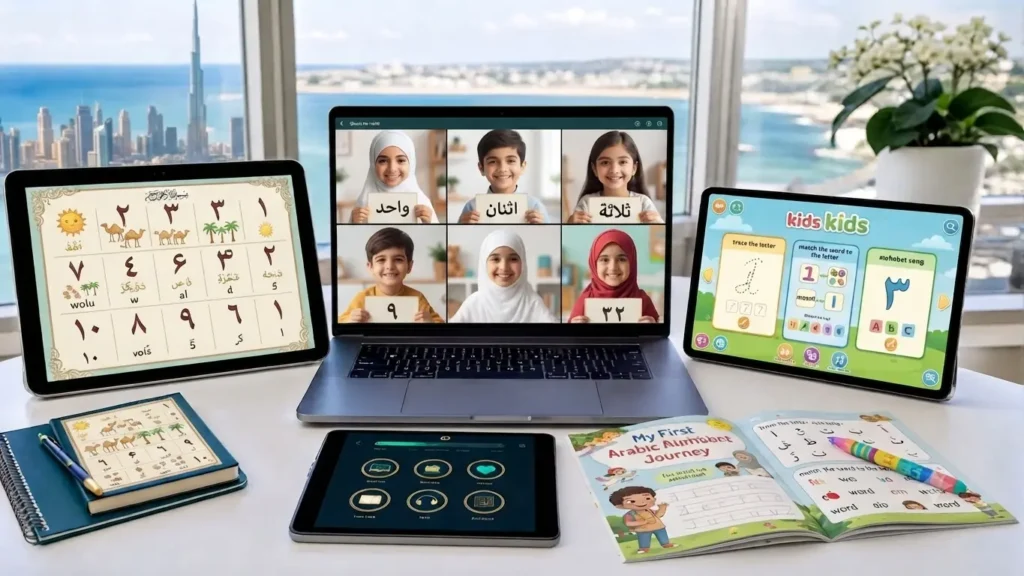
Learning Arabic numbers is one of the first and most practical milestones in a child’s Arabic language journey. For children growing up in the UAE, recognising Eastern Arabic numerals is more than an academic skill—it is part of everyday life, from reading road signs and prayer time boards to understanding prices, dates, and school materials.
By combining age-appropriate activities, everyday practice, and structured guidance, parents can help their children develop lasting confidence with Arabic numbers.
In this guide, you’ll learn how to teach Arabic numbers step by step, avoid common learning mistakes, and help your child use them naturally in real-life situations across the UAE.
1. Recognise Eastern Arabic Numerals and Understand How They Differ From Western Digits
The first thing to do when teaching Arabic numbers for kids in the UAE is show both number scripts side by side — not one at a time.
UAE children encounter two number systems every single day. Eastern Arabic numerals (٠ ١ ٢ ٣ ٤ ٥ ٦ ٧ ٨ ٩) appear on government signs, mosque prayer boards, Arabic-medium school textbooks, and Quran pages. Western Arabic numerals (0 1 2 3 4 5 6 7 8 9) appear on international shop menus, English-school materials, and global apps. Teaching them separately creates confusion when a child sees both scripts on the same UAE street sign or shop receipt.
Start with a side-by-side chart on the fridge:
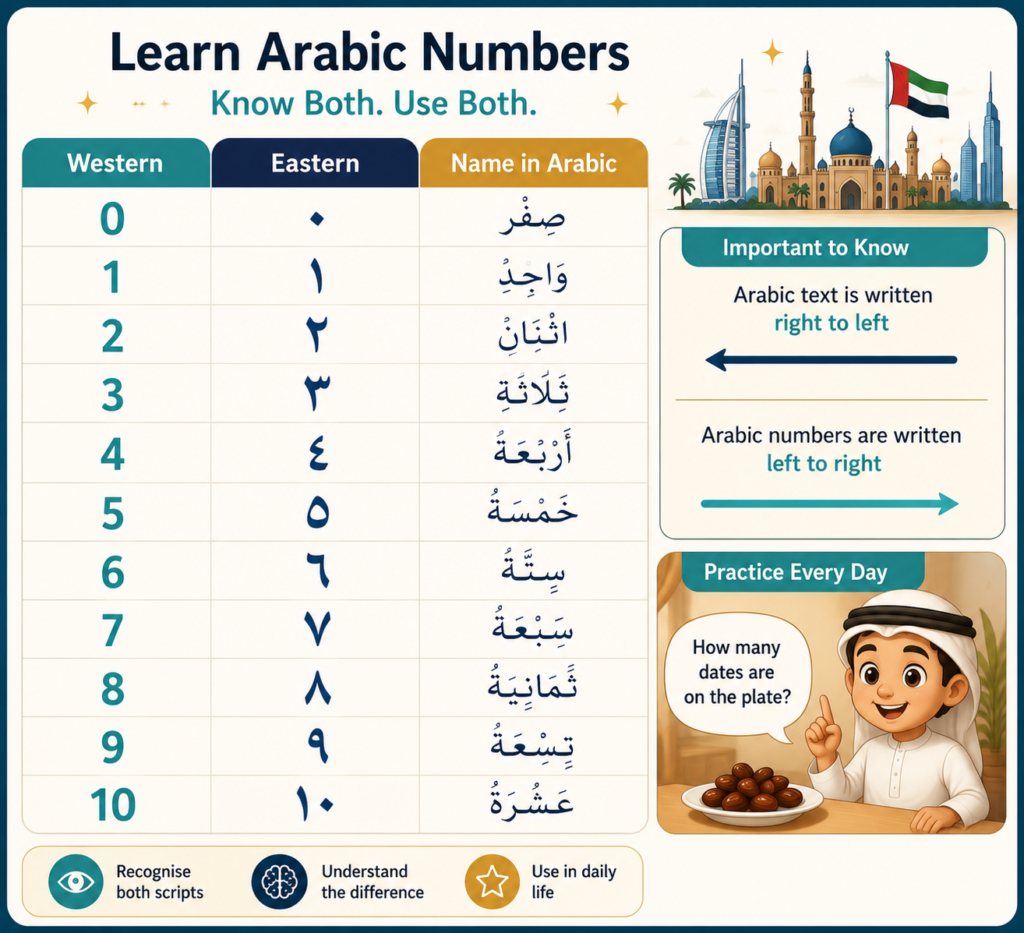
One critical difference children must learn early: although Arabic text is written right to left, Arabic numbers are written left to right — exactly like English. This surprises many learners and is worth stating clearly from day one to prevent writing errors.
Point to the chart during natural daily moments — not in a formal lesson. “How many dates are on the plate? Let’s find the number.” That level of exposure is sufficient for the first week.
Read also: The Letter Ghayn in Arabic غ — Pronunciation, Forms, Rules, and Practice
2. Learn the Correct Pronunciation of Every Arabic Number
Knowing the shape of a number and being able to say it aloud are two separate skills. Children in the UAE need both — because they will be reading prices, asking for quantities, and answering “how many?” questions in Arabic long before they sit a formal Arabic exam.
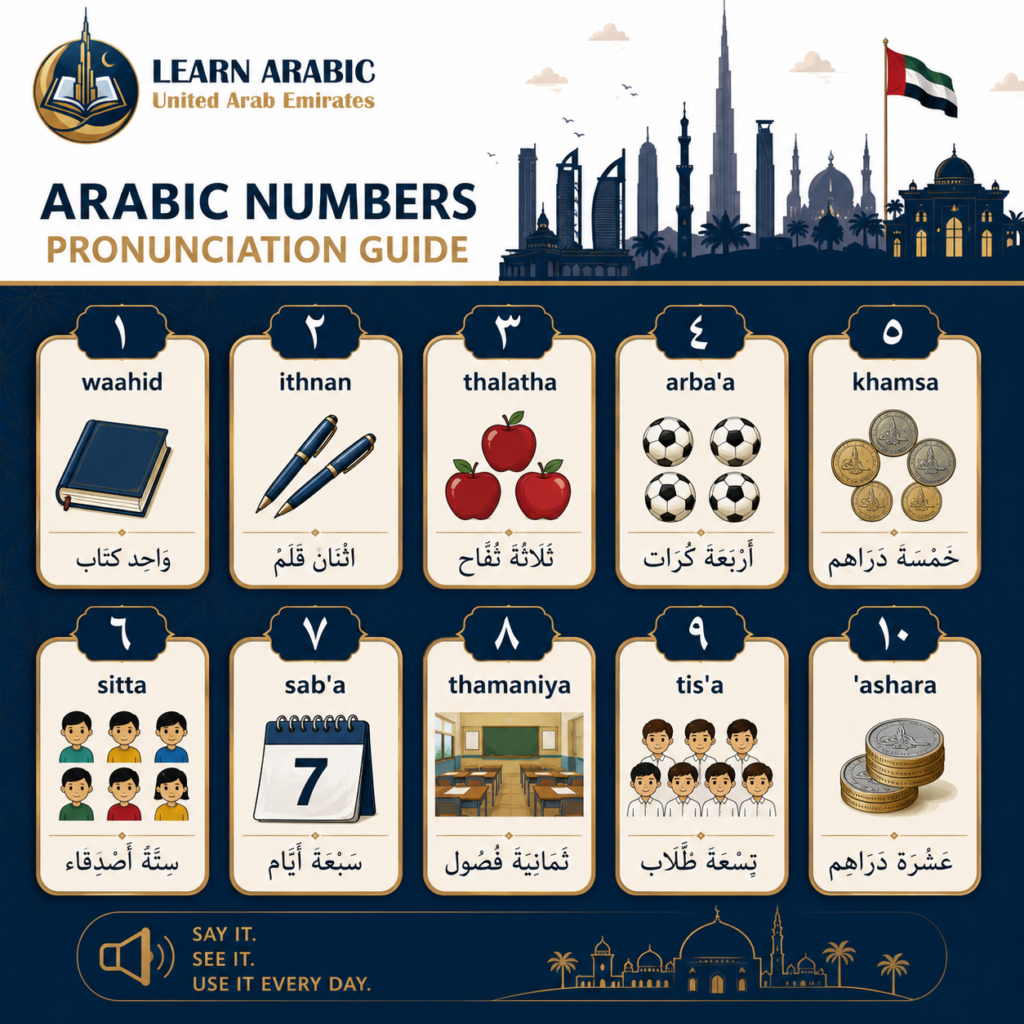
Here is a full pronunciation guide with child-friendly context examples drawn directly from UAE daily life:
| Number | Pronunciation | Child-Friendly Example |
| ١ | waahid | وَاحِد كِتَاب — one book |
| ٢ | ithnan | اثْنَان قَلَم — two pens |
| ٣ | thalatha | ثَلَاثَة تُفَّاح — three apples |
| ٤ | arba’a | أَرْبَعَة كُرَات — four balls |
| ٥ | khamsa | خَمْسَة دَرَاهِم — five dirhams |
| ٦ | sitta | سِتَّة أَصْدِقَاء — six friends |
| ٧ | sab’a | سَبْعَة أَيَّام — seven days |
| ٨ | thamaniya | ثَمَانِيَة فُصُول — eight classrooms |
| ٩ | tis’a | تِسْعَة طُلَّاب — nine students |
| ١٠ | ‘ashara | عَشَرَة دَرَاهِم — ten dirhams |
Pronunciation tip for parents: Arabic vowels are short and clipped — not drawn out the way English vowels often are. The “th” in thalatha and ithnan is the soft dental sound, as in the English word “the,” not a hard “t.” Saying each number aloud while pointing to objects around the room takes less than two minutes and is worth doing daily during the first month.
Step Inside Our Classrooms
Don’t just take our word for it—see our community in action. Click below to watch real, live snippets from our recent classes and experience our engaging teaching style firsthand!
Master Arabic in the UAE
Experience world-class Arabic language training designed for students and professionals in the Emirates.
Book Your Free Trial3. Discover the Best Age to Start Learning Arabic Numbers
There is no single right age to begin — but there is a clear sequence of what children can meaningfully learn at each stage. Starting too early with grammar rules causes frustration; starting too late with only counting drills leaves children unable to use numbers in real speech.
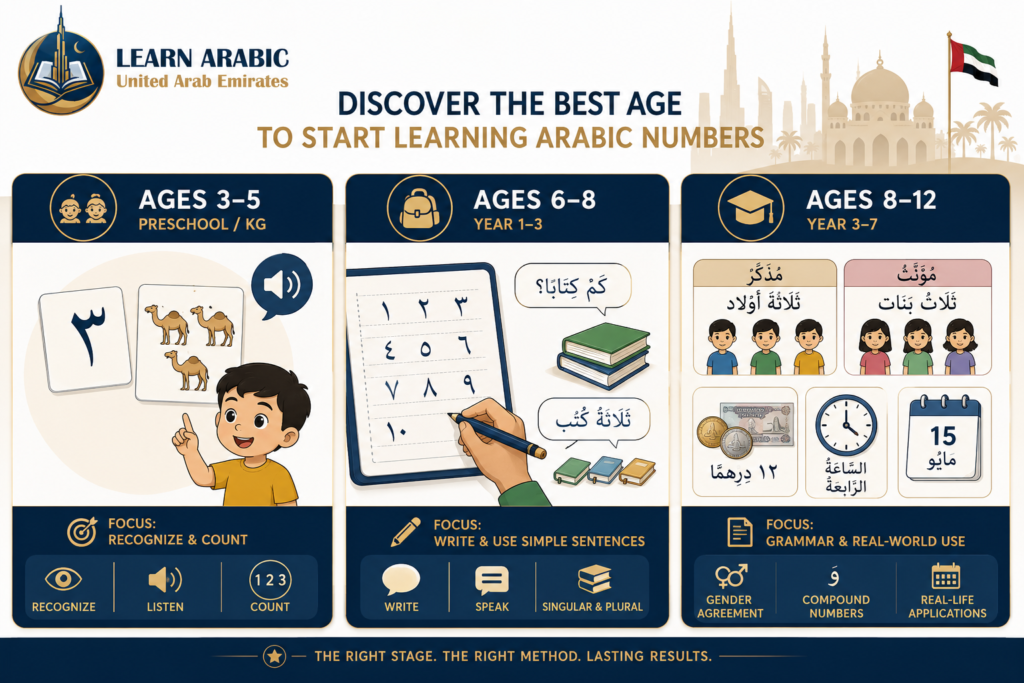
Ages 3–5 (Preschool / KG in UAE schools):
Focus entirely on digit recognition and spoken counting. Show Eastern Arabic numerals alongside pictures of quantities. Matching ٣ to a picture of three camels is the right level. No grammar, no writing yet. Arabic courses for kids designed for this age group use visual and audio methods exclusively — no reading or writing expected.
Ages 6–8 (Year 1–3 in UAE primary schools):
Introduce writing Eastern Arabic numerals through tracing. Begin basic counting sentences: “كَمْ كِتَابًا؟ — ثَلَاثَة كُتُب” (How many books? — Three books). Introduce the difference between singular and plural at this stage, but not gender polarity yet.
Ages 8–12 (Year 3–7 in UAE primary and middle schools):
Introduce the full gender agreement system (Step 5 below), compound numbers using وَ (Step 6), and real-world applications such as reading dirham values, clock times, and calendar dates. This age group benefits most from structured Arabic grammar for kids courses that sequence these rules without overwhelming learners.
The most common mistake parents make is applying Year 3 grammar expectations to a five-year-old. Match the step to the age, and progress feels natural rather than forced.
Join Our Arabic Grammar Course for Kids in the UAE with a FREE Trial
Read also: The Arabic letter ha ح – The Complete Guide to Pronunciation, Writing, and Mastery

4. Practise Counting Everyday Objects Using Arabic Vocabulary
Isolated counting drills — reciting one, two, three with no object attached — produce very little lasting retention. Children lock in Arabic numbers when they count real things, in real contexts, using vocabulary that comes up in their actual daily lives in the UAE.
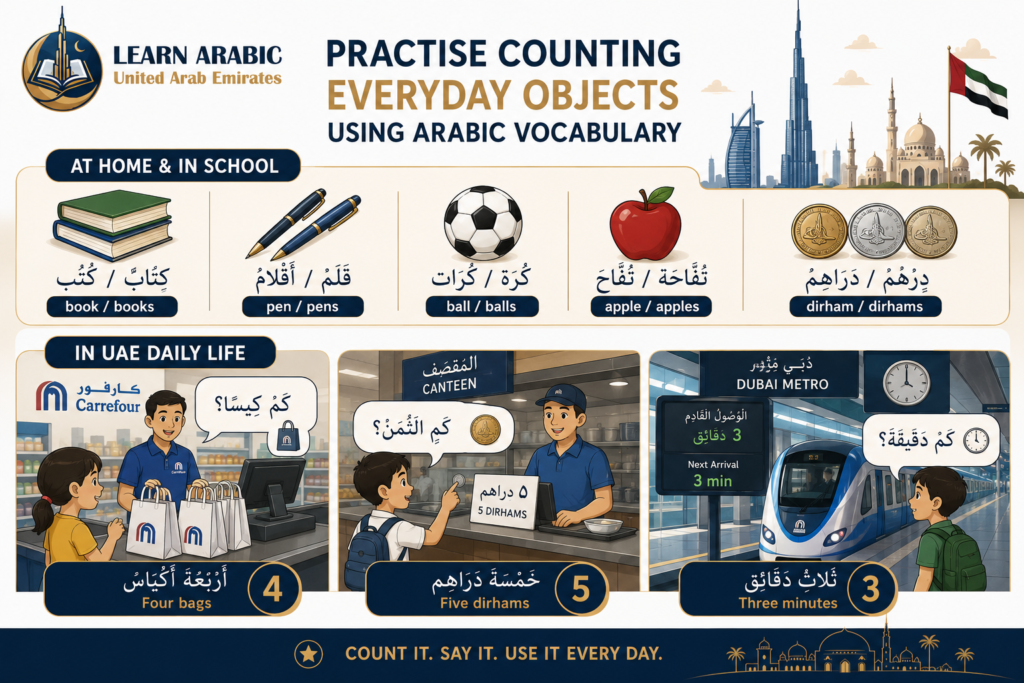
Start with objects already in your home and in your child’s school bag:
- كِتَاب / كُتُب — book / books
- قَلَم / أَقْلَام — pen / pens
- كُرَة / كُرَات — ball / balls
- تُفَّاحَة / تُفَّاح — apple / apples
- دِرْهَم / دَرَاهِم — dirham / dirhams
Then move the practice into UAE daily settings:
At the Carrefour checkout: “كَمْ كِيسًا؟ — أَرْبَعَة أَكْيَاس” (How many bags? — Four bags)
At the school canteen: “كَمِ الثَّمَن؟ — خَمْسَة دَرَاهِم” (How much does it cost? — Five dirhams)
Reading a Dubai Metro timetable: “كَمْ دَقِيقَة؟ — ثَلَاث دَقَائِق” (How many minutes? — Three minutes)
These are not invented scenarios — they are conversations UAE children have or overhear every week. Practising them at home takes five minutes and makes real-world encounters feel familiar rather than intimidating.
5. Understand Basic Arabic Number Grammar
This is the step most resources skip — and it is the exact reason many children can count fluently in Arabic but cannot use numbers correctly in a sentence.
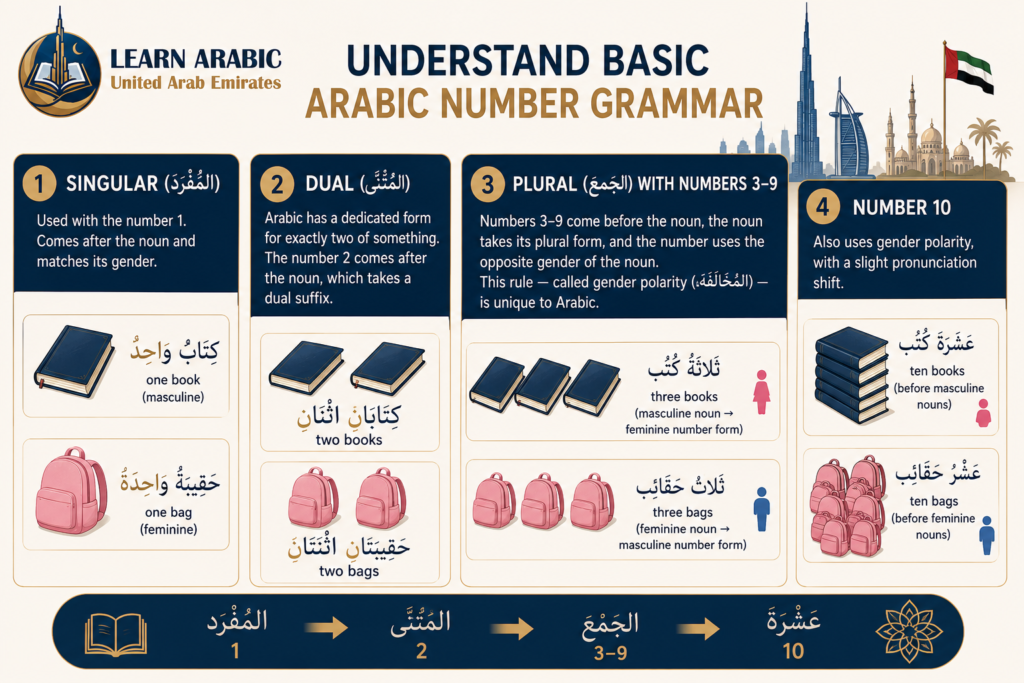
Arabic numbers follow a layered grammar system. Here is how each layer works:
Singular (المُفْرَد): Used with the number 1. Comes after the noun and matches its gender:
- كِتَابٌ وَاحِد — one book (masculine)
- حَقِيبَةٌ وَاحِدَة — one bag (feminine)
Dual (المُثَنَّى): Arabic has a dedicated grammatical form for exactly two of something — unique among major world languages. The number 2 comes after the noun, which takes a dual suffix:
- كِتَابَانِ اثْنَان — two books
- حَقِيبَتَانِ اثْنَتَان — two bags
Plural (الجَمْع) with numbers 3–10 — the gender polarity rule: Numbers 3–9 come before the noun, the noun takes its plural form, and the number uses the opposite gender of the noun. This rule — called gender polarity (المُخَالَفَة) — is unique to Arabic and is the most common point of error:
- ثَلَاثَة كُتُب — three books (masculine noun → feminine number form: ثَلَاثَة)
- ثَلَاثُ حَقَائِب — three bags (feminine noun → masculine number form: ثَلَاثُ)
Number 10: Also uses gender polarity, with a slight pronunciation shift:
- عَشَرَة كُتُب — ten books (before masculine nouns)
- عَشْرُ حَقَائِب — ten bags (before feminine nouns)
Introduce singular and dual at ages 6–8, and gender polarity from age 8 onwards. Attempting gender polarity with a six-year-old before they are comfortable with basic counting produces confusion, not fluency.
Structured Best Online Arabic Tutors sequence content specifically to prevent these errors from forming in the first place.
Learn with the Best Online Arabic Tutors in the UAE with a FREE Trial

6. Write Arabic Numerals Correctly Through Tracing Practice
Writing Eastern Arabic numerals requires more than copying shapes. Digits such as ٤, ٦, and ٧ often confuse beginners because they look very different from Western numbers, so regular tracing helps children develop accurate handwriting and number recognition.
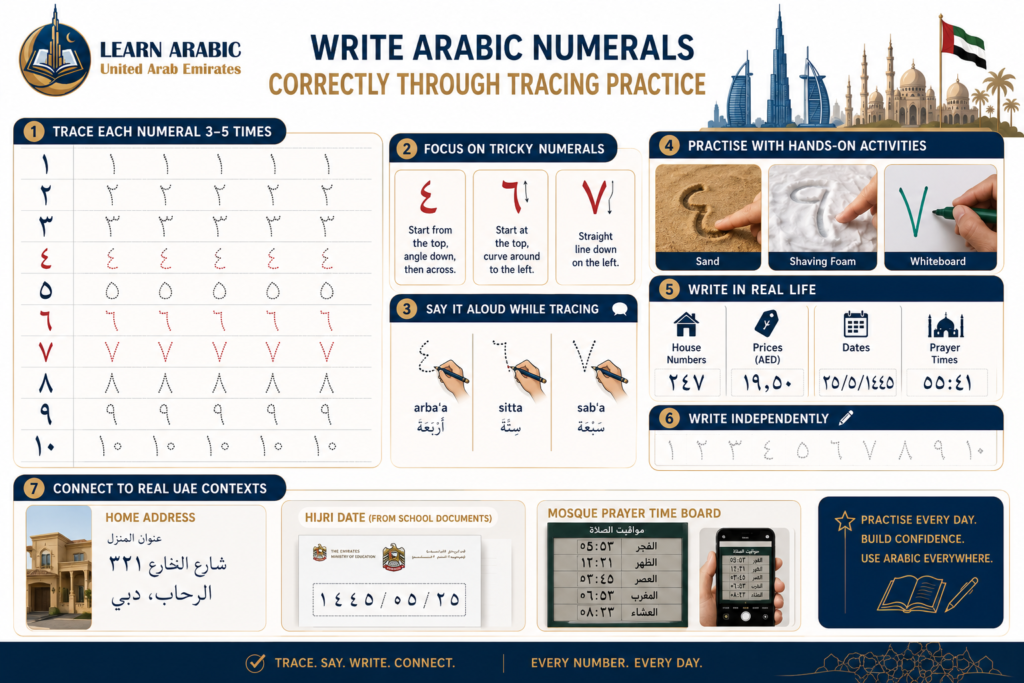
- Trace each numeral three to five times while saying its name aloud to reinforce visual, verbal, and motor memory.
- Give extra attention to ٤, ٦, and ٧, as they are the digits children confuse most often.
- Start with large dotted numerals, then gradually move to freehand writing as confidence improves.
- Use real-life examples by writing house numbers, prices, dates, or prayer times commonly seen around the UAE.
- Encourage hands-on activities such as tracing numbers in sand, shaving foam, or on a whiteboard to strengthen fine motor skills.
- Finish each session by asking your child to write the numbers independently without tracing to check progress and build confidence.
Ask children to copy their home address in Eastern Arabic numerals, write the current Hijri date (shown on official UAE school documents), or transcribe a mosque prayer time board they photographed on their phone. Connecting tracing exercises to real UAE documents gives handwriting practice a purpose beyond the worksheet.
Read also: Arabic Alphabet for Kids
7. Use Arabic Numbers in Daily UAE Life
The single most effective strategy for learning Arabic numbers in the UAE is to use the environment your child already lives in. Eastern Arabic numerals are embedded in UAE daily life in ways that create natural daily reading practice with no additional materials required.
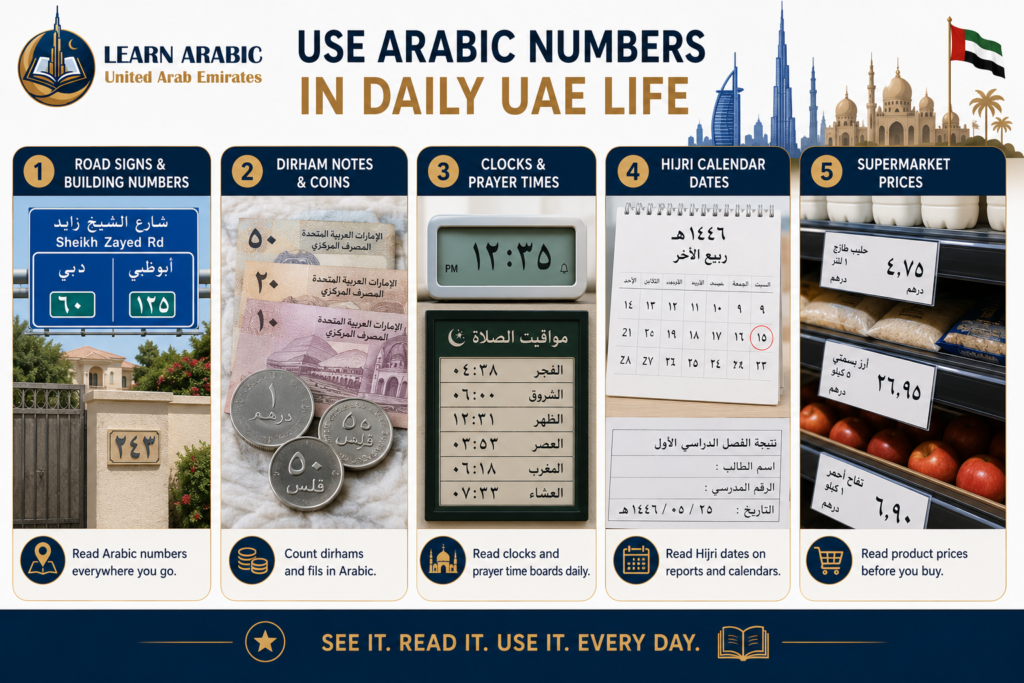
Road signs and building numbers:
Encourage your child to read Eastern Arabic numerals on road signs, villa numbers, and building entrances across the UAE. This simple habit turns every journey into a practical reading lesson.
Dirham notes and coins:
Let your child count UAE dirhams and fils in Arabic while shopping or paying for small purchases. This strengthens number recognition while introducing basic money skills.
Clocks and prayer times:
Ask your child to read digital clocks and mosque prayer time boards that display Eastern Arabic numerals. Daily repetition improves both pronunciation and confidence.
Hijri calendar dates:
Point out Hijri dates on UAE school reports, government documents, and calendars. Reading these dates helps children connect Arabic numbers with their cultural and educational environment.
Supermarket prices:
Encourage your child to read product prices in Arabic before placing items in the shopping basket. Everyday shopping becomes a fun and meaningful way to practise Arabic numbers.
Arabic courses in the UAE integrate this environment-based approach because rote memorisation without real-world anchoring rarely produces lasting fluency.
Start Our Arabic Course in the UAE with a FREE Trial

8. Build Number Vocabulary Through Games and Interactive Activities
Children remember Arabic numbers better when they learn through play. Fun, hands-on activities encourage active recall and make learning more enjoyable.
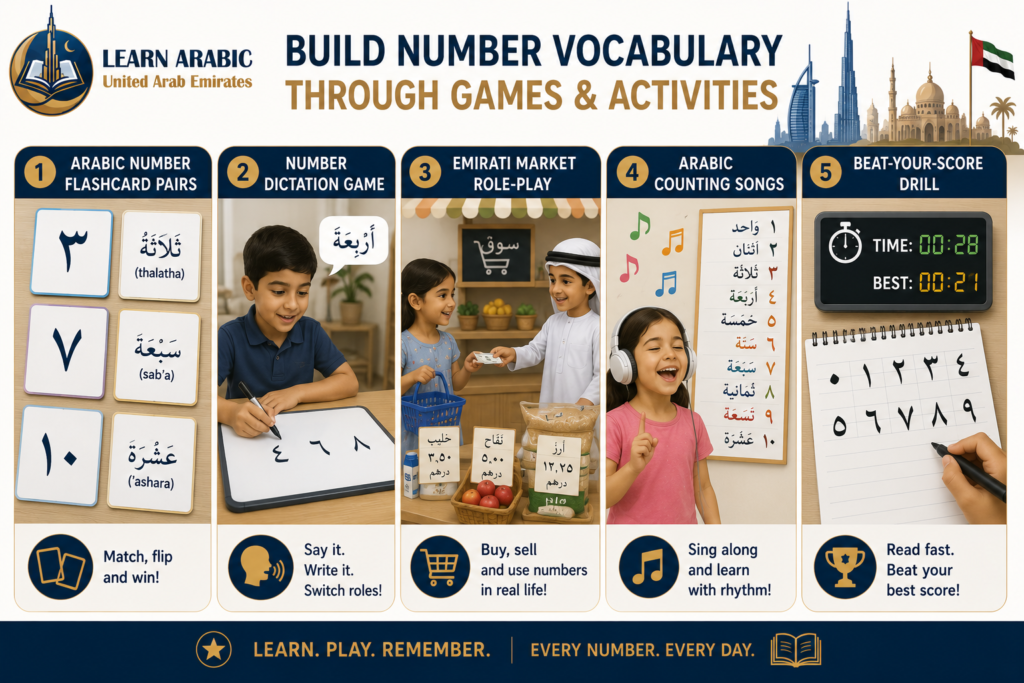
Arabic number flashcard pairs:
Use flashcards with Eastern Arabic numerals on one side and their names on the other. Matching and memory games help children recognise numbers quickly.
Number dictation game:
Say a number in Arabic and ask your child to write it, then switch roles. This improves both listening skills and accurate numeral writing.
Emirati market role-play:
Label household items with prices in UAE dirhams using Eastern Arabic numerals. Let children practise buying and selling to use numbers in realistic conversations.
Arabic counting songs:
Sing Arabic number songs during car rides or playtime to improve pronunciation and memorisation. Rhythm makes numbers easier for young learners to remember.
Beat-your-score drill:
Time your child as they read or name the numbers from ٠ to ٩, then encourage them to beat their previous score. This builds confidence, fluency, and quick recall.
Avoid Common Mistakes When Learning Arabic Numbers
Understanding where learning typically goes wrong is as valuable as knowing what to teach. These are the four mistakes that appear most consistently among children learning Arabic numbers in the UAE — and exactly how to address each one.
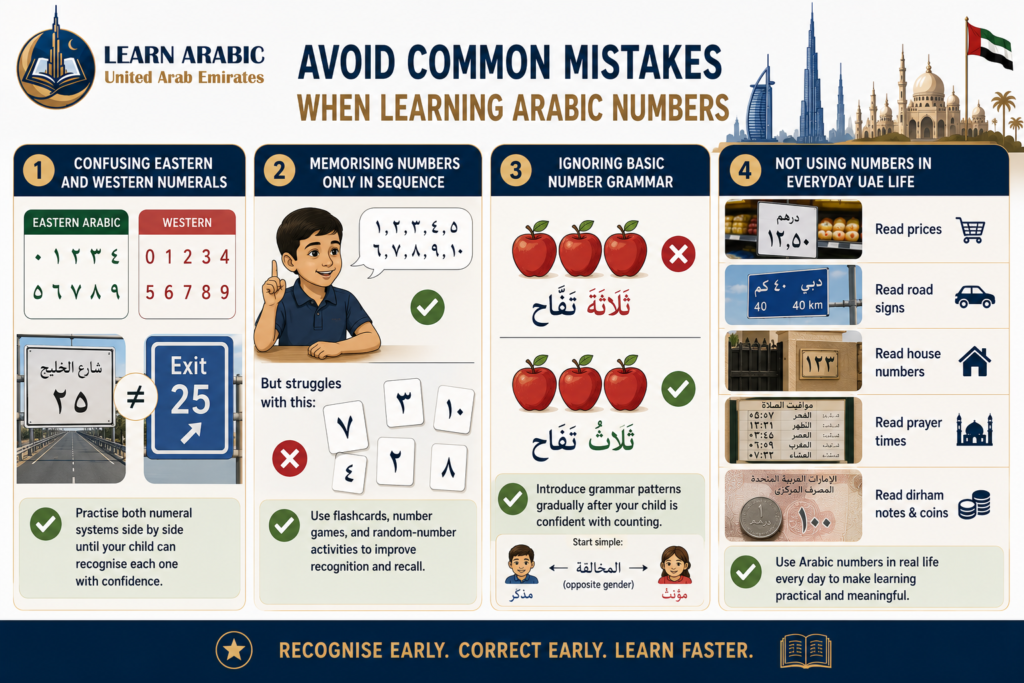
Mistake 1: Confusing Eastern and Western Numerals
Many children mix up Eastern Arabic numerals (٠–٩) with Western digits (0–9), especially when both appear on UAE school worksheets or signs. Practise both numeral systems side by side until your child can recognise each one with confidence.
Mistake 2: Memorising Numbers Only in Sequence
A child may count from 1 to 10 perfectly but struggle to identify a single number shown on its own. Use flashcards, number games, and random-number activities to improve recognition and recall.
Mistake 3: Ignoring Basic Number Grammar
As children progress, they need to learn how numbers work with nouns, including simple gender agreement rules. Introduce these grammar patterns gradually after your child is confident with counting.
Read Also: Essential Khaleeji Arabic Phrases Every Expat Needs to Know
Mistake 4: Not Using Numbers in Everyday UAE Life
Children learn faster when they apply Arabic numbers outside the classroom. Encourage them to read prices, road signs, house numbers, prayer times, and UAE dirham notes to make learning practical and meaningful.
Recognising these errors early — before they become habits — saves significant remediation time later.
Read Also: How to Learn Khaleeji Arabic in the UAE?
See Our Classroom Environment in Action
Experience a sneak peek into our live sessions. Watch the video below to see our specialized instructors interacting with students, breakdown complex texts, and cultivate an engaging, respectful learning environment.
Master Arabic in the UAE
Experience world-class Arabic language training designed for students and professionals in the Emirates.
Book Your Free TrialRead Also: Arabic Alphabet for Kids
Help Your Child Master Arabic Numbers with Expert Arabic Teachers
Your child now has the roadmap to learn, read, write, and use Arabic numbers with confidence. The next step is practising these skills through structured lessons with experienced teachers who make learning fun, interactive, and age-appropriate.
At Learn Arabic UAE, our native-level Arabic instructors help children master Eastern Arabic numerals, correct pronunciation, counting, number grammar, and everyday conversations through engaging one-to-one online lessons. Every class is tailored to your child’s age and learning level, ensuring steady progress and lasting confidence.
Book a FREE trial lesson today and start your child’s Arabic learning journey with Learn Arabic UAE.
Our Arabic courses
- Arabic Course in the UAE
- Arabic Intensive Course
- Arabic Classes for Beginners (Learn Arabic from Scratch)
- Madinah Arabic Course
- Arabic Classes for Adults
- Self-Paced Arabic Course
- Arabic Speaking Classes
- Learn to Write Arabic Course
- Arabic Grammar Course

Conclusion
Learning Arabic numbers for kids in the UAE becomes straightforward when these ten steps are followed in sequence. Start with side-by-side script recognition, move through pronunciation and age-appropriate counting practice, introduce grammar only once counting is solid, and use the UAE environment — its signs, prices, clocks, currency, and mosque boards — as a free daily classroom.
The children who progress fastest are not the ones who study the longest. They are the ones whose parents make Arabic numbers visible, useful, and connected to daily life in the UAE consistently over weeks and months. The ten steps in this guide give you the structure to do exactly that.
Frequently Asked Questions
What is the best age to start learning Arabic numbers for kids in the UAE?
Children can begin recognising Eastern Arabic numerals from age 3–4 through picture matching and counting songs. Formal writing practice suits ages 6–8. Grammar rules — including gender agreement and plural forms — are best introduced from age 8, once digit recognition and basic counting are fully secure.
What is the difference between Eastern and Western Arabic numerals?
Eastern Arabic numerals (٠١٢٣٤٥٦٧٨٩) are used throughout the UAE on government signs, mosque boards, Arabic-medium school materials, and Quran pages. Western Arabic numerals (0–9) are used globally in international contexts. UAE children encounter both daily and need confident recognition of each.
Why do Arabic numbers have masculine and feminine forms?
Arabic is a grammatically gendered language — every noun is either masculine or feminine. Numbers 3–9 use a form that is the opposite gender of the noun they describe, a rule called gender polarity. This applies to everyday UAE speech and is one of the features that separates fluent Arabic number use from mechanical counting.
How do I help my child practise Arabic numbers at home in the UAE?
Use real UAE materials — dirham notes and coins, supermarket receipts, mosque prayer time boards, lift buttons, and school report card dates. Ask your child to read any Eastern Arabic numeral they encounter and say it aloud in Arabic. Five minutes of this daily, consistently, produces faster retention than any worksheet.
Are Arabic numbers used in the Quran?
Yes. Surah numbers, verse counts, and juz divisions in the Quran all use Eastern Arabic numerals. A child who reads Eastern Arabic digits confidently can navigate the Quran’s structure independently — locating surahs, counting verses, and following along during recitation without needing a parent’s help at every step.
How long does it take to learn Arabic numbers 1–100?
Most children aged 7–10 reach confident recognition of numbers 1–100 within 8–12 weeks of daily 10–15 minute practice. Digits 1–10 typically take one to two weeks. Compound numbers (11–99) require the وَ connector pattern and correct pronunciation of tens — عشرون، ثلاثون، أربعون — which follows a regular pattern and becomes predictable within two to three weeks of consistent practice.



Leave a Reply