 Learn Arabic

Most Arabic learners expect the alphabet to be the easy part. Then they meet ح.
This single letter has no equivalent in English, no shortcut from a familiar sound, and no workaround that actually works. Replacing it with a regular English “h” does not just sound slightly off — in Arabic, it can change the word’s meaning entirely. حال (ḥāl — condition) and هال (hāl — cardamom) are two completely different words separated by one sound most beginners cannot yet hear.
The good news: ح is entirely learnable. It has a precise, definable articulation point, consistent written forms, and predictable behaviour across all vowel combinations. This guide covers all of it — from the anatomy of the sound to writing practice, vowel drills, vocabulary, and the comparisons that matter most.
What Is the Arabic Letter ح (Haa)?
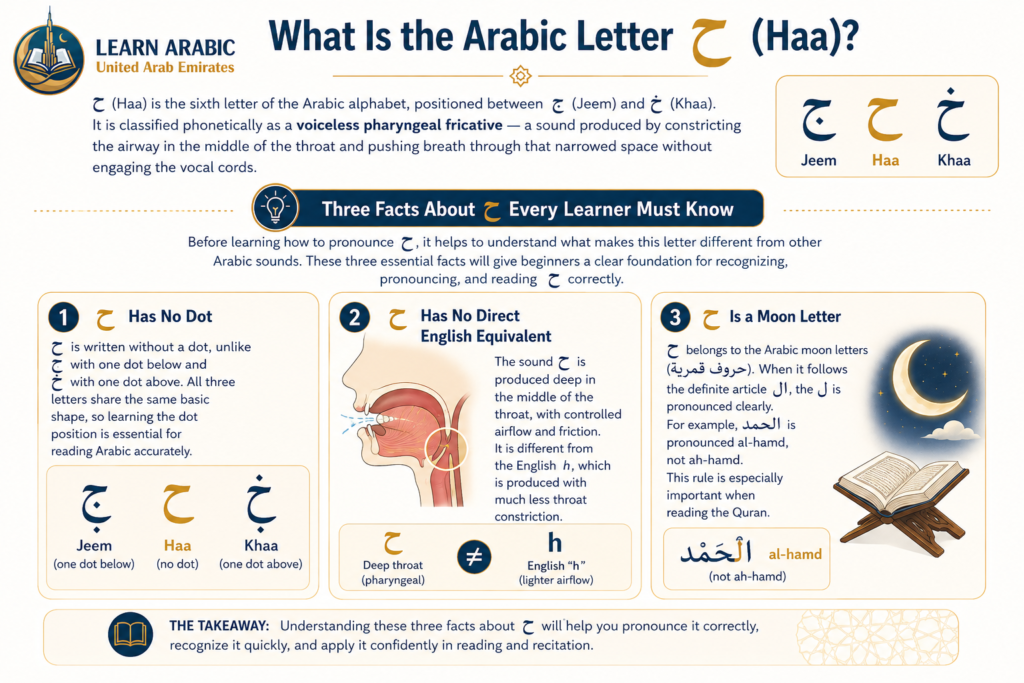
ح (Haa) is the sixth letter of the Arabic alphabet, positioned between ج (Jeem) and خ (Khaa). It is classified phonetically as a voiceless pharyngeal fricative — a sound produced by constricting the airway in the middle of the throat and pushing breath through that narrowed space without engaging the vocal cords.
Three Facts About ح Every Learner Must Know
Before learning how to pronounce ح, it helps to understand what makes this letter different from other Arabic sounds. These three essential facts will give beginners a clear foundation for recognizing, pronouncing, and reading ح correctly.
1. ح Has No Dot: ح is written without a dot, unlike ج with one dot below and خ with one dot above. All three letters share the same basic shape, so learning the dot position is essential for reading Arabic accurately.
2. ح Has No Direct English Equivalent: The sound ح is produced deep in the middle of the throat, with controlled airflow and friction. It is different from the English h, which is produced with much less throat constriction. This is why replacing ح with a regular English “h” can affect pronunciation and meaning.
3. ح Is a Moon Letter: ح belongs to the Arabic moon letters (حروف قمرية). When it follows the definite article ال, the ل is pronounced clearly. For example, الحَمْد is pronounced al-hamd, not ah-hamd. This rule is especially important when reading the Quran.
Read also: Arabic Alphabet for Kids
The Articulation Point of ح: Understanding the Throat’s Three Zones
To pronounce ح correctly, you need to understand where in the throat it originates. Classical Arabic phonetics divides the throat into three distinct zones, each producing different sounds:
| Zone | Arabic Term | Location | Letters Produced |
| Deep throat | أقصى الحلق (aqsa al-halq) | Lowest part, near the chest | ه، أ |
| Middle throat | وسط الحلق (wasat al-halq) | Centre of the throat | ح، ع |
| Upper throat | أدنى الحلق (adna al-halq) | Closest to the mouth | غ، خ |
ح originates from the middle throat (وسط الحلق). This is the precise point — not the deep throat like ه, and not the upper throat like خ. Understanding this triangulation is the key to producing the sound correctly and distinguishing it from both neighbours.
How to Physically Produce ح?
Place two fingers lightly against the front of your throat. Now exhale slowly and feel where the restriction is. For a regular English “h,” you will feel almost nothing — the sound is produced high up, near the back of the mouth. For ح, you need to pull that restriction down into the centre of your throat and add light friction to the airflow.
A practical technique that works well for English speakers: imagine fogging up a cold mirror with your breath, then move that sensation from your mouth into your throat. The moment you feel controlled constriction and warm airflow specifically in the middle of the throat — that is ح.
The sound should feel slightly effortful but not harsh. It is not a cough, not a rasp, and not a gasp. It is a deliberate, mid-throat exhalation with controlled friction.
The Four Written Forms of ح
Arabic is a cursive script. Every letter connects to those around it, and most letters change their shape depending on their position in the word.
ح has four forms:
| Position | Form | Description |
| Isolated | ح | Full open curve, stands alone |
| Initial (start of word) | حـ | Connects to the letter on its left |
| Medial (middle of word) | ـحـ | Connects on both sides; appears as a small hump between letters |
| Final (end of word) | ـح | Connects from the right; the tail drops or curves depending on style |
In medial position, ح often appears as a compact shape between surrounding letters — this is where beginners most often fail to recognise it. The absence of a dot is the reliable identifier in all four positions.
How to Pronounce ح With All Five Harakat?
The harakat (حَرَكَات) are the short vowel marks written above or below Arabic letters. Each one changes the vowel attached to the consonant. Mastering ح with all five harakat gives you the full syllable range this letter produces.
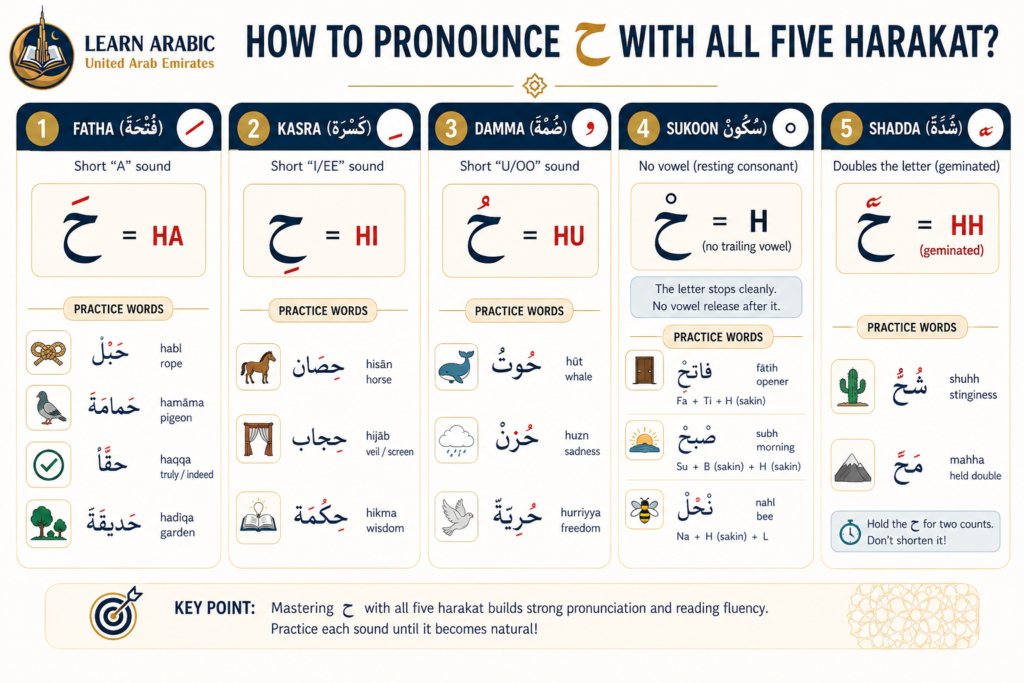
1. Fatha (فَتْحَة) — َ
A small diagonal line above the letter. Produces a short “A” sound.
حَ = HA
Practice words:
- حَبْل (habl — rope)
- حَمَامَة (hamāma — pigeon)
- حَقًّا (haqqa — truly / indeed)
- حَدِيقَة (hadīqa — garden)
2. Kasra (كَسْرَة) — ِ
A small diagonal line below the letter. Produces a short “I/EE” sound.
حِ = HI
Practice words:
- حِصَان (hisān — horse)
- حِجَاب (hijāb — veil / screen)
- حِكْمَة (hikma — wisdom)
3. Damma (ضَمَّة) — ُ
A small comma-shaped mark above the letter. Produces a short “U/OO” sound.
حُ = HU
Practice words:
- حُوت (hūt — whale)
- حُزْن (huzn — sadness)
- حُرِّيَّة (hurriyya — freedom)
4. Sukoon / Jazm (سُكُون) — ْ
A small circle above the letter. Indicates the letter carries no vowel — it is a resting consonant that attaches to the syllable before it.
حْ = H (no trailing vowel)
This form appears frequently inside words and at word endings. The letter stops cleanly — there is no vowel release after it.
Practice words:
- فَاتِح (fātih — opener): Fa + Ti + H(sakin)
- صُبْح (subh — morning): Su + B(sakin) + H(sakin)
- نَحْل (nahl — bee): Na + H(sakin) + L
5. Shadda (شَدَّة) — ّ
A small “w”-shaped mark above the letter. It doubles the letter — you articulate ح twice in a single continuous throat movement, holding the mid-throat friction for a full beat before releasing into the following vowel.
حّ = HH (geminated)
Practice words:
- شُحٌّ (shuhh — stinginess): the ح is held double before releasing
- مَحَّ — the doubled ح holds for two counts
The most common mistake with shadda on ح: learners shorten it to a single articulation. The doubling must be physically felt as a sustained throat constriction, not a quick repetition.
Step Inside Our Classrooms
Don’t just take our word for it—see our community in action. Click below to watch real, live snippets from our recent classes and experience our engaging teaching style firsthand!
Master Arabic in the UAE
Experience world-class Arabic language training designed for students and professionals in the Emirates.
Book Your Free TrialArabic Words with ح (Haa) in Different Positions
Learning ح in real Arabic words is the next step after mastering its pronunciation and written forms. Practising the letter at the beginning, middle, and end of words helps learners recognise its shape quickly and build confidence when reading Arabic.
ح in Initial Position
When ح appears at the beginning of a word, it takes its initial form حـ and connects to the following letter.
| Arabic | Transliteration | Meaning |
| حَبْل | habl | rope |
| حِصَان | ḥiṣān | horse |
| حُوت | ḥūt | whale |
| حَدِيقَة | ḥadīqa | garden |
| حَمَامَة | ḥamāma | pigeon |
| حُزْن | ḥuzn | sadness |
| حَقِيقَة | ḥaqīqa | truth / reality |
| حُرِّيَّة | ḥurriyya | freedom |
| حِكْمَة | ḥikma | wisdom |
| حَيَاة | ḥayāh | life |
ح in Medial Position
In the middle of a word, ح usually connects to the letters before and after it. Practising these examples helps learners recognise the letter when its shape appears within connected Arabic writing.
| Arabic | Transliteration | Meaning |
| مَحْفَظَة | maḥfaẓa | wallet |
| بَحْر | baḥr | sea |
| أَحْمَر | aḥmar | red |
| نَحْل | naḥl | bee |
| صُبْح | ṣubḥ | morning |
| رَحْمَة | raḥma | mercy |
| مِحْوَر | miḥwar | axis / pivot |
| سَحَاب | saḥāb | clouds |
ح in Final Position
At the end of a word, ح takes its final form ـح. Reading these examples aloud is especially useful because the letter may appear after a long vowel or another consonant.
| Arabic | Transliteration | Meaning |
| رِيح | rīḥ | wind |
| فَلَّاح | fallāḥ | farmer |
| فَاتِح | fātiḥ | opener |
| صَبَاح | ṣabāḥ | morning |
| سِلَاح | silāḥ | weapon |
| كِفَاح | kifāḥ | struggle / striving |
| مِفْتَاح | miftāḥ | key |
Example Sentences With ح
Reading ح in isolated words is one step. Reading it inside flowing sentences — where it connects to surrounding letters and harakat shift the rhythm — is the real test.
- أَحَبُّ الحِصَانَ الأَحْمَرَ — I love the red horse
- البَحْرُ وَاسِعٌ وَجَمِيل — The sea is vast and beautiful
- الحِكْمَةُ بِدَايَةُ الحَيَاةِ الحَقِيقِيَّة — Wisdom is the beginning of true life
- الصُّبْحُ يَبْدَأُ بِنُورِ الرَّحْمَة — Morning begins with the light of mercy
- حَبْلُ الحَيَاةِ فِي يَدِ الخَالِق — The rope of life is in the Creator’s hand
Notice that several of these sentences contain ح in multiple positions — initial, medial, and final — within a single sentence. Reading them aloud while maintaining the correct mid-throat articulation on every ح is a focused pronunciation drill in itself.
Our beginner Arabic courses use exactly this type of connected sentence practice from the earliest lessons — because isolated letter drills only take a learner so far.
Read also: How to Learn Khaleeji Arabic in the UAE? – Practical Steps for Real-Life Fluency

ح vs.
ه vs.
خ: How to Tell the Difference?
The letters ح، ه، and خ can sound similar to beginners, but each is produced in a different part of the throat. Knowing the difference helps you pronounce Arabic more accurately.
Sound Comparison
Here’s how ح، ه، and خ differ in pronunciation:
| Feature | ح (Haa) | ه (Ha) | خ (Khaa) |
| Articulation | Middle throat | Deep throat | Upper throat |
| Friction | Moderate | Light | Strong |
| Approximation | Throaty “H” | English h | “KH” like loch |
| Strength | Medium | Lightest | Strongest |
Think of the three sounds as ه — ح — خ: light, medium, then strong.
Practice with Words
Practise ح، ه، and خ in Arabic words, focusing on the correct throat position rather than English approximations.
| Letter | Example | Meaning |
| ح | حَال (ḥāl) | condition |
| ه | هَال (hāl) | cardamom |
| ح | حَمَّ (ḥamma) | he heated |
| ه | هَمَّ (hamma) | it worried him |
Visual Difference: ح vs.
ج vs.
خ
These letters share the same basic shape, so the dot is the key:
- ح = no dot
- ج = one dot below
- خ = one dot above
Practise spotting the dot first, then pronounce the letter.
ح in Tajweed: Hams and Moon Letter
For students learning Quranic recitation, ح has two important classifications in Tajweed: it is a Hams letter and a Moon letter. Understanding these rules helps learners pronounce ح correctly in Quranic reading.
ح as a Hams Letter
ح belongs to the 10 hams letters, represented by the mnemonic فَحَثَّهُ شَخْصٌ سَكَتَ. Hams means that breath continues to flow while the letter is being pronounced.
When saying ح, you should feel a clear flow of air from the throat. Unlike some voiced letters, the sound should not completely block the breath. Practising حَ، حِ، حُ while maintaining this airflow can help develop the correct pronunciation.
ح as a Moon Letter
ح is also one of the 14 moon letters. When ح comes after the definite article ال, the ل remains clearly pronounced rather than being assimilated into the following letter.
For example:
الحَمْد → al-hamd
This rule is especially important in Quranic recitation because الحَمْدُ لِلَّهِ appears at the beginning of Surah Al-Fatiha, which Muslims recite regularly in prayer.
A Structured Practice Method for Mastering ح
Most learners practise ح the wrong way — they repeat it in isolation a few times, assume they have it, and move on. Weeks later they are still substituting a regular English “h.” The following method builds the sound correctly from the start.
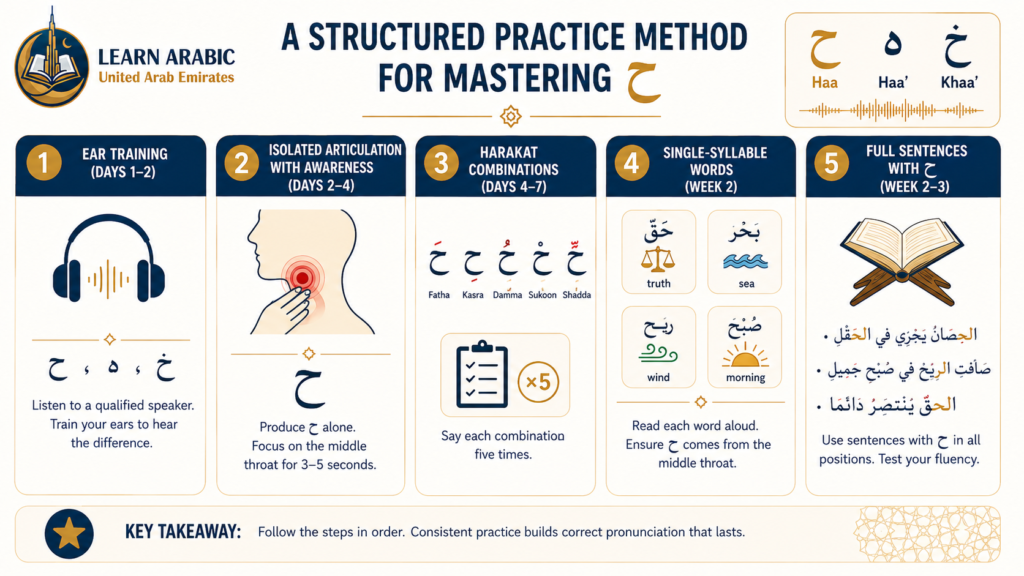
Step 1 — Ear training before mouth training (Days 1–2)
Before attempting to produce ح yourself, listen to a qualified Arabic speaker produce it in isolation and in words. Your ears must map the sound before your throat can replicate it. Listen to the contrast between ح, ه, and خ repeatedly until you can reliably hear the difference.
Step 2 — Isolated articulation with physical awareness (Days 2–4)
Produce ح alone, without a following vowel. Place your hand on your throat and locate the mid-throat zone. Hold the sound for 3–5 seconds, maintaining the friction without shifting to ه (softer) or خ (harder). This isolation drill trains physical muscle memory.
Step 3 — Harakat combinations (Days 4–7)
Drill ح with each of the five harakat in order: حَ، حِ، حُ، حْ، حّ. Say each combination five times before moving to the next. The goal is not speed — it is consistent correct placement on every repetition.
Step 4 — Single-syllable words (Week 2)
Move to single-syllable words: حَقّ، بَحْر، رِيح، صُبْح. Each word contains ح in a different position. Read each one aloud, pausing to verify the ح sound is coming from the middle throat before moving to the next word.
Step 5 — Full sentences with multiple ح occurrences (Week 2–3)
Use sentences from the vocabulary section above that contain ح in initial, medial, and final positions. Reading ح correctly when your attention is distributed across a full sentence — rather than focused on one sound — is the true test of internalisation.
If you want live feedback and correction at any stage of this process, our qualified Arabic tutors at Learn Arabic UAE provide real-time pronunciation correction from the first lesson. Reading descriptions of where ح comes from is useful; hearing a qualified teacher correct your specific error is what actually changes the sound.
Read also: Letter Ḍād (ض) in Arabic – The Letter That Defines a Language

See Our Classroom Environment in Action
Experience a sneak peek into our live sessions. Watch the video below to see our specialized instructors interacting with students, breakdown complex texts, and cultivate an engaging, respectful learning environment.
Master Arabic in the UAE
Experience world-class Arabic language training designed for students and professionals in the Emirates.
Book Your Free TrialStart Learning Arabic With a Qualified Tutor Today
Understanding how ح works is the foundation. Actually producing it correctly — consistently, in words, in sentences, in Quranic recitation — requires practice with feedback from someone who can hear exactly where your pronunciation is going wrong.
At Learn Arabic UAE, our qualified Arabic tutors work with learners from absolute beginner level through to advanced reading and Tajweed. Every lesson includes live pronunciation modelling, real-time correction, and structured progression built around your specific goals — whether that is reading the Quran, learning Modern Standard Arabic, or building foundational skills for children.
Our Arabic courses
- Arabic Course in the UAE
- Arabic Intensive Course
- Arabic Classes for Beginners (Learn Arabic from Scratch)
- Madinah Arabic Course
- Arabic Classes for Adults
- Self-Paced Arabic Course
- Arabic Speaking Classes
- Learn to Write Arabic Course
- Arabic Grammar Course
- Learn Arabic Alphabet Course
- Modern Standard Arabic (MSA) Course
- Quranic Arabic Course
- Fusha Arabic Course
- Classical Arabic Course
- Emirati Arabic Course
- Gulf Arabic Course
- Learn Saudi Arabic
- Business Arabic Course UAE
- Arabic Language Classes for Professionals in UAE
Book a free trial lesson and hear ح produced correctly from day one.

Master Arabic in the UAE
Experience world-class Arabic language training designed for students and professionals in the Emirates.
Book Your Free TrialConclusion
The ح – Arabic letter ha is the sixth letter of the alphabet and one of the most important sounds for any learner to master. It is a voiceless pharyngeal fricative produced from the middle of the throat — deeper than English “h,” softer than خ, and entirely unlike any sound in English phonology. Its four written forms follow predictable positional rules, and its five harakat combinations — حَ، حِ، حُ، حْ، حّ — cover the full range of syllables it produces across Arabic vocabulary. As a moon letter, it keeps the lam of ال fully pronounced in Quranic and everyday Arabic text. As a hams letter in Tajweed, it produces a continuous breathy airflow that must be felt, not just heard.
Mastery of ح comes from three things in sequence: accurate ear training, correct physical placement, and consistent practice in words and sentences. Get those three right and ح becomes one of the most satisfying sounds in the Arabic language to produce.
FAQs
What is the Arabic letter ح (Haa)?
ح (Haa) is the sixth letter of the Arabic alphabet. It is a voiceless pharyngeal fricative — a breathy, friction-based sound produced from the middle of the throat — with no direct equivalent in English or most Western languages. It is visually identified by its base curve shape with no dot.
How do you pronounce ح correctly?
Produce ح by constricting the middle of the throat (وسط الحلق) and pushing a controlled stream of breath through that narrowed space. The result is a forceful, breathy “H” with moderate friction — deeper than a regular English “h” and softer than the guttural خ. Physical self-check: you should feel controlled warmth and light restriction in the centre of your throat, not at the back of your mouth.
What are the four written forms of ح?
ح has four positional forms: isolated (ح), initial at the start of a word (حـ), medial in the middle of a word (ـحـ), and final at the end of a word (ـح). The dotless base curve is consistent across all four — the absence of a dot is the reliable identifier in every position.
What is the difference between ح and ه in Arabic?
ح is produced from the middle throat (وسط الحلق) with deliberate friction and breath control.
ه originates from the deepest point in the throat (أقصى الحلق) and is significantly softer and more open — closest to a gentle English “h.” The difference is not subtle in Arabic: حَال (condition) and هَال (cardamom) are two entirely different words.
Is ح a sun letter or a moon letter?
ح is a moon letter (حرف قمري). When preceded by the definite article ال, the lam is fully pronounced: الحَمْد is read al-hamd, with an audible lam. This is the opposite of sun letters, where the lam assimilates into the following consonant.
What is the Tajweed classification of ح?
In Tajweed, ح is classified as a hams letter — one of ten letters in which breath continues to flow during articulation without full engagement of the vocal cords. This means a correctly produced ح should have audible and feelable airflow throughout its articulation, not a full stop.
Why do English speakers find ح so difficult to pronounce?
The mid-throat friction of ح does not exist anywhere in English phonology. English speakers naturally produce “h” sounds near the back of the mouth with minimal throat involvement. Relocating the sound down into the centre of the throat — and adding controlled friction there — requires deliberate physical training that the English-speaking vocal tract has simply never been asked to do before.




Leave a Reply