 Learn Arabic
This article traces that history in plain terms: how Muslim mathematicians developed the system. It also illustrates why two different versions of Arabic numerals exist today, and why this number system eventually replaced Roman numerals across the world.
If you’re learning Arabic, this background also explains a detail many students find confusing on their first day of class.
You use Arabic numerals every time you check a price, dial a number, or read a date. The primary keyword itself, Arabic numerals, refers to the ten symbols (0, 1, 2, 3, 4, 5, 6, 7, 8, 9) that carried mathematics out of the ancient world and into the modern one. Most people who use them daily have never asked where they came from.
The Definition Of Arabic Numerals
Arabic numerals are the set of ten symbols used to write numbers, developed and refined by mathematicians working in the Arab and Islamic world during the medieval period. The number itself has no upper limit, but the digits used to write any number are always drawn from this same set of ten.
This is where a common mix-up happens. The digits shown at the top of this section (0–9) are often called “English numerals” in casual conversation. Historically, that’s inaccurate. They are one of two Arabic numeral systems, and they reached Europe through Arabic-speaking North Africa and Muslim Spain centuries before English speakers adopted them.
The Two Types Of Arabic Numerals
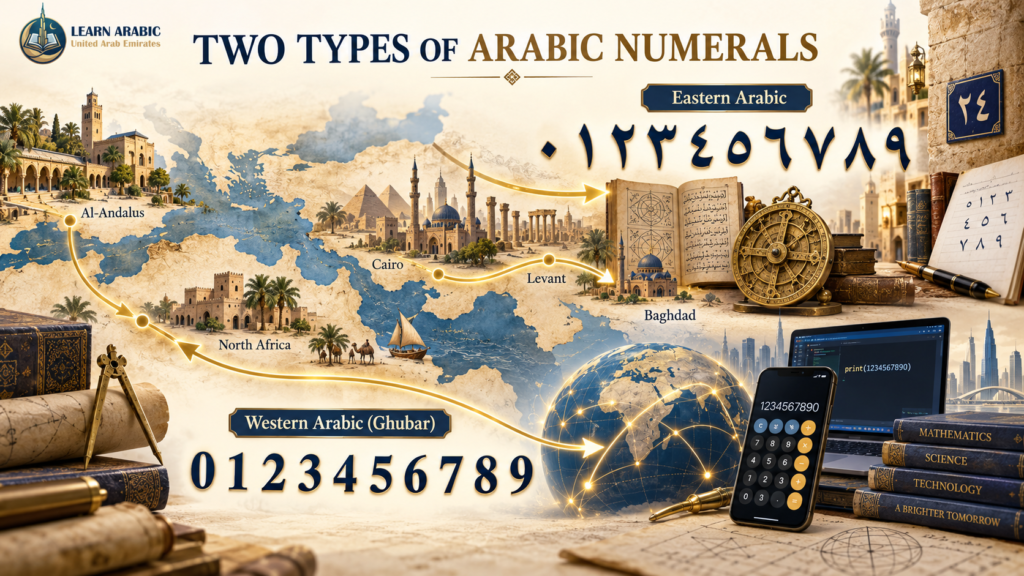
Arabic-speaking regions actually recognize two distinct numeral systems, and this is one of the most useful facts for anyone learning Arabic to know early on.
1. Eastern Arabic numerals (٠ ١ ٢ ٣ ٤ ٥ ٦ ٧ ٨ ٩) are still used across the Arab East, Egypt, the Levant, and the Arabian Peninsula. They developed from Indian numeral forms brought into Baghdad.
2. Western Arabic numerals, also called Ghubar (“dust”) numerals (0 1 2 3 4 5 6 7 8 9), developed in North Africa and Muslim Spain. These are the digits used almost everywhere in the world today, including in this sentence.
If you’ve started Arabic lessons and noticed that numbers on a page look different from the numbers on your phone, this is why: you’re seeing Eastern Arabic numerals used specifically for writing the Arabic language, while Western Arabic numerals handle math and technology globally.
Read also: 10 Steps to Learning Arabic Numbers for Kids in the UAE
The Difference Between Digits And Numbers in Arabic
A digit is a written symbol, while a number is the value it represents. There are only ten digits, but there is no limit to the numbers you can build from them.
The number 10, for example, is written using the digits 1 and 0. The number 67 uses the digits 6 and 7. This distinction matters in Arabic grammar too, where the word for “numeral” (رقم) and the word for “number” (عدد) are not interchangeable.
Understanding the Arabic number system this way, as ten building blocks rather than a fixed list of values, makes it easier to see why the invention of zero was such a breakthrough, covered next.
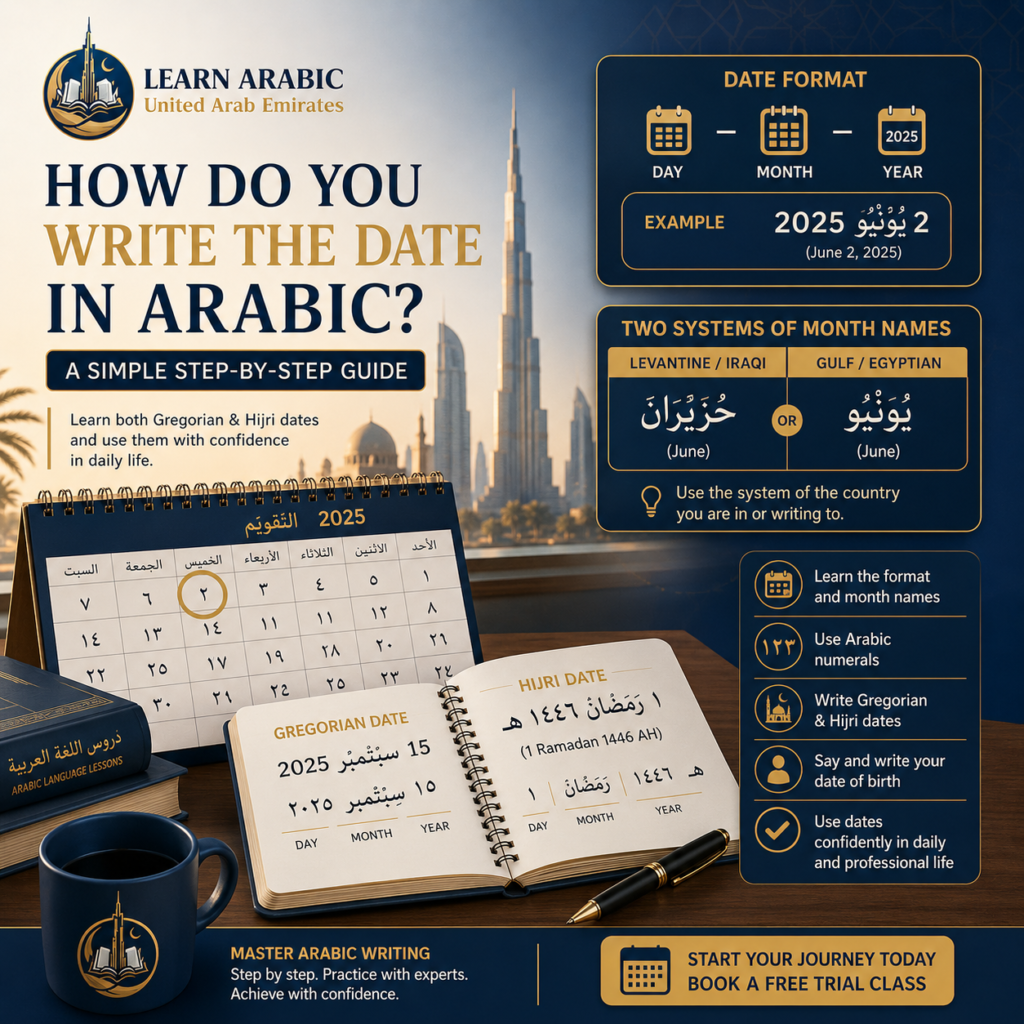
Read also: How Do You Write the Date in Arabic?
Where Did Arabic Numerals Originally Come From?
The origin of Arabic numerals traces back to the translation movement of the early Abbasid Caliphate, not to a single inventor working in isolation.
In 771 CE, an Indian astronomer arrived at the court of Caliph Abu Ja’far Al-Mansur carrying a mathematical and astronomical text called the Sindhind, written by the Indian scholar Brahmagupta in 628 CE.
The caliph ordered it translated into Arabic. This text used numeral symbols from one to nine, but not yet zero, which had not been incorporated into the system at that time.
How Al-Khwarizmi Developed The Arabic Numeral System
Muhammad ibn Musa Al-Khwarizmi, working under Caliph Al-Ma’mun, built on this translated material. Around 825 CE, he wrote a treatise known as “On the Hindu Art of Reckoning,” which organized and popularized these numerals for use in Arabic mathematics and commerce.
Al-Khwarizmi selected and refined a specific set of Indian numeral forms, which became known as the Eastern Arabic (or “aerial”) numerals, named, according to one explanation, because their shapes echoed the movements of fingers counting in the air. This version spread through Baghdad, the Levant, and Egypt.
A separate numeral tradition developed independently in the Maghreb (present-day Morocco, Algeria, and Tunisia).
These Western Arabic numerals, first documented in written form by the scholar Ibn Al-Yasamin Al-Maghribi (d. 1204) in his work “Talqih Al-Afkar,” are the direct ancestors of the digits used worldwide today.
How Zero Transformed The Arabic Number System
Zero is the single addition that gave meaning to the entire system. Roman numerals had no symbol for zero at all, which limited how large a number could be written and made basic arithmetic genuinely difficult.
Arabic mathematicians solved this with a symbol that did two jobs at once: representing “nothing” and holding a place value so that 105 could be distinguished from 15 or 1,050.
Historically, this dual role caused disagreement among mathematicians. The medieval scholar Ibn Al-Yasamin Al-Fasi argued that zero “is not a number. It only shows what comes after it, since the place was empty.”
Modern mathematics treats zero differently: it is both a digit used to represent itself and a true number, functioning as the additive identity for integers and real numbers.
The Angle Theory Behind Arabic Numeral Shapes
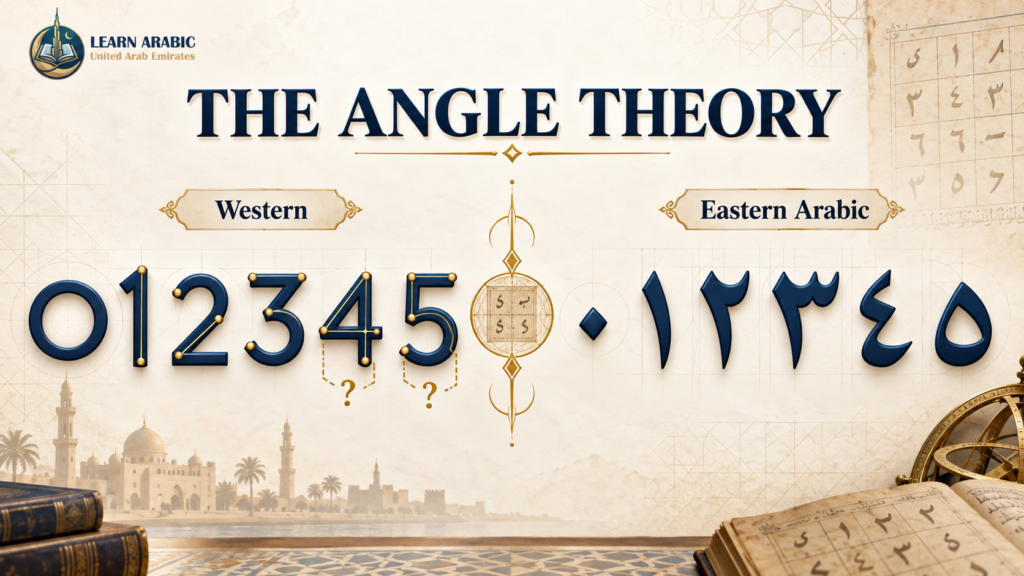
One popular explanation for the shape of each digit claims that the number of angles in a symbol matches its value, one angle for “1,” two for “2,” and so on, with “0” drawn as an angle-free circle. It’s a memorable idea, and it’s repeated often.
It doesn’t fully hold up. Researchers studying the original Ghubar forms, before European scribes reshaped them, point out that the digits 4 and 5 don’t match this angle count in their earliest documented shapes.
A more grounded explanation links early digit shapes to the numeric values assigned to Arabic letters in the abjad system. However, zero remains an exception, since “nothing” has no abjad value of its own.
If you’re mapping out how Arabic script and Arabic numerals relate, understanding the abjad letter-value system is a natural next stop. It also explains why some historical Arabic texts number their chapters using letters instead of digits.
Small details like this, where a number came from and why it looks the way it does, are exactly the kind of context built into a structured Arabic course, rather than picked up piecemeal from scattered articles.
Read Also: How To Read And Write Arabic Numbers?
Step Inside Our Classrooms
Don’t just take our word for it—see our community in action. Click below to watch real, live snippets from our recent classes and experience our engaging teaching style firsthand!
Master Arabic in the UAE
Experience world-class Arabic language training designed for students and professionals in the Emirates.
Book Your Free TrialHow Arabic Numerals Spread From The Islamic World To Europe
Western Arabic (Ghubar) numerals didn’t arrive in Europe all at once. They moved through two main routes over several centuries.
The first, and better documented, route ran through Muslim Spain (Al-Andalus) and Sicily. Toledo and later Seville became major translation centers under Christian rulers Ferdinand III (1217–1230) and Alfonso X “the Wise” (1252–1284), where Arabic scientific texts, numerals included, were rendered into Castilian and Latin.
A parallel path ran through Sicily and southern Italy, carried by the translator Michael Scot and by Leonardo of Pisa, better known as Fibonacci, whose 1202 book Liber Abaci introduced these numerals to European merchants and scholars.
Read also: Spanish Words From Arabic: Common Spanish Words with Arabic Origins
The Role of Pope Sylvester II in Introducing Arabic Numerals
Pope Sylvester II (d. 1003), who studied in Muslim Spain and reportedly at the University of Al-Qarawiyyin, is often credited as an early champion of these numerals in Christian Europe, earning him the nickname “the Numerals’ Pope” in some accounts.
His personal advocacy, however, predates their real commercial adoption in Europe by roughly two centuries.
The numerals’ practical breakthrough came later, through trade routes running from Bejaia, in present-day Algeria, where merchants, Fibonacci among them, encountered the system in daily commercial use and carried it north.
By the late 16th century, European mathematicians had reshaped these imported digit forms into the shapes recognized today, completing a transfer that began roughly 700 years earlier.
Courses that walk through Arabic script and numerals together, rather than treating them as separate topics, tend to make this history click faster, since the two systems developed side by side.
Read Also: How Are Arabic Names Structured?
Arabic Numerals Vs. Roman Numerals
Comparing Arabic numerals vs. Roman numerals side by side shows exactly why one system became universal, and the other became largely decorative.
| Feature | Arabic Numerals | Roman Numerals |
| Zero | Yes — a true place-holding digit | No symbol for zero |
| Value system | Positional (place value) | Additive/subtractive symbol combination |
| Writing large numbers | Compact (1912) | Lengthy (MCMXII) |
| Arithmetic (multiplication, division) | Straightforward with standard algorithms | Very difficult without conversion |
| Modern use | Mathematics, science, commerce, technology worldwide | Clock faces, outline numbering, monument dates |
How The Roman Numeral System Works
Roman numerals used seven letters as building blocks: I (1), V (5), X (10), L (50), C (100), D (500), and M (1,000).
Because there was no dedicated symbol for numbers like 2, 4, or 9, Romans combined letters through addition or subtraction: II for 2, IV for 4 (one before five), VI for 6 (one after five), and IX for 9 (one before ten).
Writing a number like 26 required XXVI; writing 1912 required MCMXII. Every calculation meant converting these letter combinations mentally. There was no straightforward way to carry, borrow, or multiply directly on the page.
Read Also: How Many Phonemes Are In Arabic?
Why Arabic Numerals Replaced Roman Numerals
Arabic numerals replaced Roman numerals because they made calculation itself faster and more reliable, not because of political or religious preference. Three mechanical advantages explain the shift.
First, the positional system meant a digit’s value changed based on its place- units, tens, hundreds- so any number, however large, could be written compactly. Second, zero allowed mathematicians to represent gaps in place value precisely, which Roman numerals simply couldn’t do.
Third, standard arithmetic algorithms- the same long multiplication and division taught in schools today- only became practical once numbers were written positionally.
By the time European trade and science expanded from the 13th century onward. These advantages made adoption a matter of necessity rather than preference. Roman numerals survived, but shrank into decorative and ceremonial roles, such as clock faces, chapter numbering, and inscribed dates.
Read Also: Common Mistakes New Arabic Learners Make (And How To Fix Them)
How Arabic Numerals Are Used Around The World Today
The story isn’t fully settled even now. Countries in the Arab East continue using Eastern Arabic numerals for everyday writing, while the Maghreb and virtually the entire rest of the world use Western Arabic numerals for calculation.
Regional bodies, including the Arab League and ALECSO, have recommended unifying Arab nations around the Western (Ghubar) numerals specifically because they are used internationally, and because the placement of the decimal point in the Eastern system can complicate financial and scientific calculations. Qatar, for example, has moved to adopt Western Arabic numerals in official use.
For Arabic learners, this dual-numeral reality is a practical detail, not a historical footnote; knowing which numeral system you’re looking at, and why, removes a common point of early confusion.
See Our Classroom Environment in Action
Experience a sneak peek into our live sessions. Watch the video below to see our specialized instructors interacting with students, breakdown complex texts, and cultivate an engaging, respectful learning environment.
Master Arabic in the UAE
Experience world-class Arabic language training designed for students and professionals in the Emirates.
Book Your Free TrialLearn Arabic Numbers the Right Way — From the Start
Understanding where Arabic numerals came from is one thing. Reading and writing Eastern Arabic numerals confidently in real Arabic text is another skill entirely. It’s a process many self-taught learners skip, then struggle with it later.
Learn Arabic UAE builds numerals, script, and pronunciation into one structured learning path, guided by instructors who teach the two numeral systems side by side so neither one feels unfamiliar.
You’ll practice reading real dates, prices, and numbers the way they actually appear in Arabic media and daily life, not just in isolated drills.
Our Arabic courses
- Arabic Course in the UAE
- Arabic Intensive Course
- Arabic Classes for Beginners (Learn Arabic from Scratch)
- Madinah Arabic Course
- Arabic Classes for Adults
- Self-Paced Arabic Course
- Arabic Speaking Classes
- Learn to Write Arabic Course
- Arabic Grammar Course
- Learn Arabic Alphabet Course
- Modern Standard Arabic (MSA) Course
- Quranic Arabic Course
- Fusha Arabic Course
- Classical Arabic Course
- Emirati Arabic Course
- Gulf Arabic Course
- Learn Saudi Arabic
- Business Arabic Course UAE
- Arabic Language Classes for Professionals in UAE
Our Arabic Courses for Kids
- Arabic Course for Kids
- Arabic Conversation Course for Kids
- Arabic Qaida Course for Kids
- Beginner Arabic Course for Kids
- Arabic Grammar Course for Kids
- Teen Arabic Summer Course
- UAE Kindergarten Arabic Classes
Conclusion
Arabic numerals are the product of centuries of cooperation across civilizations, Indian mathematical foundations, Abbasid-era scholarship led by figures like Al-Khwarizmi, and refinement across North Africa before the system reached Europe through Andalusia and Sicily.
The system that eventually replaced Roman numerals worldwide did so because of one structural advantage above all: a positional value system built around zero, something Roman numerals never had.
Two versions of this system remain in daily use today: Eastern Arabic numerals in the Arab East, and Western Arabic numerals almost everywhere else, including in this article. Recognizing both and understanding how each one developed gives you a clearer picture of Arabic numerals than the oversimplified “English numbers” label ever could.
Frequently Asked Questions
What Are Arabic Numerals?
Arabic numerals are the ten symbols (0–9) used to write numbers, developed and refined by mathematicians in the Arab and Islamic world. Two versions exist today: Eastern Arabic numerals, used in the Arab East, and Western Arabic (Ghubar) numerals, used globally for math and technology.
Who Invented Arabic Numerals?
No single person invented them. Indian mathematicians developed early numeral forms, Al-Khwarizmi organized and popularized them in Baghdad around 825 CE, and separate refinements in North Africa produced the Western Arabic digits used worldwide today.
Where Did Arabic Numerals Originate?
Arabic numerals originated from a combination of Indian numeral concepts, introduced to Baghdad through translated astronomical texts, and independent development in the Maghreb region, where the Western Arabic (Ghubar) forms first appeared in writing.
What Is The Difference Between Arabic Numerals And Roman Numerals?
Arabic numerals use a positional place-value system with a zero digit, allowing compact writing and straightforward arithmetic. Roman numerals combine letters additively with no zero, making large numbers lengthy and calculations far more difficult.
Why Did Arabic Numerals Replace Roman Numerals?
Arabic numerals replaced Roman numerals because their positional system and use of zero made writing large numbers and performing calculations, especially multiplication and division, dramatically faster and simpler for trade, science, and record-keeping.
What Are The Types Of Arabic Numerals?
There are two types: Eastern Arabic numerals (٠١٢٣…), still used for writing in the Arab East, and Western Arabic or Ghubar numerals (0123…), which spread through North Africa and Andalusia into Europe and are now used worldwide.
Related Articles
Learn Arabic




Leave a Reply