 Learn Arabic
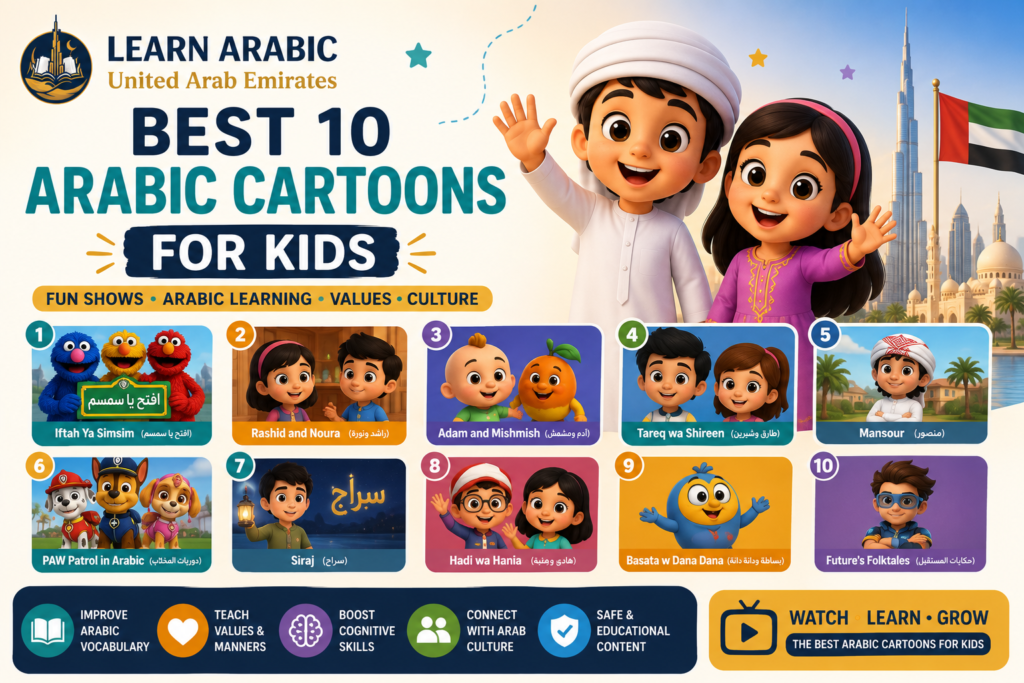
Arabic cartoons for kids do more than entertain — they build vocabulary, model social behavior, and connect children to their cultural and linguistic roots. For parents raising bilingual children or teaching Arabic at home, choosing the right show can be as impactful as a classroom lesson.
But with dozens of options across YouTube, Spacetoon, and streaming platforms, knowing which shows actually deliver is harder than it looks. This guide covers the 10 best Arabic cartoons for kids, what makes each one worth watching, and how to use them as part of a real language-learning routine.
1. Iftah Ya Simsim (افتح يا سمسم), The Most Famous Arabic Cartoon For Kids
Iftah Ya Simsim is the Arabic adaptation of Sesame Street and remains one of the most enduring educational shows in the Arab world. First broadcast in 1979 and revived in 2010, it features beloved characters like Nu’man, Qarqour, Abla, and Ka’ki in a peaceful neighborhood setting where curiosity is always rewarded.
The show’s primary goal — preparing children emotionally and intellectually for school — is built into every episode. Children learn numbers, letters, and colors, but the deeper work happens in emotional literacy: how to handle frustration, how to make friends, and how to navigate disagreement.
It airs on Spacetoon and episodes are available on YouTube. For parents introducing colors in Arabic alongside the show, the repetition across episodes makes retention noticeably faster.
Read also: How to Introduce Yourself in Arabic? Phrases, Tips & What to Say
Read More: 9 Arabic Poems For Kids
2. Rashid and Noura (راشد ونورة)
Rashid and Noura is a gem of Arabic educational animation. Noura is the bookish, inquisitive older sister; Rashid is the enthusiastic, quick-learning younger brother. Together, they compete, collaborate, and explore — and the show uses their dynamic to model exactly the kind of curiosity parents want to encourage.
What sets this show apart is its deliberate focus on the Arabic alphabet and language mechanics. Episodes are structured around specific learning outcomes, and the dialogue is crafted to expose children to proper Arabic usage without feeling like a lesson. It’s available on the Sura channel and on YouTube. Children who watch consistently begin naturally identifying letters and building simple sentences within a few weeks.
3. Adam and Mishmish (آدم ومشمش)
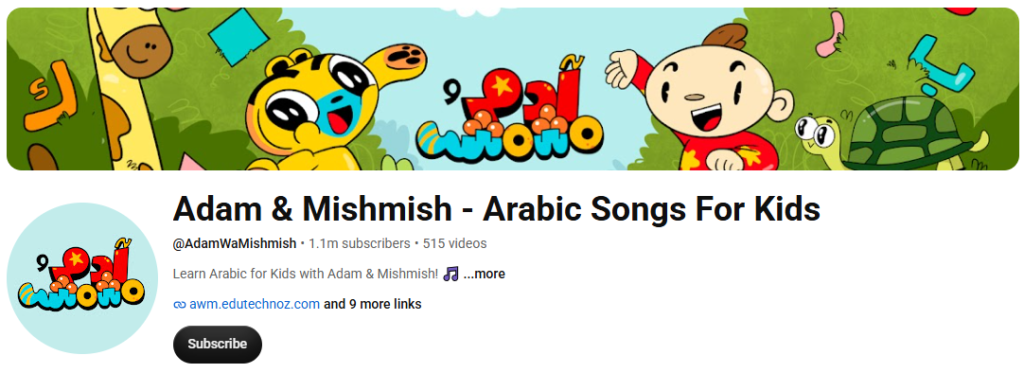
Adam and Mishmish began as a book series from Dar Al Salwa Publishing and expanded into a YouTube channel featuring animated songs and short educational videos. The visual style is bright and deliberately uncluttered, which suits the attention span of toddlers and early preschoolers.
Episodes introduce Vegetables in Arabic, fruit names, animal sounds, and basic conversational phrases through song. The audio is clear and the pacing is measured — two qualities that matter enormously when very young children are trying to connect spoken words to meaning. For families building foundational Arabic vocabulary at home, this channel is one of the most practical free resources available.
4. Tareq wa Shireen (طارق وشيرين)
Tareq wa Shireen is among the first two-dimensional Arabic cartoon series produced specifically to teach Arabic to young learners. It covers 13 thematic topics — the Arabic alphabet, numbers, animal names, body parts in Arabic for kids, seasons, time, emotions, and basic safety rules — all in a single, cohesive series.
The production is clean, the language is accessible Modern Standard Arabic, and the structure mirrors the way language teachers organize early curriculum. It’s particularly useful for children learning Arabic as a second language, making it a favorite among diaspora families and international schools. These episodes are one of the free Arabic cartoons for kids available on YouTube.
5. Mansour (منصور)
Mansour is a UAE-produced animated series following the daily adventures of a curious Emirati boy. It’s one of the few youtube Arabic cartoons for kids that places its stories in a recognizable Gulf environment — local architecture, family structures, and cultural references that children across the Arab world recognize.
The show handles social values deftly: episodes explore honesty, teamwork, and respecting elders without being heavy-handed. The Arabic used is Modern Standard with occasional Gulf-inflected phrasing, which gives children exposure to both registers. Multiple seasons are available on YouTube and through Spacetoon’s platform.
6. PAW Patrol in Arabic (دوريات المخلاب)
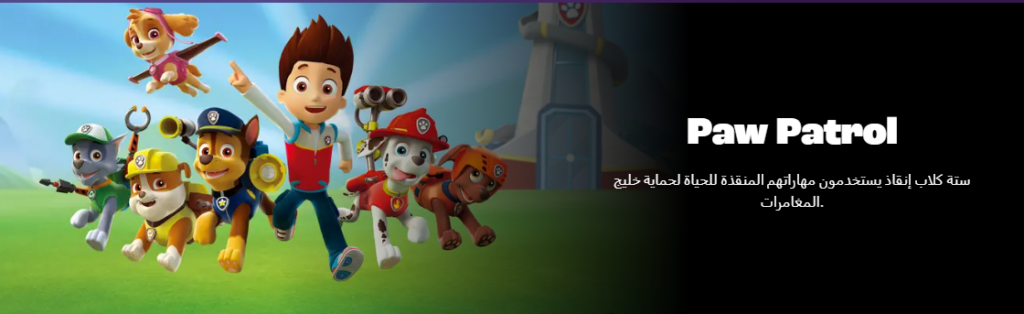
PAW Patrol might be a Canadian production, but its Arabic-dubbed version — broadcast on Nickelodeon Arabia — has become one of the most-watched shows among Arabic-speaking preschoolers globally. The formula is simple: Ryder, a 10-year-old boy, leads a team of rescue dogs, each with a specialized skill, to solve community problems.
Every episode reinforces the idea that different abilities complement each other, and that helping others is worthwhile. For children learning Arabic, the dubbed version is particularly useful because the language is clear, dialogue-heavy, and structured around repeated phrases. Children hear the same rescue commands and team dynamics episode after episode, which locks vocabulary in quickly.
7. Siraj (سراج)
Siraj is an Islamic educational cartoon produced to help children connect with Quranic values and the stories of the prophets. Episodes are visual and well-paced, with Modern Standard Arabic narration that is clear enough for non-native speakers to follow.
For families who want their children to learn Quranic vocabulary in context — rather than through rote memorization alone — Siraj provides a meaningful bridge. Children encounter Quranic concepts embedded in narrative, which research on language acquisition suggests leads to deeper retention than vocabulary lists. The series is available on YouTube and through several Islamic education platforms.
Begin your Arabic learning path with a FREE trial class
Step Inside Our Classrooms
Don’t just take our word for it—see our community in action. Click below to watch real, live snippets from our recent classes and experience our engaging teaching style firsthand!
Master Arabic in the UAE
Experience world-class Arabic language training designed for students and professionals in the Emirates.
Book Your Free TrialRead More: Thuluth Arabic Calligraphy
8. Baraem Channel Shows (براعم)
Baraem is a Qatar-based children’s channel (part of Al Jazeera Children’s Channel network) that produces and curates some of the highest-quality early childhood content in Arabic. Its original productions include Rashid and Noura (listed above) as well as a range of short programs targeting toddlers through age six.
What distinguishes Baraem from general children’s channels is editorial discipline: content is age-segmented, Arabic is consistently Modern Standard, and educational goals are transparent. Programs regularly cover family members in Arabic, daily routines, and social skills. The channel’s YouTube presence is extensive, making it accessible to families everywhere.
9. Omar and Hana (عمر وهنا)
Omar and Hana is a Malaysian Islamic animated series that has built a substantial Arabic-speaking audience through its dubbed versions. The show follows two young siblings as they navigate daily life guided by Islamic values — the muslim greeting in Arabic (As-salamu alaykum), kindness to parents, honesty, and cleanliness all appear naturally across episodes.
The animation style is gentle, the pacing is unhurried, and the Islamic content is woven into storylines rather than delivered as lectures. It’s a strong choice for parents who want their children to absorb Islamic manners and basic Arabic simultaneously. Episodes are available on YouTube with Arabic audio.

10. Karza Channel (قناة كرزة)
Karza is an Arabic YouTube channel built around one specific and ambitious goal: making children fall in love with the Arabic alphabet. Every episode centers on a single letter, presented through an original animated song with high production quality, vivid visuals, and a pace calibrated for young attention spans.
What makes Karza stand out from similar channels is the team behind it. The content was developed in consultation with child psychology specialists, which shows in the structure: no violent imagery, no overstimulating sound design, and no filler content between learning moments.
The channel has grown into one of the most trusted Arabic educational resources for diaspora families precisely because it removes the anxiety around Arabic literacy.
Children who watch Karza regularly begin recognizing letters in print earlier than average, because the visual and auditory pairing is consistent across every episode. It’s freely available on YouTube and requires no prior Arabic knowledge from the child or the parent guiding them.
Read also: Diwani Arabic Calligraphy – History, Types, and Artistic Legacy
How To Choose The Right Arabic Cartoon For Your Child?
Not every Arabic kid show suits every child. A few practical selection criteria:
A. Choosing The Right Arabic Cartoon According To Age
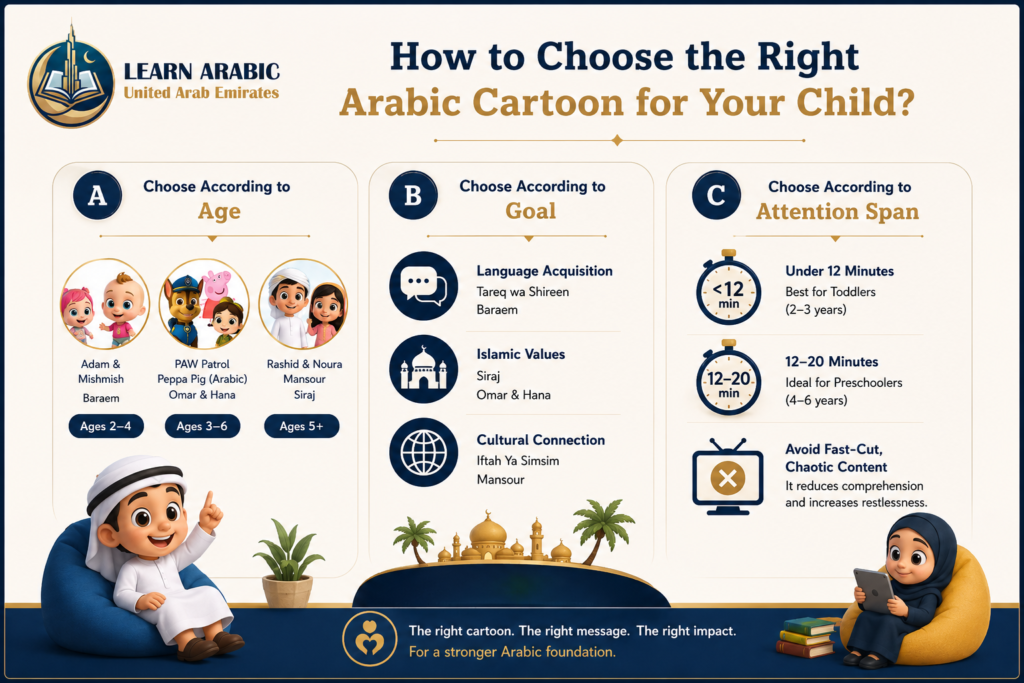
Adam and Mishmish and Baraem programming suit ages two to four. PAW Patrol, Peppa Pig in Arabic, and Omar and Hana work well for ages three to six. Rashid and Noura, Mansour, and Siraj scale to ages five and up.
B. Choosing The Right Arabic Cartoon According To Goal
For pure language acquisition, prioritize Tareq wa Shireen and Baraem. For Islamic values alongside Arabic, choose Siraj and Omar and Hana. For cultural connection to the Gulf and Arab world, Iftah Ya Simsim and Mansour deliver the richest context.
C. Choosing The Right Arabic Cartoon According To Attention Span
Episodes under 12 minutes work better for toddlers. Preschoolers (four to six) can handle 20-minute episodes if the pacing is moderate. Avoid fast-cut, visually chaotic content regardless of language — it reduces comprehension and increases restlessness.
Where to Watch Arabic Cartoons for Free?
Most of the shows above are accessible without a subscription:
- YouTube — Iftah Ya Simsim, Rashid and Noura, Adam and Mishmish, Tareq wa Shireen, Siraj, and Omar and Hana all have official channels or authorized uploads.
- YouTube Kids — A safer browsing environment for young children; search for any show name in Arabic to find it.
- Spacetoon — The channel’s YouTube presence includes a large archive of classic and current Arabic animation.
- MBC Shahid (shahid.mbc.net/ar/kids) — Free access to a curated library of Arabic children’s programming, including dubbed series.
- Baraem YouTube Channel — The official channel offers a substantial free library of original Arabic productions.
For families committed to raising genuinely bilingual children, structured Islamic Studies Courses for Kids alongside these cartoons provide the formal framework that passive viewing alone cannot deliver.
See Our Classroom Environment in Action
Experience a sneak peek into our live sessions. Watch the video below to see our specialized instructors interacting with students, breakdown complex texts, and cultivate an engaging, respectful learning environment.
Master Arabic in the UAE
Experience world-class Arabic language training designed for students and professionals in the Emirates.
Book Your Free TrialRead More: Arabic Cursive Writing
Why Learn Arabic UAE Is the Ideal Choice For Your Kids?
Cartoons do the heavy lifting for listening comprehension and vocabulary exposure. What they cannot do is teach grammar, reading, or writing — and without those pillars, comprehension plateaus by age seven or eight.
At Learn Arabic UAE, we work with children at every stage of Arabic development, from complete beginners learning the alphabet to advanced students developing writing fluency. Our instructors understand the specific challenges facing children who grow up hearing Arabic at home but haven’t studied it formally, as well as those encountering the language for the first time.
If your child has been watching Arabic cartoons and you want to turn that passive exposure into real language confidence, a structured course is the natural next step.
Book your free trial session today
Our Arabic Courses
- Self-Paced Arabic Course
- Arabic Speaking Classes
- Learn to Write Arabic Course
- Arabic Grammar Course
- Arabic Course in the UAE
- Arabic Intensive Course
- Madinah Arabic Course
- Arabic Classes for Kids
- Learn Arabic Alphabet Course
- Modern Standard Arabic (MSA) Course
- Quranic Arabic Course
- Fusha Arabic Course
- Classical Arabic Course
- Emirati Arabic Course
Master Arabic in the UAE
Experience world-class Arabic language training designed for students and professionals in the Emirates.
Book Your Free TrialConclusion
The best Arabic cartoons for kids share a few qualities that go beyond production value: clear, natural Arabic; stories grounded in recognizable daily life; and content that gives children something to think about after the screen goes off.
Iftah Ya Simsim and Rashid and Noura anchor the list for their educational rigor. Adam and Mishmish and Baraem programming fill the early toddler gap. Siraj and Omar and Hana bring Islamic values into the frame without sacrificing engagement.
Used consistently — and within appropriate time limits — these shows build the listening comprehension and vocabulary base that formal Arabic instruction can then build on. The goal isn’t hours of screen time; it’s the right content, watched intentionally, combined with reading practice, conversation, and structured learning.
Frequently Asked Questions
What are the best free Arabic cartoons for kids on YouTube?
Several high-quality Arabic cartoons are freely available on YouTube, including Iftah Ya Simsim (Sesame Street Arabic), Rashid and Noura on the Baraem channel, Adam and Mishmish, Tareq wa Shireen, and Siraj. The Spacetoon YouTube channel also offers a large archive of both original Arabic productions and dubbed international series.
At what age should children start watching Arabic cartoons?
The American Academy of Pediatrics advises against screen exposure for children under two. From age two onward, short episodes of 10 to 15 minutes with slow pacing and clear dialogue — such as Adam and Mishmish or Baraem’s programming — are appropriate.
By age four, children can engage productively with longer episodes from shows like Rashid and Noura or Mansour.
Can Arabic cartoons replace formal Arabic lessons for kids?
No — and that distinction matters. Cartoons build listening comprehension and expand vocabulary through passive exposure, which is genuinely valuable. However, they do not teach reading, writing, grammar, or speaking production. Children who combine regular exposure to Arabic cartoons with structured lessons progress noticeably faster than those doing either alone.
Which Arabic cartoon is best for children learning Arabic as a second language?
Tareq wa Shireen is specifically designed for Arabic language acquisition and covers the alphabet, numbers, body parts, colors, and social vocabulary in a curriculum-like sequence.
It is widely used in international schools and diaspora communities for this reason. Baraem channel programming is also excellent because the language is consistently Modern Standard Arabic and the pacing supports comprehension.
Is Peppa Pig in Arabic good for language learning?
Yes, particularly for very young beginners. The Arabic dubbed version uses simple, clear language tied to familiar everyday topics, which makes it genuinely comprehensible for children who are just starting out.
Comprehensible input — content children can mostly understand — is one of the most effective conditions for language acquisition, and Peppa Pig delivers that at an early level.
Are there Arabic Islamic cartoons suitable for young children?
Several strong options exist. Siraj presents Quranic stories and Islamic values through animation suited for ages five and up. Omar and Hana are gentler and work for children as young as three, covering daily Islamic manners and the basic etiquette of Muslim family life. Both are available on YouTube with Arabic audio.



Leave a Reply