 Learn Arabic

If you have ever watched Arabic written by hand — letters flowing seamlessly into one another, shifting shape as they move through each word — you were watching Arabic cursive writing. Not a stylistic choice. Not an advanced skill. The standard, everyday form of the Arabic script, used by every writer of the language, from schoolchildren to scholars.
This guide explains exactly what Arabic cursive writing is, names the main styles you need to know, shows you all 28 letters in connected form, and gives you a clear, practical method to learn it — whether you are a complete beginner or returning to strengthen your foundations.
What Is Arabic Cursive Writing?
Arabic cursive writing is the connected, flowing script in which Arabic letters are joined together to form words. In Arabic, cursive is not a special style reserved for formal occasions or artistic work — it is the standard written form of the language.
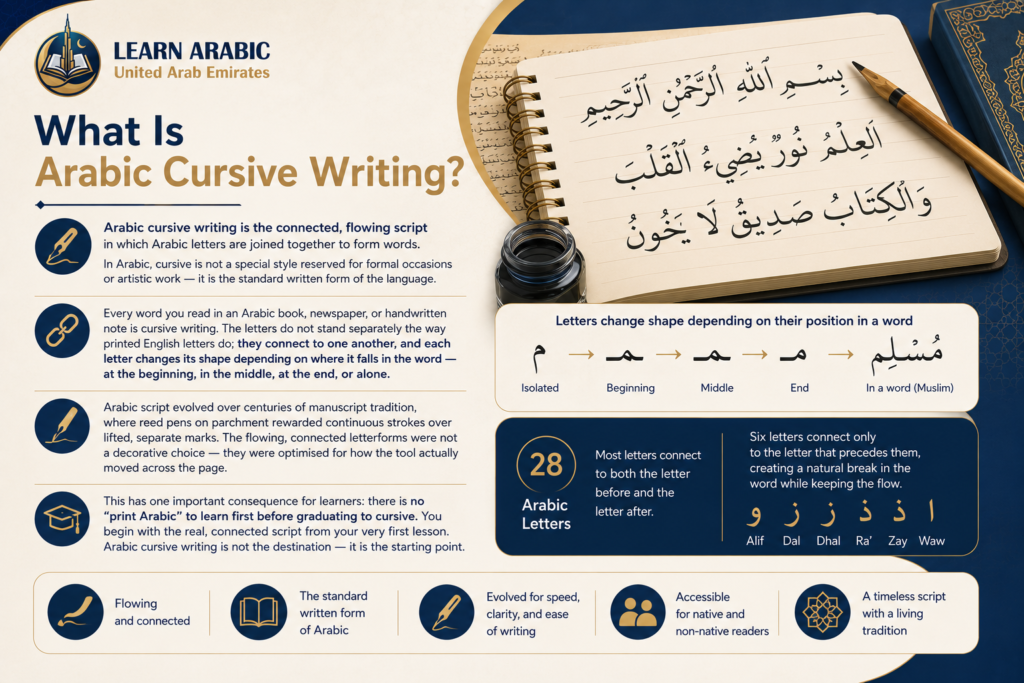
Every word you read in an Arabic book, newspaper, or handwritten note is cursive writing. The letters do not stand separately the way printed English letters do; they connect to one another, and each letter changes its shape depending on where it falls in the word — at the beginning, in the middle, at the end, or alone.
Arabic script evolved over centuries of manuscript tradition, where reed pens on parchment rewarded continuous strokes over lifted, separate marks. The flowing, connected letterforms were not a decorative choice — they were optimised for how the tool actually moved across the page.
This has one important consequence for learners: there is no “print Arabic” to learn first before graduating to cursive. You begin with the real, connected script from your very first lesson. Arabic cursive writing is not the destination — it is the starting point.
Arabic has 28 letters. Most of them connect to both the letter before and the letter after them. Six letters — ا، د، ذ، ر، ز، و (Alif, Dal, Dhal, Ra’, Zay, Waw) — connect only to the letter that precedes them, creating a natural break in the word without interrupting the overall cursive flow.
Each of the 28 letters has up to four positional forms: isolated, initial (beginning of a word), medial (middle of a word), and final (end of a word). Recognising all four forms for every letter is the foundational skill of reading Arabic cursive writing.
What Is Arabic Cursive Writing Called?
Arabic cursive writing is not one single style — it is a family of scripts, each with its own name, purpose, and level of difficulty. The two names every Arabic learner needs to know immediately are Khat ar-Ruq’ah and Khat an-Naskh.
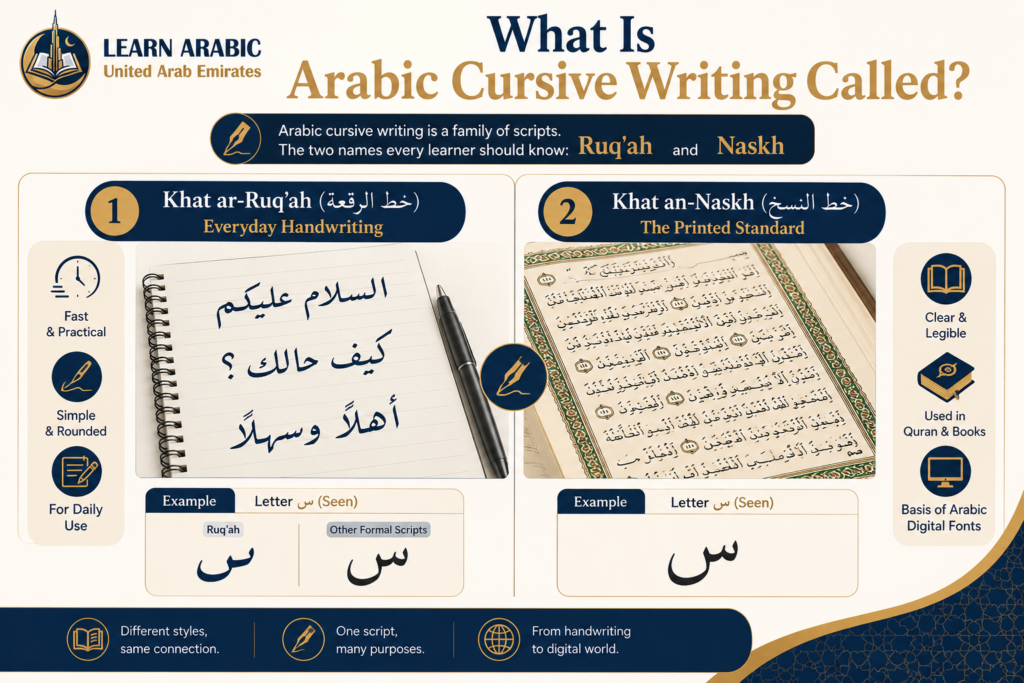
1. Khat ar-Ruq’ah (خط الرقعة) — Everyday Handwriting
Khat ar-Ruq’ah is the most common Arabic handwriting style — the script you see in students’ notes, handwritten signs, personal letters, and informal communication. It is characterised by simple, rounded letterforms, short vertical strokes, and a fast, efficient writing rhythm.
For learners, Ruq’ah is the most practical style to start with because it is designed for speed and clarity, not decoration. The letter س (Seen) in Ruq’ah, for example, is written with a single smooth rounded stroke rather than the three distinct teeth it shows in more formal scripts — a deliberate simplification that makes handwriting faster and more natural.
2. Khat an-Naskh (خط النسخ) — The Printed Standard
Khat an-Naskh is the basis of almost every Arabic digital font, printed book, and Quranic text. Its letterforms are proportioned and clear, making it the most legible style for reading. If you have ever read an Arabic newspaper, Quran, or website, you have read Naskh.
For learners who want their handwriting to resemble printed text — or who are learning Arabic to read the Quran — Naskh is the second essential style to know. It is slightly more complex to write by hand than Ruq’ah, but its letterforms are what you will encounter most in reading materials.
See Our Classroom Environment in Action
Experience a sneak peek into our live sessions. Watch the video below to see our specialized instructors interacting with students, breakdown complex texts, and cultivate an engaging, respectful learning environment.
Master Arabic in the UAE
Experience world-class Arabic language training designed for students and professionals in the Emirates.
Book Your Free TrialRead also: Body Parts in Arabic for Kids: A Complete Guide with Meanings
Advanced Calligraphy Styles – Thuluth, Diwani, Kufi
Beyond the two everyday styles sit the artistic calligraphy traditions — Khat ath-Thuluth (خط الثلث), Khat al-Diwani (خط الديواني), and al-Khatt al-Kufi (الخط الكوفي). These are not handwriting styles for daily use; they are art forms requiring years of dedicated practice.
Thuluth appears on mosque inscriptions and chapter headings in classical manuscripts. Diwani was the official script of Ottoman court documents — highly ornate, with overlapping letters and elaborate flourishes. Kufi is the oldest Arabic script style, geometric and angular, used in early Quranic manuscripts and Islamic architecture.
begin with Ruq’ah for handwriting and Naskh for reading. Treat Thuluth, Diwani, and Kufi as long-term artistic goals — not as prerequisites for Arabic literacy.
| Style | Arabic Name | Best For | Difficulty |
| Ruq’ah | خط الرقعة | Everyday handwriting, notes | Beginner |
| Naskh | خط النسخ | Books, printing, digital text | Beginner–Intermediate |
| Thuluth | خط الثلث | Mosque inscriptions, titles | Advanced |
| Diwani | خط الديواني | Decorative, Ottoman documents | Expert |
| Kufi | الخط الكوفي | Geometric art, early manuscripts | Advanced |
All 28 Arabic Letters in Cursive Form
The table below shows every Arabic letter in all four positional forms as they appear in Ruq’ah cursive — the most common everyday Arabic script. The “Connects to Next?” column is essential: the six non-connecting letters create breaks inside words that beginners frequently misread.
| Letter | Name | Isolated | Initial | Medial | Final | Connects to Next? |
| ا | Alif | ا | ا | ـا | ـا | ❌ No |
| ب | Baa | ب | بـ | ـبـ | ـب | ✅ Yes |
| ت | Taa | ت | تـ | ـتـ | ـت | ✅ Yes |
| ث | Thaa | ث | ثـ | ـثـ | ـث | ✅ Yes |
| ج | Jeem | ج | جـ | ـجـ | ـج | ✅ Yes |
| ح | Haa | ح | حـ | ـحـ | ـح | ✅ Yes |
| خ | Khaa | خ | خـ | ـخـ | ـخ | ✅ Yes |
| د | Daal | د | د | ـد | ـد | ❌ No |
| ذ | Dhaal | ذ | ذ | ـذ | ـذ | ❌ No |
| ر | Raa | ر | ر | ـر | ـر | ❌ No |
| ز | Zaay | ز | ز | ـز | ـز | ❌ No |
| س | Seen | س | سـ | ـسـ | ـس | ✅ Yes |
| ش | Sheen | ش | شـ | ـشـ | ـش | ✅ Yes |
| ص | Saad | ص | صـ | ـصـ | ـص | ✅ Yes |
| ض | Daad | ض | ضـ | ـضـ | ـض | ✅ Yes |
| ط | Taa’ | ط | طـ | ـطـ | ـط | ✅ Yes |
| ظ | Dhaa’ | ظ | ظـ | ـظـ | ـظ | ✅ Yes |
| ع | Ayn | ع | عـ | ـعـ | ـع | ✅ Yes |
| غ | Ghayn | غ | غـ | ـغـ | ـغ | ✅ Yes |
| ف | Faa | ف | فـ | ـفـ | ـف | ✅ Yes |
| ق | Qaaf | ق | قـ | ـقـ | ـق | ✅ Yes |
| ك | Kaaf | ك | كـ | ـكـ | ـك | ✅ Yes |
| ل | Laam | ل | لـ | ـلـ | ـل | ✅ Yes |
| م | Meem | م | مـ | ـمـ | ـم | ✅ Yes |
| ن | Noon | ن | نـ | ـنـ | ـن | ✅ Yes |
| هـ | Haa | هـ | هـ | ـهـ | ـه | ✅ Yes |
| و | Waw | و | و | ـو | ـو | ❌ No |
| ي | Yaa | ي | يـ | ـيـ | ـي | ✅ Yes |
in fast everyday handwriting, some letters take on simplified forms not shown in formal tables. The teeth of س (Seen) and ش (Sheen) frequently become a flat horizontal line. Dots on some letters may be grouped or placed at a slightly different angle. These are not errors — they are natural features of the Ruq’ah style written at speed. You will recognise them quickly once your eye becomes familiar with the script.

Read More: Diwani Arabic Calligraphy
How to Learn Arabic Cursive Writing?
Arabic cursive writing follows a clear acquisition sequence. The steps below are not arbitrary — each one removes a specific obstacle that trips up learners who skip ahead.
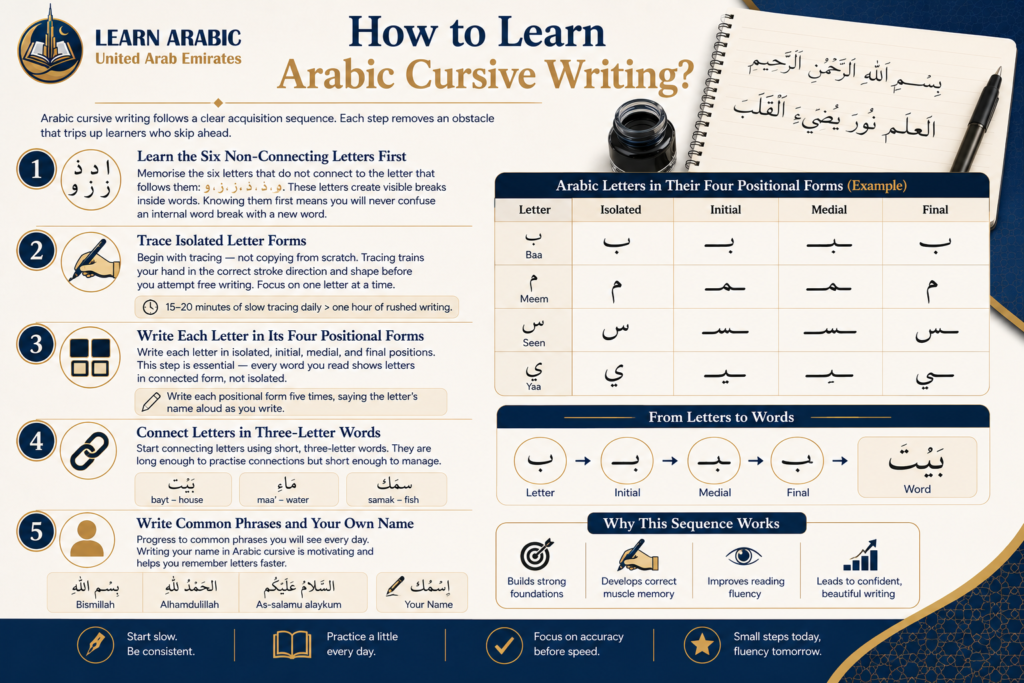
Step 1: Learn the Six Non-Connecting Letters First
Before anything else, memorise the six letters that do not connect to the letter that follows them: ا، د، ذ، ر، ز، و. These letters create visible breaks inside words — gaps that beginners sometimes misread as word boundaries. Knowing these six letters first means you will never be confused by an internal word break again.
Step 2: Trace Isolated Letter Forms
Begin with tracing — not copying from scratch. Tracing isolated letter forms trains your hand in the correct stroke direction and shape before you attempt free writing. Focus on one letter at a time. Pay attention to where each stroke starts, which direction it moves, and whether the letter stays above, on, or drops below the baseline.
Fifteen to twenty minutes of deliberate, slow tracing per day produces more measurable improvement than a one-hour rushed session. Speed is not the goal at this stage; correct form is.
Step 3: Write Each Letter in Its Four Positional Forms
Once you can trace a letter comfortably, write it independently in all four positions: isolated, initial, medial, and final. This is the step most self-study learners skip — and the omission causes reading hesitation later, because every Arabic word you encounter shows letters in connected form, not isolated.
Use the table above as your reference. Write each positional form five times, saying the letter’s name aloud as you write.
Step 4: Connect Letters in Three-Letter Words
Begin connecting letters using short, three-letter words: بَيْت (bayt – house), مَاء (maa’ – water), سَمَك (samak – fish). Three-letter words are long enough to practise connections but short enough to manage without losing the flow.
The word بَيْت is an excellent starting word: it combines ب (Baa), ي (Yaa), and ت (Taa) — three connecting letters with clearly different shapes, showing you exactly how Ruq’ah joins letters of different types.
Step 5: Write Common Phrases and Your Own Name
Once three-letter words feel natural, progress to common phrases: بِسْمِ الله، الحَمْدُ لله، السَّلَامُ عَلَيْكُم. These phrases are worth practising specifically because you will encounter them constantly in Arabic reading and writing — and the muscle memory gained from writing them transfers immediately to real-world use.
Writing your name in Arabic cursive is also highly motivating. Personal investment accelerates practice in a measurable way; most learners find they remember the letters in their own name faster than any others.
Read Also: The Best Way to Learn Arabic Vocabulary
Common Arabic Cursive Writing Mistakes and How to Fix Them
Arabic cursive writing is the default form of the language, which means beginners encounter it from day one — before habits have a chance to form in the wrong direction. These are the five mistakes that most reliably slow progress, and the specific fix for each.
| Mistake | Why It Happens | The Fix |
| Lifting the pen between letters | Carried over from English print habits | Practise writing without lifting — flow is the goal |
| Forgetting positional forms | Learning letters only in isolation | Learn initial, medial, and final forms alongside isolated forms, from the start |
| Writing inconsistently right to left | Arabic direction is opposite to English | Use lined paper, always start from the right margin |
| Making all letters the same height | Some Arabic letters extend above or below the baseline | Learn which letters go above (ل، ك) and below (ي، ق) the line as you learn each letter |
| Rushing to write fast | Speed practice before muscle memory | Write slowly and correctly — speed follows muscle memory automatically |
worth naming separately: learning Ruq’ah forms from digital fonts. Most Arabic computer fonts use Naskh, not Ruq’ah — so learners who study “cursive Arabic” from on-screen text are actually learning a different style. Use dedicated Ruq’ah handwriting resources, or work with a native instructor who writes in Ruq’ah, to ensure you are practising the right forms.

Read also: Best 10 Arabic Cartoons for Kids
Arabic Cursive Writing vs English Cursive: Key Differences
The word “cursive” means something very different in Arabic than it does in English. Understanding the distinction removes a persistent source of confusion for learners with an English-language background.
| Feature | Arabic Cursive Writing | English Cursive |
| Is it the default? | Yes — always connected | No — print is taught first |
| Do letters change shape? | Yes — up to 4 forms per letter | No — letters stay the same |
| Direction | Right to left | Left to right |
| Are any letters disconnected? | Yes — 6 letters do not connect forward | No — all letters connect |
| Is there a “print” alternative? | No mainstream equivalent | Yes — print is standard in education |
The practical implication: an English speaker who is “bad at cursive” has no equivalent disadvantage when learning Arabic. In English, print is taught first and cursive is an optional, add-on style. In Arabic, connected script is the only script — and every learner begins there.
Step Inside Our Classrooms
Don’t just take our word for it—see our community in action. Click below to watch real, live snippets from our recent classes and experience our engaging teaching style firsthand!
Master Arabic in the UAE
Experience world-class Arabic language training designed for students and professionals in the Emirates.
Book Your Free TrialMaster Arabic Cursive Writing with Learn Arabic UAE
Mastering Arabic cursive writing is easier when you learn with experienced native Arabic instructors who can guide you through every stage of the process. From forming individual letters to connecting them correctly within words, personalized feedback helps you build accurate writing habits and gain confidence much faster than self-study alone.
At Learn Arabic UAE, our structured online lessons are designed for beginners and learners of all levels. You’ll practice Ruq’ah handwriting, letter positions, connection rules, and everyday writing through one-to-one sessions tailored to your pace and learning goals. With flexible scheduling and step-by-step guidance, you’ll develop clear, natural Arabic handwriting that you can use in real-life situations.
Book your free trial class today and start building confident Arabic cursive writing skills with Learn Arabic UAE.
Our Arabic courses
- Arabic Course in the UAE
- Arabic Intensive Course
- Arabic Classes for Beginners (Learn Arabic from Scratch)
- Madinah Arabic Course
- Arabic Classes for Adults
- Self-Paced Arabic Course
- Arabic Speaking Classes
- Learn to Write Arabic Course
- Arabic Grammar Course
- Learn Arabic Alphabet Course

Master Arabic in the UAE
Experience world-class Arabic language training designed for students and professionals in the Emirates.
Book Your Free TrialConclusion
Arabic cursive writing is not a finishing skill — it is the foundation of the entire written language. Every word in every Arabic text you will ever read or write is cursive. The letters connect, shift shape by position, and flow together in a script refined over more than a thousand years of manuscript tradition.
The starting point is clear: learn the six non-connecting letters, master the positional forms of all 28 letters in Khat ar-Ruq’ah, practise three-letter words with slow deliberate strokes, and build toward common phrases. Most learners develop legible Arabic cursive handwriting within four to eight weeks of fifteen-to-twenty minutes of daily practice — provided they practise correctly, not just frequently.
Arabic cursive writing is not difficult. It is different. And that difference, once understood, becomes one of the most satisfying skills in the language to develop.
Frequently Asked Questions
If you’re new to Arabic cursive writing, it’s natural to have questions about how the script works, how long it takes to learn, and how it differs from Arabic calligraphy or English cursive. The FAQs below answer the most common questions beginners ask before starting their Arabic handwriting journey.
Is Arabic always written in cursive?
Yes — Arabic is almost always written in connected cursive form. Unlike English, where “print” and “cursive” are two separate systems with print taught first, Arabic has no mainstream print equivalent for handwriting. Every Arabic word is written with letters joined together, making cursive the default from the very first lesson.
What is Arabic cursive writing called?
The most common everyday Arabic cursive handwriting style is called Khat ar-Ruq’ah (خط الرقعة) — simple, fast, and rounded, designed for daily use. The standard printed style found in books, digital fonts, and the Quran is called Khat an-Naskh (خط النسخ). Advanced artistic styles include Khat ath-Thuluth, Khat al-Diwani, and al-Khatt al-Kufi.
How long does it take to learn Arabic cursive writing?
Most learners develop legible Arabic cursive handwriting within four to eight weeks of consistent daily practice — fifteen to twenty minutes per day of deliberate, slow writing. The key variable is not how long you practise in each session but whether you practise correct forms from the start. Writing slowly and correctly builds muscle memory far faster than writing quickly and imprecisely.
What is the difference between Arabic cursive and Arabic calligraphy?
Arabic cursive writing is everyday connected handwriting — used for notes, letters, and informal communication. Arabic calligraphy is an art form where letterforms are designed, proportioned, and decorated according to strict aesthetic rules developed over centuries. The most common everyday cursive style is Ruq’ah. The most demanding calligraphy styles — Thuluth and Diwani — typically require years of dedicated artistic practice to master.
Can beginners learn Arabic cursive writing?
Yes — and since Arabic is inherently cursive, beginners learn cursive from their very first lesson. Start with Khat ar-Ruq’ah (the everyday handwriting style), learn the six non-connecting letters, practise letter positional forms, then move to three-letter words. Working with a native instructor who provides real-time feedback on stroke direction and letter proportions accelerates progress significantly.
How is Arabic cursive writing different from English cursive?
The core difference is that Arabic cursive is the standard form of the script — not an add-on style. Arabic letters change shape depending on their position in a word (four positional forms), six letters do not connect to the following letter, and the script runs right to left. English cursive is an optional style layered onto a print system where letters keep the same shape regardless of position.



Leave a Reply