 Learn Arabic
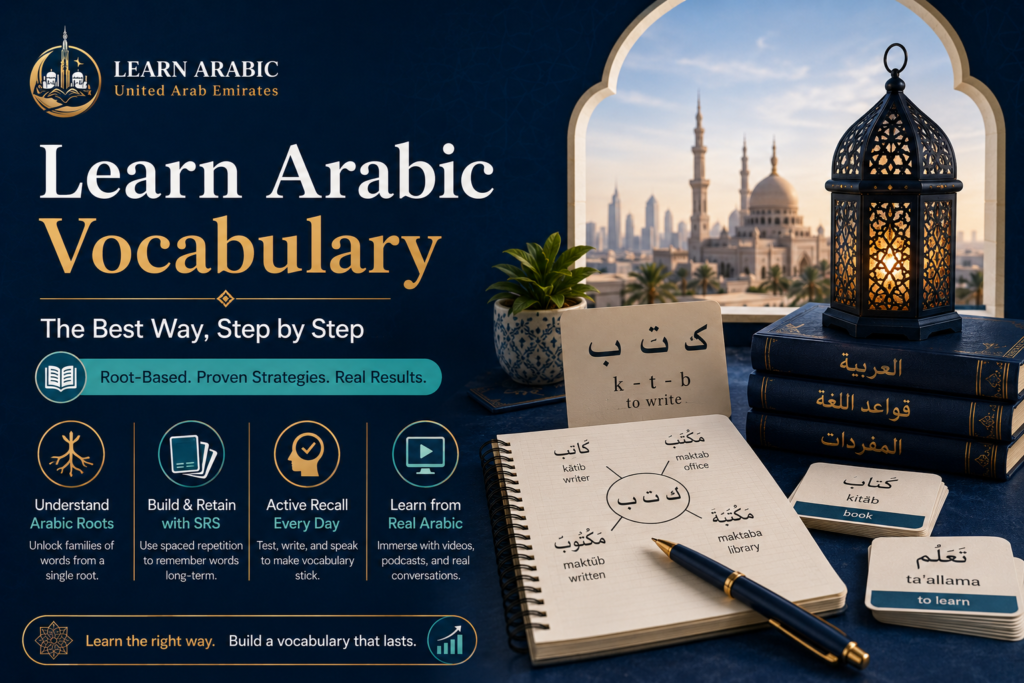
Most Arabic learners hit the same wall: they study for weeks, memorize word lists, and still feel like the vocabulary isn’t sticking. The problem usually isn’t effort — it’s method. Arabic vocabulary works differently from European languages, and the strategies that work for French or Spanish don’t transfer cleanly to Arabic.
The best way to learn Arabic vocabulary is to start with the root system, build retention through active recall, and reinforce words through real input — reading, listening, and speaking — rather than passive review. This guide walks you through every effective strategy, in the right order.
What You’ll Learn in This Article
- What Arabic vocabulary is and why it’s structured the way it is
- How many words Arabic actually contains — and how many you really need
- The most effective strategies for building and retaining Arabic vocabulary
- What makes Arabic vocabulary unique compared to other languages
- How to choose the right learning path based on your goals
What Is Arabic Vocabulary and How Is It Structured?
Arabic vocabulary is organized around a system of trilateral roots (الجذور الثلاثية, al-judhūr al-thulāthiyya) — three-consonant combinations that carry a core meaning. From each root, dozens of words are formed by applying fixed patterns called awzān (أوزان).
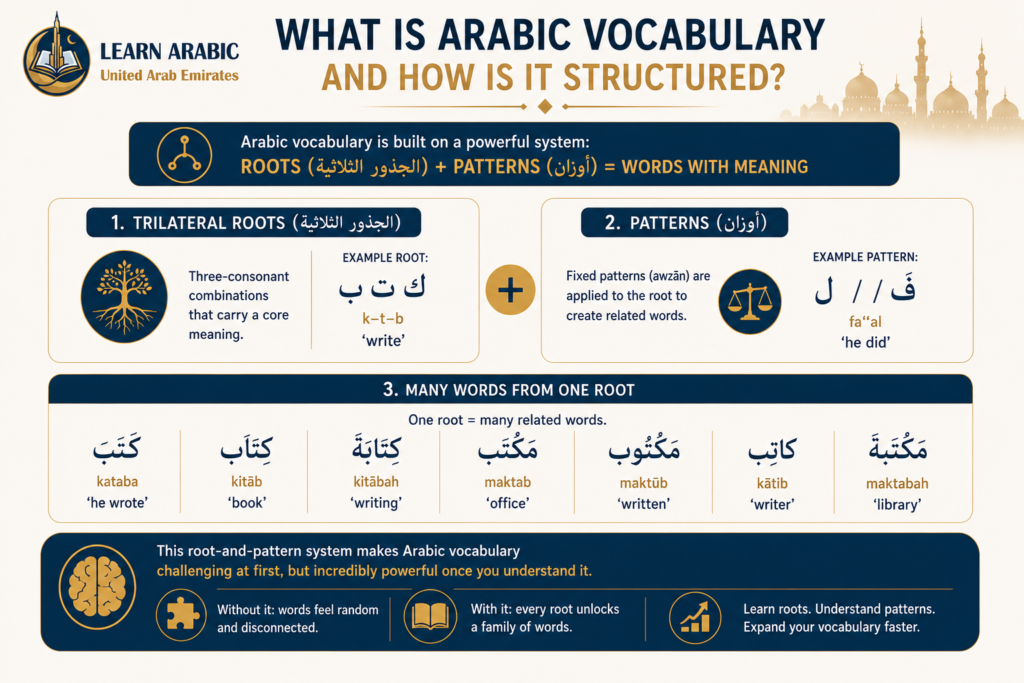
This root-and-pattern architecture is what makes Arabic vocabulary simultaneously challenging and highly learnable. Without understanding it, Arabic words feel random and disconnected. With it, every new root you learn potentially gives you access to a cluster of related words at once — making it the single most important structural concept for any vocabulary learner to grasp early.
How Many Words Does Arabic Vocabulary Contain?
Arabic is estimated to contain around 12.3 million words across its classical and modern forms — one of the largest vocabularies of any language. But that number is misleading for learners.
Modern Standard Arabic (MSA / الفصحى, al-fuṣḥā) in active daily use draws on a far smaller working set. For practical fluency, learners need approximately 1,500–2,000 high-frequency words to hold meaningful conversations and read standard texts. Most basic Quranic comprehension is accessible with around 300 high-frequency Quranic vocabulary items — a realistic short-term goal for a dedicated learner putting in 20–30 minutes a day.
Knowing your target changes how you study. A learner aiming for Quranic reading should prioritize root-based Quranic vocabulary. A learner aiming for Gulf business communication should build around MSA vocabulary first. If you’re unsure which path fits your goals, MSA Arabic course is structured around exactly this frequency-first approach.
Join Our Modern Standard Arabic Classes in the UAE with a FREE Trial

See Our Classroom Environment in Action
Experience a sneak peek into our live sessions. Watch the video below to see our specialized instructors interacting with students, breakdown complex texts, and cultivate an engaging, respectful learning environment.
Master Arabic in the UAE
Experience world-class Arabic language training designed for students and professionals in the Emirates.
Book Your Free TrialRead more: Muslim Greeting in Arabic
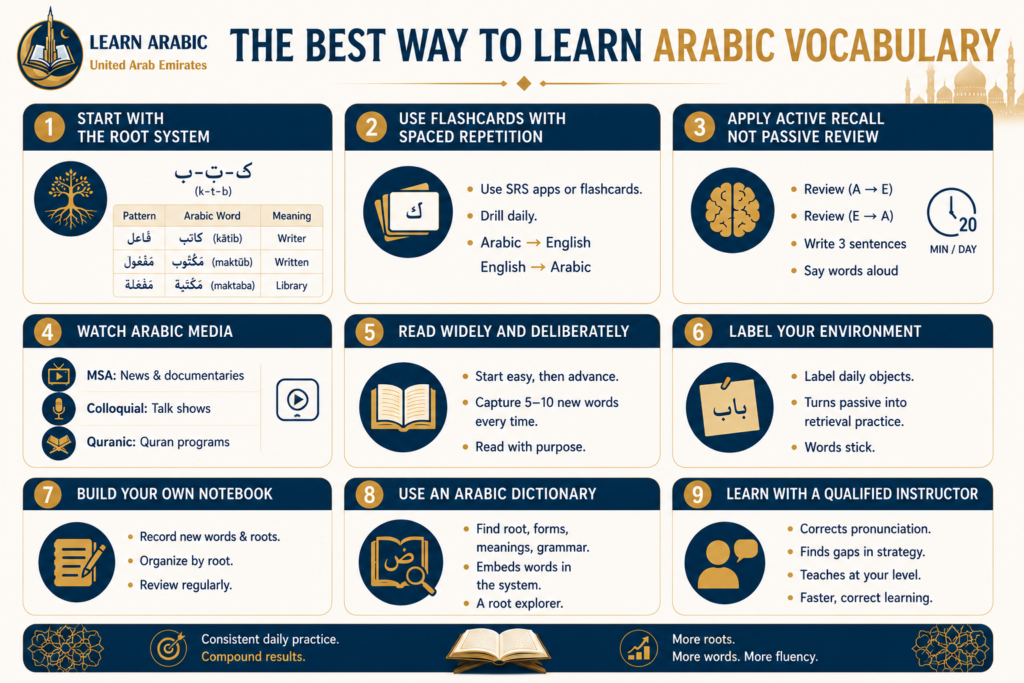
The Best Way to Learn Arabic Vocabulary: 9 Strategies
Building Arabic vocabulary is cumulative. No single strategy works in isolation — the learners who progress fastest combine several of the methods below into a consistent daily routine.
1. Start with the Arabic Root System
The Arabic root system is not a grammar concept — it is your most powerful vocabulary tool. Most Arabic words are derived from a three-consonant root with a fixed core meaning. Ten standard word patterns (awzān) are then applied to that root to generate variations.
Take the root ك-ت-ب (k-t-b), which carries the meaning of writing:
| Pattern | Arabic Word | Meaning |
| Fā’il (فَاعِل) | كَاتِب (kātib) | Writer |
| Maf’ūl (مَفْعُول) | مَكْتُوب (maktūb) | Letter / written |
| Maf’ala (مَفْعَلَة) | مَكْتَبَة (maktaba) | Library / bookshop |
Learning one root doesn’t give you one word — it gives you a family of words. This is why root-based learning has a compounding return: the more roots you know, the faster new words become guessable. Study the 10 Arabic verb forms (awzān) early, and you’ll start recognizing word families rather than memorizing isolated items.
2. Use Flashcards with Spaced Repetition
Write your highest-priority Arabic vocabulary onto flashcards — or use a digital SRS (Spaced Repetition System) app — and test yourself daily. Master one set before moving to the next.
The key is bidirectional drilling: Arabic script to English meaning, and English concept to Arabic word. One-directional drilling builds recognition. Bidirectional drilling builds production — the ability to actually use the word in speech and writing. Most learners only drill in one direction, which is why they can understand Arabic but struggle to speak it.
3. Apply Active Recall — Not Passive Review
Active recall — deliberately retrieving a word from memory rather than re-reading it — is the mechanism that converts short-term vocabulary exposure into durable long-term retention. Passive review (highlighting, re-reading lists) produces an illusion of familiarity. Active recall produces actual retention.
A 20-minute daily Arabic vocabulary session structured for active recall might look like this:
- 5 minutes: SRS card review (recognition direction — Arabic to English)
- 5 minutes: SRS card review (production direction — cover Arabic, recall it)
- 5 minutes: Write three sentences using today’s new words
- 5 minutes: Say today’s words aloud, checking pronunciation against a reference
Speaking words aloud matters more than most learners assume. Arabic pronunciation engages the makhārij al-ḥurūf (مَخَارِج الحُرُوف) — the specific articulation points for each letter — and linking pronunciation to vocabulary from the beginning prevents the mispronunciation habits that are notoriously difficult to unlearn later.
If you’re learning Arabic at your own pace and want a structured curriculum to pair with these techniques, self-paced Arabic course provides root-organized vocabulary content you can work through on your schedule.

4. Watch Arabic Media
Exposure to real Arabic speech accelerates vocabulary acquisition beyond what drills alone can achieve. Match your media to your goal:
- For Modern Standard Arabic: Arabic news broadcasts and documentaries use formal MSA. Al Jazeera Arabic is one of the most accessible entry points.
- For colloquial Arabic: Arabic talk shows and informal programs expose you to regional slang and everyday conversational expressions.
- For Quranic vocabulary: Quran broadcasts and programs by Muslim scholars reinforce classical Arabic in a meaningful, contextualized way.
The common mistake is passive watching — treating Arabic media as background noise. Active listening means pausing, looking up unknown words, and returning to the clip to confirm understanding. That extra step converts hearing into vocabulary.
5. Read Widely and Deliberately
Reading is the highest-volume vocabulary input available to Arabic learners. If reading Arabic feels difficult at first, start with children’s books — simpler sentence structures and more basic vocabulary, but still real, correct Arabic.
Progress from children’s books to standard prose, then to newspapers, then to academic or specialized texts. Reading across varied topics exposes you to vocabulary specific to different fields — professional Arabic, academic Arabic, and abstract concepts that don’t come up in conversation.
A common mistake: reading for meaning only, without stopping to note unfamiliar words. Every reading session should produce at least 5–10 new words that go into your SRS or vocabulary notebook. Reading without capture is reading that doesn’t compound.
6. Label Your Environment
Stick Arabic labels on objects you interact with daily — the door, windows, refrigerator, desk, clock, mirror. This technique works because it turns passive visual encounters into low-effort retrieval practice. Over time, you see the label, recall the Arabic word without effort, and that word becomes permanent.
It sounds simple, and it is. The learners who dismiss it are usually the ones still struggling to recall basic noun vocabulary six months in.
7. Build Your Own Vocabulary Notebook
Create a personal vocabulary resource — a notebook or digital document — where you record new words, phrases, idioms, and root families as you encounter them. Organize it by root rather than alphabetically; this reinforces the root-and-pattern structure you’re already building.
Return to your notebook regularly for review. The act of writing the word yourself, rather than just reading it, strengthens encoding. A vocabulary notebook also makes your learning visible — seeing it grow is genuinely motivating.
8. Learn to Use an Arabic Dictionary
An Arabic dictionary is not just a translation tool — it’s a root explorer. When you look up a word correctly, you find the root it belongs to, its singular and plural forms, its tense patterns, and its grammatical category. This context embeds the word into the root-and-pattern system you’re building, rather than leaving it isolated.
For learners studying independently, the Arabic dictionary is especially important. Hans Wehr’s Dictionary of Modern Written Arabic is the standard reference for MSA learners. Quranic learners often use Lane’s Lexicon or dedicated Quranic concordances alongside it.
9. Learn with a Qualified Arabic Instructor
Structured instruction accelerates every strategy above. A qualified native Arabic teacher corrects pronunciation before errors become habits, identifies gaps in your vocabulary strategy, and adapts the pace to your actual level.
Self-study builds knowledge. Expert instruction builds it faster, correctly, from the start.
For learners focused specifically on Gulf Arabic — the dialect of the UAE and the Gulf region — Gulf Arabic course provides dialect-specific vocabulary instruction you won’t get from generic MSA resources.
Begin Your Gulf Arabic Learning Journey with a FREE Trial Class

Read more: Vegetables in Arabic
What Makes Arabic Vocabulary Unique?
Arabic vocabulary stands apart from most other languages in three specific ways.
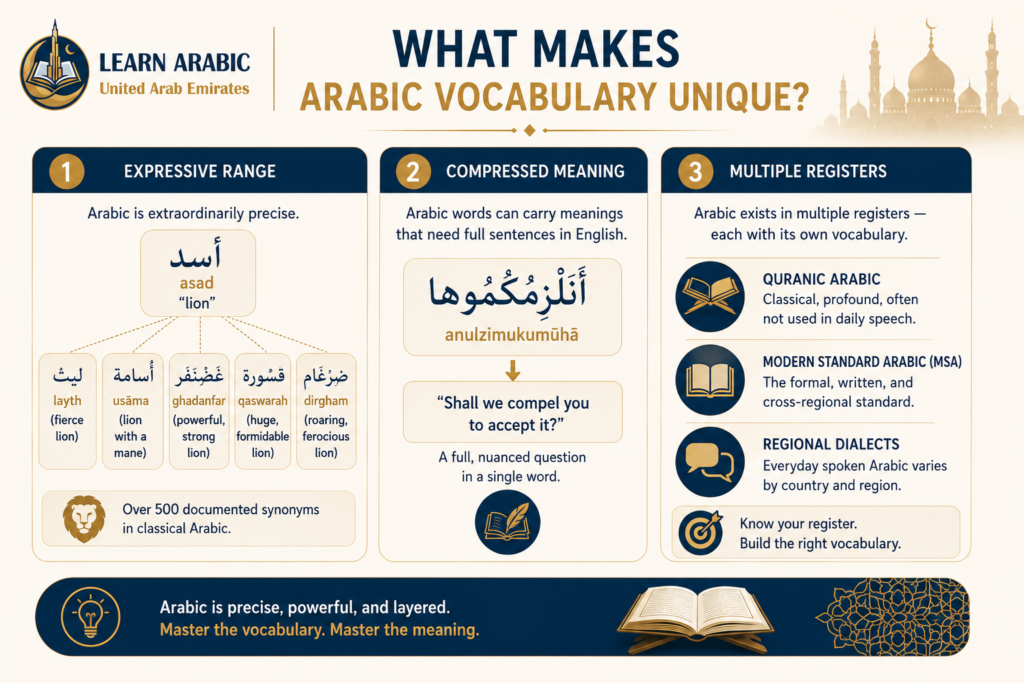
First, its expressive range. Arabic is not just large — it is extraordinarily precise. The word asad (أسد), typically translated as “lion,” has over 500 documented synonyms in classical Arabic, each carrying a different connotation: layth (ليث), usāma (أسامة), ghadanfar (غضنفر), qaswarah (قسورة), dirgham (ضرغام). English has no equivalent for this depth of synonymic precision.
Second, Arabic words can carry meanings that require entire English sentences to express. The Quranic word anulzimukumūhā (أَنُلْزِمُكُمُوهَا) translates as “Shall we compel you to accept it?” — a full, nuanced question compressed into a single word through Arabic’s morphological system.
Third, Arabic exists in multiple registers — Quranic Arabic, Modern Standard Arabic, and regional dialects — each with vocabulary that doesn’t always cross over. A word used fluently in Gulf Arabic may not appear in MSA; a classical Quranic term may not be recognized in everyday Egyptian conversation. Knowing which register you’re building vocabulary in keeps your learning focused.
Step Inside Our Classrooms
Don’t just take our word for it—see our community in action. Click below to watch real, live snippets from our recent classes and experience our engaging teaching style firsthand!
Master Arabic in the UAE
Experience world-class Arabic language training designed for students and professionals in the Emirates.
Book Your Free TrialStart Building Your Arabic Vocabulary with UAE Arabic Learning Academy
Arabic vocabulary doesn’t grow by accident — it grows through a consistent method applied by a learner who knows what they’re building toward. The strategies above work. Expert guidance makes them work faster.
UAE Arabic Learning Academy offers:
- Frequency-based, root-organized vocabulary curriculum
- Certified native Arabic instructors experienced with non-native speakers
- Flexible 1-on-1 sessions available on your schedule
- Courses for MSA, Gulf Arabic, Quranic Arabic, beginners, and advanced learners
- A free trial lesson — no commitment required
[ Book Your Free Trial Lesson]
Our Arabic courses
- Arabic Course in the UAE
- Arabic Intensive Course
- Arabic Classes for Beginners (Learn Arabic from Scratch)
- Madinah Arabic Course
- Arabic Classes for Adults
- Self-Paced Arabic Course
- Arabic Speaking Classes
- Learn to Write Arabic Course
- Arabic Grammar Course
- Learn Arabic Alphabet Course
- Modern Standard Arabic (MSA) Course
- Quranic Arabic Course
- Fusha Arabic Course
- Classical Arabic Course
- Emirati Arabic Course
- Gulf Arabic Course
- Learn Saudi Arabic
- Business Arabic Course UAE
- Arabic Language Classes for Professionals in UAE

Master Arabic in the UAE
Experience world-class Arabic language training designed for students and professionals in the Emirates.
Book Your Free TrialConclusion
Arabic vocabulary is large, rich, and unlike any European language — but it is structured, not chaotic. The root-and-pattern system gives you a lever: learn one root, and you gain access to a family of words. Apply active recall, not passive review. Read deliberately, watch Arabic media, label your environment, and build your vocabulary notebook consistently.
The learners who make real progress in Arabic vocabulary are not those who study hardest in a single session — they’re those who build small, consistent, correctly structured daily habits over time. Start with the root system, add an active recall routine, and get qualified instruction to keep your foundations clean. The vocabulary follows from there.
The best way to learn Arabic vocabulary is the structured way — and the best time to start is today.
Frequently Asked Questions
Building a strong Arabic vocabulary takes time, but understanding a few key principles can make the process much easier. Below are answers to the most frequently asked questions about learning, memorizing, and using Arabic vocabulary effectively.
What is the best way to learn Arabic vocabulary?
The best way to learn Arabic vocabulary is to start with the Arabic root system (awzān), then build retention through active recall techniques like spaced repetition flashcards — drilled in both directions (Arabic to English and English to Arabic). Reinforce with Arabic media, deliberate reading, and daily vocabulary review.
How many vocabulary words do I need to speak Arabic?
You need approximately 1,500–2,000 high-frequency Modern Standard Arabic words to hold meaningful conversations and read standard texts. For basic Quranic comprehension, around 300 high-frequency Quranic vocabulary items cover the majority of the text.
How do I memorize new words in Arabic fast?
Memorize new Arabic words fast by combining active recall (SRS flashcards, two-directional drilling) with immediate use — write the word in a sentence and say it aloud the day you learn it. Root-based learning also accelerates retention because one root generates multiple related words at once.
What is the Arabic vocabulary root system?
The Arabic root system (al-judhūr al-thulāthiyya) is a framework in which most Arabic words are derived from a three-consonant root carrying a core meaning. Fixed word patterns (awzān) are applied to that root to generate dozens of related words — nouns, verbs, adjectives, and place names — all traceable back to the same core meaning.
Does Arabic have more words than English?
Yes. Arabic is estimated to contain around 12.3 million words in its classical and modern forms, compared to English’s approximately 600,000–1 million. Much of Arabic’s breadth comes from its awzān system, which generates large families of related words from each root, and from its extensive synonymic tradition — some classical Arabic nouns have hundreds of documented synonyms.
Is Gulf Arabic vocabulary different from Modern Standard Arabic?
Yes, Gulf Arabic (al-Khalīji) has significant dialect-specific vocabulary that differs from Modern Standard Arabic. Many everyday Gulf expressions, terms for local customs, and regional idioms do not appear in MSA. Learners in the UAE or Gulf region benefit from Gulf Arabic instruction that covers this dialect-specific vocabulary alongside their MSA foundation.
Related Articles
Learn Arabic



Leave a Reply