 Learn Arabic
When you want to know the Arabic short vowels, they are the three marks: fatha, damma, and kasra. These marks sit above or below a letter to show how it should be pronounced.
Without these marks, the same string of consonants can be read in several completely different ways, leading to different meanings.
If you’ve ever looked at an Arabic word and wondered why the meaning changed even though the letters stayed the same, Arabic short vowels are almost always the answer.
This article breaks down what each short vowel looks like and how it’s pronounced. It also answers why getting these marks right is so important for reading, speaking, and understanding Arabic, whether you’re a beginner, a parent guiding a child, or a student preparing to read the Quran.
The Definition Of Arabic Short Vowels
Arabic short vowels are the three diacritical marks: fatha, damma, and kasra. You add these marks above or below a consonant to indicate a brief vowel sound.
Arabic short vowels are small symbols layered onto consonants, not standalone letters in the alphabet. This distinguishes them from English vowels, which are separate letters (a, e, i, o, u).
When you read native Arabic text, newspapers, novels, and most books, you notice that they are usually printed without these marks, because fluent readers infer them from context. However, learners rely on fully voweled text (called mushakkal in Arabic) to read correctly. That’s why children’s Arabic books, Quranic text, and beginner materials mark every short vowel.
A common mistake beginners make is assuming unmarked Arabic is “harder” Arabic. It isn’t harder. It simply expects the reader to already know which short vowel belongs where, based on grammar and vocabulary they’ve already learned. That recognition skill is built by practicing with fully marked text first.
Read Also: Arabic Grammar For Quran
The Three Arabic Short Vowels And How To Pronounce Them
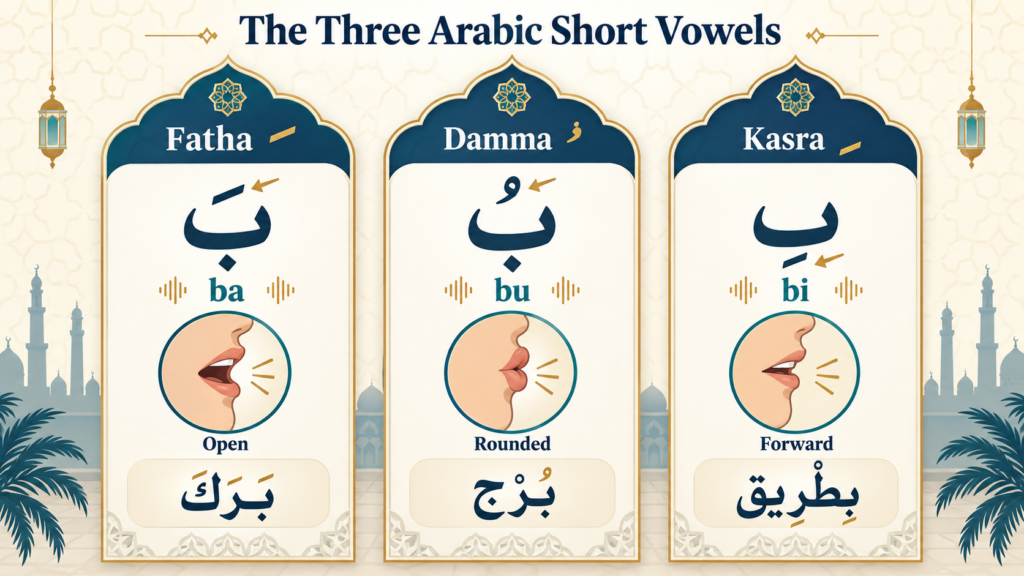
Each short vowel has a unique shape, placement on the letter, and mouth position. Getting the mouth position right is often more useful for learners than memorizing the written symbol, because it’s the sound, not the shape, that changes meaning.
1. Fatha (َ) – The Short Sound “A”
The fatha is a small diagonal stroke placed above a letter. It produces a short “a” sound, similar to the “a” in the English word “cat.” To pronounce it, the mouth opens, and the lips stay relaxed and unrounded.
Example: the letter ب with a fatha is pronounced “ba,” بَ as in the first letter of بَرَكَ (baraka).
2. Damma (ُ) – The Short Sound “U”
The damma is a small curl, similar in shape to a miniature waw, placed above a letter. It produces a short “u” sound, close to the “u” in “put.” To pronounce it, the lips round and press together slightly, almost as if about to whistle.
Example: the letter ب with a damma is pronounced “bu بُ,” as in بُرج (burj), meaning tower.
2. Kasra (ِ) – The Short Sound “I”
The kasra is a small diagonal stroke placed below a letter, the mirror position of the fatha. It produces a short “i” sound, similar to the “i” in “sit.” To pronounce it, the lower jaw drops slightly, and the sound is pushed forward in the mouth.
Example: the letter ب with a kasra is pronounced “bi بِ,” as in بِطريق (bitreeq), meaning penguin.
Many learners at Learn Arabic UAE start exactly here, with guided pronunciation drills for each of the three short vowels, because mouth position, not memorization, is what makes the sounds stick.
Read Also: Arabic Grammar For Beginners
Why Arabic Short Vowels Change The Meaning Of A Word
Short vowels are not decorative. They carry grammatical and semantic weight. The same three consonants can produce three or four different words, each with a distinct meaning, depending only on which short vowel is used.
A well-known example is the word جد. Written without vowels, it looks identical every time, but the short vowel changes everything:
- (jadd) جَدّ— grandfather
- (jidd) جِدّ — seriousness or effort
- (judd) جُدّ — seashore, the root behind the name of the city Jeddah
The same pattern appears with بر:
- (barr) بَرّ— dry land
- (birr) بِرّ— kindness or righteousness
- (burr) بُرّ— wheat
This is why reading Arabic accurately requires more than recognizing letters. It requires recognizing which short vowel a word takes in context.
There is a common error among early learners, which is guessing the vowel based on how a similar-looking word sounded before, instead of checking the grammatical role the word plays in the sentence.
Read Also: Arabic Long Vowels – The Complete Guide To ا و ي
Arabic Short Vowels And Grammatical Case (I’rab)
In Arabic, the final short vowel on a word often signals its grammatical case, whether it’s the subject, object, or possessive form in a sentence. This system is called i’rab إعراب.
As a general pattern: damma marks the nominative case (raf’) رفع, fatha marks the accusative case (nasb) نصب, and kasra marks the genitive case (jarr) جرّ.
A fourth mark, sukun سكون, a small circle showing the absence of any vowel, appears in the jussive case (jazm) جَزْمand whenever a consonant carries no vowel sound at all.
This is one reason short vowels matter far beyond pronunciation drills. Reading the correct final vowel on a word tells a fluent reader its exact role in the sentence, before they’ve even reached the end of it.
Arabic Short Vowels Vs. Long Vowels
A short vowel becomes a long vowel when it is immediately followed by its matching letter of prolongation, alif ا, waw و, or ya ي. Fatha followed by alif becomes a long “aa” sound, damma followed by waw becomes a long “oo” sound, and kasra followed by ya becomes a long “ee” sound.
Compare قَرَأَ (qara’a, “he read”), where the fatha stands alone and stays short, with قَارئ (qari’, “a reader”), where the same fatha is followed by an alif and stretches into a long vowel. The written mark is the same fatha in both cases. The extra letter after it is what changes the sound’s length.
Mastering this distinction is most important in Quranic recitation, where holding a long vowel for its correct duration (a skill called tajweed) is part of reading accurately, and where shortening a long vowel, or lengthening a short one, is considered a recitation error.
Learners working through Quran-focused Arabic study often find that short vowel accuracy is the single biggest jump between “sounding out” words and reading fluently.
It’s a foundation worth building properly rather than rushing past, which is exactly the kind of structured, one-step-at-a-time approach Learn Arabic UAE builds its beginner courses around.
Read Also: Connecting Arabic Letters Practice
Step Inside Our Classrooms
Don’t just take our word for it—see our community in action. Click below to watch real, live snippets from our recent classes and experience our engaging teaching style firsthand!
Master Arabic in the UAE
Experience world-class Arabic language training designed for students and professionals in the Emirates.
Book Your Free TrialPracticing Arabic Short Vowels – Simple Words to Start With
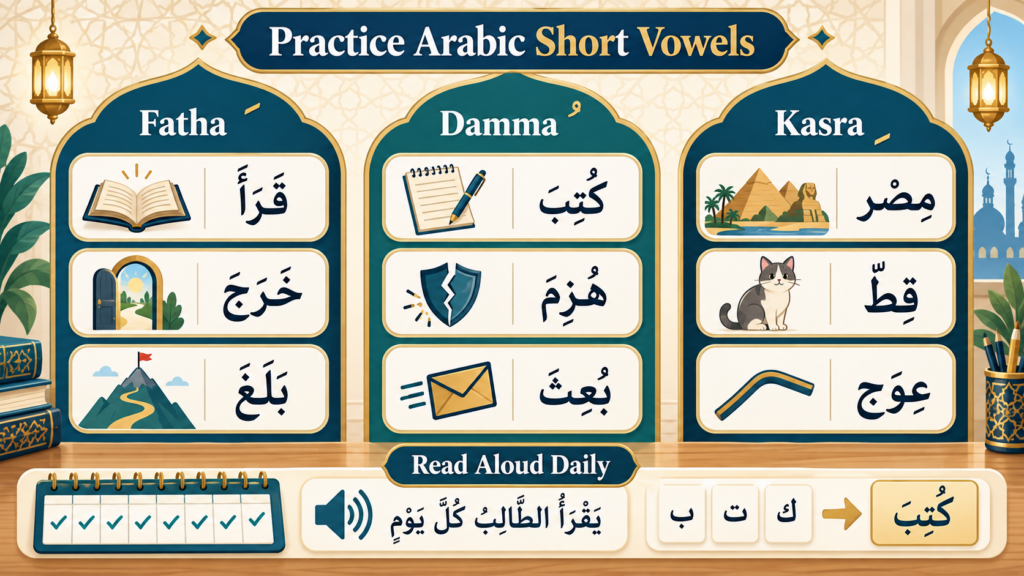
The best way to become comfortable with Arabic short vowels is to practise them inside familiar words rather than studying each mark alone. Real examples help you connect the written harakah to its sound, strengthen pronunciation, and recognize common word patterns more quickly.
1. Fatha words With Examples
The fatha produces a short “a” sound. In قَرَأَ (qara’a, “he read”), خَرَجَ (kharaja, “he went out”), and بَلَغَ (balagha, “he reached”), each consonant carries a fatha. Read the words slowly at first so every short “a” remains clear without being stretched into a long vowel.
2. Damma Words With Examples
The damma produces a short “u” sound. In the passive verbs كُتِبَ (kutiba, “it was written”), هُزِمَ (huzima, “he was defeated”), and بُعِثَ (bu‘itha, “he was sent”), the first letter carries a damma while the following consonants carry kasra and fatha.
These examples help learners practise distinguishing different short vowels within the same word.
3. Kasra Words With Examples
The kasra produces a short “i” sound. It appears at the beginning of مِصْر (Miṣr, “Egypt”), قِطّ (qiṭṭ, “cat”), and عِوَج (‘iwaj, “crookedness” or “deviation”). Pronounce the initial “i” briefly and clearly, taking care not to lengthen it into the long “ee” sound represented by yaa.
A practical way to build this skill is to read a short, fully-voweled sentence aloud daily and say each vowel sound deliberately rather than skimming past it.
This single habit, repeated over a few weeks, is often what moves a beginner from hesitant letter-by-letter reading to smoother word recognition. It’s a habit that structured lesson plans reinforce far more consistently than self-study alone.
Free Resources For Learning Arabic Short Vowels
Free online resources make it easier for beginners to practise Arabic short vowels at their own pace.
The following apps and video channels offer clear explanations, visual examples, and pronunciation practice to help learners recognize fatha, damma, and kasra and use them accurately when reading Arabic words.
1. The Arabic Grammar Learning App – Explanation, Examples, And Practice
The Arabic Grammar Learning app gives beginners convenient access to grammar explanations, tables, and examples. It is especially useful for practising short vowels, helping learners recognize fatha, damma, and kasra in words while improving reading accuracy and pronunciation.

2. The Arabic 101 YouTube channel – Listen, Watch, And Learn
The Arabic 101 YouTube channel explains Arabic grammar through clear, beginner-friendly video lessons. Its short-vowel lessons connect fatha, damma, and kasra with familiar sounds and practical words, helping learners improve pronunciation, vocabulary, and reading accuracy.
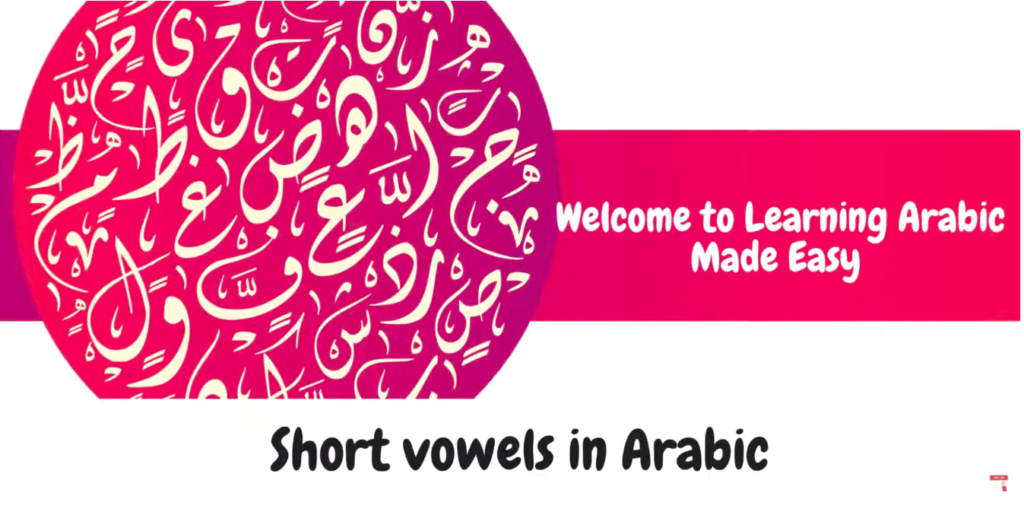
3. The Learning Arabic Made Easy channel
The Learning Arabic Made Easy channel offers clear, beginner-friendly lessons on Arabic grammar and pronunciation. Its short-vowel videos explain the names, sounds, and correct use of fatha, damma, and kasra, helping learners read and pronounce Arabic words more confidently.
Read also: The Best 8 Arabic Learning Apps for Kids
See Our Classroom Environment in Action
Experience a sneak peek into our live sessions. Watch the video below to see our specialized instructors interacting with students, breakdown complex texts, and cultivate an engaging, respectful learning environment.
Master Arabic in the UAE
Experience world-class Arabic language training designed for students and professionals in the Emirates.
Book Your Free TrialReady To Start Reading Arabic With Confidence?
Understanding fatha, damma, and kasra on paper is one thing, but pronouncing them correctly and applying them automatically while reading is absolutely another.
A guided course shows you both, with a teacher correcting your mouth position and vowel recognition in real time, instead of leaving you to guess.
Learn Arabic UAE offers structured, one-on-one Arabic lessons that start exactly here, with short vowel recognition and pronunciation, and build step by step toward fluent reading.
If you are ready to strengthen your pronunciation and read Arabic more naturally, consider starting with a guided lesson tailored to your current level.
A little focused support now with Learn Arabic UAE can help you build accurate, confident reading habits for the future.
Our Arabic courses
- Arabic Course in the UAE
- Arabic Intensive Course
- Arabic Classes for Beginners (Learn Arabic from Scratch)
- Madinah Arabic Course
- Arabic Classes for Adults
- Self-Paced Arabic Course
- Arabic Speaking Classes
- Learn to Write Arabic Course
- Arabic Grammar Course
- Learn Arabic Alphabet Course
- Modern Standard Arabic (MSA) Course
- Quranic Arabic Course
- Fusha Arabic Course
- Classical Arabic Course
- Emirati Arabic Course
- Gulf Arabic Course
- Learn Saudi Arabic
- Business Arabic Course UAE
- Arabic Language Classes for Professionals in UAE
Our Arabic Courses for Kids
- Arabic Course for Kids
- Arabic Conversation Course for Kids
- Arabic Qaida Course for Kids
- Beginner Arabic Course for Kids
- Arabic Grammar Course for Kids
- Teen Arabic Summer Course
- UAE Kindergarten Arabic Classes
Conclusion
Arabic short vowels, fatha, damma, and kasra, are small marks with a large job: they tell you how to pronounce a word, what it means, and, in many cases, what grammatical role it plays in a sentence.
Mastering them is one of the most practical first steps in learning to read Arabic accurately, whether the goal is everyday conversation, academic study, or Quranic recitation. Once fatha, damma, and kasra become automatic, reading unmarked Arabic text stops being a guessing game and starts becoming genuinely readable.
Regular practice with fully vowelled words helps train the eye and tongue to work together. Reading aloud also makes it easier to notice and correct small pronunciation errors before they become habits.
With patience and consistent practice, learners can build the strong foundation needed for smoother, more confident Arabic reading.
Frequently Asked Questions
What Are The Three Short Vowels In Arabic Called?
The three short vowels in Arabic are fatha, damma, and kasra. Fatha produces a short “a” sound and is written above the letter; damma produces a short “u” sound and is also written above the letter; and kasra produces a short “i” sound written below the letter.
How Is A Short Vowel Different From Sukun?
Sukun is not a vowel sound at all. It’s a mark showing that a consonant carries no vowel sound. It looks like a small circle above the letter and is used whenever a consonant is pronounced on its own, without an accompanying “a,” “u,” or “i” sound.
Can Changing A Short Vowel Really Change A Word’s Meaning?
Yes. Words like جَدّ (grandfather), جِدّ (seriousness), and جُدّ (seashore) share identical consonants but mean entirely different things depending only on the short vowel used. This is one of the clearest examples of why short vowels matter in Arabic.
Do I Need To Learn Short Vowels Before Long Vowels?
Yes, short vowels come first. A long vowel in Arabic is simply a short vowel followed by its matching letter of prolongation (alif, waw, or ya), so understanding the short vowel sound is the foundation for correctly producing and recognizing the long one.
Is Unmarked Arabic Text Missing The Short Vowels On Purpose?
Yes. Most Arabic text written for fluent readers- books, newspapers, signs- omits short vowel marks because native readers infer them from vocabulary and grammar. Beginners typically practice with fully marked (voweled) text until word recognition becomes automatic.
Related Articles
Learn Arabic


Leave a Reply