 Learn Arabic
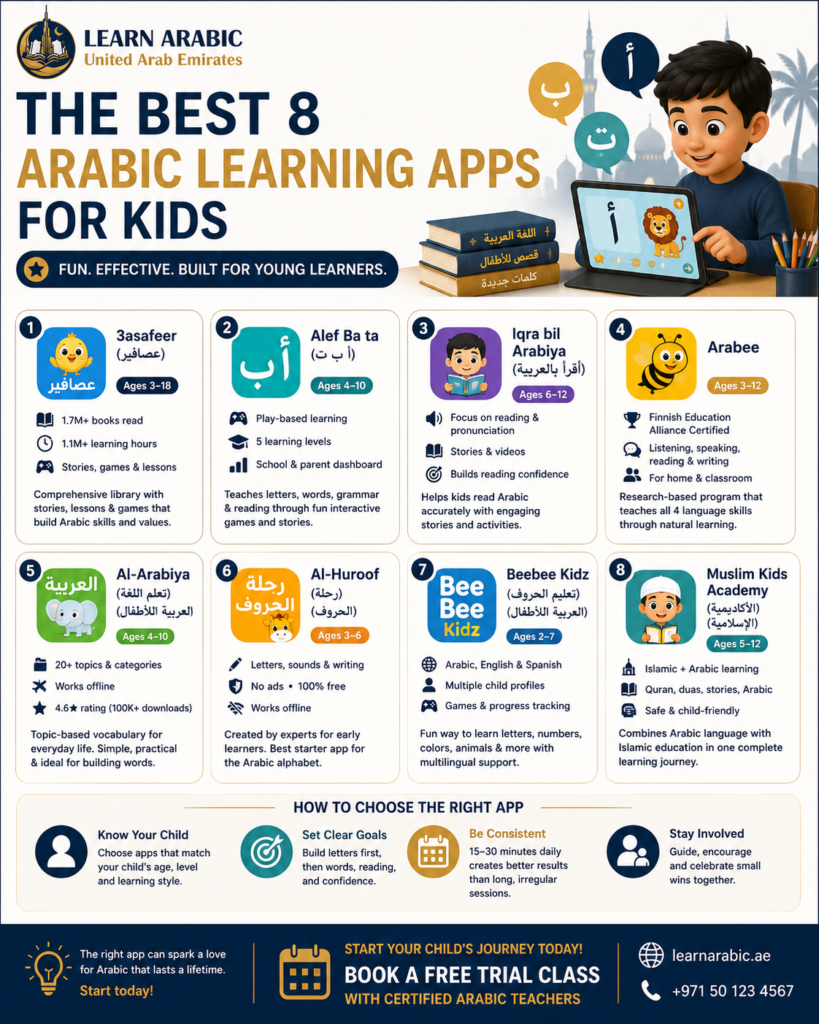
If your child is growing up in the UAE or in an Arabic-speaking household abroad, finding the right tool to teach them Arabic can feel overwhelming. There are dozens of apps competing for your attention — and your child’s — but not all of them are worth the download.
This guide breaks down the best Arabic learning apps for kids, what makes each one stand out, and how to choose the right fit for your child’s age, level, and learning goals.
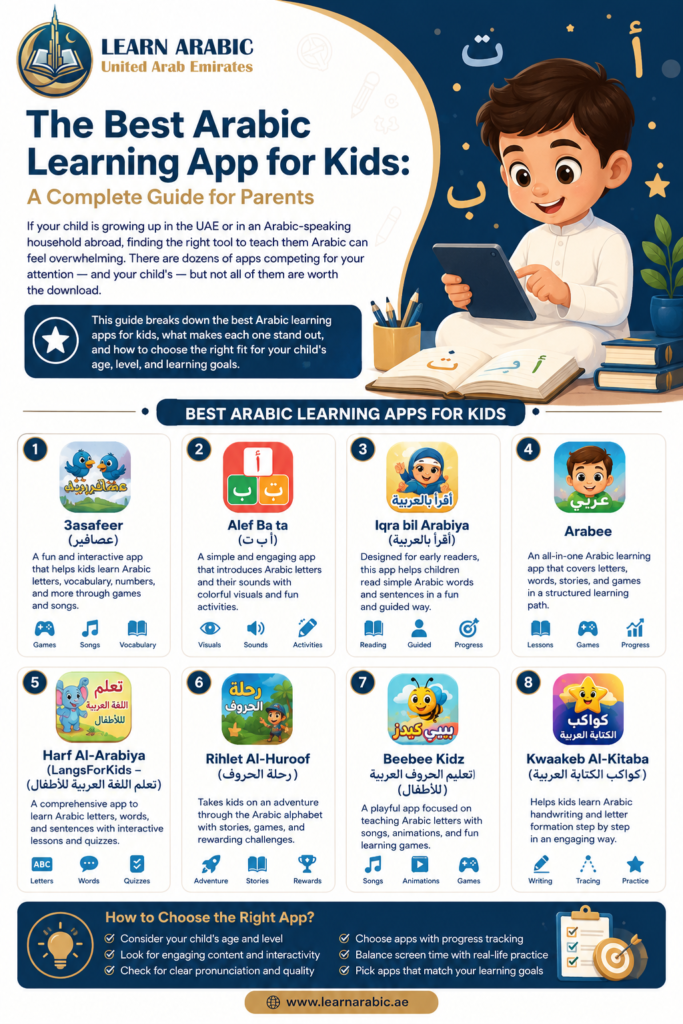
1. 3asafeer (عصافير)
3asafeer is one of the most comprehensive Arabic learning platforms available for children aged 3 to 18. It combines graded storybooks read aloud by professional voice actors, animated lessons, interactive exercises, and educational games — all built around the same characters, which helps children build continuity and attachment to the content.
What sets 3asafeer apart is the breadth of its library: over 1.7 million books read by learners in the past 30 days alone, with more than 1.1 million reading hours completed in the same period.
The platform is available for families and schools, supports Arabic-speaking children and non-native learners, and its content covers core values, emotional intelligence, applied sciences, and foundational concepts alongside pure language skills.
2. Alef Ba ta (أ ب ت)
Alef Ba ta targets children aged 4 to 10 and focuses on teaching the Arabic alphabet, sight words, grammar fundamentals, and short texts — without requiring any prior reading or writing knowledge. Its approach is fully play-based: children move through hundreds of interactive games, listening exercises, and levelled stories across five difficulty tiers.
Begin your kid’s Arabic learning path with a FREE trial class

A particularly strong feature is its school dashboard, which allows teachers to assign exercises, monitor student progress, and align platform content with classroom instruction. For parents, this means the same tool their child uses at home can reinforce exactly what is being covered in school.
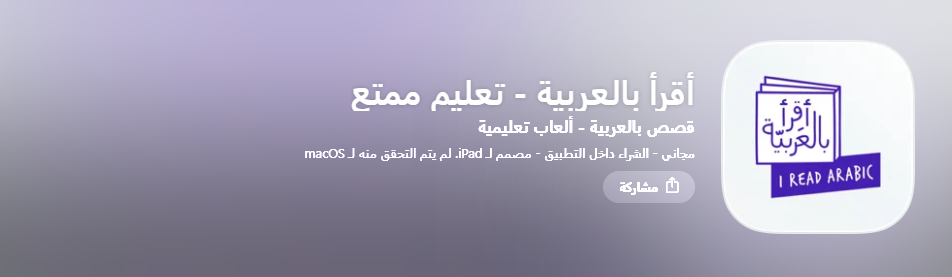
3. Iqra bil Arabiya (أقرأ بالعربية)
Iqra bil Arabiya app focuses specifically on correct Arabic reading through a combination of games, educational videos, and graduated stories. It’s one of the few Arabic apps that explicitly targets proper pronunciation and reading accuracy — not just vocabulary recognition — making it a strong choice for children who are moving beyond the alphabet stage and beginning to read full sentences.
This app is most effective after a child has already mastered Arabic letter recognition and basic blending. It is not intended to replace early phonics instruction, but rather to bridge the gap between recognising individual words and reading connected text confidently. Parents looking for a next-step resource after alphabet practice will generally find it more beneficial than introducing it too early.
Read also: Muslim Greeting in Arabic: Every Phrase, Meaning, and Response You Need
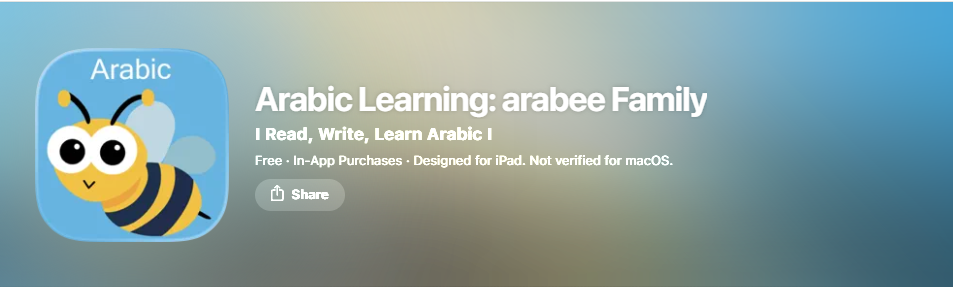
4. Arabee
Arabee has earned a certification from the Finnish Education Alliance, which evaluates learning platforms against research-based pedagogical standards. The programme covers all four language skills — listening, speaking, reading, and writing — for children aged 3 to 12, and is designed for both home and classroom use.
Its implicit learning approach means children acquire Arabic through interaction rather than memorisation drills, which aligns with how children naturally absorb language.
Because Arabee offers a broad curriculum, it can serve as a long-term learning platform rather than a short-term practice app. Many families use it throughout several years, gradually increasing lesson difficulty as children’s language skills develop. This reduces the need to switch between multiple apps every few months and provides greater continuity in the learning process.
See Our Classroom Environment in Action
Experience a sneak peek into our live sessions. Watch the video below to see our specialized instructors interacting with students, breakdown complex texts, and cultivate an engaging, respectful learning environment.
Master Arabic in the UAE
Experience world-class Arabic language training designed for students and professionals in the Emirates.
Book Your Free TrialRead also: 10 Arabic Games For Kids
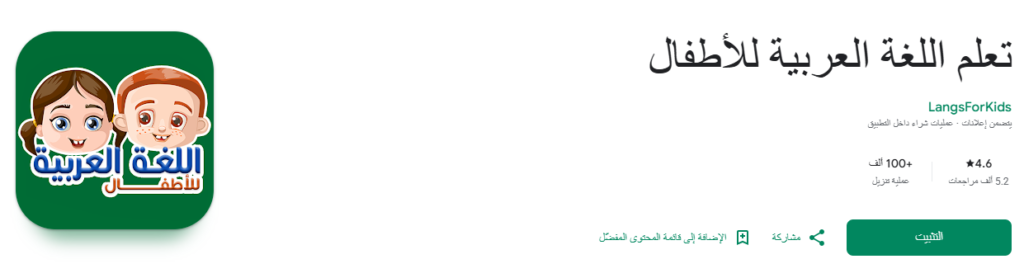
5. Al-Arabiya (LangsForKids — تعلم اللغة العربية للأطفال)
Harf Al-Arabiya app takes a topic-based approach, organising vocabulary into 20+ everyday categories: family, body parts, food, clothes, animals, school, sports, and more. With over 100,000 downloads and a 4.6-star rating, it’s a practical tool for building functional vocabulary, and it works offline — a genuine advantage for families with inconsistent connectivity.
The category-based structure also makes the app useful for targeted learning. If a child struggles with a particular topic—such as colours, animals, or school vocabulary—parents can revisit only that section instead of repeating the entire programme. This focused review saves time while strengthening weaker vocabulary areas.
Read also: Arabic Sentences for Kids
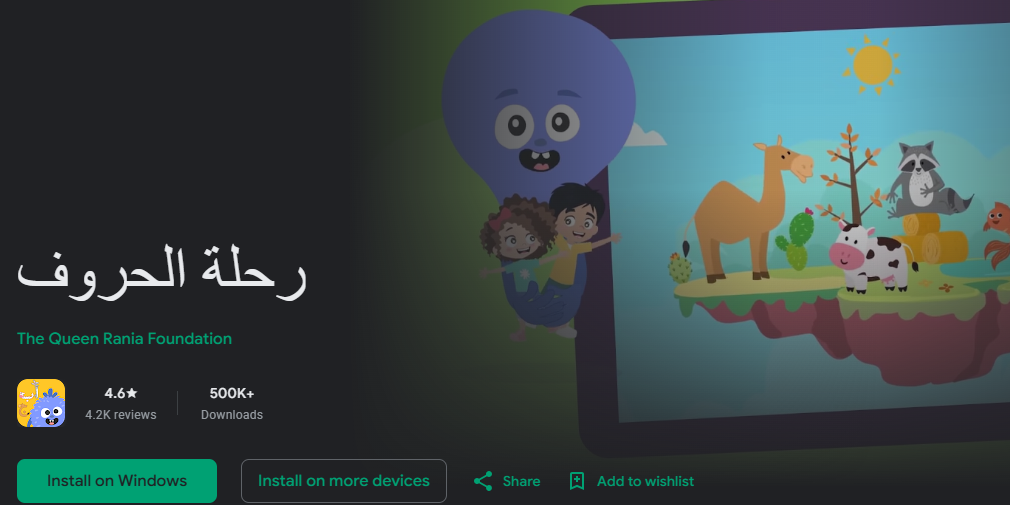
6. Al-Huroof (رحلة الحروف)
Developed by the Queen Rania Foundation and built with early childhood and Arabic language experts, Rihlet Al-Huroof targets children aged 3 to 6 and covers letter shapes, letter sounds, and early writing.
It is free, contains no advertisements, requires no subscription, and works fully offline. For parents of very young children just starting their Arabic journey, this is one of the most accessible and credible starting points available.
Start reading and writing Arabic with a FREE trial class

The app is particularly suitable for children who are not yet ready for formal school lessons. Its activities emphasise exploration and gradual discovery rather than testing or scoring, creating a low-pressure environment that encourages curiosity. This can be especially helpful for preschoolers who learn best through play and experimentation.
Read Also: Learn Quranic Vocabulary
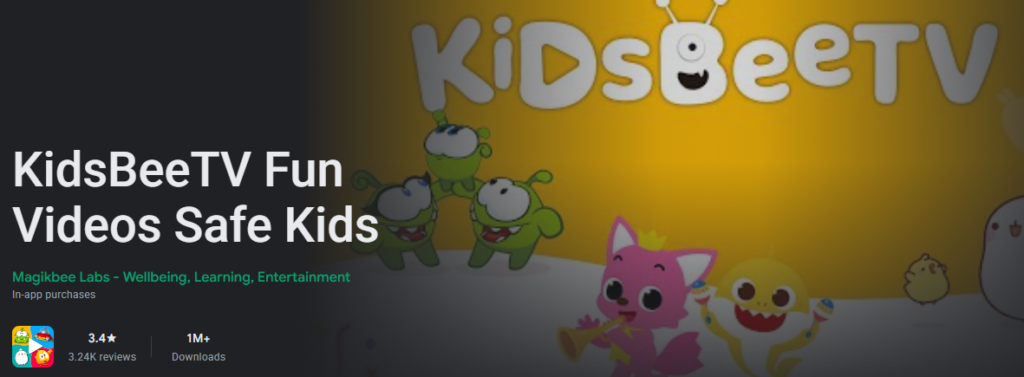
7. Beebee Kidz (تعليم الحروف العربية للأطفال)
Beebee Kidz app covers the Arabic alphabet, numbers, colours, shapes, animals, fruit, and body parts in a game-based format. A standout feature is that it supports three languages — Arabic, English, and Spanish — and allows parents to create individual profiles for each child to track progress.
With over 10 million downloads, it has become one of the most widely used Arabic learning apps for young children. Since the content covers several early-learning subjects alongside Arabic, parents may find it useful as a general preschool learning app rather than a dedicated reading programme.
Children can reinforce basic concepts such as numbers and shapes while continuing to build familiarity with Arabic words, making it a practical choice for shorter daily learning
8. Kwaakeb Al-Kitaba (كواكب الكتابة العربية)
Kwaakeb Al-Kitaba is less of a stand-alone app and more of a structured teacher and parent resource available through the Twinkl platform. It provides lesson units, audio-recorded letter stories, handwriting worksheets, clay activity cards, and grammar exercises — all developed by Arabic teachers with over 20 years of classroom experience.
The programme organises Arabic letters into four “planets,” each building on the last, and includes a pre-writing phase for children who aren’t yet ready to hold a pencil correctly.
Unlike many apps designed primarily for independent use, this programme works best when an adult guides the learning process. Parents and teachers can choose activities that match a child’s current stage, provide immediate feedback, and adapt the pace where necessary.
This makes it particularly well suited for homeschooling, tutoring sessions, and structured classroom instruction rather than unsupervised screen time.
Read also: How to Learn Arabic in the UAE?
Read also: The Best 8 Arabic Learning Apps for Kids
How to Choose the Right App for Your Child?
Choosing the best Arabic learning app for kids depends on three variables: your child’s age, their current Arabic level, and what specific skill you want to develop.
For children aged 3 to 6 who are just beginning, start with Rihlet Al-Huroof or Beebee Kidz. Both focus on letter recognition, basic sounds, and foundational vocabulary without overwhelming young learners.
For children aged 6 to 10 who can already identify letters and are starting to read, Alef Bata and Iqra bil Arabiya offer the right level of challenge with clear progression. For older children or those who need a broader literary foundation, 3asafeer’s graded library is the most content-rich option available.
A common mistake parents make is treating a single app as a complete Arabic education. No app alone can replicate the feedback loop of a live teacher, the depth of conversation practice, or the grammatical scaffolding that structured courses provide.
The most effective approach is to use apps for daily exposure and vocabulary reinforcement, while pairing them with a proper course for skill-building.
Step Inside Our Classrooms
Don’t just take our word for it—see our community in action. Click below to watch real, live snippets from our recent classes and experience our engaging teaching style firsthand!
Master Arabic in the UAE
Experience world-class Arabic language training designed for students and professionals in the Emirates.
Book Your Free TrialRead More: Arabic Calligraphy Naskh
Take Your Child’s Arabic Beyond the Screen
Apps are valuable daily tools, but they work best when they support — not replace — structured instruction. If your child is serious about building real Arabic fluency, a live course with qualified teachers provides the feedback, correction, and progression that no app can fully deliver.
At Learn Arabic UAE, our instructors work with children and adults at every level, from complete beginners to advanced learners. Whether the goal is conversational Arabic, Quranic understanding, or academic preparation, our courses are designed around your specific needs.
Book The free trial for your Kid’s session today and begin with a structured assessment and your first live lesson.

Why Do Learning Arabic UAE Get Results?
Most Arabic learning courses in the UAE are either too generic or too slow. Learn Arabic UAE was built specifically for the UAE context — serving expat families, heritage speakers, professionals, and complete beginners who need Arabic that works in real life, not just on paper.
Our instructors are native or near-native speakers with structured teaching experience. Lessons are delivered live, one-to-one or in small groups, and paced to each learner’s progress. Whether you need your kid to read the Quran, pass school Arabic exams, or simply hold a conversation with grandparents, we match the course to the actual goal.
Parents who enrol their children in structured Arabic courses alongside regular app use consistently see faster progress — because apps build exposure and vocabulary, while live instruction builds accuracy, confidence, and the ability to communicate.
Book your free trial lesson with Learn Arabic UAE today and start building the Arabic skills you need to communicate confidently in real-life situations.
Our Arabic Courses
- Quranic Arabic Course
- Fusha Arabic Course
- Classical Arabic Course
- Arabic Course in the UAE
- Arabic Intensive Course
- Madinah Arabic Course
- Arabic Classes for Adults
- Self-Paced Arabic Course
- Arabic Speaking Classes
- Learn to Write Arabic Course
- Arabic Grammar Course
- Learn Arabic Alphabet Course
- Modern Standard Arabic (MSA) Course
- Arabic Classes for Beginners (Learn Arabic from Scratch)
- Emirati Arabic Course
- Gulf Arabic Course
- Learn Saudi Arabic
- Business Arabic Course UAE
- Arabic Language Classes for Professionals in UAE
Master Arabic in the UAE
Experience world-class Arabic language training designed for students and professionals in the Emirates.
Book Your Free TrialConclusion
The best Arabic learning app for kids is the one that matches your child’s current level, holds their attention, and moves them toward a clear skill — whether that’s reading letters, building vocabulary, or following along with stories.
For most families, the answer isn’t a single app but a combination: a foundational tool like Rihlet Al-Huroof or Alef Bata for younger children, a content-rich platform like 3asafeer for reading and listening, and a structured Arabic grammar course for kids, in addition to courses enhancing speaking, and accuracy that apps cannot fully develop on their own.
Arabic is not a difficult language to love — it’s one of the world’s richest, with a literary tradition stretching back over fourteen centuries. The right tools, combined with consistent practice and qualified instruction, give every child a genuine path to fluency.
Frequently Asked Questions
What is the best Arabic learning app for kids?
There is no single best app for every child — the right choice depends on age and skill level. For children aged 3 to 6, Rihlet Al-Huroof and Beebee Kidz are strong starting points. For ages 6 to 10, Alef Bata and 3asafeer offer structured progression across reading, writing, and listening skills.
At what age should children start learning Arabic with an app?
Children can begin using Arabic learning apps from age 3, starting with letter sounds and basic vocabulary. Most well-designed apps like Rihlet Al-Huroof are specifically built for ages 3 to 6. Formal reading and writing practice is generally introduced from age 5 or 6, depending on the child’s readiness.
Can apps alone teach a child to speak Arabic fluently?
No. Apps are effective for vocabulary building, letter recognition, and listening exposure, but they cannot provide the speaking practice, pronunciation correction, and grammatical feedback that comes from live instruction. Children who use apps alongside a structured course consistently progress faster than those using apps alone.
Are there Arabic learning apps that work offline?
Yes. Several of the most popular apps, including Beebee Kidz (تعليم الحروف العربية للأطفال) and Rihlet Al-Huroof, work fully offline. This makes them practical for travel, areas with limited connectivity, or households where screen time is managed without constant internet access.
What is the difference between a free and a paid Arabic learning app for kids?
Free apps like Rihlet Al-Huroof offer solid foundational content with no in-app purchases. Subscription-based platforms like 3asafeer and Alef Bata offer significantly broader content libraries, progress tracking, and school integration features. For serious long-term learning, a subscription platform paired with live instruction typically delivers better outcomes than free tools alone.
How much screen time should children spend on Arabic learning apps?
International health guidelines recommend no more than one hour of screen time per day for children aged 3 to 6, and up to two hours for older children. Within that limit, Arabic learning apps are most effective when used in short, focused sessions of 10 to 20 minutes, repeated daily rather than in longer infrequent blocks.



Leave a Reply