 Learn Arabic
If you’ve been wondering what are the Arabic names of each of the five pillars of Islam?, you already sense they’re more than vocabulary.
Each term carries the exact meaning Muslims use every day, in prayer, in charity, in fasting, and in pilgrimage. Getting the Arabic right matters, because English translations only approximate what the original words carry.
At Learn Arabic in the UAE Academy, this is one of the first vocabulary sets new students ask about, whether they’re learning Arabic for religious study, for daily life in the UAE, or simply to understand the language behind the practice.
This guide gives you the Arabic name of each of the five pillars, the correct pronunciation, and the real meaning behind every term — in the order Muslims observe them.
What you’ll learn in this article:
- The Arabic term for each of the five pillars, written in Arabic script.
- How to pronounce each term correctly (transliteration included).
- The precise meaning behind each Arabic word — not just the English label.
- Common mistakes learners make when reading these terms aloud.
- Where to continue studying Arabic and Islamic terminology properly.
The Five Pillars Of Islam And Their Arabic Names
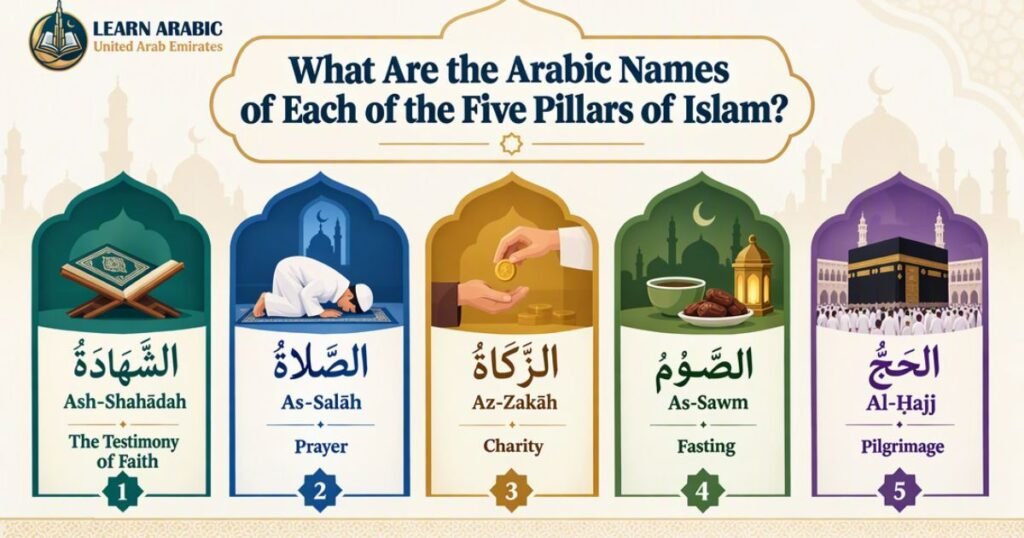
What are the Arabic names of each of the five pillars of Islam? Collectively, they are known in Arabic as أركان الإسلام (Arkan al-Islam), meaning “the pillars of Islam.” Each individual pillar also has its own Arabic name, shown below before the full explanation of each one.
| Pillar (English) | Arabic Term | Transliteration | Literal Meaning |
| Declaration of Faith | الشهادة | Ash-shahādah | Testimony / witnessing |
| Prayer | الصلاة | As-salāh | The five daily prayers |
| Almsgiving | الزكاة | Az-zakāh | Purification / growth |
| Fasting in Ramadan | الصوم | As-sawm | Abstention |
| Pilgrimage to Mecca | الحج | Al-ḥajj | Intention to visit / pilgrimage |
1. Shahada (الشهادة) — The Declaration of Faith
Shahada is the Arabic word for the formal testimony of faith that a person recites to affirm belief in Islam. The full statement is: “Ash-hadu an la ilaha illa Allah, wa ash-hadu anna Muhammadan rasul Allah” — “I bear witness there is no god but God, and Muhammad is His messenger.”
A detail learners often miss: the word Shahada comes from the root sh-h-d, “to witness,” the same root used in Arabic for legal testimony in court. That’s a deliberate linguistic choice — the declaration is treated as sworn testimony, not a private feeling.
2. Salah (الصلاة) — Prayer
Salah is the Arabic term for the five daily obligatory prayers performed at fixed times: Fajr, Dhuhr, Asr, Maghrib, and Isha. Each prayer name is itself tied to a specific position of the sun, which is why timing tables shift daily rather than following a fixed clock.
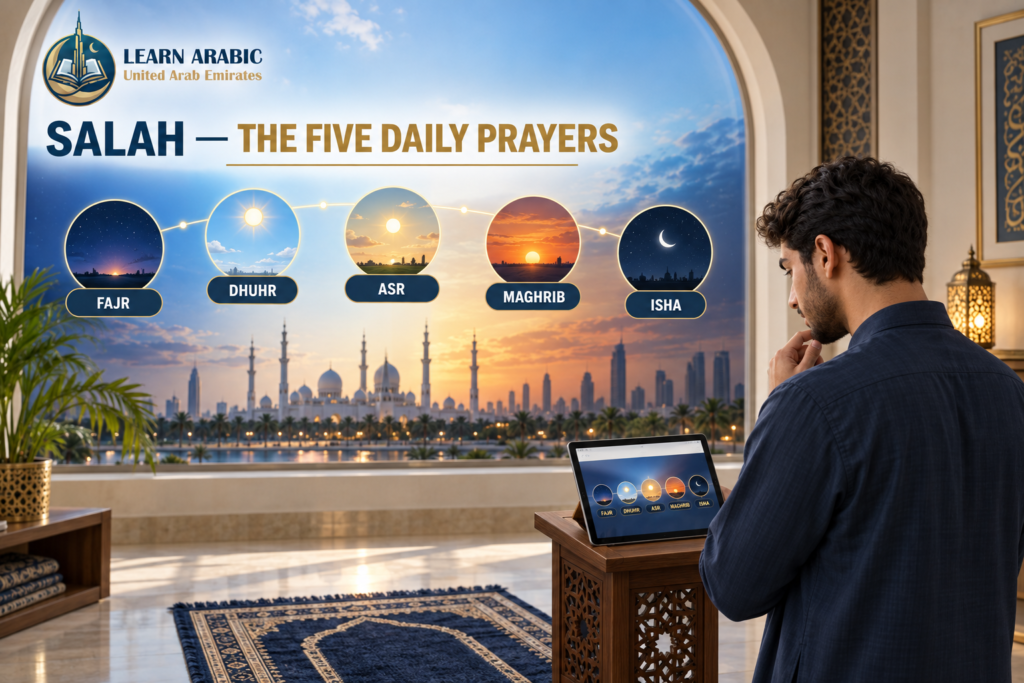
Students studying with a structured Islamic Studies course usually learn these five prayer names before anything else, since they appear constantly in daily conversation and in the Quran.
3. Zakat (الزكاة) — Almsgiving
Zakat is the Arabic name for the obligatory annual payment of a portion of a Muslim’s wealth to those in need. The word itself means both “purification” and “growth” — the idea is that giving away a fixed share purifies the remaining wealth and allows it to grow with blessing.
The standard rate is 2.5% of savings that exceed the nisab (minimum threshold), calculated once a year — not a fixed dollar amount, which is a common misunderstanding among new learners.
4. Sawm (الصوم) — Fasting
Sawm is the Arabic word for fasting, most commonly associated with the month of Ramadan. It means abstaining from food, drink, and specific behaviors from dawn (Fajr) until sunset (Maghrib).

One detail that separates a specialist explanation from a generic one: sawm isn’t only physical abstention. Classical scholarship treats speech, intention, and conduct as part of the fast — which is why the term covers more ground than the English word “fasting” suggests.
See Our Classroom Environment in Action
Experience a sneak peek into our live sessions. Watch the video below to see our specialized instructors interacting with students, breakdown complex texts, and cultivate an engaging, respectful learning environment.
Master Arabic in the UAE
Experience world-class Arabic language training designed for students and professionals in the Emirates.
Book Your Free Trial5. Hajj (الحج) — Pilgrimage
Hajj is the Arabic name for the pilgrimage to Mecca, required once in a lifetime for Muslims who are physically and financially able.
The word’s root carries the sense of “setting out with clear intention,” which is reflected in the ihram garments pilgrims wear — plain white cloth that removes visible markers of wealth or status.
Learning Arabic in the UAE Academy’s Islamic Studies Courses walk students through each of these five terms in context, alongside the Quranic verses and hadith where they first appear.
Read Also: Names Of Animals In Arabic
How to Pronounce and Read Arabic Names Correctly?
Knowing what are the Arabic names of each of the five pillars of Islam? is only half the task. This section answers the second half: how do you pronounce and read each name correctly?
Each term above is written using standard Modern Standard Arabic script, and each carries specific letters — like the ḥ in Ḥajj or the emphatic ṣ in Ṣalāh — that don’t have a direct English sound.
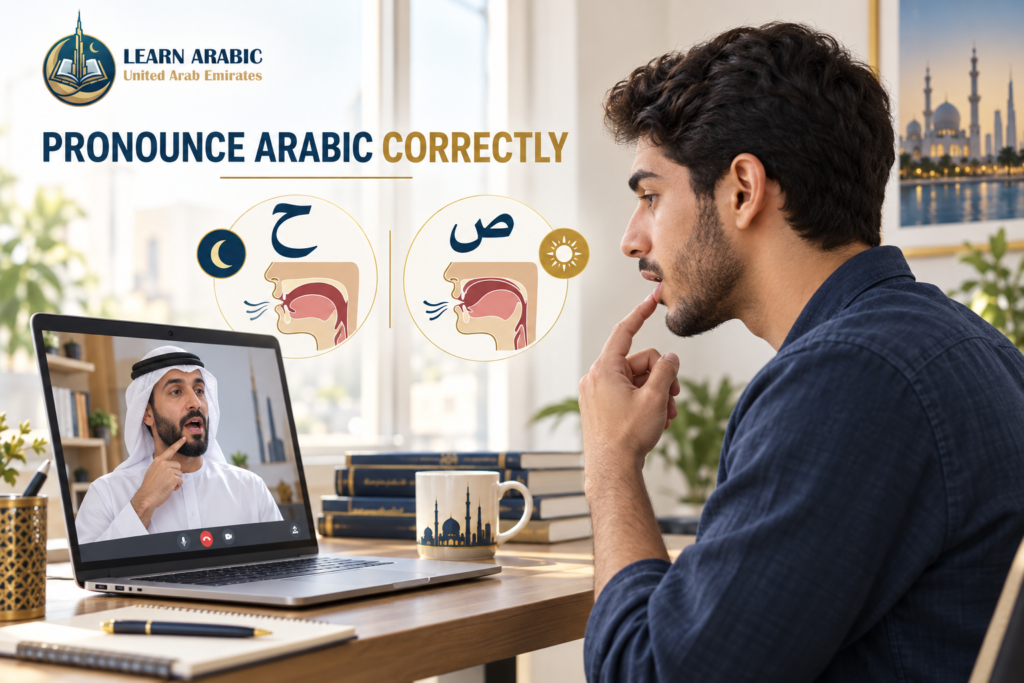
Reading them correctly takes practice with the Arabic alphabet itself, not just the transliteration. The letter ح (ḥa) in الحج (Hajj) is a hard, breathy “h” made from deep in the throat — different from the soft English “h.” Learners who skip this distinction often pronounce Hajj identically to a much softer English “h” sound, which changes the word entirely in spoken Arabic.
Similarly, the ص (ṣad) in الصلاة and الصوم is a heavier, more emphatic “s” than the regular Arabic س. Mixing the two up is one of the most common beginner errors, and it’s the kind of detail a structured Arabic Course in the UAE corrects early, before it becomes a habit.
Whenever a term includes the definite article “al-” (as in Al-hajj or Az-zakah), the sound of the “l” often assimilates into the following letter if that letter is a “sun letter” — which is why you’ll see “Az-zakah” written instead of “Al-zakah.” Recognizing sun letters versus moon letters early makes every other Arabic religious term easier to read correctly.
Why Learning These Arabic Terms Matters Beyond Memorization?
What are the Arabic names of each of the five pillars of Islam? The answer isn’t just a vocabulary exercise. It changes how a reader understands the Quran and hadith, where these terms appear untranslated in every English commentary.
For families raising children with both languages, this is often the starting point. Learn Arabic in the UAE Academy’s Islamic Studies Course for Kids introduces the five pillars as one of the first vocabulary units, pairing each Arabic word with its meaning and correct pronunciation from the start.
Adults coming to Arabic later — whether for religious study, family reasons, or life in the UAE — often need a different pace and depth.
Step Inside Our Classrooms
Don’t just take our word for it—see our community in action. Click below to watch real, live snippets from our recent classes and experience our engaging teaching style firsthand!
Master Arabic in the UAE
Experience world-class Arabic language training designed for students and professionals in the Emirates.
Book Your Free TrialRead Also: How to Teach Kids Arabic in the UAE?
Start Learning the Five Pillars in Authentic Arabic Today
You don’t have to guess at pronunciation or piece together transliterations from scattered sources.
Learn Arabic in the UAE Academy teaches the Arabic names, correct pronunciation, and full meaning of the five pillars as part of a structured Islamic Studies curriculum — for kids, adults, and female learners alike.
Our Arabic courses:
- Arabic Course in the UAE
- Arabic Intensive Course
- Arabic Classes for Beginners (Learn Arabic from Scratch)
- Madinah Arabic Course
- Arabic Classes for Adults
- Self-Paced Arabic Course
- Arabic Speaking Classes
- Learn to Write Arabic Course
- Arabic Grammar Course
- Learn Arabic Alphabet Course

Conclusion
What are the Arabic names of each of the five pillars of Islam? They are Shahada, Salah, Zakat, Sawm, and Hajj, and each carries a precise meaning that goes beyond its English translation, from Shahada’s legal sense of “testimony” to Zakat’s dual meaning of “purification and growth.
Reading them correctly, in Arabic script, is the difference between memorizing a translation and actually understanding the term the way it’s used in the Quran and daily Muslim life.
Whether you’re a parent introducing these words to your children or an adult building your own Arabic vocabulary, the five pillars are one of the most useful starting points in Islamic Arabic study — and one Learn Arabic in the UAE Academy structures its courses around from day one.

Frequently Asked Questions
What are the Arabic names of each of the five pillars of Islam? The questions below cover what learners most often ask next about pronunciation, meaning, and how the terms are used together.
1. What is the Arabic name for all five pillars together?
The five pillars together are called أركان الإسلام (Arkan al-Islam) in Arabic, meaning “the pillars of Islam.” Each pillar also has its own individual Arabic name — Shahada, Salah, Zakat, Sawm, and Hajj — listed and explained above.
2. How do you pronounce Shahada correctly in Arabic?
Shahada is pronounced “Ash-shahādah,” with a soft, elongated “aa” sound in the final syllable. It comes from the Arabic root sh-h-d, meaning “to witness” or “to testify.”
3. What does Zakat mean literally in Arabic?
Zakat literally means “purification” and “growth” in Arabic, not simply “charity.” The term reflects the belief that giving a fixed portion of wealth purifies what remains and allows it to grow with blessing.
4. Why is Hajj sometimes written as Al-Hajj?
Al-Hajj includes the Arabic definite article “al-” (“the”), making it “the pilgrimage” rather than just “pilgrimage.” Both Hajj and Al-Hajj refer to the same obligatory pilgrimage to Mecca.
5. Is Salah the same word as prayer in Arabic?
Salah (الصلاة) is the specific Arabic term for the five daily obligatory prayers, not a general word for prayer. Personal, informal supplication in Arabic is instead called du’a, a separate term from Salah.


Leave a Reply