 Learn Arabic
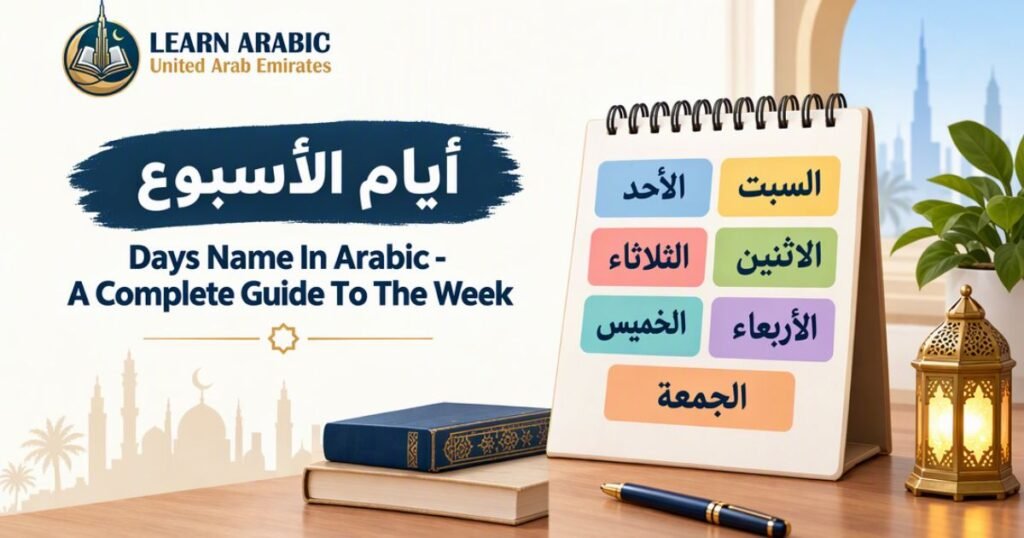
If you’ve started searching for the days name in Arabic, you’ve probably already noticed something that trips up most new learners: the Arabic week doesn’t run Sunday through Saturday, and half the day names are just numbers in disguise.
Once you see the pattern, though, the whole system becomes far easier to remember than most vocabulary lists.
This guide walks you through every days name in Arabic, where each one comes from, how the Arabic week is actually structured in the UAE today, and how to use these words correctly in real sentences — not just recite them in order.
At Learn Arabic In the UAE Academy, this is one of the first vocabulary sets we teach new students, because it shows up constantly in scheduling, appointments, and daily conversation from week one.
By the end, you’ll know the full list, the logic behind the names, and the small mistakes that make learners sound less fluent than they are.
The Seven Days Of The Week In Arabic
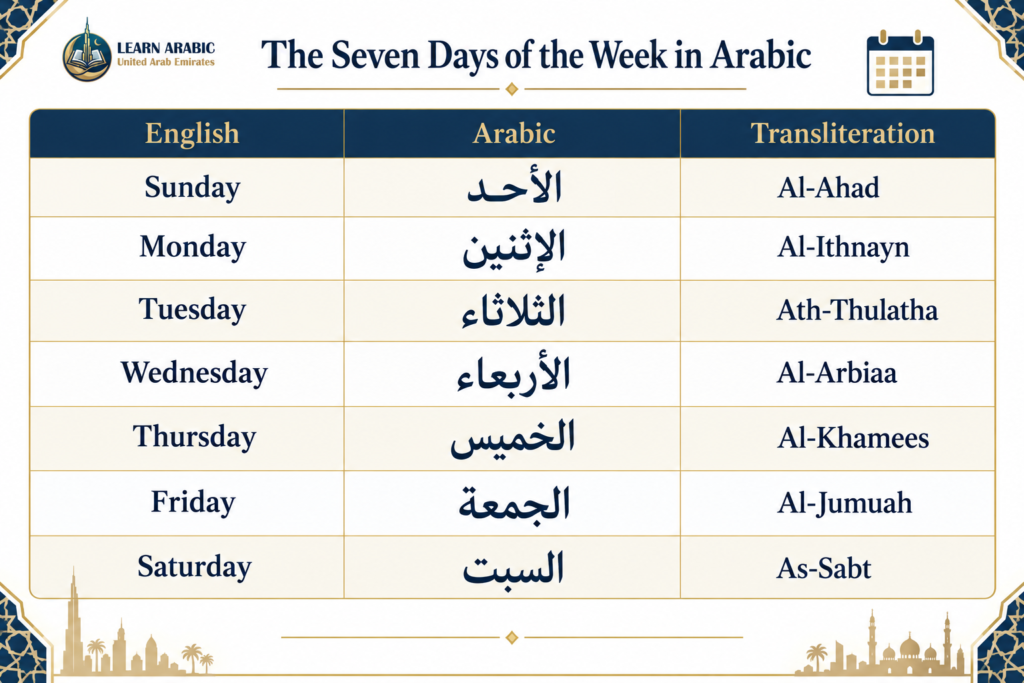
Arabic day names are a fixed set of seven words, each carrying the definite article “al-” (the) as part of its formal name in Modern Standard Arabic. Learning the Days Name in Arabic is easiest when you see them as a pattern rather than seven unrelated words, since most of them come directly from counting.
Before breaking down the meaning of each one, here is the complete list you’ll want to reference as you read the rest of this guide.
| English | Arabic | Transliteration |
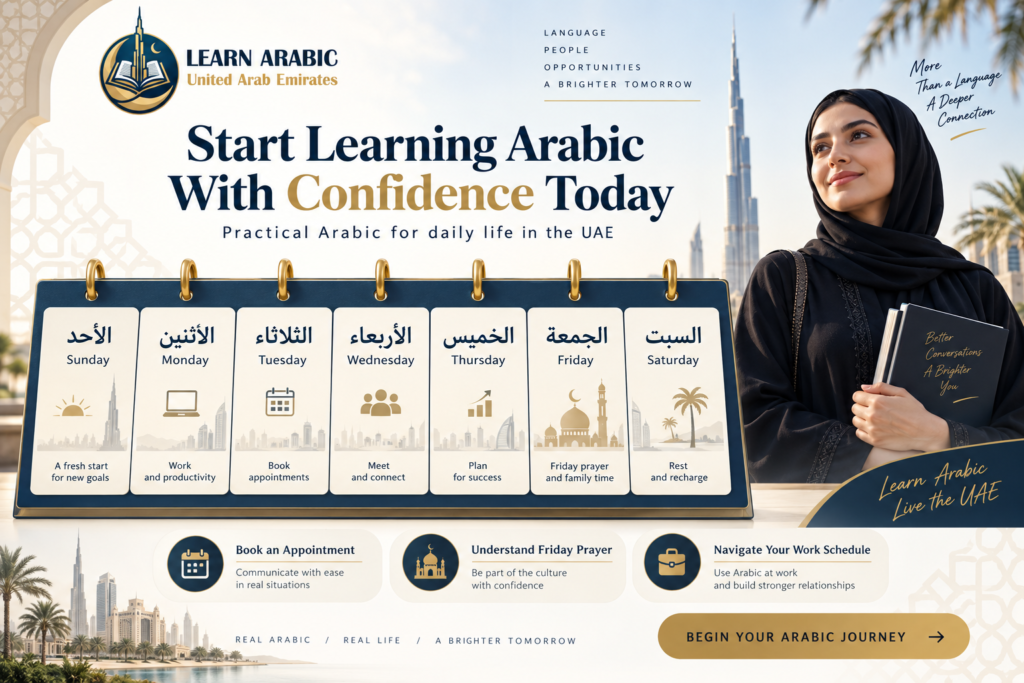
| Sunday | الأحد | Al-Ahad |
| Monday | الإثنين | Al-Ithnayn |
| Tuesday | الثلاثاء | Ath-Thulatha |
| Wednesday | الأربعاء | Al-Arbiaa |
| Thursday | الخميس | Al-Khamees |
| Friday | الجمعة | Al-Jumuah |
| Saturday | السبت | As-Sabt |
Use this table as your quick reference for every day name in Arabic. It pairs the Arabic script with a clear transliteration and the English equivalent, so you can check pronunciation and meaning at a glance before reading the breakdown below.
What Does Each Day’s Name Actually Mean?
Al-Ahad (Sunday) means “the one” or “the first,” marking it as day one in the counting sequence. Al-Ithnayn (Monday) comes from ithnān, the number two, and Ath-Thulatha (Tuesday) comes from thalātha, three.
The pattern continues with Al-Arbiaa (Wednesday), from arba’a, four, and Al-Khamees (Thursday), from khamsa, five. Once you know Arabic numbers one through five, four of these five names become almost self-explanatory.
Al-Jumuah (Friday) breaks the counting pattern on purpose. It comes from the root jama’a, meaning “to gather,” and refers to the congregational Friday prayer that gives the day its religious weight across the Arab and Muslim world.
As-Sabt (Saturday) is the other exception. It shares its root with the Hebrew word Shabbat, both Semitic languages inheriting the same word for “rest,” which is why Saturday closes the traditional week rather than opening it.
A practical way to lock this in: think of it as an anchor-and-count method. Anchor the two meaningful days first — Jumuah (gathering) and Sabt (rest) — then count one through five for everything in between. Two named days, five numbered days, and the whole list stops being seven random words to memorize separately.
Getting the pronunciation right matters just as much as knowing the meaning, since a mispronounced hamza or a flattened “th” sound can change how a day name is heard.
This is exactly the kind of detail that’s hard to self-correct from a list alone, which is one reason our Arabic Classes for Adults build in live pronunciation feedback rather than leaving learners to guess from a transliteration chart.
Read Also: Fruit Names In Arabic
Weekdays Name In Arabic And How The Week Is Ordered
Knowing the weekdays name in Arabic is only half the picture — the order they fall in is where most learners get confused. Once you’re comfortable with the Days Name in Arabic themselves, understanding the traditional Islamic order versus the modern UAE work week is the next step.
This section separates the two, since mixing them up is the single most common ordering mistake new learners make.
Why does the Traditional Week Start on Saturday?
In Modern Standard Arabic, the formal week is counted starting from As-Sabt (Saturday) and ending with Al-Jumuah (Friday), which is treated as the closing, holy day. This is why the numbered days run in the order they do: Al-Ahad (“the first”) falls right after Saturday, not before it.
At the same time, Al-Ahad literally translating to “the first” is also why many calendars and dictionaries list Sunday as the opening day of the week — the name itself argues for that position. Both conventions exist in real usage, so don’t be surprised to see the list ordered either way depending on the source.
The Modern UAE Work Week and Weekend
For everyday life in the UAE, the calendar convention matters less than the work schedule, and that has changed recently. The UAE moved its official weekend from Friday-Saturday to Saturday-Sunday in 2022, with a half working day on Friday to preserve time for congregational prayer.
This puts the UAE workweek at Sunday through Thursday for government entities, with many private companies following a similar Monday-through-Friday pattern instead.
Other Gulf countries still follow older patterns: Saudi Arabia used a Thursday-Friday weekend until 2013 before shifting to Friday-Saturday, while Egypt runs its workweek Sunday through Thursday.
The takeaway for a learner living in or working with the UAE: when someone says “next Sunday” in a business context here, they usually mean the first day back at work, not a day off — the opposite of what “Sunday” implies in most English-speaking countries.
Step Inside Our Classrooms
Don’t just take our word for it—see our community in action. Click below to watch real, live snippets from our recent classes and experience our engaging teaching style firsthand!
Master Arabic in the UAE
Experience world-class Arabic language training designed for students and professionals in the Emirates.
Book Your Free TrialDays Of The Week In Arabic In Everyday Sentences
Knowing the days of the week in Arabic in isolation won’t get you far in conversation. The real skill is combining them with a handful of small connector words that turn a single noun into “last Tuesday,” “every Friday,” or “next Wednesday.” This section covers the four patterns you’ll use constantly once you start scheduling, chatting, or making plans in Arabic.
1. Saying “On” a Day — يوم
To say something happens on a specific day, place yawm (يوم) before the day’s name. Yawm al-jumuah means “on Friday,” and yawm al-ithnayn means “on Monday.” This is the pattern you’ll reach for most often when describing a schedule.
2. Talking About Last and Next Week
For something that already happened, add al-madi (الماضي) after the day: as-sabt al-madi means “last Saturday.” For something upcoming, add al-qadim (القادم) instead — al-arbiaa al-qadim means “next Wednesday.”
These two suffixes work with every day name on the list without exception, which makes them one of the highest-value patterns to memorize early.
3. Describing Something That Happens “Every” Week
To describe a recurring event, place kull (كل) before the day’s name: kull jumuah means “every Friday,” and kull khamees means “every Thursday.” This construction is common in describing prayer schedules, classes, and recurring appointments.
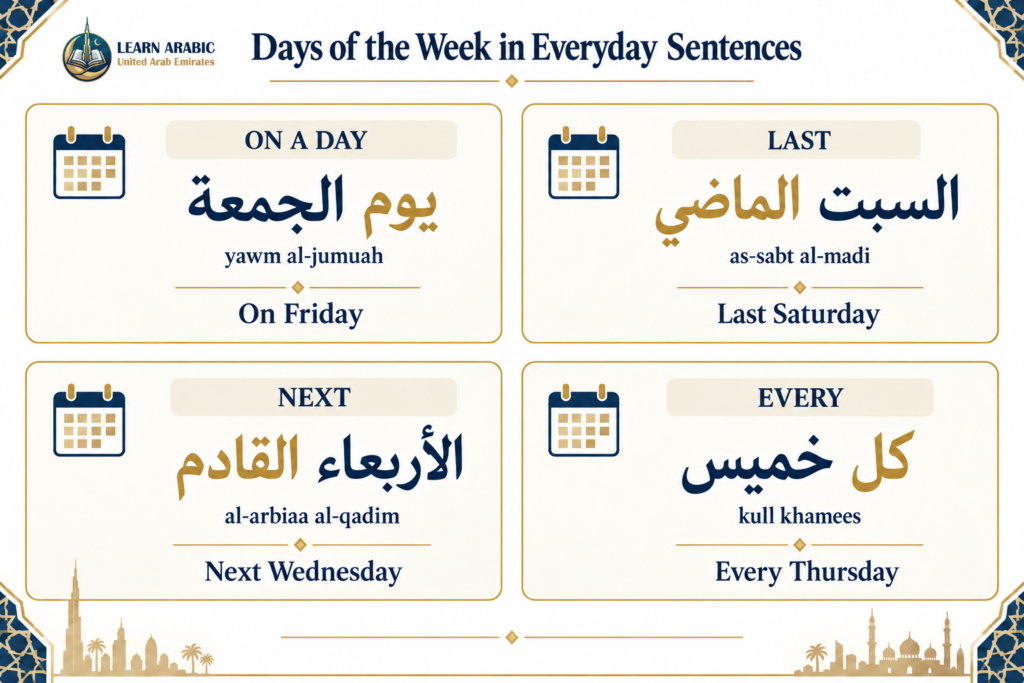
These four patterns turn seven vocabulary words into dozens of usable phrases, and they’re exactly the kind of structure that’s easier to internalize by speaking them out loud repeatedly rather than reading them silently.
That’s the core of what our Arabic Speaking Classes focus on — building these patterns into automatic speech rather than something you have to translate in your head each time.
Common Mistakes When Learning Days of the Week in Arabic
Most learners get the vocabulary list right within a week or two. The mistakes that linger longer are usually about usage and context, not memorization. Here are the three that come up most often with students working through this exact topic.
1. Assuming the Friday-Saturday Weekend Still Applies Everywhere
Older textbooks and language apps often teach Friday-Saturday as “the” Arab weekend without noting that this has changed in several countries.
In the UAE specifically, treating Friday-Saturday as the weekend will cause you to miss the actual Saturday-Sunday off days that apply since 2022.
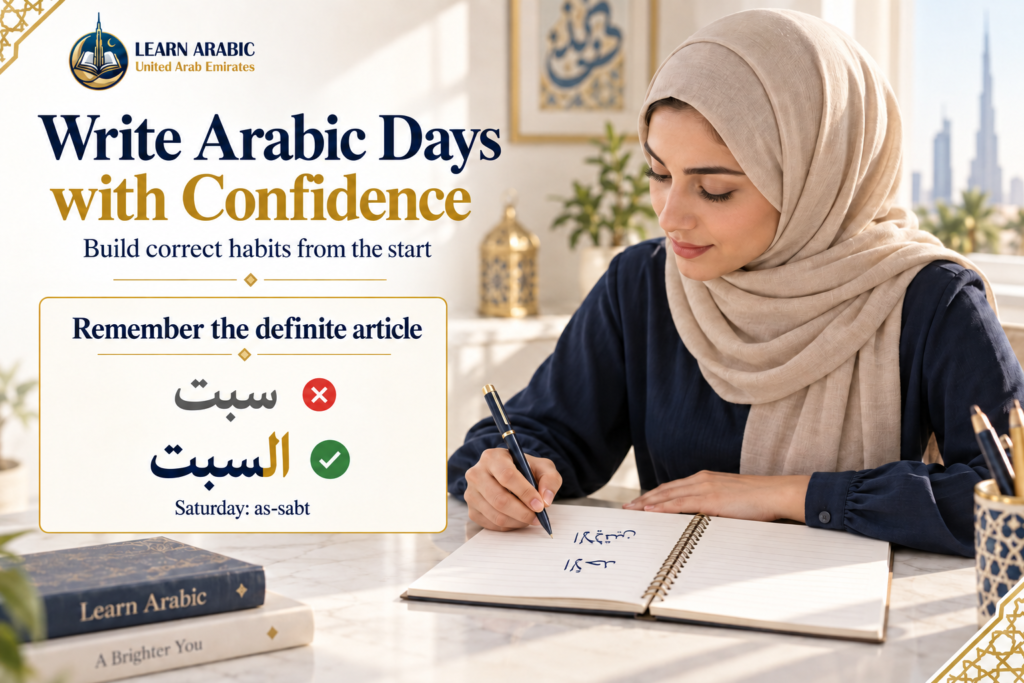
2. Dropping the Definite Article “ال” in Formal Writing
In casual speech, Arabic speakers frequently drop the “al-” and just say “jumuah” or “khamees.” In formal or written Arabic, however, the definite article is part of the correct name — writing “sabt” instead of “as-sabt” reads as informal or incomplete in a professional context.
3. Translating Day Names Literally Instead of Learning Them as Fixed Words
Because five of the seven names are built from numbers, some learners try to translate them literally in conversation — saying “the third day” instead of “Ath-Thulatha.” This slows down real speech. The numeric origin is a memory tool, not something to translate live once you’re speaking.
Building correct habits with the definite article and formal structure early is far easier than unlearning shortcuts later, which is part of why grammar fundamentals and writing practice go hand in hand — something covered directly in our Learn to Write Arabic Course and Arabic Grammar Course.
See Our Classroom Environment in Action
Experience a sneak peek into our live sessions. Watch the video below to see our specialized instructors interacting with students, breakdown complex texts, and cultivate an engaging, respectful learning environment.
Master Arabic in the UAE
Experience world-class Arabic language training designed for students and professionals in the Emirates.
Book Your Free TrialRead Also: The Arabic Letter Ba
Start Learning Arabic With Confidence Today
Reading a list of day names is a starting point. Speaking them correctly, in the right sentence pattern, at the right speed, is what actually helps in daily life in the UAE — whether that’s booking an appointment, planning around Friday prayer, or simply understanding a colleague’s schedule.
Learn Arabic In the UAE Academy builds exactly this kind of practical fluency into every course, with structured pronunciation practice and real conversation from your very first lesson.
Our Arabic courses:
- Arabic Course in the UAE
- Arabic Intensive Course
- Arabic Classes for Beginners (Learn Arabic from Scratch)
- Madinah Arabic Course
- Arabic Classes for Adults
- Self-Paced Arabic Course
- Arabic Speaking Classes
- Learn to Write Arabic Course
- Arabic Grammar Course
- Learn Arabic Alphabet Course
- Quranic Arabic Course
- Fusha Arabic Course
Conclusion
The days’ names in Arabic follow a logic that makes them easier to learn than they first appear: five numbered days anchored by two named exceptions, Al-Jumuah for gathering and As-Sabt for rest. Add in the connector words for “on,” “last,” “next,” and “every,” and you have a complete, usable system rather than a memorized list.
The one detail worth carrying forward is that the days of the week in Arabic aren’t just a vocabulary exercise — in the UAE, they map onto a real, current work schedule that shifted as recently as 2022.
Getting both the words and the context right is what separates textbook knowledge from everyday fluency, and it’s exactly what Learn Arabic In the UAE Academy focuses on building from lesson one.

Frequently Asked Questions
These are the questions students ask most often once they’ve learned the basic list of Arabic day names and start using them in real conversation.
1. What are the seven days’ names in Arabic?
The seven days name in Arabic are Al-Ahad (Sunday), Al-Ithnayn (Monday), Ath-Thulatha (Tuesday), Al-Arbiaa (Wednesday), Al-Khamees (Thursday), Al-Jumuah (Friday), and As-Sabt (Saturday). Five of these come directly from the numbers one through five.
2. Which day does the Arabic week start on?
Modern Standard Arabic formally starts the week on As-Sabt (Saturday) and ends it on Al-Jumuah (Friday). Al-Ahad, meaning “the first,” is also why some sources list Sunday as the opening day instead.
3. Why is Friday important in the Arabic-speaking world?
Friday, Al-Jumuah, is named after the root “to gather” because it is the day of congregational prayer in Islam. Many businesses across the Gulf still adjust their hours around Friday for this reason.
4. Is the weekend the same across all Arab countries?
No. The UAE moved to a Saturday-Sunday weekend with a half day on Friday in 2022, while other countries such as Saudi Arabia and Egypt follow different patterns. Always check the specific country’s current schedule rather than assuming Friday-Saturday applies everywhere.
5. Do I need to include “al-” when saying a day name?
In formal or written Arabic, yes — “al-” is part of the correct name, as in as-sabt rather than just sabt. In casual spoken Arabic, native speakers often drop it, but learners are better off keeping it until the formal form feels automatic.
6. How do you say “next Sunday” in Arabic?
To say “next Sunday,” add al-qadim after the day’s name: al-ahad al-qadim. The same pattern works for every day of the week to mean “next.”



Leave a Reply