 Learn Arabic
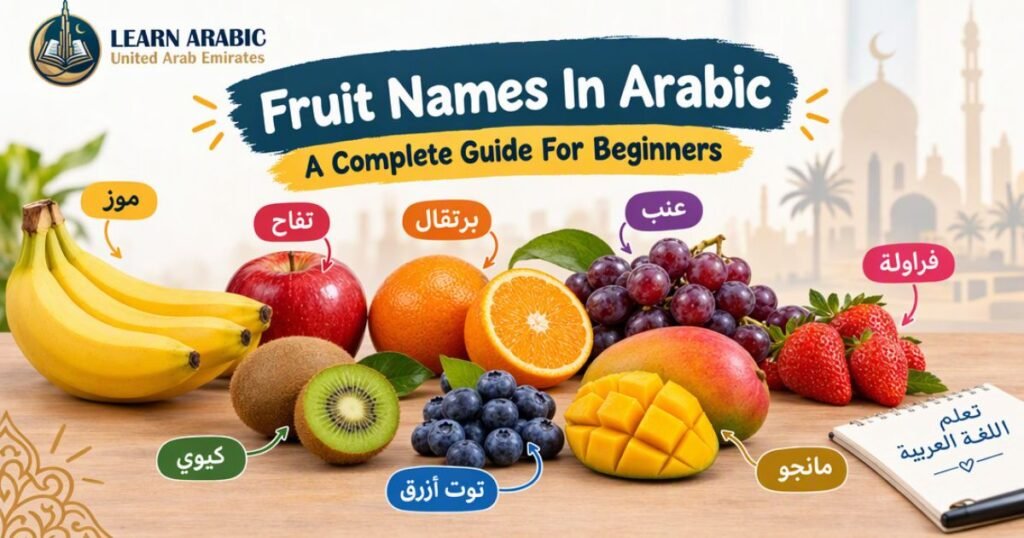
Picture yourself walking through a fruit souq in Abu Dhabi or Dubai. Vendors are calling out prices, crates of dates and pomegranates line the stalls, and someone hands you a taste of fresh mango. You want to ask for a kilo of it, but you don’t know the word.
Fruit names in Arabic are some of the first words any beginner should learn, and for good reason. They’re concrete, they’re visual, and you’ll use them constantly, whether you’re ordering juice, shopping at a local market, or chatting with a tutor about what you had for breakfast.
At Learn Arabic in the UAE Academy, we start almost every new student on food vocabulary before anything else, because it builds confidence fast and gives you something to say on day one.
This guide walks you through the fruit names in Arabic you’ll actually use, how to pronounce them correctly, why several of them carry religious weight in the region, and how to use them in real conversation.
What you’ll learn in this article
- The Arabic word for “fruit” and when to use its singular and collective forms.
- 15+ essential fruit names in Arabic, with pronunciation guidance.
- Why certain fruits are mentioned in the Quran and what that means culturally.
- Ready-to-use phrases for buying fruit at a souq or talking about your favorites.
- Practice exercises to test what you’ve learned.
The Arabic word for fruit
The word for “fruit” in Arabic is فاكهة (fākihah). It’s a collective noun, meaning it can refer to a single fruit or to fruit in general, similar to how English uses “fruit” without needing a plural.
The plural form is فواكه (fawākih), and it’s the word you’ll hear most at a market, when a vendor is talking about their full selection rather than one item.
So if you say “هذه فاكهة لذيذة” (hādhihi fākihah ladhīdhah), you mean “this is a delicious fruit.” If you say “أحب أكل الفواكه الطازجة” (uḥibbu akla al-fawākih aṭ-ṭāzajah), you mean “I love eating fresh fruits.”
Knowing which form to reach for is a small detail that makes your Arabic sound natural rather than textbook-stiff.
Fākihah vs. fawākih: a quick rule
Use فاكهة when you’re speaking generally (“fruit is good for you”) or about one item. Use فواكه when you’re naming a variety or a category, such as “the fruits section” (قسم الفواكه) at a supermarket, or “tropical fruits” (الفواكه الاستوائية).
Essential Fruit Names In Arabic You Should Learn First
These are the fruit names you’ll reach for most often, whether you’re at a juice bar, a supermarket, or a souq.
Each one includes a transliteration and a simple pronunciation guide so you can start saying them out loud right away.

A. Everyday fruits for market and café conversations
Start with these — they’re the fruits you’ll actually be handed, asked about, or need to order almost every day, whether you’re at a souq stall or a juice counter.
| Arabic | Transliteration | English | Pronunciation |
| تُفَّاحَة | tuffāḥa | Apple | TOOF-fah-ha |
| مَوْزَة | mawza | Banana | MOW-za |
| بُرْتُقَالَة | burtuqāla | Orange | boor-too-QAH-la |
| عِنَب | ʿinab | Grapes | EE-nab |
| بَطِّيخ | baṭṭīkh | Watermelon | bat-TEEKH |
| فَرَاوْلَة | farāwla | Strawberry | fa-RAW-la |
| خَوْخَة | khawkha | Peach | KHAW-kha |
| لَيْمُون | laymūn | Lemon | lay-MOON |
| مَانْجُو | mangoo | Mango | MAN-goh |
| مِشْمِش | mishmish | Apricot | MISH-mish |
| بَرْقُوق | barqūq | Plum | bar-KOOK |
Notice that برتقال (orange) traces back to “Portugal” — oranges reached the Arab world through Portuguese traders centuries ago, and the name stuck.
Small details like this make vocabulary easier to remember, because you’re attaching a word to a story instead of memorizing it cold.
B. Fruits mentioned in the Quran and their cultural weight
A handful of fruit names in Arabic carry more than culinary meaning. They appear directly in Quranic verses, and understanding them gives you real cultural literacy, not just vocabulary.
- تَمْر (tamr) means dates. Dates are the fruit most tied to Ramadan, since families traditionally break their fast (إفطار, iftar) by eating an odd number of them, following a well-known prophetic practice. The Quran references dates alongside grapevines in Surah An-Nahl (16:67).
- رُمَّان (rummān) means pomegranate, mentioned in Surah Ar-Rahman (55:68) among the fruits of Paradise. Its hundreds of seeds are often read as a symbol of abundance.
- تِين (tīn) means fig, and it opens Surah At-Tin (95:1), where it’s mentioned alongside the olive — a rare honor in the text that scholars read as pointing to both the fruits’ nutritional value and the significance of the lands where they grow.
- عِنَب (ʿinab), grapes, appears repeatedly across the Quran, both as an earthly crop and as a description of the gardens of Paradise.
- If your goal is reading and understanding Quranic Arabic rather than just conversational vocabulary, this kind of fruit-and-scripture connection is exactly the ground we cover in our Madinah Arabic Course, which is built around classical texts rather than everyday chat.
Step Inside Our Classrooms
Don’t just take our word for it—see our community in action. Click below to watch real, live snippets from our recent classes and experience our engaging teaching style firsthand!
Master Arabic in the UAE
Experience world-class Arabic language training designed for students and professionals in the Emirates.
Book Your Free TrialRead Also: Sun And Moon Letters In Arabic
How to pronounce Arabic fruit words correctly?
Fruit vocabulary happens to be excellent pronunciation practice, because it packs in several sounds that don’t exist in English and that show up constantly elsewhere in the language.
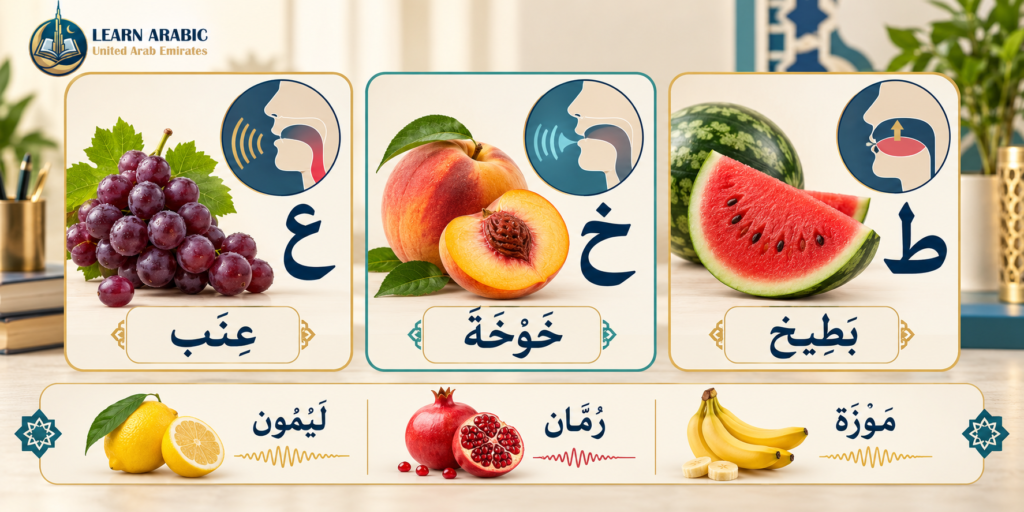
The ع in عِنَب (grapes) is a sound made deep in the throat — start by saying “ah,” then push the sound further back and add a slight constriction. It has no English equivalent, so this one takes repetition.
The خ in خَوْخَة (peach) is a raspy “kh” sound, similar to the “ch” in the Scottish word “loch.”
The ط in بَطِّيخ (watermelon) is an emphatic “t,” produced by pressing your tongue firmly against the roof of your mouth. It sounds heavier and more forceful than a regular English “t.”
Mastering Long Vowels for More Natural Arabic Pronunciation
Arabic distinguishes short and long vowels, and getting this wrong changes how natural you sound. In لَيْمُون (lemon), hold the “ū” — say lay-MOON, not lay-mun.
In رُمَّان (pomegranate), stretch the “ā” — room-MAAN — which gives the word its characteristic rhythm. In مَوْزَة (banana), the “aw” combination sounds like the “ow” in “cow,” not a flat “o.”
Live correction from a tutor is what actually fixes these habits — reading a pronunciation guide only gets you partway there.
This is one of the reasons our Arabic Classes for Beginners build in real-time speaking practice from the very first lesson, rather than saving conversation for later.
Using Fruit Names In Everyday Conversations
Knowing the words is only half the job. The real value shows up when you can use them in a real exchange, whether that’s at a souq, a café, or a conversation with a friend about what you like to eat.

A. Phrases for shopping at the souq
These phrases work with any fruit name dropped into the blank:
- أُرِيدُ كِيلُو __________ مِن فَضْلِك (urīdu kīlū __________ min faḍlik) — I want a kilo of __________, please
- كَمْ سِعْرُ __________؟ (kam siʿr al-__________?) — How much is the __________?
- هَلْ __________ طَازَجَة؟ (hal al-__________ ṭāzaja?) — Is the __________ fresh?
- أَعْطِنِي خَمْسَة __________ (aʿṭinī khamsa __________) — Give me five __________
A common mistake beginners make here is memorizing the vocabulary word but forgetting the question structure around it, so they can name the fruit but can’t actually ask its price or ask if it’s fresh.
Practicing the full phrase, not just the noun, is what makes the vocabulary usable in the moment.
B. Talking about your favorite fruits
- فَاكِهَتِي المُفَضَّلَة هِيَ __________ (fākihatī al-mufaḍḍala hiya al-__________) — My favorite fruit is __________
- أُحِبُّ __________ كَثِيرًا (uḥibbu al-__________ kathīran) — I like __________ very much
- هَلْ تُحِبُّ __________؟ (hal tuḥibbu al-__________?) — Do you like __________?
If your Arabic is at a point where you’re comfortable stringing several of these phrases together in one conversation, that’s usually the signal that it’s time to move from casual self-study into structured lessons.
Our Arabic Intensive Course is designed for exactly that stage, taking learners from scattered vocabulary to fluent, connected sentences.
Practice exercises to lock in your new vocabulary
Repetition is what turns vocabulary you recognize into vocabulary you can recall on demand. Try these short exercises using only the fruits covered above.
Match the word to its meaning:
- مَوْزَة
- بَطِّيخ
- رُمَّان
- فَرَاوْلَة
- تُفَّاحَة
A. Watermelon B. Pomegranate C. Banana D. Strawberry E. Apple
(Answers: 1-C, 2-A, 3-B, 4-D, 5-E)
Fill in the blank:
- أحب أكل _____ في الصيف — I like eating _____ in summer (watermelon)
- عصير _____ منعش جداً — _____ juice is very refreshing (orange)
- _____ من أهم الفواكه في العالم العربي — _____ is one of the most important fruits in the Arab world (dates)
(Answers: البطيخ, البرتقال, التمر)
See Our Classroom Environment in Action
Experience a sneak peek into our live sessions. Watch the video below to see our specialized instructors interacting with students, breakdown complex texts, and cultivate an engaging, respectful learning environment.
Master Arabic in the UAE
Experience world-class Arabic language training designed for students and professionals in the Emirates.
Book Your Free TrialRead Also: The Arabic Letter Waw
Start speaking Arabic with confidence
You now have the words to shop, order, and talk about the fruit you love. But vocabulary lists only take you so far — real fluency comes from speaking it out loud, being corrected in real time, and building sentences beyond single words.
That’s what a structured course gives you, and it’s what Learn Arabic in the UAE Academy has been doing for learners across the UAE for years.
Our Arabic courses:
- Arabic Course in the UAE
- Arabic Intensive Course
- Madinah Arabic Course
- Arabic Classes for Adults
- Self-Paced Arabic Course
- Arabic Speaking Classes
- Learn to Write Arabic Course
- Arabic Grammar Course
- Learn Arabic Alphabet Course
- Quranic Arabic Course
- Fusha Arabic Course
- Classical Arabic Course
- Emirati Arabic Course

Whether you’re starting completely from scratch, want intensive daily practice, or you’re aiming for classical or Emirati Arabic specifically, there’s a course built for where you are right now.
Conclusion
Fruit names in Arabic are one of the easiest, most rewarding places to start building real vocabulary.
You’ve now covered the core words, the pronunciation patterns behind them, the religious and cultural weight several of them carry, and the phrases that turn a word list into an actual conversation.
The next step is practicing these fruit names in Arabic out loud, in full sentences, until they come without thinking, and that’s exactly the kind of steady progress Learn Arabic in the UAE Academy is built to support.

Frequently Asked Questions About Fruit Names In Arabic
Here are quick answers to the questions learners ask most often about fruit vocabulary, pronunciation, and usage in Arabic.
1. What is the Arabic word for fruit?
The Arabic word for fruit is فاكهة (fākihah), used for a single fruit or fruit in general. The plural, فواكه (fawākih), is used when referring to several kinds of fruit at once, such as at a market or in a fruit salad.
2. Why are some fruits mentioned in the Quran?
Fruits such as dates, figs, pomegranates, and grapes are mentioned in the Quran as signs of divine provision and, in some verses, as descriptions of Paradise. Learning these words gives you insight into Islamic culture as well as everyday vocabulary.
3. How do Egyptian and Gulf Arabic pronunciations of fruit names differ?
Pronunciation shifts by region rather than the words themselves changing.
موز (banana), for example, is often pronounced closer to “mooz” in Egyptian Arabic and closer to “mawz” in Gulf and Levantine Arabic, including the Emirati dialect spoken in the UAE.
4. Do I need to know fruit vocabulary before starting Arabic lessons?
No. Fruit vocabulary is a common starting point precisely because it’s simple and useful, but any structured Arabic course, including our Beginners course, will build this vocabulary in as part of the first few lessons rather than assuming you already know it.
5. What’s the best way to memorize Arabic fruit vocabulary?
Learn fruit names in small groups rather than one long list: everyday fruits first, then fruits with cultural or religious significance, then regional specialties. Pairing each word with a full phrase, rather than the word alone, helps it stick for real conversation.
One response to “Fruit Names In Arabic – A Complete Guide For Beginners”
Leave a Reply
Related Articles
Learn Arabic




[…] Read Also: Fruit Names In Arabic […]