 Learn Arabic
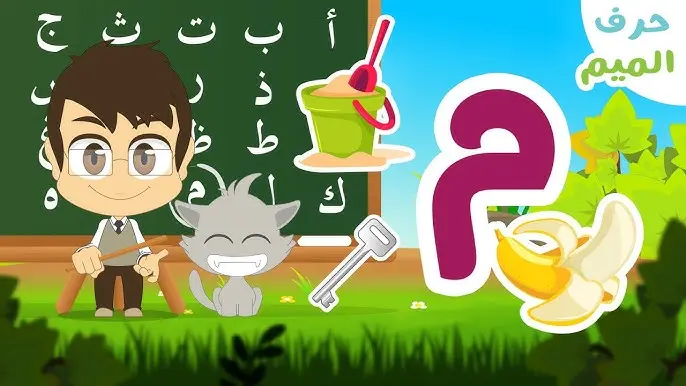
The Arabic letter م (Meem) is one of the most frequently used letters in the Arabic language — and one of the easiest for English speakers to pick up. Its sound is identical to the English “M,” its shape is unlike any other Arabic letter, and it appears in hundreds of everyday words. Whether you are just starting your Arabic journey or brushing up on the fundamentals, mastering Meem is a small step with an outsized payoff.
This guide covers everything you need to know about م: how it sounds, how it is written in every position, how vowels change its pronunciation, and how to start using it in real Arabic words today.
What Is the Arabic Letter م (Meem)?
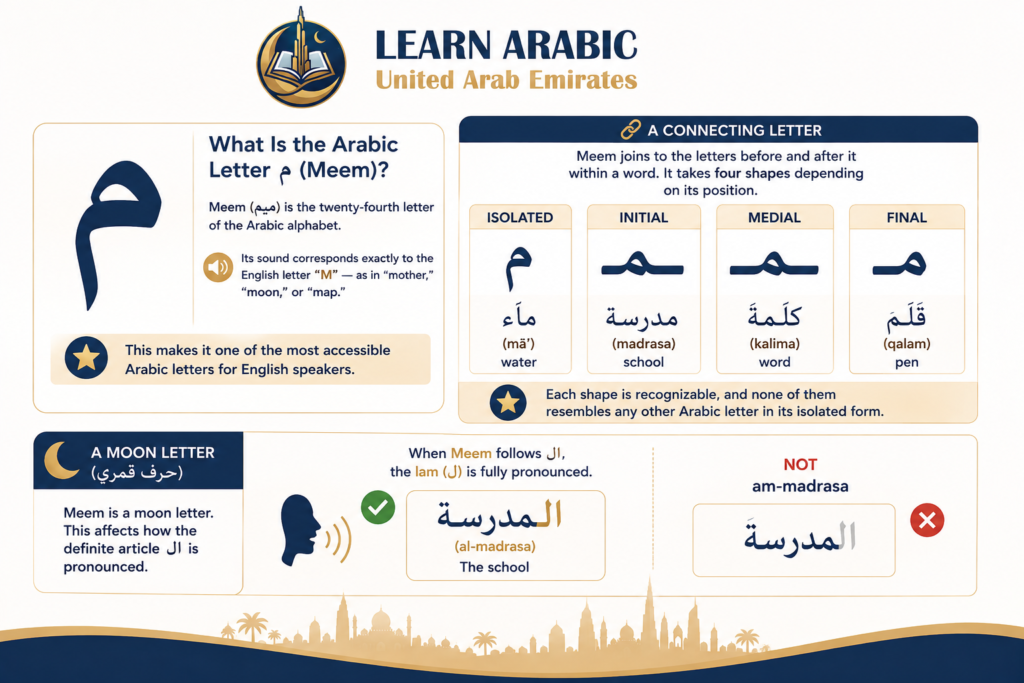
The Arabic letter م, called Meem (ميم), is the twenty-fourth letter of the Arabic alphabet. Its sound corresponds exactly to the English letter “M” — as in “mother,” “moon,” or “map.” This makes it one of the most accessible Arabic letters for English speakers, because there is no unfamiliar sound to learn.
Meem is a connecting letter, meaning it joins to the letters before and after it within a word. As a result, it takes four distinct shapes depending on where it appears: isolated, initial (beginning of a word), medial (middle of a word), and final (end of a word). Each shape is recognizable, and none of them resembles any other Arabic letter in its isolated form.
Meem is also a moon letter (حرف قمري). This is a grammatical classification that affects how the definite article الـ is pronounced. When Meem follows الـ, the lam (ل) is fully pronounced — so “the school” is pronounced al-madrasa, not am-madrasa.
How to Pronounce the Arabic Letter م (Meem)?
The articulation point (مخرج) of Meem is the lips. Specifically, Meem is produced by pressing both lips firmly together while allowing air to pass through the nasal passage. This gives Meem its characteristic nasal resonance — the same quality English speakers hear in words like “hum” or “name.”
Two other Arabic letters also involve the lips: ب (Ba) and و (Waw). The key difference is this:
- ب (Ba): lips press together, then burst open — like the English “B.”
- م (Meem): lips press together, and air escapes through the nose — the lips do not burst open.
- و (Waw): lips open slightly and round into an “O” shape — like the English “W” or “oo.”
Understanding this distinction early prevents a common mistake where learners conflate the sounds of ب and م in connected speech.
If your goal is to communicate more confidently in the UAE, the Emirati Arabic Course at Learn Arabic UAE can help you develop practical speaking and listening skills in the local dialect.
Speak Emirati Arabic with Confidence in the UAE with a FREE Trial Class

Meem (م) with Harakat and Long Vowels
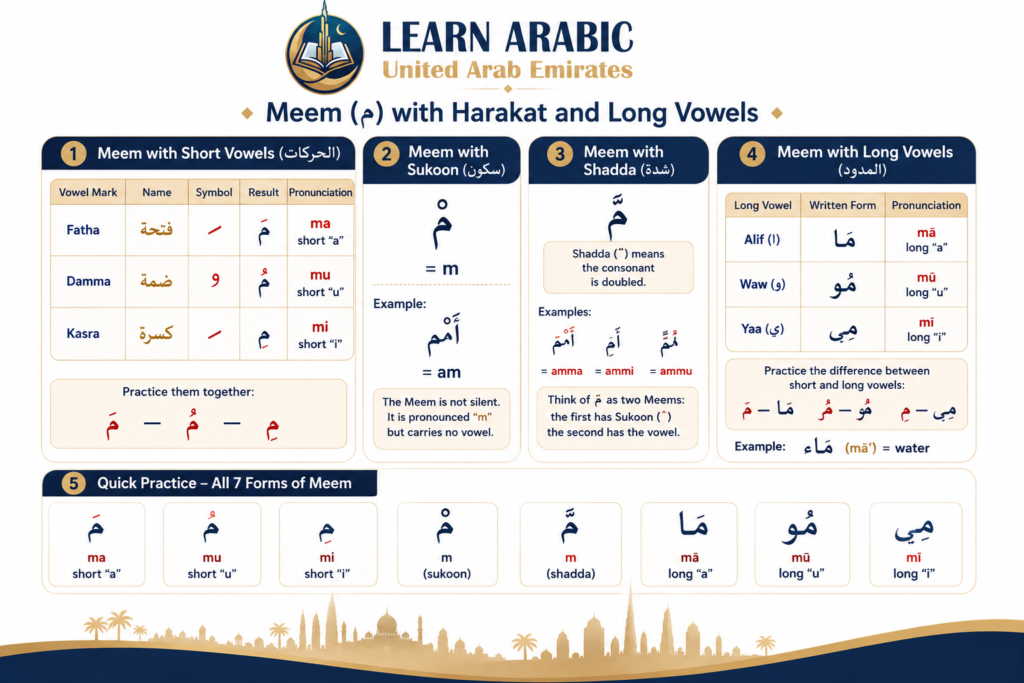
Learning how م (Meem) changes with different vowel marks is essential for reading Arabic accurately. By practicing Meem with short vowels, Sukoon, Shadda, and long vowels, learners can become more comfortable recognizing its sound in different words.
1. Meem with Short Vowels (الحركات)
The three main short vowels — Fatha, Damma, and Kasra — are small marks placed above or below the letter. Each one changes the vowel sound that follows م.
| Vowel Mark | Name | Symbol | Result | Pronunciation |
| Fatha | فتحة | َ | مَ | ma — short “a” |
| Damma | ضمة | ُ | مُ | mu — short “u” |
| Kasra | كسرة | ِ | مِ | mi — short “i” |
Practice them together:
مَ — مُ — مِ
2. Meem with Sukoon (سكون)
Sukoon (ْ) indicates that the letter carries no vowel after it. When Meem has Sukoon, it is pronounced as a clear “m” sound attached to the vowel or syllable before it.
مْ = m
For example:
أَمْ = am
Here, the Meem is not silent. The م itself is pronounced, but it does not carry an additional vowel sound.
3. Meem with Shadda (شدة)
Shadda (ّ) indicates that the consonant is doubled. When م carries Shadda, the Meem sound is held slightly longer than a single Meem.
Examples:
- أَمَّ — amma
- أَمِّ — ammi
- أَمُّ — ammu
A useful way to understand it is to think of مّ as two Meems combined: the first has Sukoon, while the second carries the vowel.
4. Meem with Long Vowels (المدود)
Long vowels extend the vowel sound after م. The three main long-vowel combinations are:
| Long Vowel | Written Form | Pronunciation |
| Alif (ا) | مَا | mā — long “a” |
| Waw (و) | مُو | mū — long “u” |
| Yaa (ي) | مِي | mī — long “i” |
Practice the difference between short and long vowels:
مَ — مَا
مُ — مُو
مِ — مِي
For example, the long ā sound appears in مَاء (māʾ), meaning “water.”
Regularly practicing مَ، مُ، مِ، مْ، مّ، مَا، مُو، مِي will make it easier to recognize and pronounce Meem accurately in complete Arabic words.
These vowel patterns are especially important when learning to read and pronounce Modern Standard Arabic accurately. If you want to develop these skills beyond individual letters, the Fusha Arabic Course at Learn Arabic UAE provides structured practice in reading, speaking, vocabulary, and formal Arabic communication.
Master Fusha Arabic in the UAE with a FREE Trial Class

Step Inside Our Classrooms
Don’t just take our word for it—see our community in action. Click below to watch real, live snippets from our recent classes and experience our engaging teaching style firsthand!
Master Arabic in the UAE
Experience world-class Arabic language training designed for students and professionals in the Emirates.
Book Your Free TrialThe Four Shapes of the Arabic Letter م
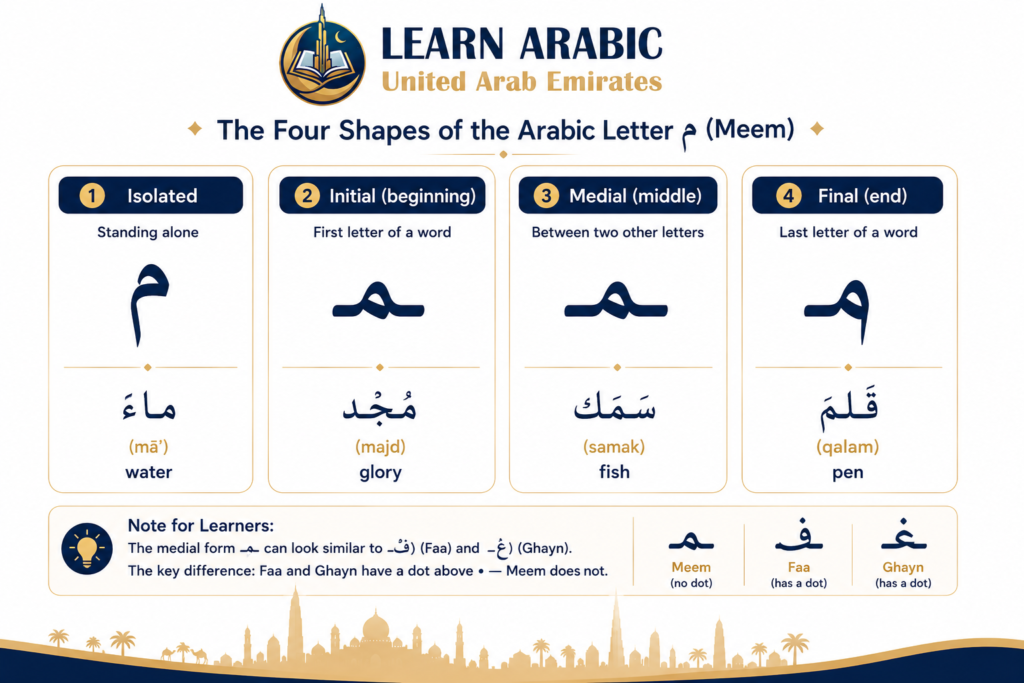
Because Meem is a connecting letter, it connects to the letter before it and the letter after it — which means its shape shifts based on position. The underlying form (the small round loop with a descending tail) is always present, but the connector strokes change.
| Position | Shape | When It Appears |
| Isolated | م | Standing alone |
| Initial (beginning) | مـ | First letter of a word |
| Medial (middle) | ـمـ | Between two other letters |
| Final (end) | ـم | Last letter of a word |
One practical note for learners: the medial form ـمـ can look similar to the medial forms of Faa (ـفـ) and Ghayn (ـغـ). The key difference is that both Faa and Ghayn carry a dot above the loop — Meem does not. If you see a medial round loop with no dot, it is Meem.
1. Isolated Form — م
When م stands alone, it is written in its isolated form.
Begin by forming the small rounded body of the letter, then extend the tail downward below the baseline. This descending tail is one of the most recognizable features of the isolated Meem.
Practice:
م — م — م
2. Initial Form — مـ
When م appears at the beginning of a connected word, it joins to the letter that follows it.
For example:
مَجْد (majd) — Glory
Focus on keeping the body of the Meem clear while leaving enough space to connect smoothly to the following letter.
3. Medial Form — ـمـ
When م appears between connecting letters, it joins on both sides and takes a more compact form.
For example:
سَمَك (samak) — Fish
Pay attention to the rounded body of م and make sure the incoming and outgoing strokes connect smoothly with the surrounding letters.
4. Final Form — ـم
When م appears at the end of a word, it may connect to the preceding letter.
For example:
قَلَم (qalam) — Pen
The final form keeps the recognizable rounded body of Meem and finishes with its descending tail.
Arabic Words with the Letter م
Seeing Meem in real vocabulary is the fastest way to internalize its use. The following examples place م at the beginning, middle, and end of words, across a range of topics.
Arabic Words Beginning with م
When م appears at the beginning of a word, it takes its initial form and connects to the following letter when that letter allows connection.
| Arabic | Pronunciation | English |
| مَسْجِد | Masjid | Mosque |
| مَدْرَسَة | Madrasa | School |
| مَنْزِل | Manzel | Home / House |
| مَوْز | Mawz | Banana |
| مُهَنْدِس | Muhandes | Engineer |
| مِفْتَاح | Miftah | Key |
Read also: How to Speak Arabic Language in the UAE? – A Step-by-Step Guide for Beginners
Arabic Words with م in the Middle
When م appears in the middle of a word, notice how it connects naturally with the surrounding letters while maintaining its recognizable shape.
| Arabic | Pronunciation | English |
| كَلِمَة | Kalima | Word |
| رُمَّان | Rummaan | Pomegranate |
| جُمَل | Jumal | Sentences |
| تِمْسَاح | Timsah | Crocodile |
| تِمْثَال | Timthal | Statue |
| قَمِيص | Qamees | Shirt |
Arabic Words Ending with م
When م appears at the end of a word, focus on pronouncing the final “m” clearly without adding an extra vowel after it.
| Arabic | Pronunciation | English |
| قَلَم | Qalam | Pen |
| عِلْم | ‘Ilm | Knowledge / Science |
| ثَوْم | Thoum | Garlic |
| نَجْم | Najm | Star |
| حَجْم | Hajm | Size / Volume |
| أُمّ | Umm | Mother |
A useful observation for learners: قَلَم (pen) and عِلْم (knowledge) are two of the most commonly encountered final-Meem words in Arabic texts, Islamic studies, and everyday speech. Recognizing them on sight is a practical early milestone.
If you want to go beyond individual letters and develop real fluency in reading, speaking, or understanding Arabic — whether Modern Standard Arabic (Fusha) or Emirati dialect — structured learning makes the difference. Explore the Arabic courses and begin building from the alphabet up.
Make This Summer Count with Arabic Classes for Teens in the UAE and a FREE Trial Class

How to Practice the Arabic Letter م (Meem)?
Regular, structured practice is one of the best ways to become comfortable with م (Meem). Instead of focusing only on memorizing its shape, combine pronunciation, vowel practice, writing, vocabulary, and simple sentences.
1. Practice the Meem Sound
Start by pronouncing “mmm” while keeping your lips gently closed. Hold the sound briefly and notice the vibration as you pronounce it.
Repeat:
م — م — م
This helps you become familiar with the basic sound of Meem before adding vowels.
2. Practice م with Short and Long Vowels
Next, combine م with the main short vowels and Sukoon:
مَ — مُ — مِ — مْ
Then practice the long-vowel combinations:
مَا — مُو — مِي
Read each combination slowly several times before increasing your speed.
3. Practice Writing the Four Forms
Write the isolated م several times before moving to its connected forms:
م — مـ — ـمـ — ـم
Practice each form separately, paying attention to how Meem changes when it appears at the beginning, middle, or end of a word.
4. Practice Reading and Writing Meem Words
Use the vocabulary you have already learned to test yourself. Cover the English meanings and try to read the Arabic words aloud without assistance.
Then reverse the exercise: look at the English meaning and try to write the corresponding Arabic word from memory.
5. Use م in Simple Arabic Sentences
Finally, move from individual words to short sentences. Start with familiar vocabulary containing م, such as:
مَاء — Water
مَدْرَسَة — School
قَلَم — Pen
Using these words in simple sentences helps reinforce م while developing your vocabulary, reading, and writing skills at the same time.
Read also: The Arabic Letter ن (Nūn) – Pronunciation, Writing, Forms, and Examples
See Our Classroom Environment in Action
Experience a sneak peek into our live sessions. Watch the video below to see our specialized instructors interacting with students, breakdown complex texts, and cultivate an engaging, respectful learning environment.
Build Your Arabic Skills with Learn Arabic UAE
Knowing individual letters is the foundation, but fluency in Arabic requires structured progression: from letters to syllables, from syllables to words, from words to grammar, from grammar to real conversation.
At Learn Arabic UAE, our courses are designed for learners at every level — whether you are beginning with the alphabet, learning to read the Quran, mastering Emirati dialect for daily life, or studying Modern Standard Arabic for professional purposes. Our teachers are native speakers with real classroom experience, and every course is built around practical, fast progress.
Our Arabic courses
- Arabic Course in the UAE
- Arabic Intensive Course
- Gulf Arabic Course
- Learn Saudi Arabic
- Business Arabic Course UAE
- Arabic Language Classes for Professionals in UAE
Master Arabic in the UAE
Experience world-class Arabic language training designed for students and professionals in the Emirates.
Book Your Free TrialConclusion
The Arabic letter م (Meem) is the twenty-fourth letter of the Arabic alphabet and one of its most foundational building blocks. Produced by pressing the lips together and releasing air through the nasal passage, its sound is identical to the English “M” — making it one of the most approachable Arabic letters for new learners.
Meem takes four shapes — isolated, initial, medial, and final — and connects to surrounding letters in a word. It is classified as a moon letter, meaning the lam of الـ is always pronounced before it. It appears at the beginning, middle, and end of hundreds of essential Arabic words, from مَاء (water) to قَلَم (pen) to أُمّ (mother).
Mastery of Meem does not come from reading about it — it comes from writing it, saying it, and reading it in real words. Use the examples and practice sequence in this guide, then take the next step: structured Arabic instruction that takes you from single letters to genuine language ability.
Read also: How to Learn Quran for Kids in the UAE – 7 Practical Steps for Parents
Frequently Asked Questions About the Arabic Letter م
What is the Arabic letter م called?
The Arabic letter م is called Meem (ميم). It is the twenty-fourth letter of the Arabic alphabet and corresponds to the English letter “M” in both name and pronunciation.
How do you pronounce the Arabic letter م?
Press both lips firmly together and allow air to pass through the nose while making the “M” sound — exactly as in the English word “mother.” No new mouth position needs to be learned; the sound is the same.
Is Meem م a sun letter or a moon letter?
Meem م is a moon letter (حرف قمري). When a word beginning with Meem takes the definite article الـ, the lam is fully pronounced — so المدرسة is read “al-madrasa,” not “am-madrasa.”
How many forms does the letter م have?
Meem has four written forms: isolated (م), initial (مـ), medial (ـمـ), and final (ـم). The round loop and descending tail are present in all forms; the connecting strokes change based on position.
What is the difference between medial Meem ـمـ and medial Faa ـفـ?
Both letters feature a round loop in their medial forms, which can confuse beginners. The key difference: Faa (ـفـ) and Ghayn (ـغـ) both carry a dot above the loop, while Meem (ـمـ) has no dot. No dot means Meem.
What are some common Arabic words that start with م?
Common words beginning with Meem include مَدْرَسَة (madrasa – school), مَاء (maa’ – water), مَسْجِد (masjid – mosque), مَوْز (mawz – banana), and مُهَنْدِس (muhandes – engineer). These are high-frequency words that appear across everyday speech, written Arabic, and Quranic text.



Leave a Reply