 Learn Arabic

If you live, work, or study in the United Arab Emirates, learning Arabic can make everyday life easier and help you connect more closely with the local culture. From reading signs on Sheikh Zayed Road to understanding conversations in government offices, shopping centres, restaurants, and local communities, Arabic is part of the UAE’s everyday environment.
But learning how to speak Arabic language in the UAE does not mean memorizing hundreds of words at once or spending hours studying grammar every day. A better approach is to learn step by step, focus on useful expressions, practise speaking regularly, and gradually become familiar with the Arabic used in different situations across the Emirates.
Here are the practical steps you can follow to start speaking Arabic with greater confidence.
1. Decide Which Type of Arabic You Need in the UAE
Before learning how to speak Arabic language in the UAE, decide what you want Arabic for.
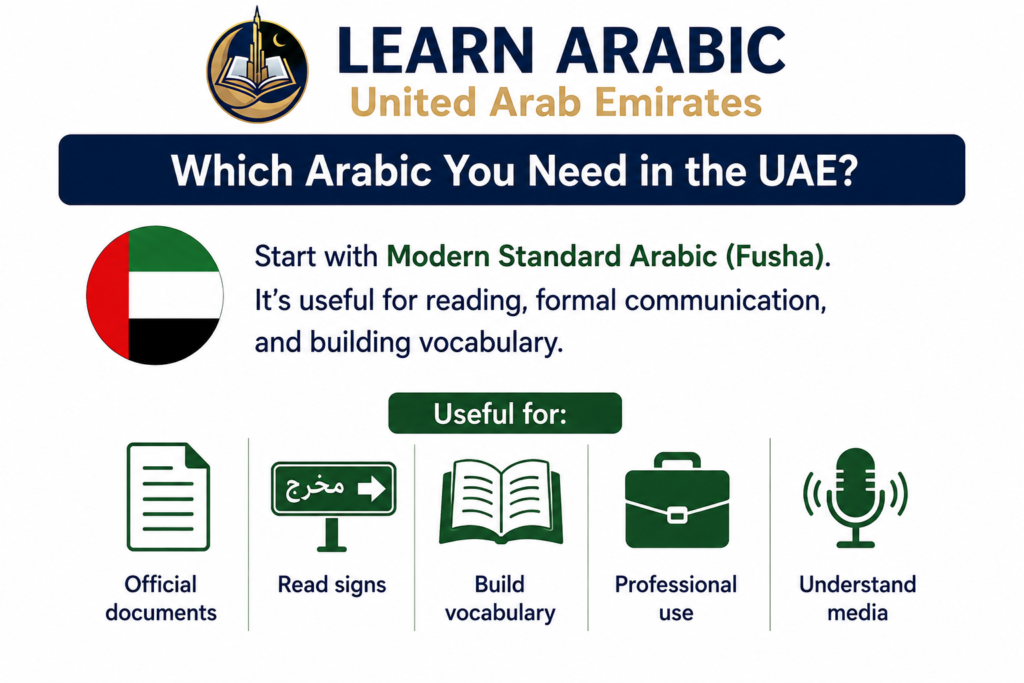
The UAE uses Arabic in official and formal contexts, while everyday conversations can include Emirati and other Gulf Arabic varieties. As a beginner, Modern Standard Arabic (MSA), often called Fusha, provides a strong foundation for reading, formal communication, vocabulary, and understanding written Arabic.
For example, MSA is useful when you want to:
- Understand official documents and formal information.
- Read Arabic signs and written instructions.
- Build a strong vocabulary foundation.
- Communicate in professional and educational settings.
- Understand Arabic media and formal speech.
If your main goal is to build a solid foundation in formal Arabic, a structured Fusha Arabic course can help you develop the language systematically.
Once your foundation is strong, you can gradually become more comfortable with the spoken Arabic you hear around you in Dubai, Abu Dhabi, Sharjah, Ajman, and other emirates.
Speak Fusha Arabic with Confidence in the UAE with a FREE Trial Class
2. Learn the Arabic Alphabet and Correct Pronunciation
You cannot become a confident Arabic speaker without becoming familiar with Arabic sounds.
Arabic has 28 letters, and some sounds may be unfamiliar to English speakers. Letters such as ع, ح, خ, غ, and ق require practice because their pronunciation does not always have a direct equivalent in English.
Start by learning:
- The sound of each Arabic letter.
- How letters change shape within words.
- Short and long vowels.
- Basic pronunciation rules.
- Common Arabic combinations and words.
Do not worry about speaking perfectly at this stage. The goal is to make your pronunciation understandable and gradually train your mouth and ear to recognize Arabic sounds.
For someone living in the UAE, learning the alphabet also has an immediate practical benefit. You will begin recognizing Arabic on road signs, shop names, menus, government websites, Metro signs, and advertisements around you.
3. Memorize Useful Arabic Words for Daily Life in the UAE
Once you understand the alphabet and basic pronunciation, move quickly into practical vocabulary.
Instead of learning random vocabulary from a dictionary, choose words connected to situations you actually experience in the UAE.
For example:
| English | Arabic | Pronunciation |
| Hello | مرحبًا | Marḥaban |
| Thank you | شكرًا | Shukran |
| Please | من فضلك | Min faḍlik |
| Yes | نعم | Naʿam |
| No | لا | Lā |
| Where? | أين؟ | Ayna? |
| How much? | كم؟ | Kam? |
| Water | ماء | Māʾ |
| Coffee | قهوة | Qahwah |
| Today | اليوم | Al-yawm |
Practise words that you can actually use at a supermarket in Sharjah, a café in Dubai, a taxi in Abu Dhabi, or a government service centre.
The more relevant the vocabulary is to your daily routine, the easier it becomes to remember.
4. Learn Complete Sentences Instead of Individual Words
Knowing individual Arabic words is useful, but speaking requires you to combine those words into meaningful sentences.
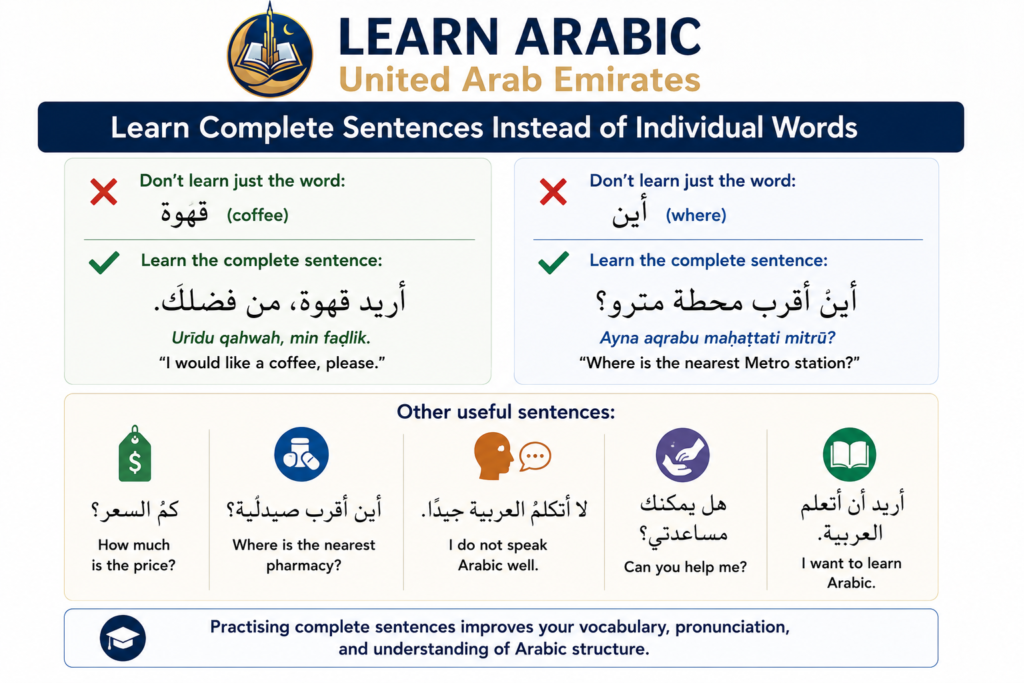
Instead of memorizing only قهوة (coffee), learn:
أريد قهوة، من فضلك.
Urīdu qahwah, min faḍlik.
“I would like a coffee, please.”
Instead of learning only أين (where), learn:
أين أقرب محطة مترو؟
Ayna aqrabu maḥaṭṭati mitrū?
“Where is the nearest Metro station?”
Other useful sentences include:
- كم السعر؟ — How much is the price?
- أين أقرب صيدلية؟ — Where is the nearest pharmacy?
- لا أتكلم العربية جيدًا. — I do not speak Arabic well.
- هل يمكنك مساعدتي؟ — Can you help me?
- أريد أن أتعلم العربية. — I want to learn Arabic.
Practising complete sentences teaches you vocabulary, pronunciation, and sentence structure at the same time.
5. Build Basic Arabic Grammar
You do not need to master every Arabic grammar rule before you start speaking. However, understanding basic grammar will help you create your own sentences instead of relying entirely on memorized phrases.
Start with simple concepts such as:
- Masculine and feminine forms.
- Singular and plural.
- Personal pronouns.
- Basic verb forms.
- Question structures.
- Negation.
- Common prepositions.
- Basic sentence patterns.
For example, learning the difference between أنا (I), أنتَ (you, masculine), and أنتِ (you, feminine) helps you understand how Arabic sentences change according to the person being addressed.
As your vocabulary grows, grammar gives you the framework to combine words correctly.
Learners who want a more systematic approach can use a structured Arabic Grammar Course to develop this foundation gradually rather than trying to memorize complicated rules independently.
Master Arabic Grammar in the UAE with a FREE Trial Class

6. Practise Speaking Arabic Every Day
If your goal is to learn how to speak Arabic language in the UAE, speaking cannot be optional.
Many beginners spend weeks reading Arabic vocabulary and watching lessons without actually saying anything. This creates a gap between understanding Arabic and being able to use it in a real conversation Start with very short speaking exercises.
For five minutes each day, describe what you are doing:
أنا في دبي.
“I am in Dubai.”
أنا ذاهب إلى العمل.
“I am going to work.”
أشرب القهوة.
“I am drinking coffee.”
أذهب إلى المترو.
“I am going to the Metro.”
You can practise while driving, walking, preparing breakfast, or getting ready for work. The important thing is to make speaking part of your daily routine.
Do not wait until your Arabic is perfect before speaking. Mistakes are a normal part of language learning.
7. Use Your Daily Life in the UAE as Speaking Practice
One of the biggest advantages of learning Arabic in the UAE is that you are surrounded by opportunities to encounter the language.
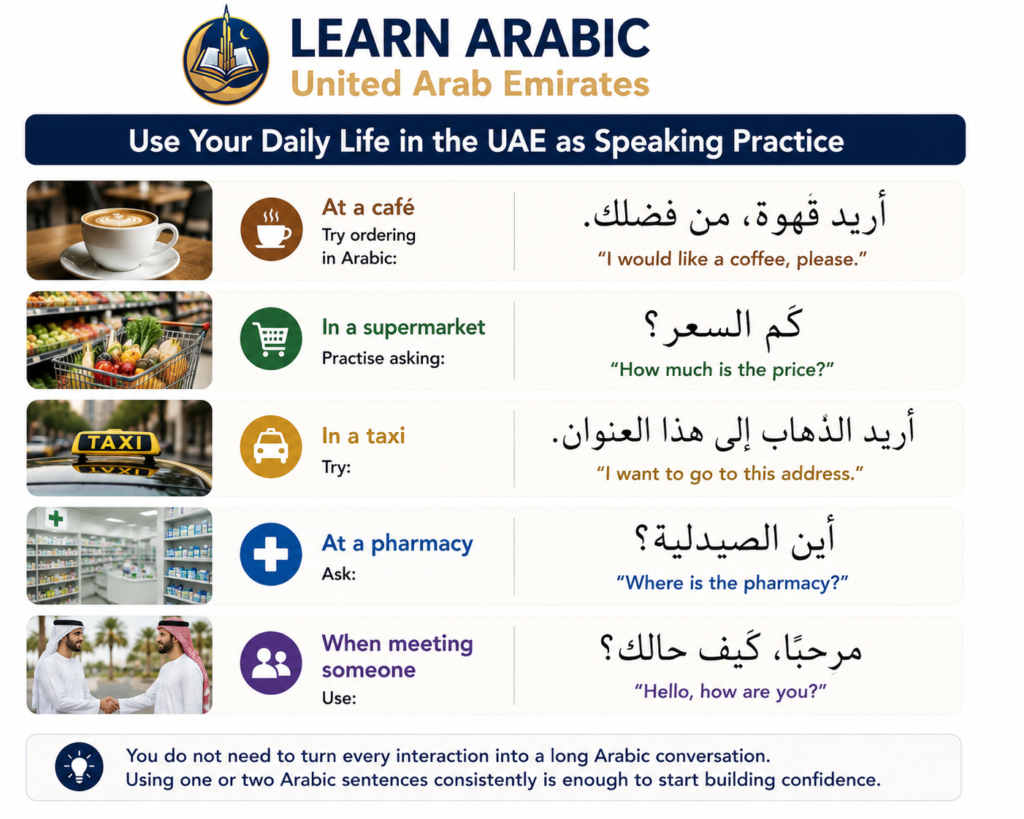
Use ordinary situations as small speaking exercises.
At a café
Try ordering in Arabic:
أريد قهوة، من فضلك.
In a supermarket
Practise asking:
كم السعر؟
In a taxi
Try:
أريد الذهاب إلى هذا العنوان.
“I want to go to this address.”
At a pharmacy
Ask:
أين الصيدلية؟
“Where is the pharmacy?”
When meeting someone
Use:
مرحبًا، كيف حالك؟
“Hello, how are you?”
You do not need to turn every interaction into a long Arabic conversation. Using one or two Arabic sentences consistently is enough to start building confidence.
Step Inside Our Classrooms
Don’t just take our word for it—see our community in action. Click below to watch real, live snippets from our recent classes and experience our engaging teaching style firsthand!
Master Arabic in the UAE
Experience world-class Arabic language training designed for students and professionals in the Emirates.
Book Your Free Trial8. Listen to Arabic Spoken in the UAE
Speaking improves when you regularly listen to Arabic Pay attention to the Arabic you encounter around you—in public announcements, local media, conversations, shops, and other everyday environments.
At the beginning, do not try to understand every single word. Instead, focus on:
- Recognizing familiar words.
- Identifying common expressions.
- Listening to pronunciation.
- Noticing how sentences sound.
- Repeating short phrases after the speaker.
You can also listen to beginner-level Arabic audio for a few minutes every day. Repeating the same short audio several times can be more useful than listening to a long recording once.
As you become more comfortable with formal Arabic, you can gradually expose yourself to Gulf and Emirati speech so you can better understand everyday conversations.
Read also: The Arabic Letter ن (Nūn) – Pronunciation, Writing, Forms, and Examples
9. Learn Arabic for Your Workplace
If you work in Dubai, Abu Dhabi, Sharjah, or another UAE emirate, Arabic can also support professional communication.
The vocabulary you need at work will depend on your industry. A business professional may need expressions related to meetings, clients, negotiations, emails, presentations, and workplace communication.
Start by learning phrases such as:
- صباح الخير — Good morning.
- شكرًا لك — Thank you.
- سعدت بلقائك — Nice to meet you.
- هل يمكننا أن نبدأ؟ — Can we start?
- أحتاج إلى مزيد من المعلومات. — I need more information.
- سأتواصل معك لاحقًا. — I will contact you later.
If Arabic is important for your career, a structured Business Arabic course in the UAE can help you focus on professional vocabulary and communication rather than learning unrelated expressions.
Take Your Business Arabic to the Next Level in the UAE with a FREE Trial Class

10. Create a Simple Arabic Practice Routine
Consistency is more effective than studying for several hours only once a week. A short daily routine can help you develop your vocabulary, listening, speaking, and reading skills without making Arabic practice feel overwhelming.
Build a 20-Minute Daily Arabic Routine
You can divide just 20 minutes of daily practice into four simple activities:
- 5 Minutes — Vocabulary: Learn five useful Arabic words related to your daily life, work, family, or surroundings.
- 5 Minutes — Listening: Listen to a short Arabic recording and repeat words or phrases you recognize.
- 5 Minutes — Speaking: Say a few Arabic sentences aloud, focusing on clear pronunciation and natural expression.
- 5 Minutes — Reading: Read a short Arabic text, message, sign, or beginner-level passage.
Make Arabic Part of Your Daily Life
You do not always need a dedicated study session to improve your Arabic. Connecting practice to activities you already do can make learning easier to maintain.
For example:
- Practise new vocabulary while drinking your morning coffee.
- Listen to Arabic during your Dubai Metro journey.
- Read Arabic signs while travelling around the UAE.
- Practise speaking during your evening walk.
- Review new words before going to bed.
Focus on Consistency
The goal is to make Arabic a regular part of your daily routine, rather than something you study only when you have extra time. Even a few minutes of focused practice each day can help reinforce what you have learned and gradually build greater confidence in using Arabic.
11. Practise With Native Arabic Speakers
Eventually, you need to move from practising Arabic alone to using it with other people Look for opportunities to speak with Arabic speakers and start with simple conversations.
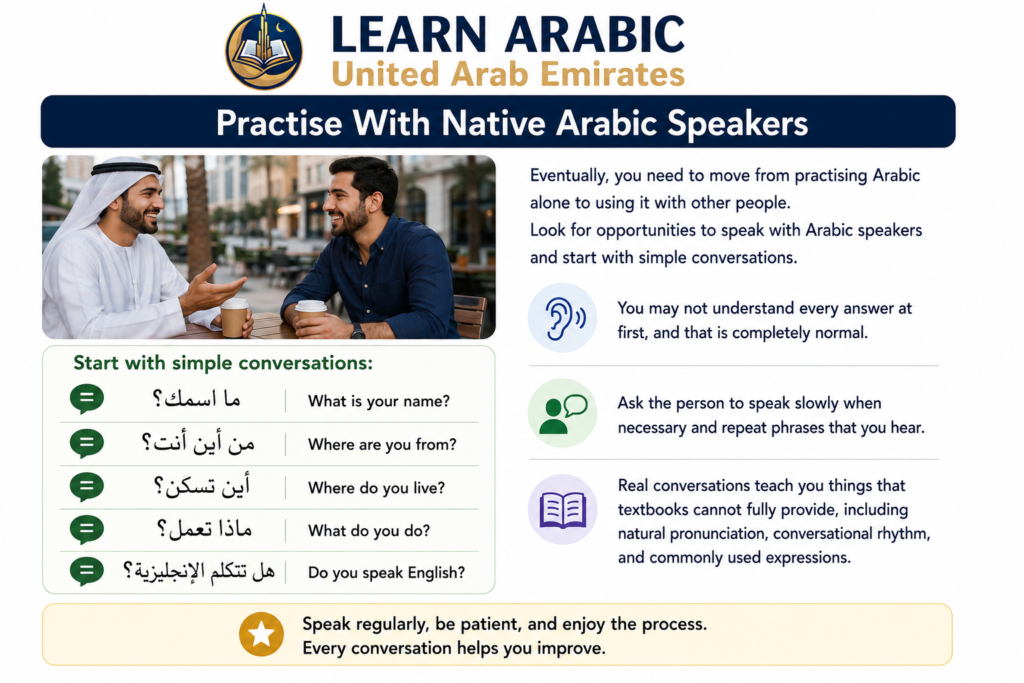
You can begin with:
ما اسمك؟
“What is your name?”
من أين أنت؟
“Where are you from?”
أين تسكن؟
“Where do you live?”
ماذا تعمل؟
“What do you do?”
هل تتكلم الإنجليزية؟
“Do you speak English?”
You may not understand every answer at first, and that is completely normal. Ask the person to speak slowly when necessary and repeat phrases that you hear.
Real conversations teach you things that textbooks cannot fully provide, including natural pronunciation, conversational rhythm, and commonly used expressions.
12. Combine Fusha With UAE Everyday Arabic
A common question among UAE residents is whether they should learn Fusha or Emirati Arabic The answer depends on your goals.
Fusha (MSA) is particularly useful for formal Arabic, reading, writing, education, media, and official communication.
Emirati and Gulf Arabic can be useful for understanding informal conversations and communicating more naturally in local social situations.
For many beginners, building a strong foundation in Fusha first provides a useful starting point. You can then add commonly used Emirati or Gulf expressions as your listening and speaking skills develop.
This approach prevents you from feeling overwhelmed by trying to learn every variety of Arabic at the same time.
Read also: The Arabic Letter م (Meem) – Pronunciation, Writing, and Examples
13. Track Your Progress Every Week
Learning how to speak Arabic language in the UAE becomes easier when you can see your progress.
At the end of every week, ask yourself:
- How many new Arabic words did I learn?
- How many sentences can I say without looking at my notes?
- Can I introduce myself in Arabic?
- Can I order something in Arabic?
- Can I ask for directions?
- Can I understand simple questions?
- Did I speak Arabic with another person this week?
Do not measure progress only by how fluent you sound Being able to understand a road sign that you could not read a month ago is progress. Ordering coffee in Arabic for the first time is progress.
Understanding a simple question without translating it into English is progress Small improvements eventually become conversational ability.
How Long Does It Take to Speak Arabic in the UAE?
There is no single timeline for learning Arabic because progress depends on your starting level, study time, learning method, and opportunities to practise.
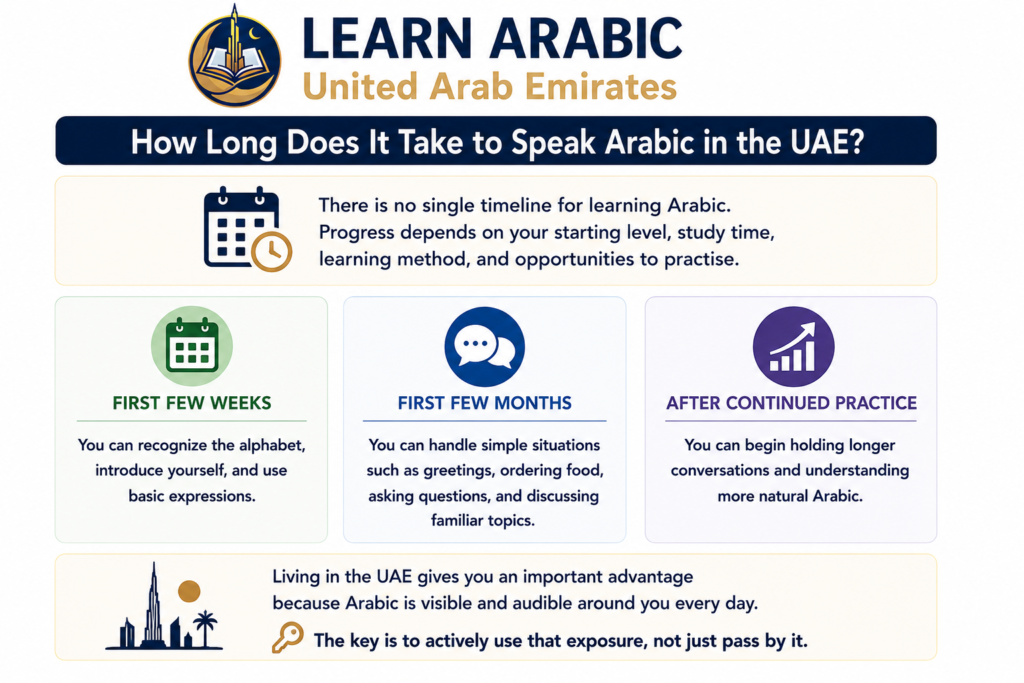
However, consistent daily practice can help you progress through stages:
First few weeks: You can recognize the alphabet, introduce yourself, and use basic expressions.
First few months: You can handle simple situations such as greetings, ordering food, asking questions, and discussing familiar topics.
After continued practice: You can begin holding longer conversations and understanding more natural Arabic.
Living in the UAE can give you an important advantage because Arabic is visible and audible around you every day. The key is to actively use that exposure rather than simply passing by it.
Common Mistakes to Avoid When Learning Arabic in the UAE
If you want to learn how to speak Arabic language in the UAE, avoiding a few common mistakes can make your learning more effective.
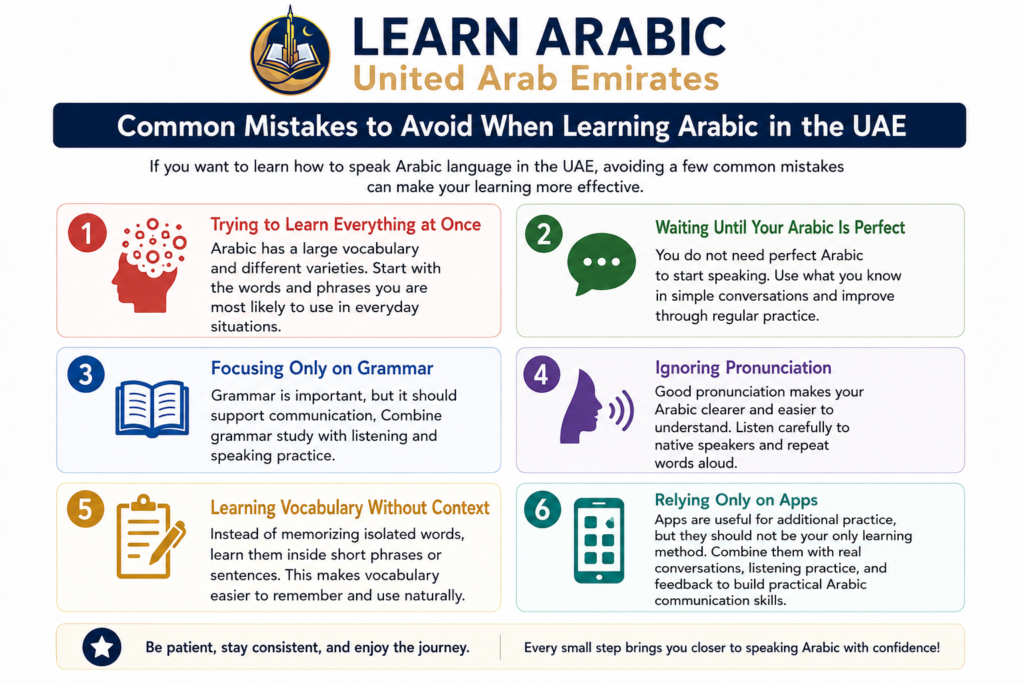
1. Trying to Learn Everything at Once
Arabic has a large vocabulary and different varieties. Start with the words and phrases you are most likely to use in everyday situations.
2. Waiting Until Your Arabic Is Perfect
You do not need perfect Arabic to start speaking. Use what you know in simple conversations and improve through regular practice.
3. Focusing Only on Grammar
Grammar is important, but it should support communication. Combine grammar study with listening and speaking practice.
4. Ignoring Pronunciation
Good pronunciation makes your Arabic clearer and easier to understand. Listen carefully to native speakers and repeat words aloud.
5. Learning Vocabulary Without Context
Instead of memorizing isolated words, learn them inside short phrases or sentences. This makes vocabulary easier to remember and use naturally.
6. Relying Only on Apps
Apps are useful for additional practice, but they should not be your only learning method. Combine them with real conversations, listening practice, and feedback to build practical Arabic communication skills.
Read also: How to Learn Quran for Kids in the UAE – 7 Practical Steps for Parents
See Our Classroom Environment in Action
Experience a sneak peek into our live sessions. Watch the video below to see our specialized instructors interacting with students, breakdown complex texts, and cultivate an engaging, respectful learning environment.
Learn Arabic for Everyday Life in the UAE with Learn Arabic UAE
Learning how to speak Arabic language in the UAE becomes much easier when your lessons reflect the situations you actually face in daily life. Whether you want to communicate more confidently at work, understand formal Arabic, or become more comfortable using Arabic in shops, restaurants, government services, and everyday conversations, structured practice can help you move from memorized phrases to real communication.
At Learn Arabic UAE, learners can build their skills through guided Arabic courses designed for different goals and levels. With regular speaking, listening, reading, and vocabulary practice, you can gradually develop the confidence to use Arabic more naturally across Dubai, Abu Dhabi, Sharjah, and the rest of the UAE.
Our Arabic courses
- Modern Standard Arabic (MSA) Course
- Quranic Arabic Course
- Fusha Arabic Course
- Classical Arabic Course
- Emirati Arabic Course
- Gulf Arabic Course
- Learn Saudi Arabic
- Business Arabic Course UAE
- Arabic Language Classes for Professionals in UAE
Master Arabic in the UAE
Experience world-class Arabic language training designed for students and professionals in the Emirates.
Book Your Free Trial
Conclusion
Learning how to speak Arabic language in the UAE becomes much easier when you focus on practical communication and consistent practice. Start with the Arabic alphabet and pronunciation, build useful vocabulary, learn everyday sentences, and gradually develop your grammar and listening skills. Most importantly, use Arabic in real situations around you, whether you are ordering coffee in Dubai, asking for directions in Abu Dhabi, shopping in Sharjah, or communicating at work.
You do not need to become fluent overnight. By taking small steps every day and combining structured lessons with regular speaking practice, you can steadily build the confidence to communicate in Arabic and better connect with life and culture in the UAE.
Frequently Asked Questions
1. How can I learn how to speak Arabic language in the UAE?
Start by learning the Arabic alphabet and pronunciation, then focus on common words and complete sentences used in everyday situations. Practise speaking daily, listen to Arabic regularly, and use opportunities around the UAE to communicate with Arabic speakers.
2. Should I learn Fusha or Emirati Arabic in the UAE?
For beginners, Fusha (Modern Standard Arabic) provides a strong foundation for reading, writing, formal communication, and understanding Arabic across different contexts. After developing this foundation, you can gradually learn Emirati or Gulf Arabic expressions for everyday conversations.
3. How long does it take to speak Arabic in the UAE?
The time varies depending on your study routine, previous language experience, and speaking practice. With consistent daily practice, beginners can learn basic greetings, questions, and everyday expressions within the first few months and gradually develop stronger conversational skills.
4. What Arabic phrases should I learn first in the UAE?
Start with practical expressions such as مرحبًا (Marhaban) for “hello,” شكرًا (Shukran) for “thank you,” من فضلك (Min faḍlik) for “please,” أين؟ (Ayna?) for “where?” and كم؟ (Kam?) for “how much?” These phrases are useful in everyday situations such as shopping, restaurants, transportation, and asking for directions.
5. Can I learn to speak Arabic while living and working in the UAE?
Yes. Your daily environment can become part of your Arabic practice. You can read Arabic signs, listen to Arabic conversations, practise with colleagues or native speakers, and use simple Arabic phrases when ordering food, shopping, travelling, or interacting in professional settings.



Leave a Reply