 Quran

Learning the Quran is one of the most meaningful gifts parents can give their children. But for many families in the UAE, the question is not whether their child should learn the Quran—it is how to learn Quran for kids in the UAE in a way that is age-appropriate, consistent, and enjoyable.
The UAE provides a particularly supportive environment for Arabic and Quran learning. Arabic is the country’s official language, while Islam is its official religion. Schools also include Arabic and Islamic education within the educational system, including for students who do not speak Arabic as their first language.
At the same time, children in Abu Dhabi, Dubai, Sharjah, Ajman, and other emirates grow up in busy, multicultural environments. Parents may need to balance school, activities, technology, and family commitments while creating a regular Quran routine.
The good news is that learning the Quran does not have to feel overwhelming. With the right approach, parents can help children build their Arabic reading skills, improve their recitation, learn Tajweed, memorize short surahs, and develop a positive relationship with the Quran.
Step 1: Start by Assessing Your Child’s Arabic and Quran Level
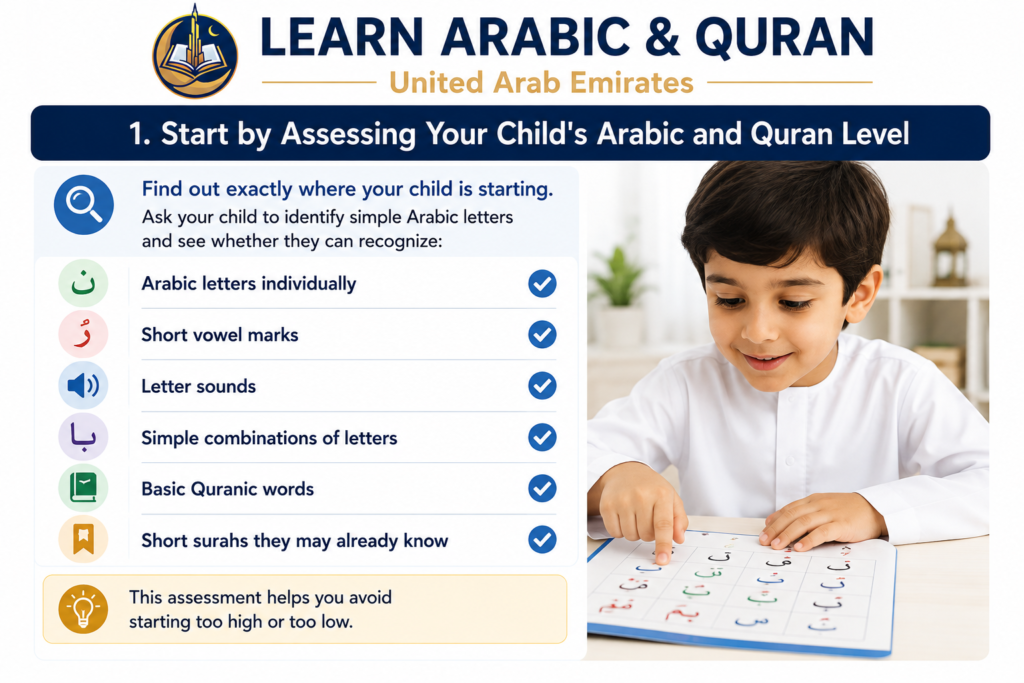
Before choosing a Quran learning program, find out exactly where your child is starting.
Some children in the UAE grow up speaking Arabic at home, while others may attend English-medium international schools and have limited Arabic reading skills. Even children from the same family can have very different abilities.
Ask your child to identify simple Arabic letters and see whether they can recognize:
- Arabic letters individually
- Short vowel marks
- Letter sounds
- Simple combinations of letters
- Basic Quranic words
- Short surahs they may already know
This assessment helps you avoid starting too high or too low.
For a child who does not yet recognize the Arabic alphabet, beginning with the fundamentals is essential. A structured Arabic alphabet course can help children become familiar with letter shapes and sounds before moving into more advanced Quran reading.
Build a Strong Foundation in Arabic Letters in the UAE with a FREE Trial Class

This foundation is especially important because Quranic Arabic requires accurate pronunciation. Children should learn the difference between similar sounds gradually rather than memorizing words without understanding how their letters are formed.
Why the foundation matters?
A child who develops strong Arabic reading skills from the beginning will generally find it easier to:
- Recognize Quranic words
- Follow vowel markings
- Read from the Mushaf
- Develop accurate pronunciation
- Progress toward Tajweed
- Memorize verses more confidently
The goal is not to rush into memorization. The goal is to create a foundation that makes future learning easier.
Step 2: Choose a Quran Learning Path That Matches Your Child’s Age
There is no single method for every child. The right approach depends on age, Arabic ability, attention span, and previous Quran experience.
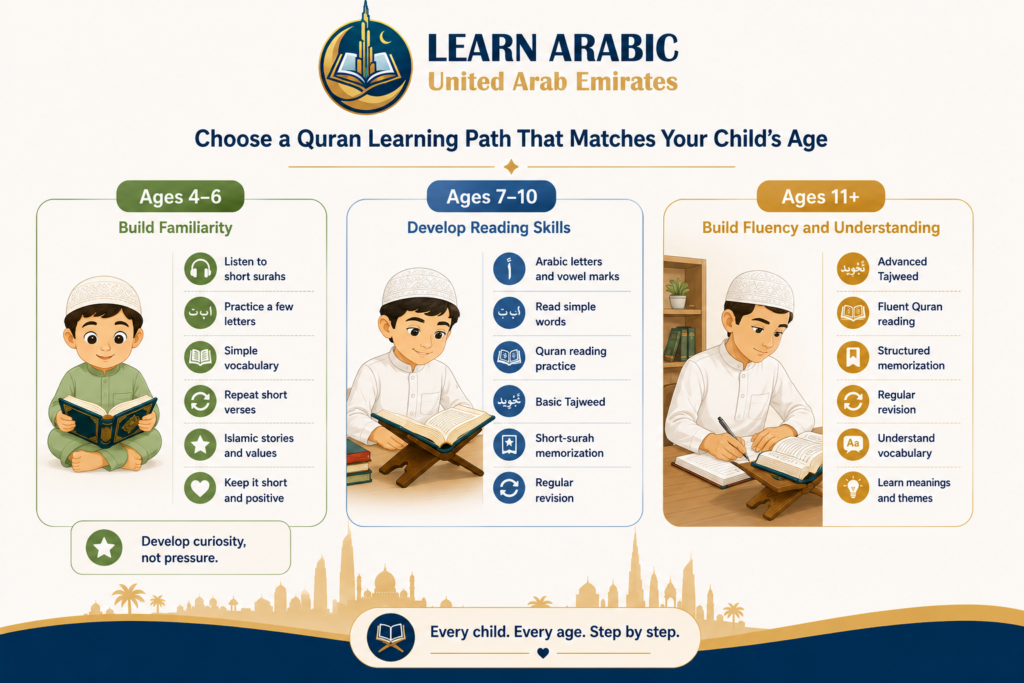
For younger children, learning should be simple, interactive, and based on repetition. Older children can gradually handle more structured reading, Tajweed, memorization, and meaning.
A practical progression can look like this:
Ages 4–6: Build Familiarity
At this stage, focus on making the Quran a familiar and positive part of the child’s life.
Parents can:
- Listen to short surahs together
- Practice a few Arabic letters at a time
- Introduce simple Quranic vocabulary
- Repeat short verses
- Tell age-appropriate stories connected to Islamic values
- Avoid long lessons that cause frustration
The objective is to develop curiosity rather than pressure.
Ages 7–10: Develop Reading Skills
Children at this stage can usually benefit from a more structured learning routine.
Focus on:
- Arabic letters and vowel marks
- Reading simple words
- Quran reading practice
- Basic Tajweed
- Short-surah memorization
- Regular revision
Ages 11 and Above: Build Fluency and Understanding
Older children can gradually move toward:
- More advanced Tajweed
- Fluent Quran reading
- Structured memorization
- Regular revision
- Understanding vocabulary
- Learning basic meanings and themes of surahs
At this stage, it becomes increasingly valuable to connect what children recite with what they understand.
Step 3: Build a Simple and Consistent Quran Routine
When considering how to learn Quran for kids, consistency is often more effective than long study sessions. Children can benefit from short, focused periods of Quran learning that become a familiar part of their weekly routine.
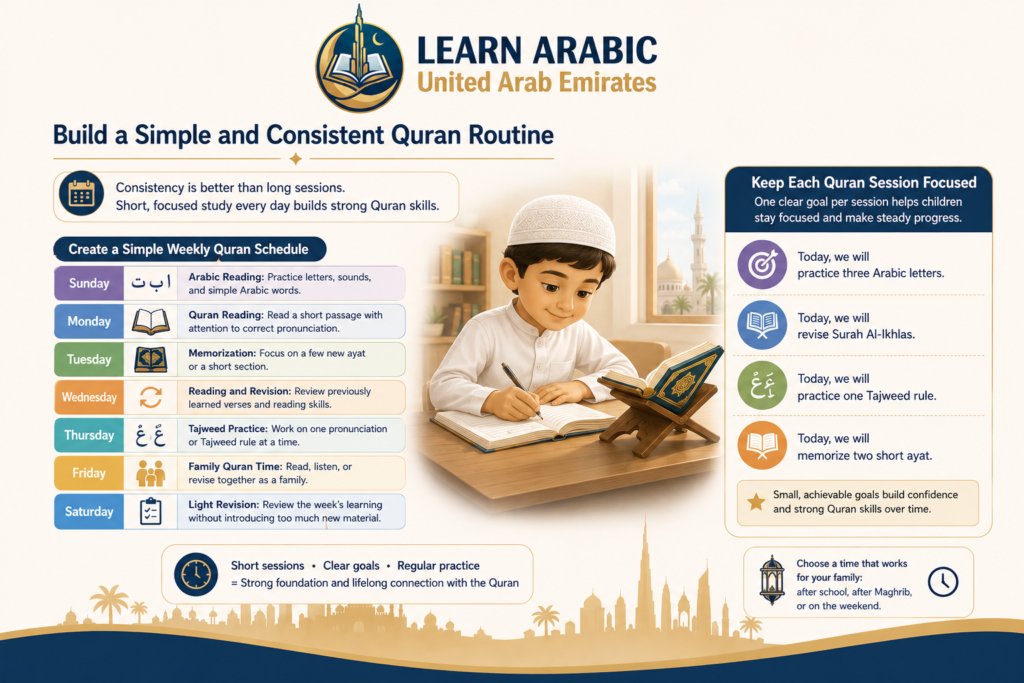
Instead of trying to cover reading, memorization, revision, and Tajweed in one session, spread these activities throughout the week.
Create a Simple Weekly Quran Schedule
A weekly routine could look like this:
- Sunday — Arabic Reading: Practice letters, sounds, and simple Arabic words.
- Monday — Quran Reading: Read a short passage with attention to correct pronunciation.
- Tuesday — Memorization: Focus on a few new ayat or a short section.
- Wednesday — Reading and Revision: Review previously learned verses and reading skills.
- Thursday — Tajweed Practice: Work on one pronunciation or Tajweed rule at a time.
- Friday — Family Quran Time: Read, listen, or revise together as a family.
- Saturday — Light Revision: Review the week’s learning without introducing too much new material.
The exact schedule can be adjusted to suit your family’s routine. For families in the UAE, sessions might take place after school, after Maghrib, or during a quieter part of the weekend. What matters most is creating a routine your child can follow consistently.
Keep Each Quran Session Focused
Children can find it difficult to concentrate when too many objectives are introduced at once. Give each session one clear and manageable goal.
For example:
- Today, we will practice three Arabic letters.
- Today, we will revise Surah Al-Ikhlas.
- Today, we will practice one Tajweed rule.
- Today, we will memorize two short ayat.
Small, achievable goals can make Quran learning easier to manage and help children build their skills gradually without making each session feel overwhelming.
Step 4: Teach Quran Reading Before Expecting Heavy Memorization
Memorization can be an important part of Quran education, but children also need to develop the ability to read accurately.
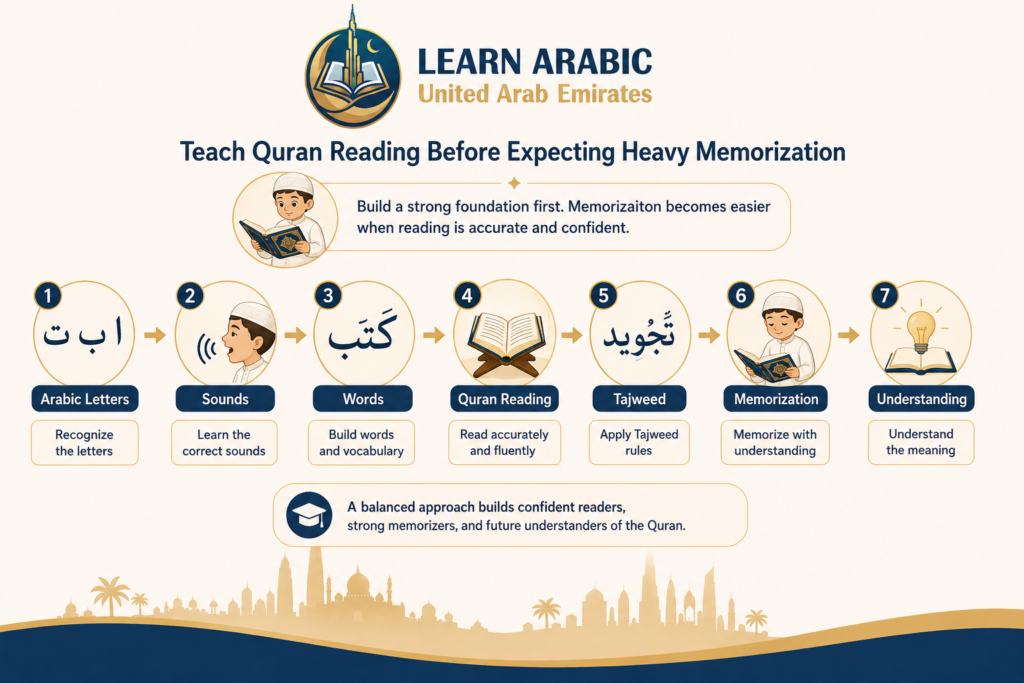
A child who memorizes sounds without understanding the written Arabic may struggle when they encounter unfamiliar verses.
That is why parents should build a progression:
Arabic letters → sounds → words → Quran reading → Tajweed → memorization → understanding
This sequence gives children multiple skills instead of relying only on memorization It is also where Arabic learning can support Quran education.
Children who become more comfortable recognizing Arabic letters and words may feel more confident when reading from the Mushaf.
Step 5: Introduce Tajweed Gradually
Tajweed helps children learn how to recite the Quran correctly. However, teaching Tajweed to children does not mean overwhelming them with technical terminology Start with pronunciation.
Children should hear a correct recitation, repeat it, and receive gentle correction. Over time, more rules can be introduced according to their ability.
A good Tajweed routine can include:
- Listening to a qualified reciter
- Repeating short passages
- Practicing difficult Arabic sounds
- Correcting pronunciation immediately but gently
- Revising previously learned rules
- Applying Tajweed while reading actual Quranic verses
The Prophet ﷺ emphasized the value of learning and teaching the Quran. In Sahih al-Bukhari, the Prophet ﷺ said: “The best among you are those who learn the Qur’an and teach it.”
Children should therefore be encouraged to see Quran learning as a gradual journey rather than a competition.
And when a child struggles, parents should not assume that difficulty means failure. Sahih Muslim records that the person who finds reciting the Quran difficult receives two rewards.
That message can be especially encouraging for young learners who are still developing their pronunciation.
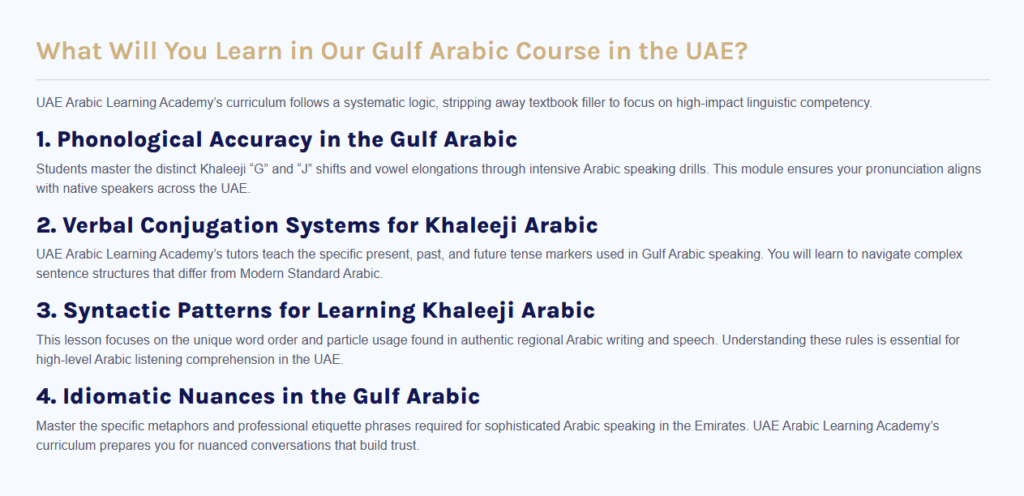
For families living in Dubai, Abu Dhabi, Sharjah, or other emirates, a Gulf Arabic course can be especially useful when the wider goal is helping children communicate naturally in their local environment.
Speak Gulf Arabic with Confidence in the UAE with a FREE Trial Class
Step 6: Choose the Right Quran Teacher or Learning Environment in the UAE
Finding the right teacher is one of the most important parts of how to learn Quran for kids in the UAE Parents have several possibilities, including Quran education through centers, mosque study circles, and online learning.
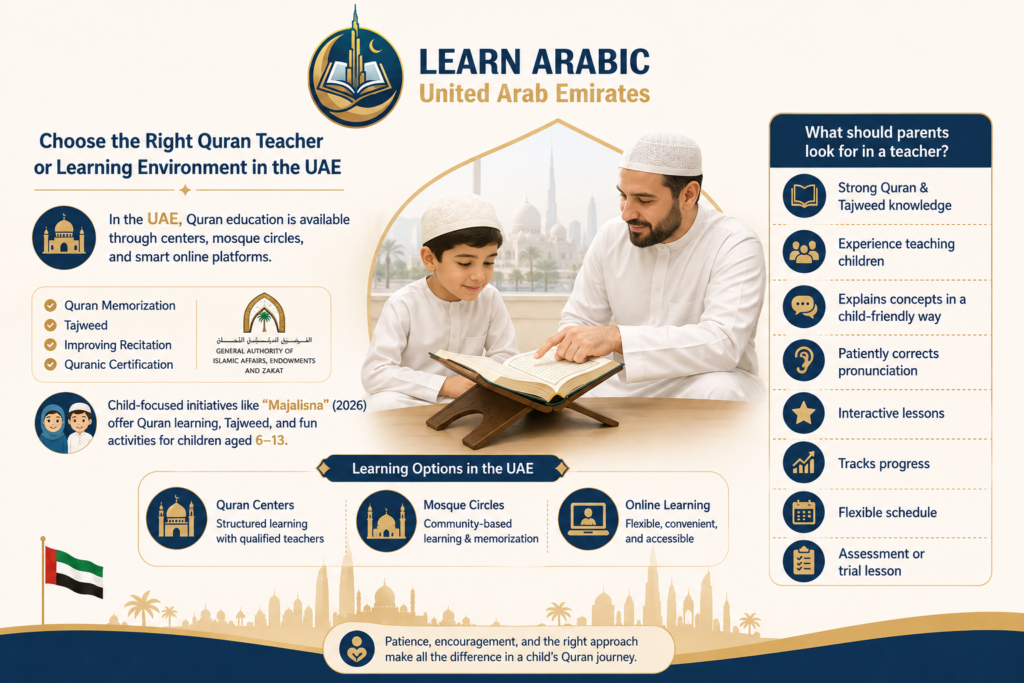
The UAE’s General Authority of Islamic Affairs, Endowments and Zakat provides Quran education through memorization centers, mosque circles, and a smart platform for remote Quran education. Its services include Quran memorization, Tajweed, improving recitation, and Quranic certification.
The UAE also provides child-focused Quran initiatives. For example, the 2026 “Majalisna” initiative included Quran learning, recitation, Tajweed, and interactive activities for children aged 6–13, welcoming both citizens and residents.
This means parents can consider both in-person and online options depending on their emirate, schedule, and child’s learning style.
What should parents look for in a teacher?
Before enrolling your child, ask:
- Does the teacher have strong Quran and Tajweed knowledge?
- Do they have experience teaching children?
- Can they explain difficult concepts in a child-friendly way?
- Do they correct pronunciation patiently?
- Is the lesson interactive?
- Does the teacher track progress?
- Can the schedule fit your family’s routine?
- Does the program offer an assessment or trial lesson?
A technically knowledgeable teacher is not automatically the right teacher for a six-year-old. Teaching children requires patience, communication, encouragement, and the ability to adapt the lesson to the child’s level.
Step 7: Connect Quran Learning With Arabic and Everyday Life
One of the biggest advantages of learning Quran in the UAE is that children live in a country where Arabic is part of everyday public life.
Arabic is the official language of the UAE, and Arabic appears throughout education and public life Parents can use this environment to reinforce what children learn.
For example, when your child learns a new Arabic letter, point it out in familiar Arabic words. When they learn a Quranic word, explain its simple meaning. When they hear Arabic at school or in the community, encourage them to recognize words they already know.
Children can also benefit from exposure to Gulf Arabic in everyday situations. Learning the difference between Quranic/Classical Arabic, Modern Standard Arabic, and spoken varieties can help parents set realistic expectations. A child does not need to speak Gulf Arabic fluently to begin learning the Quran.
Step Inside Our Classrooms
Don’t just take our word for it—see our community in action. Click below to watch real, live snippets from our recent classes and experience our engaging teaching style firsthand!
Master Arabic in the UAE
Experience world-class Arabic language training designed for students and professionals in the Emirates.
Book Your Free TrialHow to Make Quran Learning Enjoyable for Children?
Learning the Quran should be serious, but that does not mean it has to feel stressful.
Children respond better when parents create positive associations with learning.
Try these simple strategies:
Celebrate progress
If your child finally pronounces a difficult letter correctly, acknowledge the improvement Instead of simply saying “Good job,” tell them exactly what they did well.
Use repetition
Children often need to hear and repeat the same verse many times. Repetition is not wasted time; it is part of learning.
Listen together
Play a clear Quran recitation during quiet family moments. Listening can help children become familiar with pronunciation and rhythm.
Keep the Quran visible
A calm Quran corner at home can remind children that Quran reading is a normal part of family life.
Avoid comparison
Do not compare your child’s memorization speed with another child’s One child may memorize quickly but need more reading practice. Another may read beautifully but need more time to memorize.
How Often Should Kids Learn the Quran?
There is no universal schedule that works for every child A practical starting point is short, regular sessions several times per week, combined with light practice at home.
The right frequency depends on:
- The child’s age
- Current Quran level
- School schedule
- Attention span
- Memorization goals
- Family routine
- Whether the child is learning Arabic at the same time
For example, a child attending school in Dubai may benefit from three structured Quran lessons during the week, with short revision sessions at home. Another child may do better with shorter daily practice.
A Simple Weekly Quran Plan for Kids in the UAE
If you are unsure where to begin, try this simple structure:
| Day | Activity | Time |
| Sunday | Quran reading | 15–20 minutes |
| Monday | Arabic letters/reading | 15 minutes |
| Tuesday | Quran memorization | 15–20 minutes |
| Wednesday | Quran reading + Tajweed | 20 minutes |
| Thursday | Memorization revision | 15 minutes |
| Friday | Family Quran listening | 10–20 minutes |
| Saturday | Weekly revision | 15–20 minutes |
The schedule can be adjusted around school, family commitments, and your child’s energy level.
The aim is to create a routine that your child can maintain throughout the school year—not something that works for only two weeks.
Should Children Learn Arabic Alongside the Quran?
For many families, learning Arabic alongside Quran reading can be extremely helpful The Quran was revealed in Arabic, and understanding the language can eventually help children move beyond pronunciation toward vocabulary and meaning.
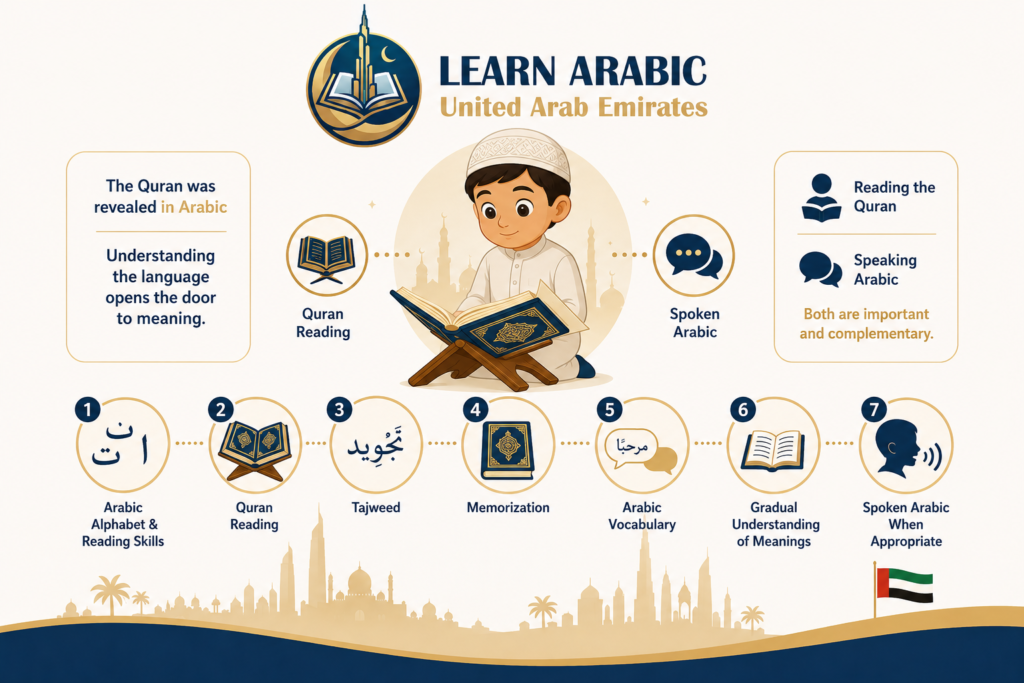
However, parents should distinguish between learning to read Quranic Arabic and learning conversational Arabic They are related, but they are not identical goals.
A child may learn to read the Quran correctly without being able to hold a conversation in Arabic. Conversely, a child may speak a variety of Arabic at home without being able to read the Quran fluently.
That is why a balanced approach can include:
- Arabic alphabet and reading skills
- Quran reading
- Tajweed
- Memorization
- Arabic vocabulary
- Gradual understanding of meanings
- Spoken Arabic when appropriate
This approach can be particularly valuable in the UAE, where children encounter Arabic in school, public spaces, and everyday interactions.
For families who want to develop broader Arabic communication skills alongside Quran learning, Arabic programs in the UAE can provide a wider language-learning foundation.
Explore the Best Arabic Programs in the UAE with a FREE Trial Class

Common Mistakes Parents Make When Teaching Quran to Kids
Helping children learn the Quran requires patience, consistency, and an approach that matches their age and learning needs. When exploring how to learn Quran for kids, parents should pay attention not only to the course or teacher they choose, but also to the learning environment they create at home.
1. Introducing Too Much at Once
Trying to combine Arabic letters, Quran reading, Tajweed, memorization, meanings, and Islamic studies in a single session can overwhelm a young learner.
2. Expecting Immediate Progress
Learning to read and recite the Quran correctly is a gradual process. Every child develops reading, pronunciation, and memorization skills at a different pace.
3. Turning Every Mistake into Criticism
Children need correction to improve, but repeatedly criticizing every mistake can make Quran practice stressful and discourage them from reading aloud.
4. Focusing Only on Memorization
Memorizing surahs is valuable, but Quran learning should not depend on memorization alone. Children also need to develop accurate reading, pronunciation, Tajweed, and eventually an age-appropriate understanding of what they read.
5. Changing Quran Teachers Too Often
Frequently changing teachers can interrupt a child’s routine and make it difficult to follow a consistent learning method.
6. Ignoring Your Child’s Learning Style
Children do not all learn in the same way. Some respond well to listening and repetition, while others benefit more from visual activities, writing, movement, or direct interaction.
Why Learning Quran Early Can Be Meaningful for Children?
Early Quran education is not simply about producing a child who can recite a certain number of surahs It can help establish a lifelong relationship with the Quran.
Children can gradually learn to:
- Recognize Arabic letters
- Read Quranic words
- Improve pronunciation
- Apply basic Tajweed
- Memorize short surahs
- Understand simple meanings
- Build regular worship habits
- Appreciate Islamic values
The goal should be a child who sees the Quran as part of their life—not simply another subject they have to finish.
See Our Classroom Environment in Action
Experience a sneak peek into our live sessions. Watch the video below to see our specialized instructors interacting with students, breakdown complex texts, and cultivate an engaging, respectful learning environment.
Build a Strong Arabic Foundation for Quran Learning with Learn Arabic UAE
Building strong Arabic skills can make Quran learning easier and more meaningful for children, especially as they progress from recognizing individual letters to reading words, understanding vocabulary, and following Arabic text with greater confidence.
At Learn Arabic UAE, children can develop their Arabic through structured lessons designed around their age, current level, and learning goals. With guided practice in reading, pronunciation, vocabulary, grammar, and communication, learners can build an Arabic foundation that supports both their wider language development and their journey with Quranic Arabic.
Book your free evaluation session today
Our Arabic Courses for Kids
- Arabic Course for Kids
- Arabic Conversation Course for Kids
- Arabic Qaida Course for Kids
- Beginner Arabic Course for Kids
- Arabic Grammar Course for Kids
- Teen Arabic Summer Course
- UAE Kindergarten Arabic Classes
Master Arabic in the UAE
Experience world-class Arabic language training designed for students and professionals in the Emirates.
Book Your Free Trial
Conclusion
Learning the Quran is a journey, and children do not need to master everything at once.
Start with the Arabic letters. Build reading confidence. Introduce Tajweed gradually. Memorize short surahs. Practice regularly. Most importantly, create an environment where the Quran is associated with love, patience, family, and positive learning.
For parents asking how to learn Quran for kids in the UAE, the answer is not about finding one perfect method. It is about combining the right foundation, qualified guidance, consistent practice, and an environment that allows children to grow at their own pace.
When Arabic learning becomes part of the child’s everyday life, Quran education can become more natural and meaningful. With the right support, children in the UAE can develop both the language skills and Quranic foundation they need to continue learning with confidence.
Frequently Asked Questions About How to Learn Quran for Kids
What is the best age to start teaching the Quran to children?
There is no single perfect age for every child. Young children can begin with listening, short surahs, and familiarity with Arabic sounds, while formal reading can develop as their attention and language skills mature. The key is to make the experience age-appropriate and positive.
How can I teach Quran to my child if I do not speak Arabic?
You do not need to be fluent in Arabic to support your child’s Quran learning. A qualified teacher can handle pronunciation, reading, and Tajweed, while parents can reinforce the routine through listening, revision, and encouragement.
How often should children learn the Quran?
A consistent schedule several times per week is a practical starting point. Short sessions are often easier for younger children than long lessons. The ideal frequency should take the child’s age, school schedule, ability, and goals into account.
Should my child learn Arabic before learning the Quran?
Not necessarily. Children can begin learning Quran reading alongside the Arabic alphabet. However, developing Arabic reading skills can make Quran learning easier, while broader Arabic education can eventually support vocabulary and understanding.
Is online Quran learning suitable for children in the UAE?
Online learning can be a practical option for families who want flexible scheduling or one-to-one instruction. The most important factors are the teacher’s Quran and Tajweed knowledge, experience with children, lesson structure, and ability to provide individual feedback. The UAE’s official Quran education services also include remote Quran education through a smart platform.
Where can children learn Quran in the UAE?
Families can explore Quran education through official Quran centers, mosque study circles, and remote learning options. Availability and registration requirements can vary by program and emirate, so parents should check the relevant official provider before enrolling.




Leave a Reply