 Quran
Every noun in Arabic carries a gender, making masculine and feminine nouns in Arabic a fundamental concept to master, as there is no neutral “it.” This fact applies to verbs, adjectives, pronouns, and even how you point at something. If you’re learning Arabic and keep guessing wrong about whether a word is masculine or feminine, you’re not alone.
This is one of the first grammar hurdles non-native speakers hit, and getting it right changes how natural your sentences sound.
This article presents masculine and feminine nouns in Arabic in detail. It also explains how to identify them, the markers that signal feminine words, the handful of nouns that break the rules, and how gender ripples through the rest of your sentence.
At Learn Arabic UAE, this is one of the first structural concepts we cover with new students, because once it clicks, whole sentences start falling into place.
1. Real vs. Figurative Masculine Nouns
A real masculine noun (مذكر حقيقي) refers to an actual male, a person or animal, and typically has a feminine counterpart of the same root. Rajul (رجل, “man”) is real masculine because its feminine form, imra’a (امرأة, “woman”), exists.
A figurative masculine noun (مذكر مجازي) is treated as masculine grammatically but has no living referent and no feminine counterpart; words like kitab (كتاب, “book”), jabal (جبل, “mountain”), or qamar (قمر, “moon”) fall here. There’s nothing biologically male about a book; Arabic simply assigns it masculine by convention.
One detail that trips learners up: a real masculine noun stays masculine even if it looks feminine. Hamza (حمزة) is a real masculine name, used for men, despite ending in the ta marbuta that normally marks feminine words. The grammatical category is decided by what the word refers to, not by how it’s spelled.
2. Real vs. Figurative Feminine Nouns
A real feminine noun (مؤنث حقيقي) refers to an actual female, imra’a (امرأة, “woman”), taliba (طالبة, “female student”), qitta (قطة, “cat”). A figurative feminine noun (مؤنث مجازي) has no living referent but is still grammatically feminine: shams (شمس, “sun”), tawila (طاولة, “table”), waraqa (ورقة, “paper”).
There’s no female sun; Arabic just assigns these words feminine agreement throughout the sentence.
This is the piece most textbooks gloss over: figurative gender isn’t optional or a rounding error. It governs every verb, adjective, and pronoun attached to that noun, exactly the way real gender does.
A private tutor can catch this kind of mismatch the moment it happens in conversation, which is exactly the kind of correction our one-on-one sessions at Learn Arabic UAE are built around. You get feedback in the moment, not after a test.
Read also: Does Arabic Have Grammatical Gender? 9 Easy Rules You Need To Know
3. Recognizing Ta Marbuta (ة)
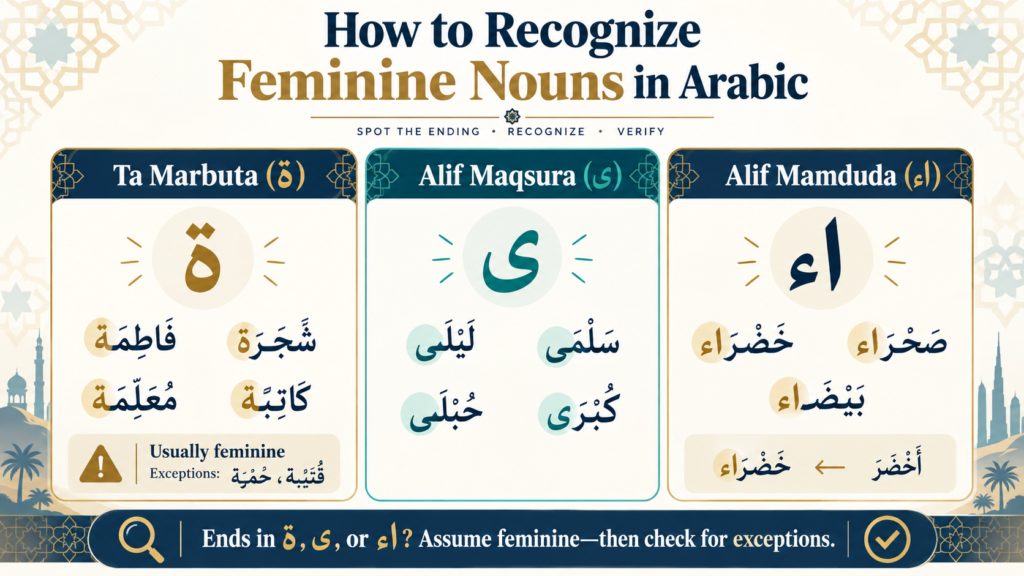
When studying masculine and feminine nouns in Arabic, the ta marbuta (ة) is the most common feminine marker by far. It appears at the end of nouns and adjectives: Fatima (فاطمة), shajara (شجرة, “tree”), mu’allima (معلمة, “female teacher”), kataba (كاتبة, “female writer”). If you see a word ending in ta marbuta, treat it as feminine by default, with the real-masculine exceptions noted above (Hamza, Qutaiba, and similar proper names).
Step Inside Our Classrooms
Don’t just take our word for it—see our community in action. Click below to watch real, live snippets from our recent classes and experience our engaging teaching style firsthand!
Master Arabic in the UAE
Experience world-class Arabic language training designed for students and professionals in the Emirates.
Book Your Free Trial4. Recognizing Alif Maqsura (ى) And Alif Mamduda (اء)
Understanding the endings of masculine and feminine nouns in Arabic is essential for mastering the language. This shortened alif shows up at the end of some feminine nouns and adjectives, especially names and superlative-style words: Layla (ليلى), Salma (سلمى), hubla (حبلى, “pregnant”), kubra (كبرى, “greater/greatest,” feminine form).
The extended alif (ألف ممدودة) ending marks feminine color adjectives and some nouns: sahra’ (صحراء, “desert”), khadra’ (خضراء, “green,” feminine), bayda’ (بيضاء, “white,” feminine). Most Arabic color adjectives follow this exact af’al/fa’la’ structure, where the masculine form (akhdar, أخضر) has no alif mamduda, and the feminine form does.
Here’s a decision check worth memorizing when analyzing masculine and feminine nouns in Arabic: if a noun ends in one of these three markers, assume feminine first, then check whether it’s a known real-masculine exception. That single rule resolves the large majority of gender guesses correctly.
Read also: How Many Letters Are In The Arabic Alphabet?
5. Navigating Dual-Gender Nouns (Both Masculine And Feminine)
When exploring masculine and feminine nouns in Arabic, you will find that a small set of Arabic nouns can take either masculine or feminine agreement, and both are considered correct. Native speakers move between the two without noticing, but this flexibility is a genuine trap for learners. These include:
- الطريق (road)
- السبيل (path)
- العنق (neck)
- السكّين (knife)
- السوق (market)
- الروح (soul/spirit)
You might correct yourself out of a sentence that was already right. If you hear or read one of these words paired with what looks like the “wrong” gender agreement, check this list before assuming an error.
Working through real texts with a tutor is where this kind of nuance actually sticks. It’s one of the areas covered in Learn Arabic UAE’s structured grammar track, where students see these dual-gender words in context rather than as an isolated list to memorize.
Read also: Arabic Broken Plurals – 2 Categories Of Jam’ Al-Taksir
6. Mastering Pronoun And Demonstrative Agreement
Gender agreement extends far beyond the words themselves; it directly affects how you connect demonstratives and pronouns to masculine and feminine nouns in Arabic.
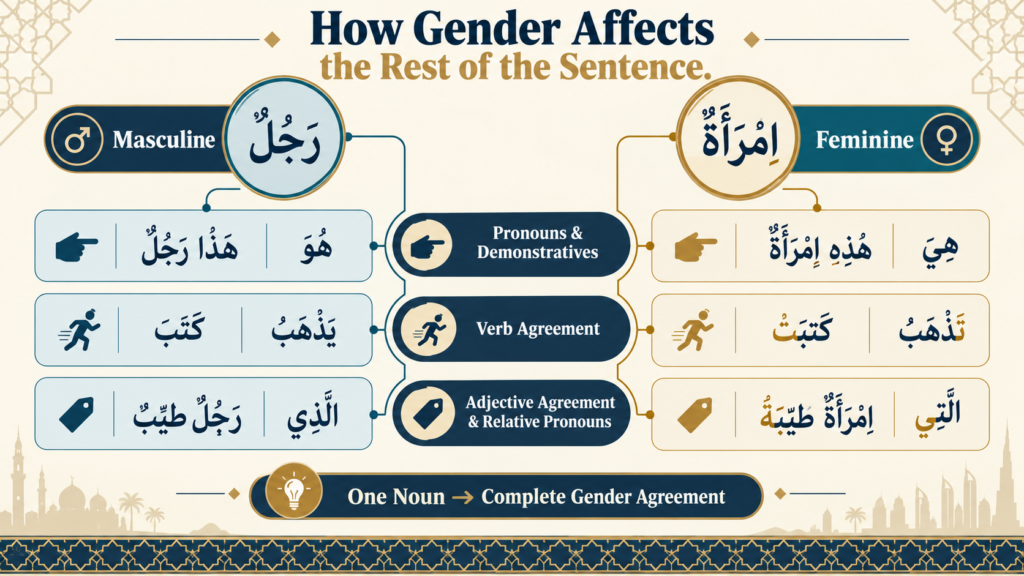
Demonstratives change with gender: hatha (هذا, “this”) points to masculine nouns, hathihi (هذه, “this”) to feminine ones, hatha rajul (“this is a man”) versus hathihi imra’a (“this is a woman”). Personal pronouns follow the same split: huwa (هو) for masculine, hiya (هي) for feminine.
7. Applying Verb Agreement Across Tenses
Verbs shift to match a feminine subject, most visibly in the past tense, where a ta suffix is added: kataba (كتب, “he wrote”) becomes katabat (كتبت, “she wrote”).
The same logic extends to the present tense (yadhhabu / tadhhabu, “he goes” / “she goes”) and the imperative (idhhab / idhhabi, “go,” addressed to a man / a woman).
See Our Classroom Environment in Action
Experience a sneak peek into our live sessions. Watch the video below to see our specialized instructors interacting with students, breaking down complex texts, and cultivating an engaging, respectful learning environment.
Master Arabic in the UAE
Experience world-class Arabic language training designed for students and professionals in the Emirates.
Book Your Free Trial8. Matching Adjectives and Predicates with Noun Gender
When forming complete sentences with masculine and feminine nouns in Arabic, adjectives must take the gender of the noun they describe, not the gender of the speaker or listener: rajul tayyib (رجل طيب, “a good man”) versus imra’a tayyiba (امرأة طيبة, “a good woman”).
Relative pronouns follow suit too — alladhi (الذي) for masculine antecedents, allati (التي) for feminine ones.
Read also: The 10 Most Used Sentences In Arabic – Easy Expressions You Need To Know
Common Mistakes Non-Native Speakers Make
A few gender errors appear repeatedly among learners when studying masculine and feminine nouns in Arabic. If you are learning Arabic grammar, you should take care of these frequent mistakes first, before they stick and need a lot of correction later:
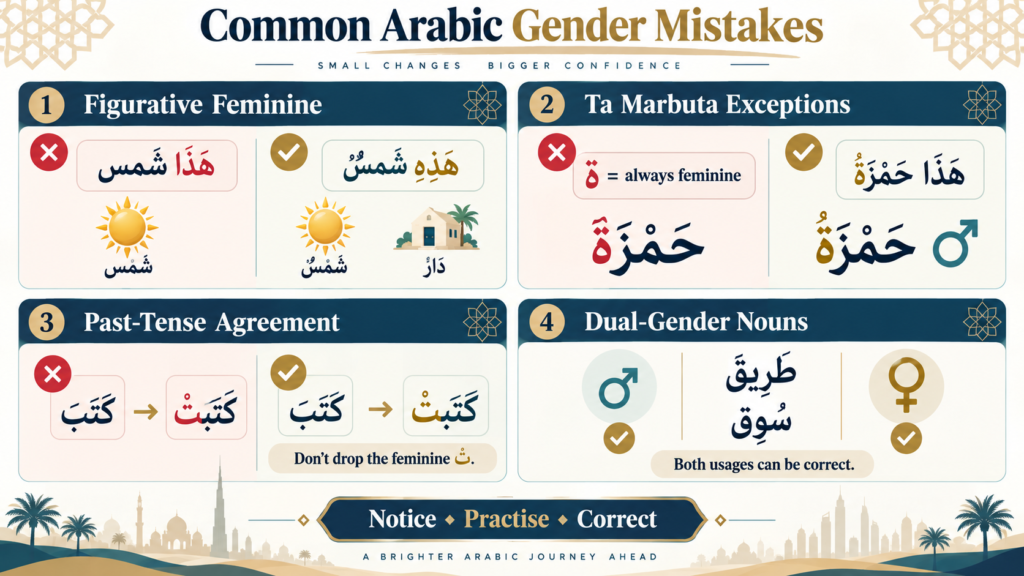
1. Treating Figurative Feminine Nouns As Masculine
This frequent error happens when a non-native speaker treats figurative feminine nouns as masculine, because there’s no obvious “female” meaning; shams (sun) and dar (house) are two of the most common ones missed.
2. Assuming Ta Marbuta ة Always Wins
This recurrent mistake appears when a beginner learner thinks that ta marbuta ة always refers to feminine nouns, overriding known real-masculine exceptions like Hamza.
3. Forgetting Verb Agreement In The Past Tense
This recurrent mistake appears among new Arabic learners and non-native speakers, especially the ta suffix, since it’s easy to hear but easy to drop when speaking quickly.
4. Over-Correcting Dual-Gender Nouns
This happens among non-natives when they mistake words like tareeq (road) or souq (market), assuming one form must be wrong when both are standard usage.
None of these are signs you’re bad at Arabic. They’re the exact points where the language departs from patterns most European or East Asian languages follow, which is why they take deliberate practice rather than passive exposure to fix.
Start Speaking With Confidence Today
Reading the rules is one thing; using them without hesitating mid-sentence is another. Learn Arabic UAE’s tutors correct gender agreement in real time, inside real conversation, so the rule becomes a habit instead of a fact you memorized once and forgot.
Book a session and start applying masculine and feminine agreement the way native speakers actually use it, in speech, not just on paper.
If you would like to use Arabic gender rules more naturally, begin with a lesson suited to your level. Supportive, guided practice can help you speak with greater accuracy and confidence, one sentence at a time.
Our Arabic courses
- Business Arabic Course UAE
- Arabic Language Classes for Professionals in UAE
- Arabic Course for Kids
- Arabic Conversation Course for Kids
- Arabic Qaida Course for Kids
- Beginner Arabic Course for Kids
- Arabic Grammar Course for Kids

Master Arabic in the UAE
Experience world-class Arabic language training designed for students and professionals in the Emirates.
Book Your Free TrialConclusion
Masculine and feminine nouns in Arabic follow a logic once you separate the default (masculine) from the marked (feminine) category, and once you learn the three markers, ta marbuta, alif maqsura, and alif mamduda, that flag most feminine words.
The exceptions, real masculine nouns that look feminine, and the small set of dual-gender nouns, are worth memorizing precisely because they’re exceptions, not because the whole system is unpredictable.
Gender agreement is not decoration in Arabic; it’s structural. It decides which demonstrative you use, which verb ending applies, and which adjective form is correct. Mastering masculine and feminine nouns in Arabic early means every sentence after that gets easier to build correctly, rather than harder to unlearn later.
Frequently Asked Questions
Does Arabic Have Gendered Nouns?
Yes, every noun in Arabic is either masculine or feminine. There is no neutral gender. This affects the pronouns, verbs, and adjectives used with that noun throughout a sentence, which is different from languages like English where only pronouns carry gender.
What Is The Default Gender Of Nouns In Arabic?
Masculine is the default gender in Arabic. A noun is only marked feminine when it specifically needs to be, usually through a written ending like ta marbuta, alif maqsura, or alif mamduda.
How Do You Know If An Arabic Noun Is Feminine?
Most feminine nouns end in one of three markers: ta marbuta (ة), alif maqsura (ى), or alif mamduda (اء). Some feminine nouns carry no marker at all, like umm (mother) or shams (sun), so the marker rule works most of the time but not universally.
Are There Arabic Nouns That Can Be Both Masculine And Feminine?
Yes, a small set of nouns take either gender correctly, including tariq (road), sabil (path), ‘unuq (neck), sikkin (knife), souq (market), and ruh (soul). Both agreements are considered standard usage for these words.
Why Is A Name Like Hamza Masculine If It Ends In A Feminine Letter?
Hamza is a real masculine noun. It refers to a male person, so it keeps masculine grammatical treatment regardless of its spelling. Real gender, based on what the word refers to, overrides the written feminine marker in these specific cases.
Do Arabic Adjectives Change Based On Noun Gender?
Yes, adjectives must match the gender of the noun they describe. A good man is rajul tayyib, while a good woman is imra’a tayyiba. The adjective’s ending shifts to agree with the noun, not with the speaker or the listener.




[…] Read also: Masculine And Feminine Nouns In Arabic […]