 Quran
Quran
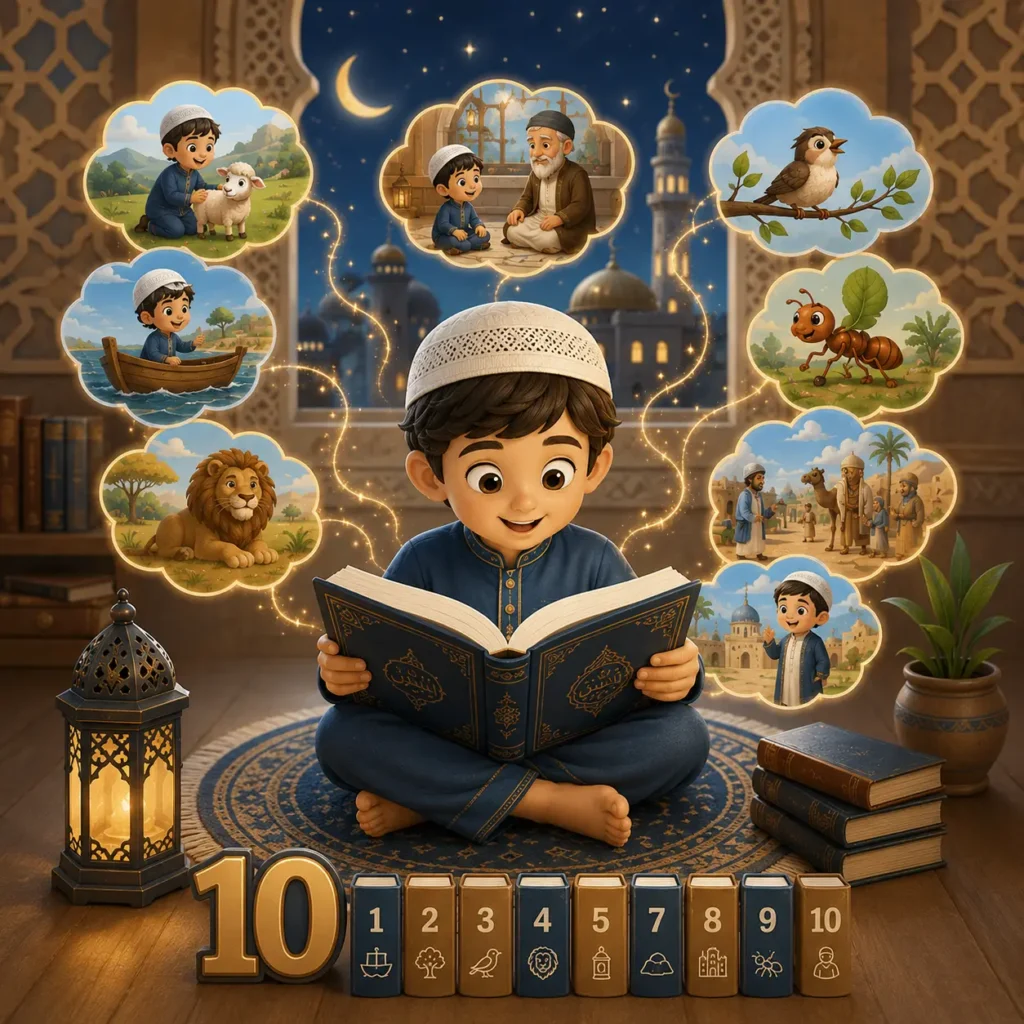
Children don’t learn languages through drills — they learn through stories. A well-chosen Arabic story can teach your child new vocabulary, cultural values, and even script recognition without them realising they’re studying at all. The right story meets them where they are: simple sentences, familiar emotions, and a satisfying ending they’ll want to hear again.
This guide brings together ten of the most effective easy Arabic stories for kids, each chosen because it works both as a language tool and as a genuinely engaging tale. Whether you’re a parent in the UAE raising bilingual children, or a teacher looking for reading material that doesn’t feel like homework, these stories deliver.
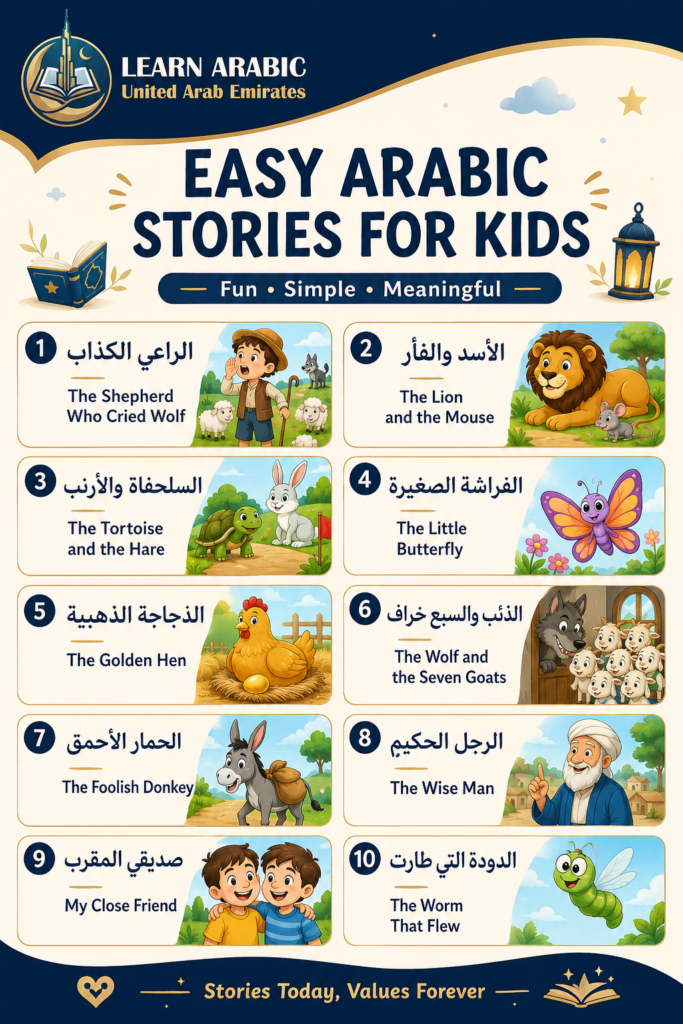
1. الراعي الكذاب — The Shepherd Who Cried Wolf, The Most Interesting Easy Arabic Story For Kids
A young shepherd, bored in the fields, shouts that a wolf is attacking his flock. The villagers run to help — and find him laughing. He repeats the trick until the day a real wolf arrives. Nobody comes.
This story has survived across cultures for centuries because its message is both simple and unforgettable. In Arabic, it introduces essential vocabulary around village life, animals, and basic emotions: الذئب (wolf), القرية (village), الكذب (lying), and الأغنام (sheep).
The short dialogue sections are perfect for read-aloud practice, since children quickly learn what each character will say next and begin anticipating the Arabic words. The understood lesson is الصدق (honesty) is not optional — it protects you when it matters most.
Start reading and writing Arabic with a FREE trial class

2. الأسد والفأر — The Lion and the Mouse
A small mouse wakes a sleeping lion and begs for its life. The lion, amused, lets it go. Later, the lion is caught in a hunter’s net — and it is the tiny mouse who chews through the ropes to free him.
This is arguably the most universally known fable, and its Arabic version remains one of the clearest entry points for new learners. The vocabulary is concrete: أسد (lion), فأر (mouse), شبكة (net), حرية (freedom). The sentence structures are short and active.
Children who hear this story often begin picking up the phrase لكلٍّ منّا عازته (we all need each other) before they’ve consciously learned it. The core lesson of this story is that size does not determine value. Small acts of kindness return in unexpected ways, and it is among the favorite stories for kids aged 3 to 7 years.
3. السلحفاة والأرنب — The Tortoise and the Hare
The overconfident hare races the slow tortoise, stops to rest mid-course, and wakes up to find the tortoise has already crossed the finish line.
In Arabic storytelling traditions, this fable is retold with particular emphasis on مثابرة (perseverance) and التواضع (humility) — two values that appear repeatedly in Arabic literature for children.
The vocabulary of movement and competition makes this story especially useful: يركض (to run), يتوقف (to stop), يفوز (to win), يخسر (to lose). Children naturally predict what will happen, which keeps them engaged even when they don’t catch every word.
This story is suitable for children from age 4 to 8 years old, and teaches them that steady effort and perseverance lead to success, while arrogance can waste natural talent.
Start you journey of Mastering Arabic Writing in the UAE with a Free Trial Class

4. الفراشة الصغيرة — The Little Butterfly
A curious little butterfly ignores her mother’s warnings and flies far from the garden. She encounters danger and, with help, finds her way home — wiser and more grateful.
What makes this story particularly useful for Arabic language learning is its focus on nature vocabulary: حديقة (garden), زهور (flowers), سماء (sky), خطر (danger).
The emotional arc is simple enough for very young children to follow even with limited comprehension, while the dialogue between mother and butterfly introduces polite Arabic phrasing that young learners can begin using themselves.
Parents who want to extend learning beyond stories might find it useful to explore how to introduce yourself in Arabic alongside character dialogues, since many of the same sentence patterns appear in both contexts. Also, this story serves kids from age 3 to 6 years old to learn listening to those who care for you keeps you safe.
5. الدجاجة الذهبية — The Golden Hen
A farmer owns a hen that lays one golden egg each day. Impatient for more, he decides to cut her open to take all the eggs at once — and loses everything.
This story introduces the concept of الطمع (greed) through concrete, visual storytelling that children find instantly engaging. The vocabulary of farm life — مزرعة (farm), بيضة (egg), ذهب (gold), صبر (patience) — is practical and widely reused across Arabic stories.
The pacing is excellent for read-aloud sessions: short scenes, clear turning points, and a sharp, memorable ending. The lesson of this story to children aged 5 to 9 years is to know that impatience and greed destroy what patience would have multiplied.
Meet our Azhari-trained instructors

6. الذئب والسبع خراف — The Wolf and the Seven Goats
A mother goat warns her seven kids before leaving home: do not open the door to strangers. A cunning wolf disguises his voice and paws to trick them inside.
The repetitive structure of this story — the wolf tries, fails, tries differently — makes it ideal for early Arabic learners because the same vocabulary recurs in slightly different contexts each time.
Children learn صوت (voice), باب (door), غريب (stranger), and خطر (danger) without the words feeling drilled. The story also opens natural conversations about family safety in Arabic thus is interesting to children from age 4 to 7 years.
The story teaches children that caution keeps them safe and that they should listen carefully before trusting others.
7. الحمار الأحمق — The Foolish Donkey
A salt merchant’s donkey discovers that falling into a river lightens his load as the salt dissolves. He begins doing it intentionally — until the merchant replaces the salt with cotton, which absorbs the water and becomes unbearably heavy.
This story is a favourite in Arabic-speaking households because it blends gentle humour with a clear moral. Vocabulary around trade and weight — ملح (salt), قطن (cotton), ثقيل (heavy), خفيف (light) — gives children practical, everyday language. The structure also teaches cause-and-effect reasoning in Arabic, which supports comprehension skills well beyond storytelling.
It teaches the children that shortcuts that seem smart often lead to consequences you didn’t plan for, and so suitable for children aged 5 – 9 years.
Step Inside Our Classrooms
Don’t just take our word for it—see our community in action. Click below to watch real, live snippets from our recent classes and experience our engaging teaching style firsthand!
Master Arabic in the UAE
Experience world-class Arabic language training designed for students and professionals in the Emirates.
Book Your Free Trial8. الرجل الحكيم — The Wise Man
Villagers come to a wise man to complain about the same problems, over and over. One day, he tells them a joke. They laugh loudly. He repeats it — smiles. He repeats it again — silence. Then he says: “You cannot laugh at the same joke twice, yet you cry over the same problems endlessly.”
This story works beautifully for slightly older children because it introduces abstract thinking in Arabic. Words like حكمة (wisdom), مشكلة (problem), ابتسامة (smile), and تكرار (repetition) appear in context that makes their meaning instantly clear. The story also models conversational Arabic at a rhythm children can follow and imitate.
For children building vocabulary beyond stories, exploring education vocabulary in Arabic is a natural next step — many of the abstract words in this tale, like تعلّم (to learn) and فهم (to understand), appear frequently in classroom language. This story is designed for elementary- to intermediate-level children.
Read also: How to Write Arabic Letters in Calligraphy?
9. صديقي المقرب — My Close Friend
Two friends cross a desert together. One slaps the other during an argument. The hurt friend writes about the incident in the sand. Later, the same friend saves him from sinking in quicksand.
He carves this into a rock. When asked why — sand for the bad, stone for the good — he explains that forgiveness should travel with the wind, while gratitude should be permanent.
This story is a masterclass in Arabic metaphor at a level children can grasp. It introduces صداقة (friendship), مغفرة (forgiveness), امتنان (gratitude), رمل (sand), and صخرة (rock) in a way that makes these abstract concepts tangible. The image of writing in sand versus carving in stone is one children remember for years.
10. الدودة التي طارت — The Worm That Flew
A small worm named Dodo dreams of flying, believing she is useless because she only crawls and digs in the soil. A wise old tree reveals that the worm’s daily burrowing brings air to the roots and keeps the tree alive. With the tree’s help, Dodo climbs to the highest branch and feels the wind — and discovers that she was flying all along, in her own way.
This story, originally from إشراقة Academy’s original content, stands apart from the classic fables because it directly addresses self-worth and hidden contribution. Vocabulary includes تربة (soil), جذور (roots), هواء (air), حلم (dream), and أجنحة (wings). The emotional arc is gentle enough for very young children and rich enough to prompt genuine discussion.
What makes it especially effective for language learning is that Dodo’s problem — not seeing her own value — is one children recognise immediately, which keeps them emotionally invested while the Arabic washes over them.
Book a Free Trial Lesson in for you Child in our Reading Quran Course

Tips For Using Arabic Stories With Young Learners
Reading the story is only the first step. The real language acquisition happens in the ten minutes after.
A. Before Reading The Story: Introduce To Kid Key Vocabulary
A small amount of preparation helps children follow the story more confidently. Familiar words also reduce frustration and increase engagement from the beginning.
Preview three to five key Arabic words with a simple picture or gesture. Don’t pre-translate the whole story — just plant anchors.
B. During Reading The Story: Encourage Your Child’s Active Listening
Children learn more when they actively participate rather than simply listen. Brief pauses create opportunities for comprehension and interaction.
Slow down at key vocabulary moments. Pause after dialogue and ask in simple Arabic: ماذا قال؟ (What did he say?)
C. After Reading: Reinforce Understanding Of Your Child Through Retelling
Retelling helps children organize what they have understood from the story. It also strengthens memory and encourages language production.
Ask your child to retell the story in any language. The act of reconstruction, even in English, deepens Arabic vocabulary retention.
D. Choose Stories Just Above Your Child’s Current Level
The most effective stories provide a manageable challenge without overwhelming the learner. Children progress faster when they can understand most of the content while still encountering new language.
Research into language acquisition consistently shows that comprehensible input at +1 (slightly above the learner’s current level) produces faster gains than stories that are completely comfortable.
Read Also: Daily Routine In Arabic For Kids
See Our Classroom Environment in Action
Experience a sneak peek into our live sessions. Watch the video below to see our specialized instructors interacting with students, breakdown complex texts, and cultivate an engaging, respectful learning environment.
Master Arabic in the UAE
Experience world-class Arabic language training designed for students and professionals in the Emirates.
Book Your Free TrialHow Learn Arabic UAE Helps Children Go Further
Stories build love for a language. Structured learning builds fluency.
At Learn Arabic UAE, children and adults move from enjoying Arabic stories to using the language confidently in real situations. Courses are tailored to where each learner is — whether that’s recognising letters for the first time or building conversational skills for everyday life in the Emirates.
Check out our top Arabic courses for UAE residents:
- Arabic Course in the UAE
- Arabic Classes for Beginners — Learn Arabic from Scratch
- Arabic Classes for Adults
- Quranic Arabic Course
- Emirati Arabic Course
- Gulf Arabic Course
- Business Arabic Course UAE
- Arabic Grammar Course
- Learn Arabic Alphabet Course
- Modern Standard Arabic (MSA) Course
- Self-Paced Arabic Course
Learners at Learn Arabic UAE regularly report that combining structured lessons with Arabic storytelling at home accelerates their progress significantly — the stories reinforce what classes teach, and the classes give the stories deeper meaning.
Families exploring the Quran together will also find that building learn Quranic vocabulary alongside classic Arabic stories creates a natural bridge between everyday Arabic and the language of Islamic texts.
Book your free trial session today

Conclusion
Easy Arabic stories for kids are one of the most underused tools in language education. The ten stories above — from the cunning wolf to the worm who wanted to fly — each carry Arabic vocabulary and cultural wisdom that children absorb naturally, without the resistance that formal study sometimes triggers.
Stories like الأسد والفأر (The Lion and the Mouse) and صديقي المقرب (My Close Friend) do something that flashcards cannot: they make children care. And when a child cares about what happens next, they pay closer attention to the language carrying the story forward.
Use these stories as a starting point. Layer in the vocabulary tips. And when your child is ready to move beyond storytime, structured Arabic courses — built around real life in the UAE — are waiting to take them further.
Frequently Asked Questions
What age is appropriate for easy Arabic stories for kids?
Most easy Arabic stories work well from age three onwards, with stories like The Lion and the Mouse and The Little Butterfly suited to ages three to six, and tales like The Wise Man and My Close Friend engaging children from seven to eleven.
Can Arabic stories help children learn the Arabic script?
Yes, particularly when paired with read-aloud sessions where an adult points to the text while reading. Seeing Arabic words in context — especially high-frequency words that recur across multiple stories — builds pattern recognition that accelerates script learning.
How many new Arabic words should a child encounter per story session?
Language acquisition research suggests that encountering five to ten new words per session — in context, not as a list — produces the most sustainable retention. The stories in this guide are chosen partly because they deliver new vocabulary naturally through repetition and context rather than requiring pre-study.
Are classical fables better than original Arabic stories for kids?
Both serve different purposes. Classical fables like الأسد والفأر carry universal themes and are supported by a vast range of illustrated editions. Original stories — like الدودة التي طارت from إشراقة Academy — often reflect more contemporary values around self-worth and collaboration. A healthy reading diet includes both.
How do I find more easy Arabic stories for kids online?
Digital libraries offer graded Arabic stories sorted by difficulty and age range. YouTube channels such as زاد الحروف provide audio read-alouds with voice modulation that helps children follow along.
For children in the UAE specifically, combining these resources with learn Arabic phrases from a structured course creates a reinforced learning environment where stories and lessons support each other.
Should a child understand every word in an Arabic story to benefit from it?
No — and this is one of the most important things parents misunderstand. Comprehension at roughly 70–80% is actually ideal for language acquisition. Full comprehension means the story is too easy; zero comprehension means it’s too hard.



Leave a Reply