 Quran
Arabic broken plurals (جمع التكسير) confuse almost every student when they first encounter them. When you think you’ve learned the plural rule- add a letter here, add ون or ات there- you run into كتاب becoming كُتُب, or رجل becoming رجال, with no obvious pattern in sight.
This article breaks down exactly what Arabic broken plurals are. It also shows why Arabic grammar treats them differently, and how to recognize and use them correctly.
By the end of this article, you’ll be able to identify a broken plural on sight. In addition, you will be able to understand its two main categories and read real Quranic examples with confidence.
The Definition Of Arabic Broken Plurals
An Arabic broken plural is a plural formed by changing the internal structure of the singular word. The letters, vowels, or both change, instead of simply attaching a suffix to them.
Words like رجل (man) becoming رجال (men), كرسي (chair) becoming كراسي (chairs), and قلم (pen) becoming أقلام (pens) are all broken plurals. The singular form is reshaped, not extended.
This is different from how many languages handle plurals, where you typically just add an ending.
In Arabic, broken plurals are the largest and most irregular category of plurals. They cover the vast majority of everyday nouns, which is exactly why they trip up learners moving past the beginner stage.
Why Are They Called “Broken” Plurals?
Broken plurals are called جمع التكسير (jam’ al-taksir) because the process literally “breaks” the original shape of the singular word and rebuilds it.
The Arabic root ك-س-ر means “to break,” and grammarians chose this term specifically to contrast it with the two sound plurals, where the singular stays fully as it is.
For example, كتاب (book) doesn’t just gain a suffix. It’s restructured entirely into كُتُب. The internal vowels change, and sometimes letters are added or dropped. That structural change is the “break.”
Read also: The 10 Most Used Sentences In Arabic (And What They Really Mean)
How Arabic Broken Plurals Differ From Sound Plurals
Arabic has three plural categories: sound masculine plural (جمع المذكر السالم), sound feminine plural (جمع المؤنث السالم), and broken plural (جمع التكسير).
The two sound plurals keep the singular word’s structure completely intact (unbroken) and simply add a fixed ending: ون or ين for masculine, and ات for feminine, as in معلم becoming معلمون or فاضلة becoming فاضلات.
Broken plurals follow no single suffix rule at all. But as you’ll learn, each singular noun is reshaped according to one of roughly two dozen recognized patterns. The pattern that applies depends on the noun’s own structure, number of letters, vowel pattern, and sometimes just how native speakers have always said it.
This is the single biggest adjustment learners have to make. Sound plurals are memorized as a rule; broken plurals are memorized word by word and pattern by pattern.
A quick way to tell them apart when reading: if a plural ends in a fixed ون / ين / ات and the rest of the word looks like the singular, it’s sound. If the internal shape of the word looks different from its singular, with extra letters, missing letters, or different vowels, then you’re looking at a broken plural.
At Learn Arabic UAE, this exact distinction is one of the first things we drill in our grammar-focused Arabic courses, because students who don’t lock it in early tend to guess plurals randomly for years afterward.
Read also: Does Arabic Have Grammatical Gender?
Step Inside Our Classrooms
Don’t just take our word for it—see our community in action. Click below to watch real, live snippets from our recent classes and experience our engaging teaching style firsthand!
Master Arabic in the UAE
Experience world-class Arabic language training designed for students and professionals in the Emirates.
Book Your Free TrialThe Two Categories Of Arabic Broken Plurals
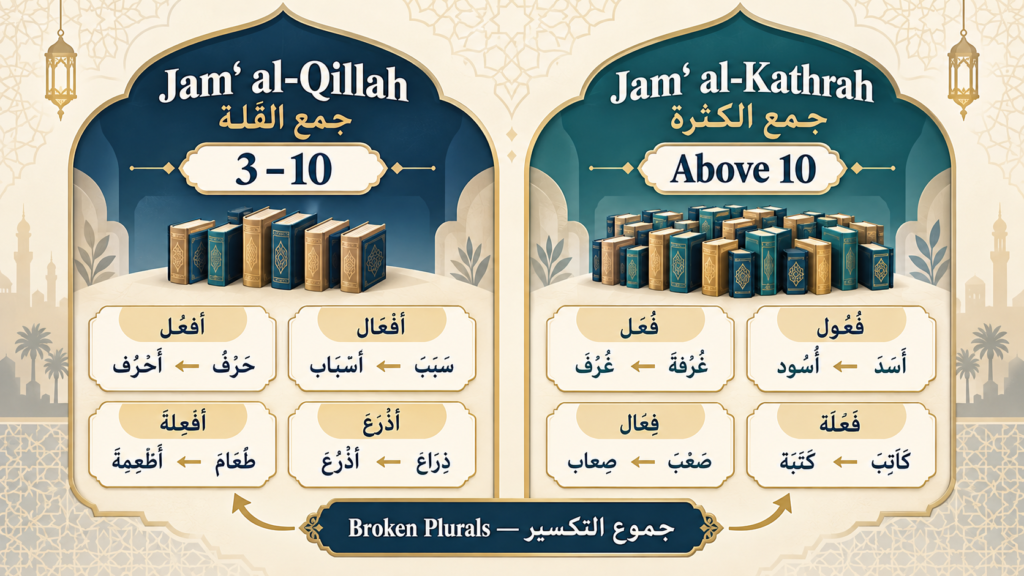
Classical Arabic grammar divides broken plurals into two functional categories based on the quantity they represent, not just their shape. Recognizing which category a plural belongs to helps you predict its pattern and understand classical texts more accurately.
1. Jam’ Al-Qillah (Plural Of Paucity)
Jam’ al-qillah جمع القِلة is the plural used for quantities from three to ten. It typically follows one of four recognized patterns: أفْعُلْ (حرف → أحرف), أفْعُلٌ (ذراع → أذرُع), أفْعَال (سبب → أسباب), and أفْعِلَة (طعام → أطعمة).
These four patterns are considered the “core” paucity patterns, although a handful of words fall outside them with no fixed rule, such as شيخ becoming شِيخة.
2. Jam’ Al-Kathrah (Plural Of Abundance)
Jam’ al-kathrah جمع الكثرة covers quantities above ten and includes the majority of broken plural patterns, with over twenty distinct forms recognized by grammarians. Common examples include فُعَل (غرفة → غُرَف), فُعُول (أسد → أُسُود), فِعال (صعب → صِعاب), and فَعَلَة, used specifically for rational beings on the وزن فاعل, such as كاتب becoming كَتَبَة.
In practice, many broken plurals can be used for both large and small quantities in everyday speech, but the classical distinction still matters for anyone studying Nahw نحو and Sarf صرف (Arabic grammar and morphology) seriously, since exam questions and classical texts often assume you know which category a given plural belongs to.
Read also: Masculine And Feminine Nouns In Arabic
Common Patterns (Awzan) Of Arabic Broken Plurals
Arabic grammarians catalogued the recurring shapes, or awzan, that broken plurals fall into because there’s no single suffix rule. Recognizing a handful of the most frequent ones will let you correctly guess the plural of most new words you encounter.
High-Frequency Broken Plural Patterns
Broken plurals follow several recurring patterns that become easier to recognize through regular exposure.
Learning the most common awzan helps learners identify plural forms more quickly, make informed predictions, and understand unfamiliar vocabulary while reading or listening.
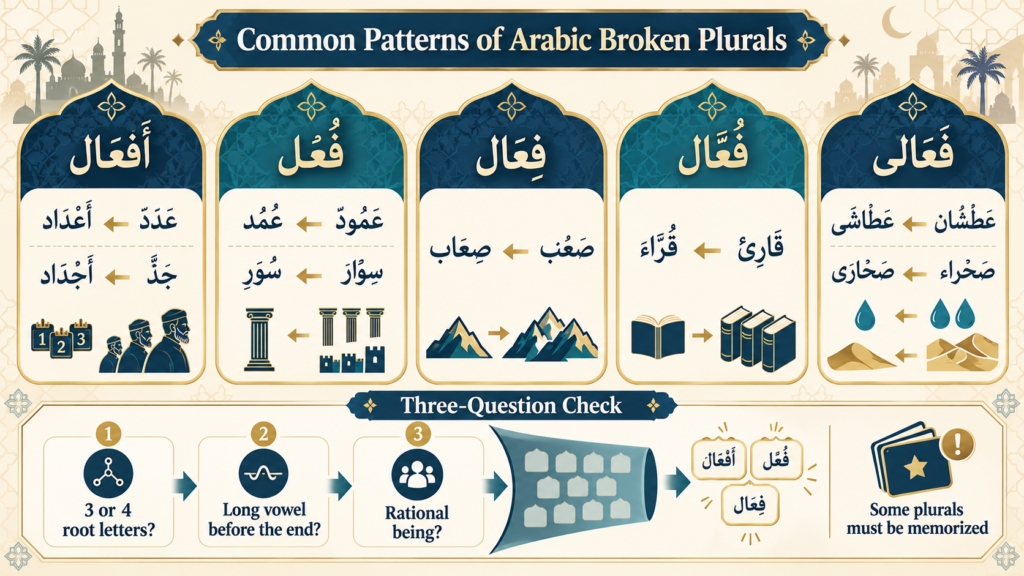
- أفْعال: عدد → أعداد, جد → أجداد
- فُعُل: عمود → عُمُد, سِوار → سُوَر
- فِعال: كتاب → كِتاب… (صعب → صِعاب)
- فُعَّال: قارئ → قُرّاء
- فَعالى: عطشان → عطاشى, صحراء → صحارى
A practical decision rule we teach at Learn Arabic UAE is the Three-Question Broken Plural Check. Ask whether the singular word is trilateral or quadrilateral, whether its final letter is preceded by a long vowel (مدّ), and whether it describes a rational being.
Answering those three questions narrows a word down to two or three likely patterns instead of twenty-seven, which is far more useful for a learner than memorizing the full list up front.
One common beginner mistake is assuming you can reverse-engineer every broken plural from the singular using a formula, the way sound plurals can. Actually, it can’t. Some patterns genuinely have to be memorized per word. Native speakers themselves learn many of them through exposure rather than rules.
Structured Arabic courses that drill vocabulary with its correct plural form from day one save students years of guessing later.
Read also: How Many Letters Are In The Arabic Alphabet?
How Are Broken Plurals Declined (I’rab)?
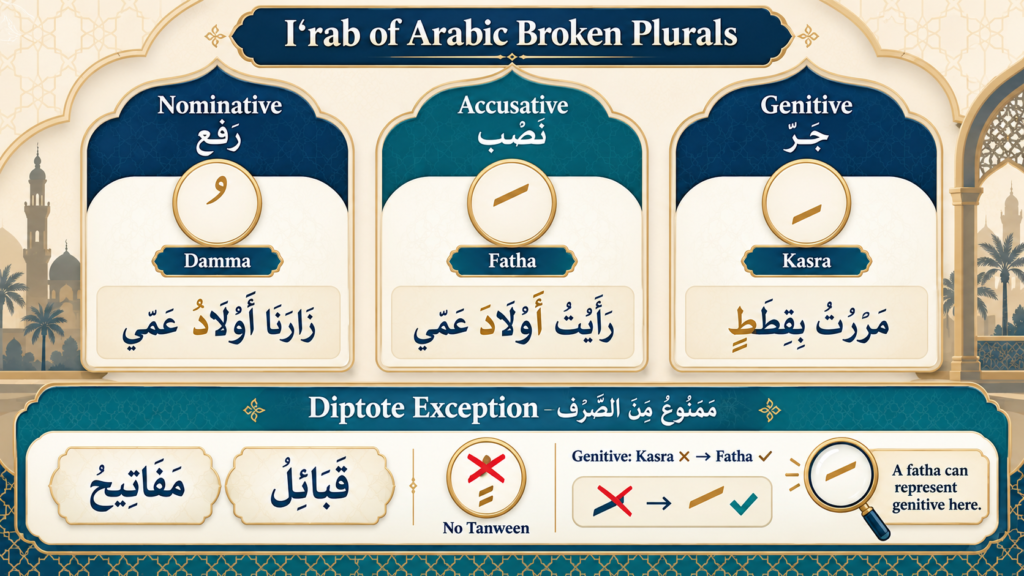
A broken plural is declined using the same original case markers as a singular noun: damma (ُ) for the nominative رفع, fatha (َ) for the accusative نصب, and kasra (ِ) for the genitive جرّ. For example, in زارنا أولادُ عمي (my uncle’s sons visited us), أولاد takes damma as the subject; in مررت بقطط (I passed by cats), قطط takes kasra after the preposition.
The one exception is a broken plural in the sighat muntaha al-jumu’ صيغة منتهى الجموع pattern, a plural ending in a long alif followed by two or three letters, such as قبائل or مفاتيح. These are mamnu’ min al-sarf ممنوع من الصرف (diptotes).
This means that they don’t take tanween, and their genitive case is marked with fatha instead of kasra. This is a detail that trips up even intermediate learners, since it looks like an accusative form but is actually a genitive one.
Broken Plurals In The Quran
Quranic Arabic offers some of the clearest, most frequently cited examples of broken plurals. The Quran has a lot of ayahs (verses) to learn this rule and master it. For example:
وَلَقَدْ أَرْسَلْنَا إِلَىٰ أُمَمٍ مِّن قَبْلِكَ فَأَخَذْنَاهُم بِالْبَأْسَاءِ وَالضَّرَّاءِ لَعَلَّهُمْ يَتَضَرَّعُونَ
“Before thee We sent (messengers) to many nations, and We afflicted the nations with suffering and adversity, that they might learn humility”.
أُمَم (nations) is the broken plural of أمة.
Here is another example:
لَهُم مِّن فَوْقِهِمْ ظُلَلٌۭ مِّنَ ٱلنَّارِ وَمِن تَحْتِهِمْ ظُلَلٌۭ ۚ ذَٰلِكَ يُخَوِّفُ ٱللَّهُ بِهِۦ عِبَادَهُۥ ۚ يَـٰعِبَادِ فَٱتَّقُونِ
They shall have Layers of Fire above them, and Layers (of Fire) below them: with this doth Allah warn off his servants: “O My Servants! then fear ye Me!”
The word ظُلَل (layers/canopies) is the broken plural of ظل.
Here is one more example:
يَسْأَلُونَكَ عَنِ الْأَهِلَّةِ ۖ قُلْ هِيَ مَوَاقِيتُ لِلنَّاسِ وَالْحَجِّ ۗ
They ask you, [O Muhammad], about the new moons. Say, “They are measurements of time for the people and for Hajj.”
The word أَهِلَّة (crescent moons), a jam’ al-qillah, is the plural of هلال, alongside مواقيت, the plural of ميقات. The importance of these examples goes beyond grammar drills. Understanding broken plurals directly improves comprehension of Quranic text, since a large share of Quranic vocabulary appears in plural rather than singular form.
Students working toward Quranic Arabic fluency, not just conversational Arabic, get real practical value from mastering this topic early rather than treating it as an abstract grammar exercise.
If you are worried about learning grammar because it feels disconnected from actually reading and understanding Arabic, this is exactly where the two connect.
Learn Arabic UAE’s Quranic Arabic and Nahw/Sarf classes build broken plural recognition directly into reading practice, so the rule and the real text reinforce each other instead of living in separate lessons.
See Our Classroom Environment in Action
Experience a sneak peek into our live sessions. Watch the video below to see our specialized instructors interacting with students, breaking down complex texts, and cultivating an engaging, respectful learning environment.
Master Arabic in the UAE
Experience world-class Arabic language training designed for students and professionals in the Emirates.
Book Your Free TrialStart Learning Arabic Grammar The Right Way
Arabic broken plurals are hard to self-teach from a list of twenty-seven patterns. They’re easy to learn with a tutor who drills the right words, in the right order, against real texts.
Book a session with Learn Arabic UAE and start building real reading fluency instead of memorizing rules you’ll forget.
If you would like clearer guidance with broken plurals, start with a lesson suited to your current level. With structured practice and supportive feedback, these patterns can gradually become easier to recognize and use with confidence.
Our Arabic courses
- Arabic Course in the UAE
- Arabic Intensive Course
- Arabic Classes for Beginners (Learn Arabic from Scratch)
- Madinah Arabic Course
- Arabic Classes for Adults
- Arabic Speaking Classes
- Arabic Grammar Course
- Business Arabic Course UAE
- Arabic Language Classes for Professionals in UAE
Conclusion
Arabic broken plurals are the plurals formed by restructuring a singular word’s internal letters or vowels, rather than adding a fixed suffix the way sound plurals do.
They split into jam’ al-qillah for quantities of three to ten and jam’ al-kathrah for quantities above ten. They also follow roughly two dozen recognized patterns rather than one universal rule.
When you can spot the pattern family a word belongs to, and you can remember the diptote exception for sighat muntaha al-jumu’, you’ll find that reading real Arabic text, including the Quran, becomes noticeably easier. Mastering broken plurals isn’t a minor detail in Arabic grammar. It’s one of the main gates to fluent reading.
Frequently Asked Questions
What Is A Broken Plural In Arabic?
A broken plural is an Arabic plural formed by changing the internal structure of the singular noun, its letters, its vowels, or both, instead of adding a fixed ending. Examples include رجل becoming رجال and كتاب becoming كُتُب.
Why Is It Called “Broken” Plural?
It’s called broken (جمع التكسير) because the process breaks and reshapes the original structure of the singular word, unlike sound plurals, which keep the singular fully intact and simply add ون, ين, or ات.
What’s The Difference Between Jam’ Al-Qillah And Jam’ Al-Kathrah?
Jam’ al-qillah refers to broken plurals used for quantities from three to ten and follows four main patterns. Jam’ al-kathrah refers to plurals used for quantities above ten and includes over twenty recognized patterns.
How Is A Broken Plural Declined In A Sentence?
Most broken plurals are declined with the original case markers: damma for nominative, fatha for accusative, kasra for genitive, exactly like a singular noun. The exception is the sighat muntaha al-jumu’ pattern, which is a diptote and takes fatha in the genitive instead of kasra.
Are Broken Plurals Used In The Quran?
Yes, broken plurals appear frequently in the Quran. Examples include أُمَم (nations, plural of أمة) in Surah Al-An’am 6:42, and أَهِلَّة (crescent moons, plural of هلال) in Surah Al-Baqarah 2:189.




Leave a Reply