 Learn Arabic
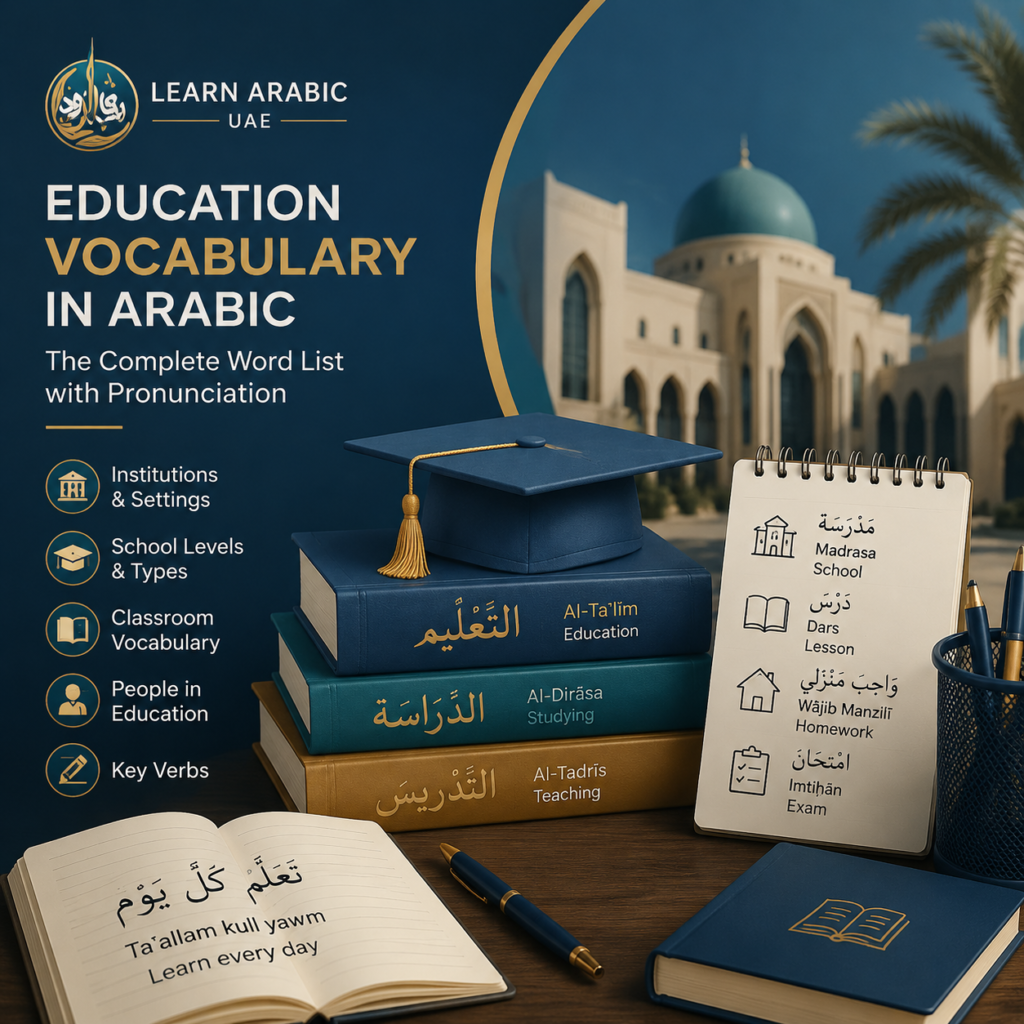
If you’ve ever sat in an Arabic class and realized you don’t even know the word for “homework” or “teacher,” you’re not alone. Education vocabulary in Arabic is one of the most practical sets of words you can learn — and one of the most overlooked. Whether you’re studying Arabic yourself, supporting a child through an Arabic-medium school, or preparing for a university environment in the Arab world, mastering this vocabulary opens doors that grammar drills alone never will.
This guide gives you every word you need — organized by category, with Arabic script, transliteration, and English meaning — plus the key verbs that make these nouns come alive in real conversation.
What You’ll Learn in This Article
- The Arabic words for schools, universities, and educational institutions
- Academic stages from kindergarten through postgraduate study
- Classroom vocabulary: lessons, exams, schedules, and supplies
- Key people in the education system — from students to professors
- Essential education verbs: teach, study, graduate, pass, fail
- How to start using this vocabulary in real Arabic sentences
Education Vocabulary in Arabic: Institutions and Settings
Before you can talk about what happens inside a school, you need to know what to call the building. Arabic has distinct words for each type of educational institution, and using the right one signals that you genuinely know the language.
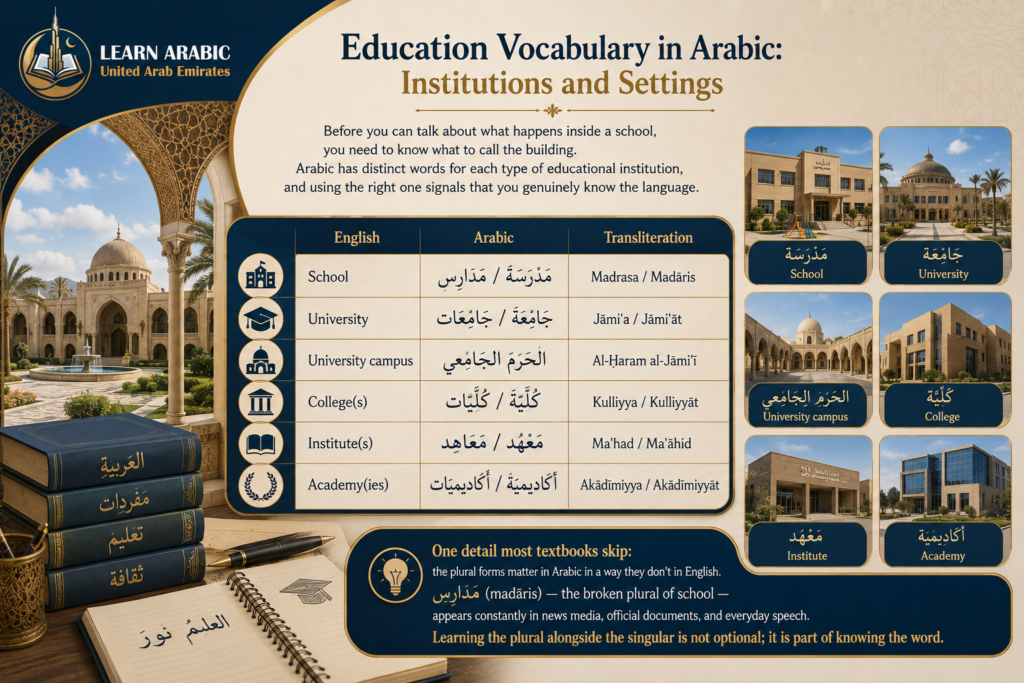
Here are the core institution words you’ll encounter in formal and everyday Arabic:
| English | Arabic | Transliteration |
| School | مَدْرَسَة / مَدَارِس | Madrasa / Madāris |
| University | جَامِعَة / جَامِعَات | Jāmi’a / Jāmi’āt |
| University campus | الحَرَم الجامِعي | Al-Ḥaram al-Jāmi’ī |
| College(s) | كُلِّيّة / كُلِّيّات | Kulliyya / Kulliyyāt |
| Institute(s) | مَعْهَد / مَعَاهِد | Ma’had / Ma’āhid |
| Academy(ies) | أكاديمية / أكاديميات | Akādīmiyya / Akādīmiyyāt |
One detail most textbooks skip: the plural forms matter in Arabic in a way they don’t in English.
مَدَارِس (madāris) — the broken plural of school — appears constantly in news media, official documents, and everyday speech. Learning the plural alongside the singular is not optional; it is part of knowing the word.
Arabic Words for School Levels and Types
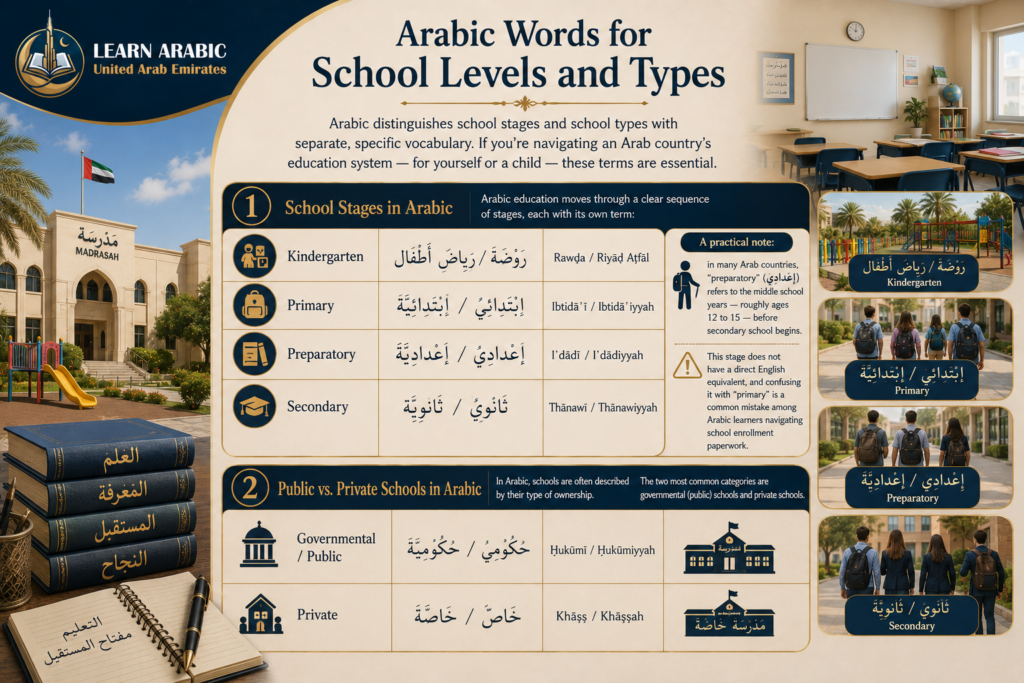
Arabic distinguishes school stages and school types with separate, specific vocabulary. If you’re navigating an Arab country’s education system — for yourself or a child — these terms are essential.
1. School Stages in Arabic
Arabic education moves through a clear sequence of stages, each with its own term:
- Kindergarten — رَوْضَة / رِياض أَطْفال — Rawḍa / Riyāḍ Aṭfāl
- Primary — اِبْتِدائِي / اِبْتِدائِيَّة — Ibtidāʾī / Ibtidāʾiyyah
- Preparatory — إِعْدادِي / إِعْدادِيَّة — Iʿdādī / Iʿdādiyyah
- Secondary — ثانَوِي / ثانَوِيَّة — Thānawī / Thānawiyyah
A practical note: in many Arab countries, “preparatory” (إعدادي) refers to the middle school years — roughly ages 12 to 15 — before secondary school begins. This stage does not have a direct English equivalent, and confusing it with “primary” is a common mistake among Arabic learners navigating school enrollment paperwork.
2. Public vs. Private Schools in Arabic
In Arabic, schools are often described by their type of ownership. The two most common categories are governmental (public) schools and private schools. Learning these adjectives will help you talk about schools, education, and everyday conversations.
- Governmental / Public — حُكُومِي / حُكُومِيَّة — Ḥukūmī / Ḥukūmiyyah
- Private — خَاصّ / خَاصَّة — Khāṣṣ / Khāṣṣah
Core Education Vocabulary in Arabic: Concepts and Processes
This is the vocabulary that describes what education is — the concepts you’ll hear in classrooms, read in academic policy documents, and use when discussing learning in formal Arabic contexts.
The distinction between التَّعَلُّم (learning) and التَّدْريس (teaching) is more than semantic: Arabic grammar encodes the distinction between who is receiving knowledge and who is transmitting it into the verb structure itself. Understanding both terms helps you follow any academic discussion.
| English | Arabic | Transliteration |
| Education | التَّعْليم | Al-Ta’līm |
| Formal education | التعليم النظامي | Al-Ta’līm al-Niẓāmī |
| Informal education | التعليم غير الرسمي | Al-Ta’līm Ghayr al-Rasmī |
| Learning | التَّعَلُّم | Al-Ta’allum |
| E-learning | التَّعَلُّم الإلكتروني | Al-Ta’allum al-Iliktrūnī |
| Studying | الدِّراسة | Al-Dirāsa |
| Distance learning | الدِّراسة عن بُعد | Al-Dirāsa ‘an Bu’d |
| Teaching | التَّدْريس | Al-Tadrīs |
| Attendance | الحُضُور | Al-Ḥuḍūr |
| Application form | استمارة تقديم | Istimārat Taqdīm |
| Registration | التَّسْجيل | Al-Tasjīl |
| Graduation | التَّخَرُّج | Al-Takharruī |
If you’re planning to study in an Arabic-medium environment, the self-paced Arabic courses at Learn Arabic UAE are designed to help you build exactly this kind of academic and formal vocabulary at your own pace — without time pressure.
Join Our Self-Paced Arabic Classes in the UAE with a FREE Trial

Step Inside Our Classrooms
Don’t just take our word for it—see our community in action. Click below to watch real, live snippets from our recent classes and experience our engaging teaching style firsthand!
Master Arabic in the UAE
Experience world-class Arabic language training designed for students and professionals in the Emirates.
Book Your Free TrialClassroom and Academic Vocabulary in Arabic
This category covers the everyday language of academic life — what you talk about when you talk about studying.
1. General Classroom Terms
Whether you’re talking about school, university, or an Arabic language course, these classroom terms are among the most useful words you’ll hear every day. Learning them will help you understand teachers, follow lessons, and discuss your studies with confidence.
| English | Arabic | Transliteration |
| Degree / mark | دَرَجَة / دَرَجات | Daraja / Darajāt |
| Stage / grade | مَرْحَلَة / مَراحِل | Marḥala / Marāḥil |
| Lesson / class | دَرْس / دُرُوس | Dars / Durūs |
| Class(es) | حِصَّة / حِصَص | Ḥiṣṣa / Ḥiṣaṣ |
| Lecture(s) | مُحاضَرة / مُحاضرات | Muḥāḍara / Muḥāḍarāt |
| Schedule / timetable | جَدْوَل / جَداوِل | Jadwal / Jadāwil |
| Subject(s) | مادَّة / مَواد | Mādda / Mawādd |
| Classroom / semester | فَصْل / فُصُول | Faṣl / Fuṣūl |
| Homework | واجِب مَنْزلي | Wājib Manzilī |
| Research(es) | بَحْث / بُحوث | Baḥth / Buḥūth |
| Curriculum(s) | مَنْهَج / مَنَاهِج | Manhaj / Manāhij |
| Syllabus(es) | مُقَرَّر / مُقَرَّرات | Muqarrar / Muqarrарāt |
| School uniform | زِيّ مَدْرَسي | Ziyy Madrasī |
| School supplies | الأدوات المدرسية | Al-Adawāt al-Madrasiyya |
| Fees | رُسوم | Rusūm |
2. Qualifications and Academic Levels
One area where Arabic learners frequently get confused is the vocabulary around qualifications. Arabic uses borrowed terms for some degrees (ماجستير, دكتوراة) alongside original Arabic words for others (بكالوريوس comes from the Latin baccalaureus but is fully naturalized in Arabic). Knowing them all prepares you for any academic context.
| English | Arabic | Transliteration |
| Qualification(s) | مُؤَهّل / مُؤهّلات | Mu’ahhal / Mu’ahhалāt |
| Certification(s) | شهادة / شهادات | Shahāda / Shahādāt |
| Post-graduate studies | دِراسات عُلْيا | Dirāsāt ‘Ulyā |
| Diploma | دِبلومة | Diblōma |
| Bachelor | بكالوريوس | Bakkālūriyyūs |
| Master | ماجِسْتير | Mājistīr |
| PhD | دُكْتوراة | Duktūrāh |
| Thesis | أُطْروحة | Uṭrūḥa |
3. Exams and Results
Talking about exams, grades, and academic achievements is an important part of school and university life. The following vocabulary will help you discuss tests, results, and educational opportunities in Arabic.
- Exam(s) — اِمْتِحان / اِمْتِحانات — Imtiḥān / Imtiḥānāt
- Test(s) — اِخْتِبار / اِخْتِبارات — Ikhtibār / Ikhtibārāt
- Result(s) — نَتيجَة / نَتائِج — Natījah / Natāʾij
- Scholarship(s) — مِنْحَة / مِنَح — Minḥah / Minaḥ
For learners who want to read academic texts, understand university announcements, or navigate formal Arabic environments with confidence, the Modern Standard Arabic (MSA) course at Learn Arabic UAE builds exactly the vocabulary base these contexts demand.
Start Our Modern Standard Arabic Classes in the UAE with a FREE Trial
People in Arabic Education: Roles and Titles
Arabic uses different words for educators depending on their role and level of teaching. For example, مُعَلِّم (muʿallim) is the general word for a teacher, مُدَرِّس (mudarris) usually refers to someone who teaches a specific school subject, while أُسْتاذ (ustādh) is a respectful title commonly used for university professors or highly respected teachers.
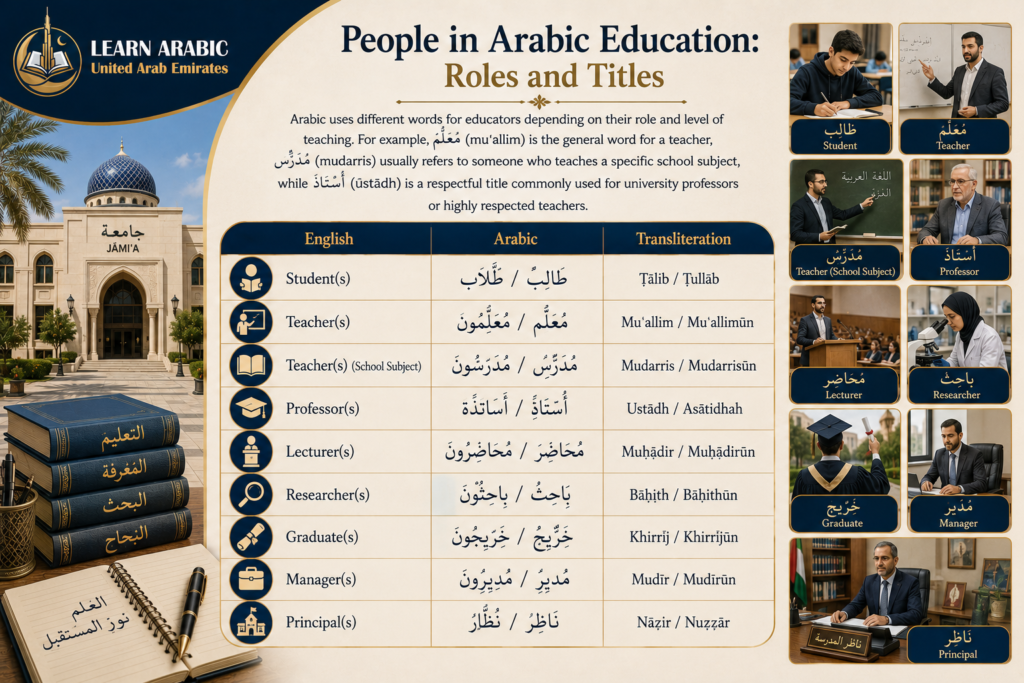
- Student(s) — طالِب / طُلَّاب — Ṭālib / Ṭullāb
- Teacher(s) — مُعَلِّم / مُعَلِّمُون — Muʿallim / Muʿallimūn
- Teacher(s) (School Subject) — مُدَرِّس / مُدَرِّسُون — Mudarris / Mudarrisūn
- Professor(s) — أُسْتاذ / أَساتِذَة — Ustādh / Asātidhah
- Lecturer(s) — مُحاضِر / مُحاضِرُون — Muḥāḍir / Muḥāḍirūn
- Researcher(s) — باحِث / باحِثُون — Bāḥith / Bāḥithūn
- Graduate(s) — خِرِّيج / خِرِّيجُون — Khirrīj / Khirrījūn
- Manager(s) — مُدير / مُديرُون — Mudīr / Mudīrūn
- Principal(s) — ناظِر / نُظَّار — Nāẓir / Nuẓẓār
Essential Education Verbs in Arabic
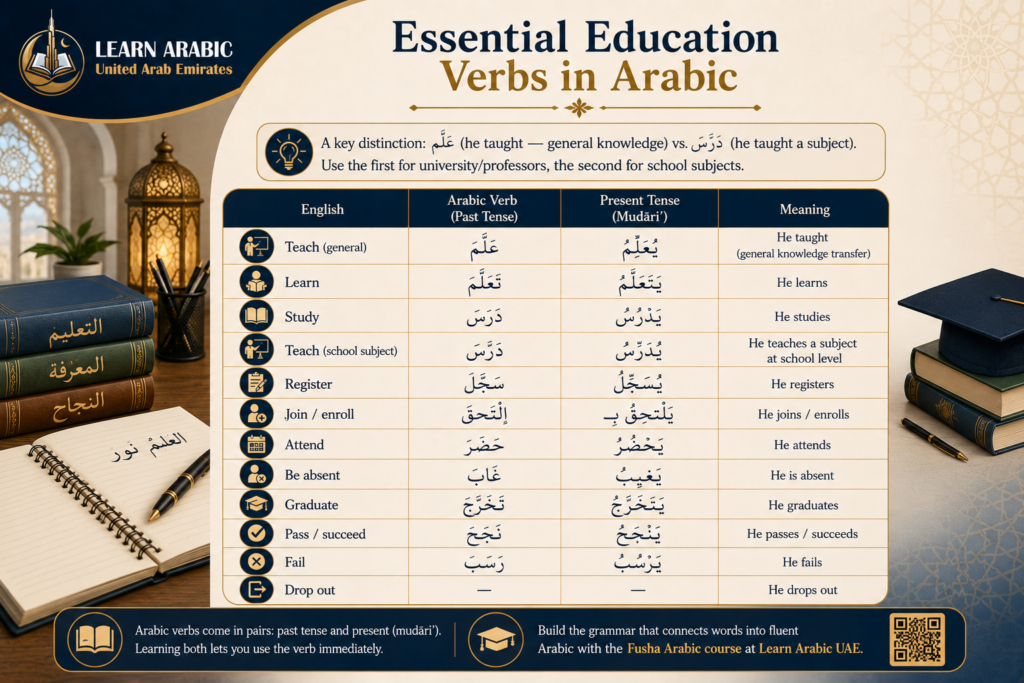
Vocabulary lists without verbs are half the picture. These are the action words that let you say what actually happens in an educational setting — not just name it.
A key distinction worth learning immediately: عَلَّمَ (he taught — general knowledge transfer) and دَرَّسَ (he taught a subject at school level) are not interchangeable. In a sentence about a university professor, you use the first; in a sentence about a schoolteacher covering mathematics, you use the second. This nuance is consistently overlooked in standard Arabic vocabulary resources.
| English | Arabic Verb | Present Tense |
| Teach (general) | عَلَّمَ | يُعَلِّمُ |
| Learn | تَعَلَّمَ | يَتَعَلَّمُ |
| Study | دَرَسَ | يَدْرُسُ |
| Teach (school subject) | دَرَّسَ | يُدَرِّسُ |
| Register | سَجَّلَ | يُسَجِّلُ |
| Join / enroll | اِلْتَحَقَ | يَلْتَحِقُ بـ |
| Attend | حَضِرَ | يَحْضِرُ |
| Be absent | غابَ | يَغيبُ |
| Graduate | تَخَرَّجَ | يَتَخَرَّجُ |
| Pass / succeed | نَجَحَ | يَنْجَحُ |
| Fail | رَسَبَ | يَرْسُبُ |
| Drop out | — | — |
Notice that Arabic verbs come in pairs: the past tense form and the present (mudāri’) form. Learning both from the start means you can use the verb immediately — not just recognize it when you see it.
If you want to move from recognizing vocabulary to actually constructing sentences in formal Arabic, the Fusha Arabic course at Learn Arabic UAE builds the grammar framework that connects words like these into fluent, accurate speech and writing.
See Our Classroom Environment in Action
Experience a sneak peek into our live sessions. Watch the video below to see our specialized instructors interacting with students, breakdown complex texts, and cultivate an engaging, respectful learning environment.
Master Arabic in the UAE
Experience world-class Arabic language training designed for students and professionals in the Emirates.
Book Your Free TrialStart Learning Arabic with Native-Level Instructors
You now have the complete education vocabulary toolkit. The next step is turning those words into natural, confident conversations—and that takes more than memorizing vocabulary lists. It requires structured lessons, consistent practice, and guidance from experienced instructors.
At Learn Arabic UAE, our expert native-level teachers help you use education-related vocabulary in real-life situations, whether you’re speaking with teachers, communicating at school, discussing university studies, or navigating everyday academic conversations. Every lesson focuses on practical communication, accurate pronunciation, and the grammar you need to speak with confidence.
[Start your Arabic course today →]
Our Arabic courses
- Arabic Course in the UAE
- Arabic Intensive Course
- Arabic Classes for Beginners (Learn Arabic from Scratch)
- Madinah Arabic Course
- Arabic Classes for Adults
- Self-Paced Arabic Course
- Arabic Speaking Classes
- Learn to Write Arabic Course
- Arabic Grammar Course
- Learn Arabic Alphabet Course
- Modern Standard Arabic (MSA) Course
- Quranic Arabic Course
- Fusha Arabic Course
- Classical Arabic Course
- Emirati Arabic Course
- Gulf Arabic Course
- Learn Saudi Arabic
- Business Arabic Course UAE
- Arabic Language Classes for Professionals in UAE
Master Arabic in the UAE
Experience world-class Arabic language training designed for students and professionals in the Emirates.
Book Your Free TrialConclusion
Education vocabulary in Arabic is one of the highest-return investments an Arabic learner can make. These words appear in school communication, university enrollment, professional contexts, and everyday conversation across the entire Arab world. More importantly, once you know the key verbs — نَجَحَ, دَرَسَ, تَخَرَّجَ — you stop just recognizing Arabic and start producing it.
Keep two distinctions in mind as you practice: the difference between مُعَلِّم and مُدَرِّس for teachers, and the difference between عَلَّمَ and دَرَّسَ for teaching. They reflect a precision in Arabic that rewards the learner who pays attention to it.
Frequently Asked Questions
Whether you’re learning Arabic for school, university, or everyday communication, it’s natural to have questions about education-related vocabulary. Here are concise answers to some of the most common questions learners ask.
What is the Arabic word for education?
The Arabic word for education is التَّعْليم (al-ta’līm). It refers broadly to the process of formal instruction. The related word التَّعَلُّم (al-ta’allum) means learning — what the student does — while التَّدْريس (al-tadrīs) means teaching — what the instructor does.
How do you say “student” in Arabic?
Student in Arabic is طالِب (ṭālib) for a male student and طالِبة (ṭāliba) for a female student. The plural for a group of students is طُلَّاب (ṭullāb) or طَلَبة (ṭalaba). Both plural forms are correct and widely used.
What is the difference between دَرْس and حِصَّة?
دَرْس (dars) refers to a lesson — the content being taught.
حِصَّة (ḥiṣṣa) refers to a class period — the scheduled time slot in which a lesson takes place. A teacher can cover one دَرْس across multiple حِصَص if the content is long enough.
How do you say “I passed the exam” in Arabic?
“I passed the exam” in Arabic is نَجَحْتُ في الاِمْتِحان (najaḥtu fī al-imtiḥān). The verb نَجَحَ (najaḥa) means to pass or succeed, and الاِمْتِحان is the exam.
What is the Arabic word for curriculum?
Curriculum in Arabic is مَنْهَج (manhaj), with the plural مَنَاهِج (manāhij). The related word مُقَرَّر (muqarrar) refers specifically to a syllabus — the assigned content for a particular course — and is often used in university settings.
How do you say “distance learning” in Arabic?
Distance learning in Arabic is الدِّراسة عن بُعد (al-dirāsa ‘an bu’d), which translates literally as “studying from a distance.” The more modern term التَّعَلُّم الإلكتروني (al-ta’allum al-iliktrūnī) is used for e-learning specifically.
Leave a Reply