 Learn Arabic
The 10 most used sentences in Arabic that beginners face when they learn Arabic vocabulary word by word and freeze the moment a real conversation starts are among the most vital expressions. The fix isn’t more vocabulary. It’s learning the ten most used sentences in Arabic that native speakers actually repeat every single day, in the order and context they use them.
This article breaks down those 10 most used sentences plus the emotional and cultural words that surround them: habibi, haram, and the phrases Emiratis and other Arabic speakers use for hello, goodbye, mom, and birthdays. Each one comes with the literal meaning, the cultural layer behind it, and when to use it.
By the end of this article, you’ll know which phrase fits a formal meeting, which one fits a friend, and which one you should never mix up.
1. As-salamu Alaykum – Marhaban
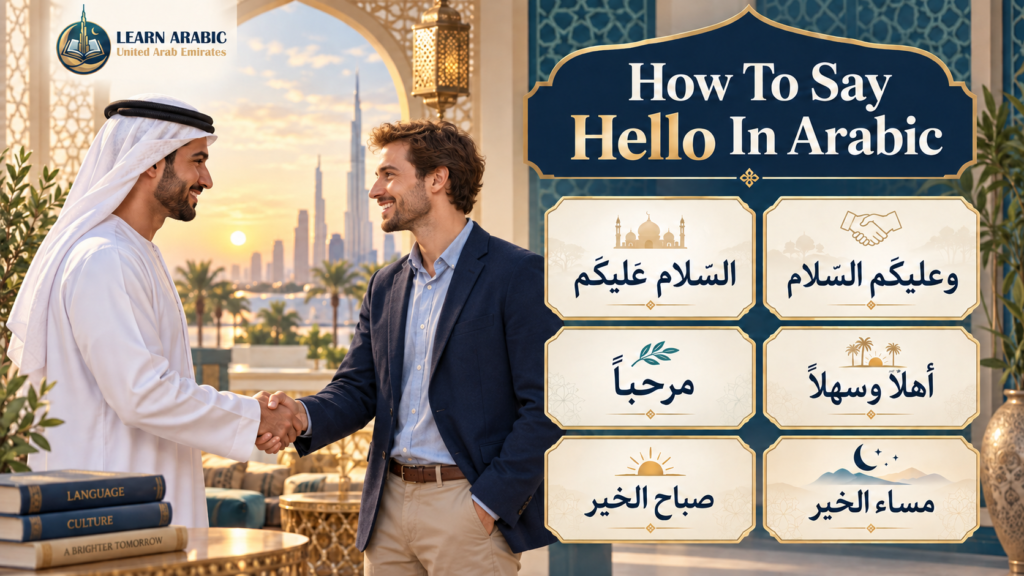
السلام عليكم (as-salamu alaykum) is on top of the 10 most used sentences in Arabic. It is a widely used greeting across the Arab world and carries an Islamic origin, meaning “peace be upon you.” The expected reply is “وعليكم السلام” (wa alaykum as-salam).
مرحباً (marhaban) is the direct, neutral equivalent of “hello”, appropriate in any setting, formal or casual. أهلاً وسهلاً (ahlan wa sahlan) adds warmth and is what you’ll hear when someone welcomes you into their home or business.
Time-based greetings are important too, such as صباح الخير (sabah al-khayr, “good morning”), which is answered with صباح النور, and مساء الخير (masa’ al-khayr, “good evening”) is answered with مساء النور.
Read also: Masculine And Feminine Nouns In Arabic
2. Ma Ismuk? – Equivalent Of What’s Your Name In Arabic
The second sentence among the 10 most used sentences in Arabic is the question ما اسمك؟ (ma ismuk), or “What’s your name?” This reply usually follows the question: متشرف بمعرفتك (mutasharrif bi-ma’rifatik), “Pleased to meet you”.
لا أفهم (la afham), “I don’t understand,” is one of the most practically useful sentences for a beginner, since it signals the other person to slow down or rephrase rather than switch to English.
Read also: How Many Letters Are In The Arabic Alphabet?
Step Inside Our Classrooms
Don’t just take our word for it—see our community in action. Click below to watch real, live snippets from our recent classes and experience our engaging teaching style firsthand!
Master Arabic in the UAE
Experience world-class Arabic language training designed for students and professionals in the Emirates.
Book Your Free Trial3. Kayfa Haluk? – Kefak
كيف حالك؟ (kayfa haluk) is a most frequent expression among the 10 most used sentences in Arabic. It is the standard way to ask about someone’s well-being, and أنا بخير، شكراً (ana bekhair, shukran), “I’m fine, thank you,” is the near-universal reply. In Gulf dialects, you’ll also hear the shorter كيفك؟ (kefak).
A common mistake learners make here: they memorize the question but never practice the automatic reply, so the conversation stalls after one exchange. Drill the question-and-answer pair together, not separately.
At Learn Arabic UAE, our conversation-first lessons pair every new greeting with its natural response, so you’re never left guessing what comes next.
4. Habibi – Several Meanings
حبيبي (habibi) is one of the most recurrent expressions among the 10 most used sentences in Arabic. It comes from the root ح-ب-ب (h-b-b), meaning “to love.” Literally, it translates to “my beloved,” but in daily use it functions closer to “dear,” “buddy,” or “my friend,” depending on who’s speaking. Between spouses or romantic partners, it carries genuine affection.
Between close friends, especially in Gulf and Levantine dialects, it’s a casual term of warmth, similar to how “man” or “dude” softens a sentence in English. The feminine form is حبيبتي (habibti).
5. Haram Meaning In Arabic
حرام (haram) is another recurrent expression among the 10 most used sentences in Arabic. It means “forbidden” or “prohibited,” and its opposite is حلال (halal), “permitted.” In everyday speech, people also use it loosely to express sympathy or disapproval, saying “haram” about a sad situation, similar to saying “that’s a shame.”
In its formal, religious sense, haram refers specifically to acts prohibited under Islamic law, and the word also names sacred places, such as المسجد الحرام (the Grand Mosque in Mecca).
Knowing both the everyday and formal uses prevents a common misunderstanding: not every use of “haram” is a religious ruling. Context decides the weight of the word.
6. Rā’i – The Equivalent Of Gorgeous In Arabic
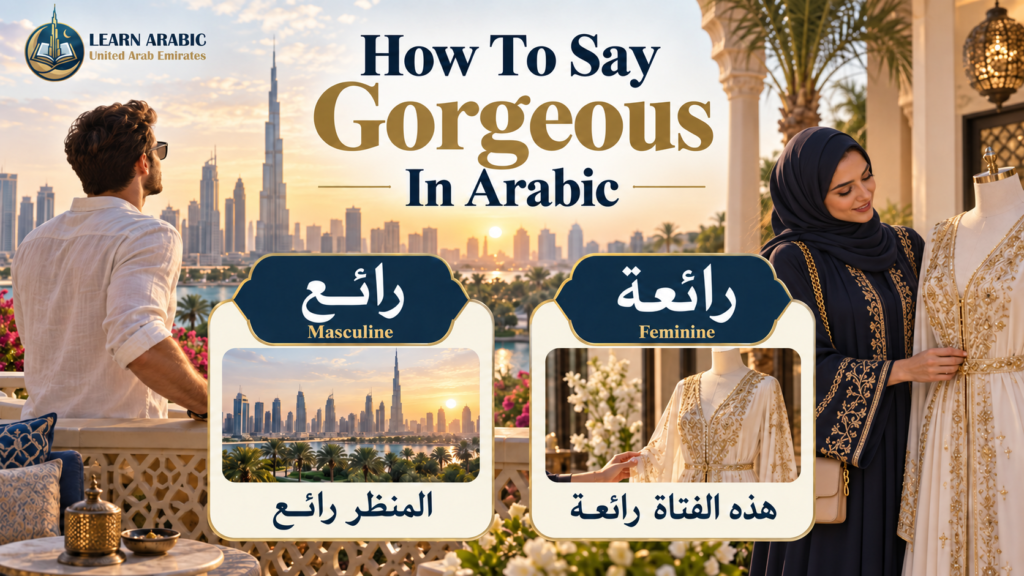
رائع (rā’i‘) is a common word among the 10 most used sentences in Arabic. It is a translation for “gorgeous,” “wonderful,” or “amazing,” used for people, places, and things. It is a safe, versatile word for describing anything impressive, from a view to an outfit, without the intimacy carried by words like habibi.
Use رائع with masculine nouns and رائعة (rā’i‘a) with feminine nouns. For example, المنظر رائع means “The view is gorgeous,” while هذه الفتاة رائعة means “This girl is gorgeous.”
In everyday conversation, the word can also express enthusiastic approval, similar to saying “Fantastic!” or “Wonderful!”
Read also: Arabic Broken Plurals – 2 Categories Of Jam’ Al-Taksir
7. Shukran, Shukran Jazilan, And Jazak Allah Khairan
Another common word among the 10 most used sentences in Arabic is شكراً (shukran). It is the simplest and most recurrent way to say thank you in Arabic, and شكراً جزيلاً (shukran jazilan) intensifies it to “thank you very much.” The standard reply is عفواً (afwan) or لا شكر على واجب (“no thanks needed for a duty”).
Beyond the standard phrase, Arabic has layered thanks depending on the depth of gratitude. جزاك الله خيراً (jazak Allah khairan), “may God reward you with good”, is a religious expression of thanks used when someone’s help felt significant. تسلم
(teslam), common in Levantine and Gulf dialects, literally wishes the other person safety in return for what they did, and تسلم إيدك (teslam idak) specifically thanks someone for something made by hand, a meal, for example.
This is where a simple decision rule helps. Use shukran for routine exchanges, shukran jazilan when the favor was bigger than usual, and jazak Allah khairan when you want to express thanks with genuine warmth in a culturally resonant way.
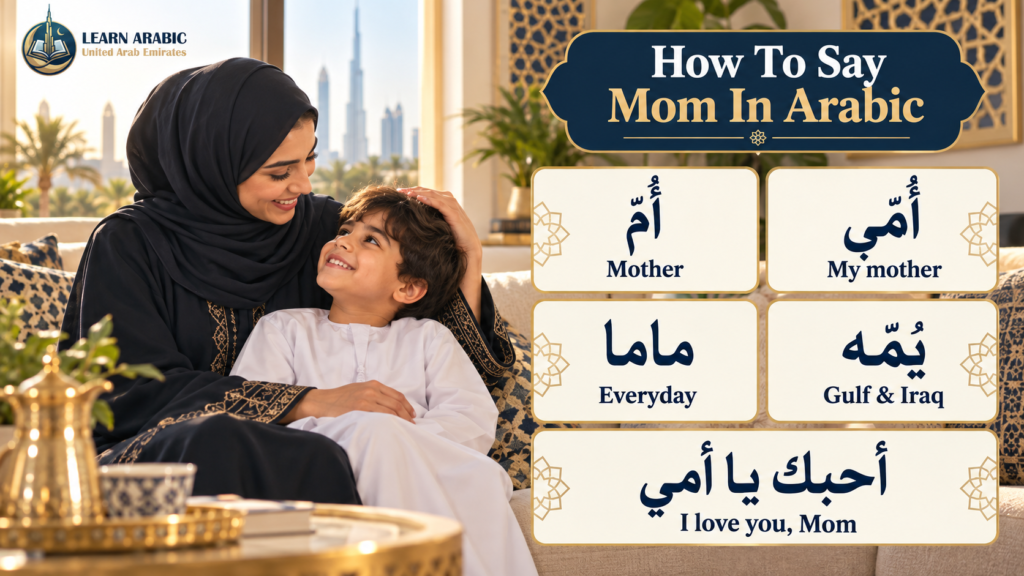
8. Ummi, Umm, Yumma, And More Equivalents Of Mom In Arabic
Here are more common expressions among the 10 most used sentences in Arabic. The formal MSA word for “mother” is أُمّ (umm), while أُمّي (ummī) means “my mother.” Everyday usage differs by region, with ماما (mama) being one of the warmest and most widespread options across Egypt, the Levant, and the Gulf.
In parts of the Gulf and Iraq, children may say يُمّه (yumma), while forms used across the Maghreb vary by country and family.
To address your mother directly, you can say يا أُمّي (yā ummī), meaning “O my mother,” or simply ماما in casual speech. For example, أحبك يا أمي means “I love you, Mom.” The best choice depends on the dialect, setting, and level of warmth you want to express.
9. Kul ‘Am Wa Anta Bekhair – Happy Birthday In Arabic
كل عام وأنت بخير (kul ‘am wa anta bekhair), “every year and you are well”, is one of the most common expressions among the 10 most used sentences in Arabic. The most classic and widely used birthday phrase in Arabic, suitable for any relationship. عيد ميلاد سعيد (eid milad sa’id) is the direct, simple equivalent of “happy birthday,” commonly used with colleagues or acquaintances.
Egyptians often add كل سنة وأنت طيب, while Gulf speakers add wishes like “عساها سنة خير عليك” (may this be a year of goodness for you).
See Our Classroom Environment in Action
Experience a sneak peek into our live sessions. Watch the video below to see our specialized instructors interacting with students, breaking down complex texts, and cultivating an engaging, respectful learning environment.
Master Arabic in the UAE
Experience world-class Arabic language training designed for students and professionals in the Emirates.
Book Your Free Trial10. Ma’as-salama – Goodbye In Arabic
Here we reach the final expression that is most frequent among the 10 most used sentences in Arabic. مع السلامة (ma’ as-salama), “go with safety”, is understood everywhere and works in any setting. Younger speakers across the region increasingly use باي (bye), borrowed directly from English.
Regionally, Levantine speakers often say الله معك (Allah ma’ak), “God be with you,” while Gulf and Maghreb speakers favor في أمان الله (fi aman Allah), “in God’s protection”, both wishes of safekeeping rather than a plain farewell.
Read also: Does Arabic Have Grammatical Gender? 9 Easy Rules You Need To Know
Start Speaking Arabic, Not Just Memorizing Words And Expressions
Reading ten sentences is the easy part; using them correctly, in the right tone, at the right moment, is what actually builds fluency.
That skill comes from speaking practice with a real instructor who corrects you in the moment, not from repeating a list alone.
Learn Arabic UAE offers structured live courses that take you from these ten essential sentences to full conversations, with instructors who explain exactly which phrase fits which situation, formal, religious, or casual.
If you are ready to move beyond memorized phrases, consider trying a lesson suited to your current level. With patient guidance and regular conversation practice, you can gradually turn familiar sentences into natural, confident communication.
Get your free trial today and start speaking Arabic with confidence.
Our Arabic courses
- Arabic Course in the UAE
- Arabic Intensive Course
- Arabic Classes for Beginners (Learn Arabic from Scratch)
- Madinah Arabic Course
- Arabic Classes for Adults
- Self-Paced Arabic Course
- Arabic Speaking Classes
- Learn to Write Arabic Course
- Arabic Grammar Course
- Learn Arabic Alphabet Course
- Modern Standard Arabic (MSA) Course
Master Arabic in the UAE
Experience world-class Arabic language training designed for students and professionals in the Emirates.
Book Your Free TrialConclusion
The 10 most used sentences in Arabic aren’t random vocabulary. They’re the working toolkit for greetings, gratitude, introductions, and daily transactions that native speakers rely on constantly.
Layered on top of them, words like habibi, haram, and the regional variations for mom, goodbye, and happy birthday give you the cultural fluency that a phrasebook alone can’t teach.
The fastest path forward is simple: pick one formal phrase and one dialect version for each situation above, and start using both in real conversation.
That combination, knowing the standard Arabic sentence and its regional cousin, is what separates someone who memorized Arabic from someone who actually speaks it.
Frequently Asked Questions
What Is The Most Common Arabic Greeting?
السلام عليكم (as-salamu alaykum) is the most common and widely recognized Arabic greeting, used across nearly all Arabic-speaking countries and religious contexts. Its standard reply is “وعليكم السلام.”
Is Habibi Only Used Between Couples?
No, habibi is used both romantically and casually among friends, especially in Gulf and Levantine dialects. Context and tone of voice usually make the intended meaning clear.
Does Haram Always Refer To Religion?
Not always. Haram formally means “forbidden” under Islamic law, but it’s also used casually to express sympathy or mild disapproval about a situation, similar to saying “that’s a shame.”
What’s The Difference Between Shukran And Jazak Allah Khairan?
Shukran is the standard, everyday way to say thank you in Arabic, while jazak Allah khairan is a religious expression meaning “may God reward you with good,” used for deeper or more meaningful gratitude.
How Do I Say Mom In Arabic Across Different Regions?
The formal word is ummi, but ماما (mama) is most common in Egypt, the Levant, and the Gulf, while يُمّه (yumma) is typical in Gulf and Iraqi dialects.
Is It Better To Learn Modern Standard Arabic Or A Dialect First?
It depends on your goal: MSA is understood everywhere and useful for reading and formal settings, while a regional dialect helps you sound natural in daily conversation. Most learners benefit from starting with core MSA sentences, like the ten covered here, then layering in the dialect of the region they interact with most.


Leave a Reply