 Learn Arabic
Ask any parent who has tried to sit a four-year-old down with a workbook — the session rarely lasts ten minutes. But watch that same child spend forty minutes chasing letter tiles across the floor, and you start to understand how Arabic language learning actually works for young minds.
Arabic games for kids succeed where drills fail because they exploit the brain’s natural learning architecture: emotion, movement, repetition in context, and the desire to compete or create.
When a child fishes magnetic letters from a bowl to spell their first Arabic word, they’re building letter recognition, motor memory, and vocabulary simultaneously — without any of it feeling like study. This guide covers 10 Arabic games for kids, drawn from classroom practice, home learning research, and language pedagogy.
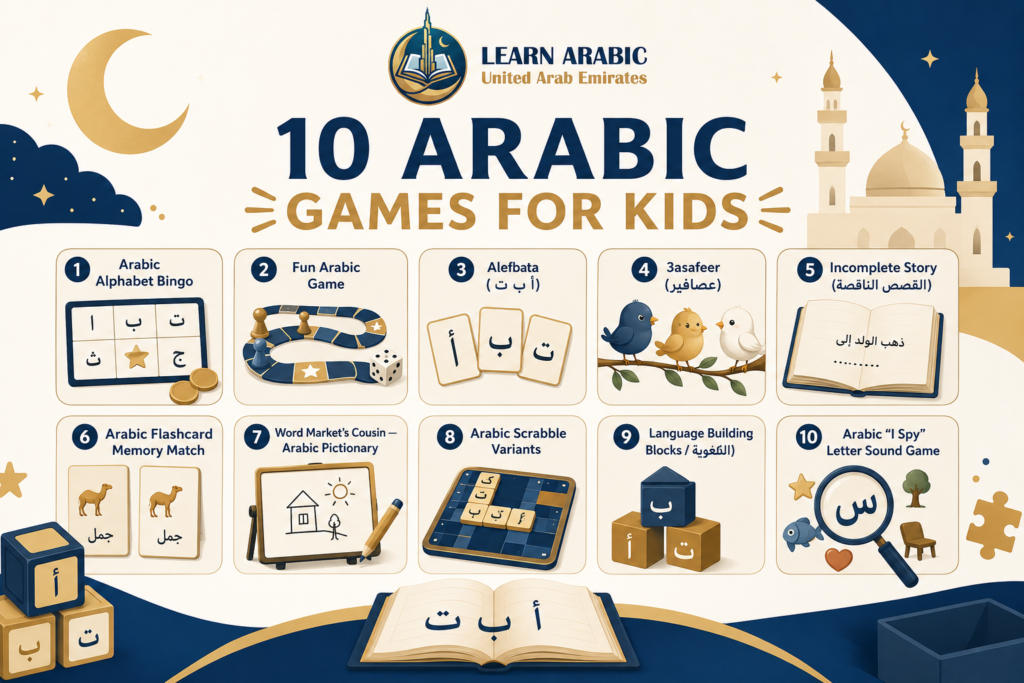
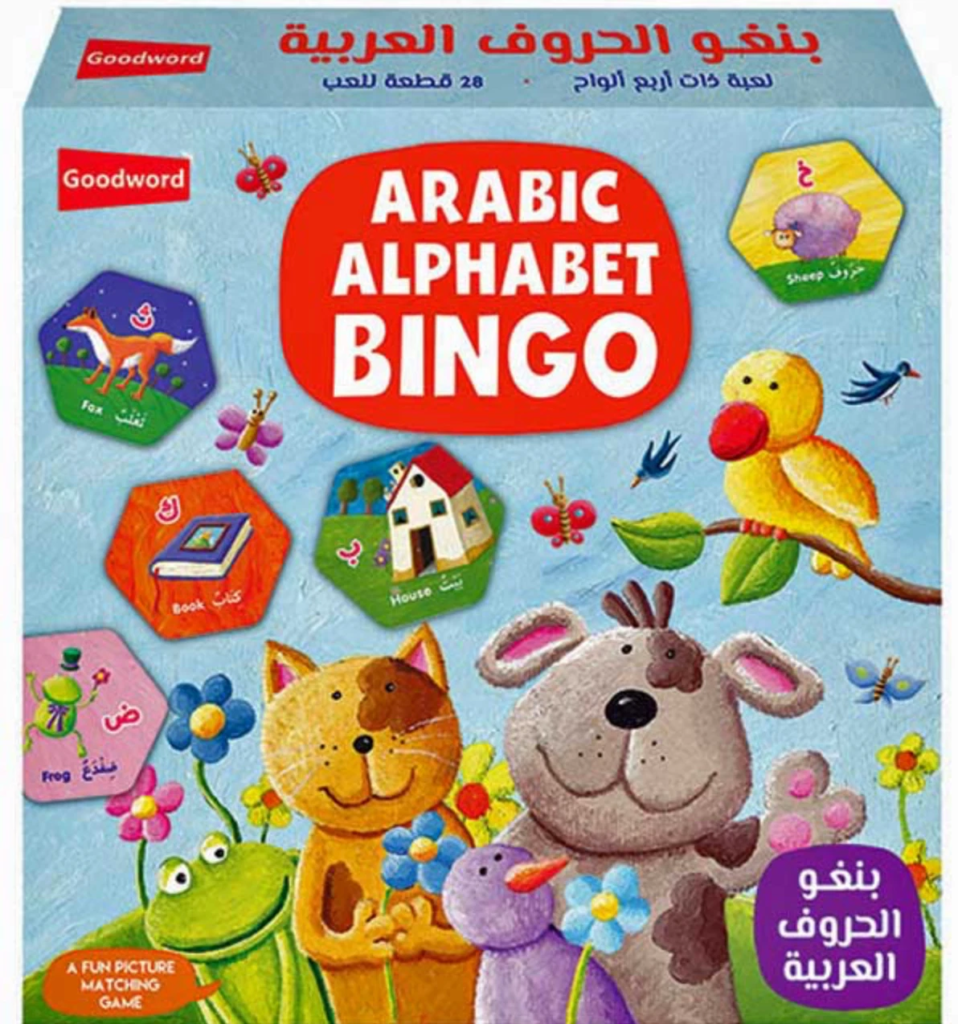
1. Arabic Alphabet Bingo
Create bingo cards using Arabic letters instead of numbers — a simple 5×5 grid with one letter per square. The caller reads out letter names; children mark their cards. The first to complete a row wins.
One 10–15 minute session covers all 28 Arabic letters repeatedly without children registering it as drilling. The competitive element keeps attention sharp even for children who would normally resist sitting still.
One detail that doubles the value: rotate who calls. When a child reads the letter names aloud rather than simply listening, they shift from recognition to production — encoding the letter more deeply in a single session.
Book your free trial lesson at Learn Arabic UAE and start building the Arabic skills that help you communicate confidently when it matters most.

2. Fun Arabic Game
Fun Arabic Games offers a collection of browser-based Arabic activities that require no download or account setup, making it immediately accessible for parents and teachers. The platform covers hangman in Arabic, picture quizzes, word building, letter tracing, and spelling challenges.
The hangman game is particularly engaging for older beginners (ages 7 and up), as it builds vocabulary through contextual guessing rather than rote memorization.
The picture quiz format pairs images with their Arabic labels, reinforcing the connection between spoken and written Arabic in a visually intuitive way. Word-building activities help children understand how Arabic root letters combine to form words.
The letter tracing module stands out as one of the platform’s most effective tools. Each Arabic letter is displayed with example words and visual stroke guides, helping children move beyond passive recognition toward forming the letters themselves.
Read also: Education Vocabulary in Arabic: The Complete Word List with Pronunciation
3. Alefbata (أ ب ت)
Alef Ba ta is a structured Arabic learning platform designed for children aged 4–10, built around the philosophy that language acquisition happens most naturally through play. The platform combines hundreds of interactive games with listening exercises, sight word practice, graded readers, and downloadable grammar worksheets.
What sets Alefbata apart is that it requires no prior reading or writing ability to get started. A four-year-old with zero exposure to Arabic can begin on the platform and be guided through the alphabet systematically before moving on to word formation and simple sentences.
The graded story library is particularly strong — stories increase in complexity gradually, so children are always reading just slightly above their current level, which research supports as one of the most effective methods for building reading fluency.
The sight word component mirrors methods used in English early literacy programs, helping children recognize high-frequency Arabic words by shape before they can sound them out phonetically.
4. 3asafeer (عصافير)
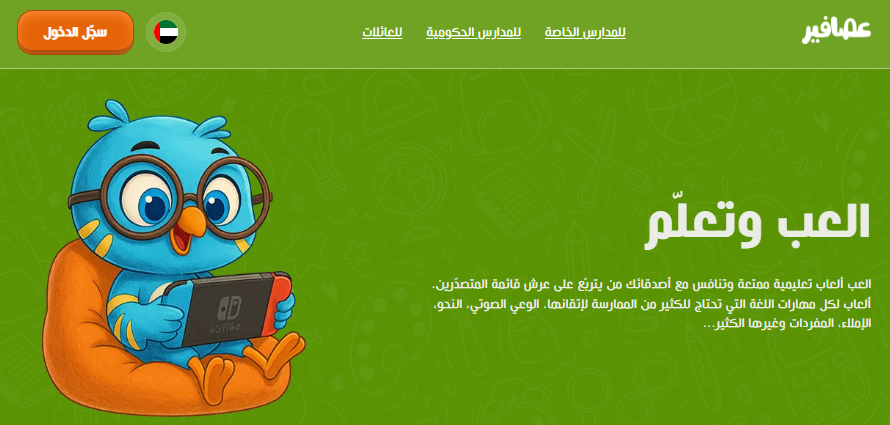
3asafeer is a free, cheerfully designed platform offering Arabic games, printable worksheets, and interactive stories aimed primarily at children aged 4–8.
Content is organized across skill levels and covers foundational areas including the Arabic alphabet, numbers, colors, and early vocabulary, making it one of the more comprehensive free resources available in this age range.
The jigsaw puzzle format is a highlight: children assemble puzzles that, when completed, reveal an Arabic letter or word — combining spatial reasoning with language learning in a satisfying way.
The word-completion activities (fill-in-the-missing-letter style) are well-calibrated for ages 5–8, offering just enough challenge to maintain engagement without becoming frustrating.
Read More: Learn Arabic for Kids Online For Free in the UAE
5. Incomplete Story (القصص الناقصة)
Begin a short Arabic story and stop at a turning point: “ذات يوم ذهب سامي إلى السوق ليشتري…” (One day Sami went to the market to buy…). The child must complete the sentence or continue the story using any Arabic words they know.
Mistakes are welcomed, not corrected immediately. The goal is productive language use — attempting Arabic sentences even imperfectly — because production is what accelerates speaking confidence. A structured vocabulary reference for Arabic sentences for kids gives you ready-made sentence structures to launch the story and support children who need prompting.
For children who need extra encouragement, allow the storytelling to continue in a mix of Arabic and the child’s home language, gradually increasing the Arabic proportion over weeks.
See Our Classroom Environment in Action
Experience a sneak peek into our live sessions. Watch the video below to see our specialized instructors interacting with students, breakdown complex texts, and cultivate an engaging, respectful learning environment.
Master Arabic in the UAE
Experience world-class Arabic language training designed for students and professionals in the Emirates.
Book Your Free TrialRead also: Learn To Read Arabic For Kids in The UAE – A Roadmap
6. Arabic Flashcard Memory Match
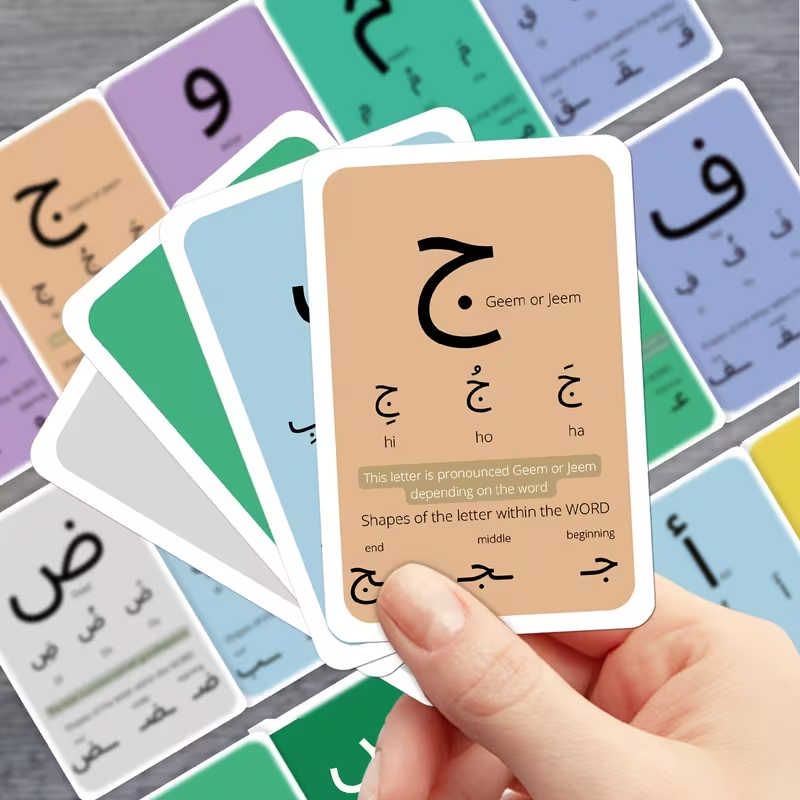
Lay pairs of cards face-down: one card shows an Arabic letter, its pair shows a picture of a word beginning with that letter. Children flip two cards per turn, searching for matching pairs.
| Letter Card | Picture Card | Arabic Word | English Meaning |
| ب | House illustration | بيت | House |
| ت | Apple illustration | تفاحة | Apple |
| س | Fish illustration | سمكة | Fish |
| ك | Book illustration | كتاب | Book |
The letter-to-word association is built through gameplay rather than memorization, which is why these connections persist. Each session teaches vocabulary alongside the alphabet — two skill areas in one sitting. Scale up by increasing the number of pairs as vocabulary grows.
Join Our Self-Paced Arabic Classes in the UAE with a FREE Trial

Read also: The Best 8 Arabic Learning Apps for Kids
7. Word Market’s Cousin — Arabic Pictionary
One child draws a picture while others guess the Arabic word being illustrated. No speaking — only drawing. This forces children to think visually about word meaning, building semantic memory in a way that repetition cannot replicate.
For ages 6–8, use concrete nouns: animals, foods, colours. A colour-only round works especially well here — where every drawing must represent a colour and others guess the Arabic name.
A full vocabulary reference on colors in Arabic gives you the complete list to run this round immediately. For ages 8–12, introduce action verbs like يجري (runs) or يأكل (eats), requiring children to draw movement rather than static objects.
Read also: Learn Arabic Phrases
8. Arabic Scrabble Variants
Create letter tile sets from index cards — one Arabic letter per card, multiple copies of common letters. Children draw tiles at random and build words, scoring points for length or complexity.
| Age Group | Rule Adaptation | Skill Focus |
| Ages 8–10 | 3-letter words only | Basic spelling |
| Ages 11–13 | Any word length | Expanded vocabulary |
| Ages 14–15 | Quranic vocabulary only | Quranic Arabic |
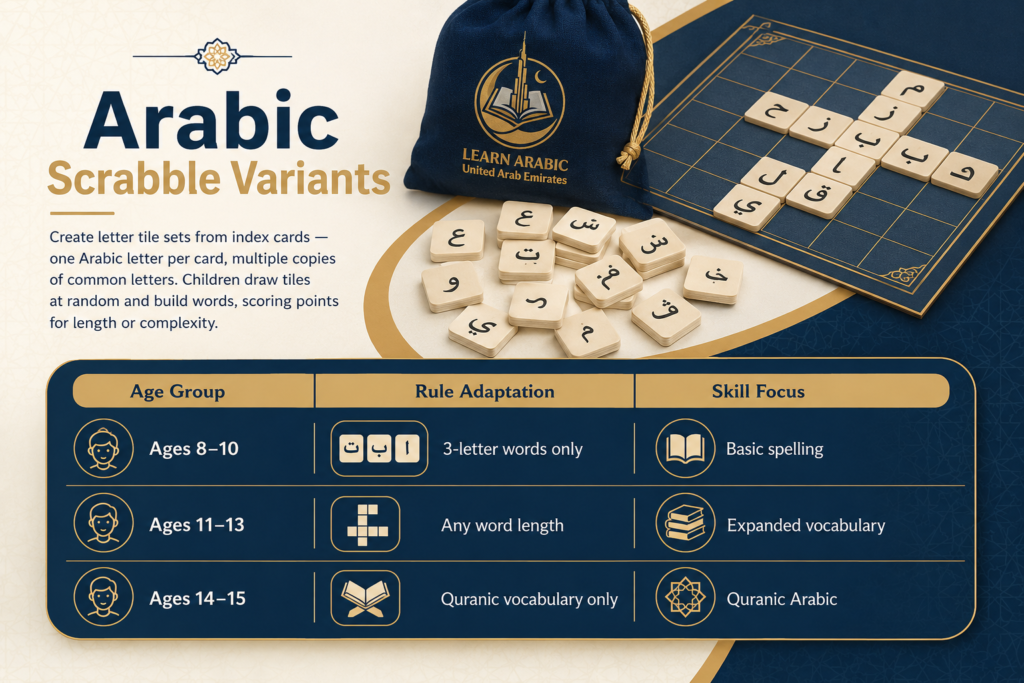
The tile-building format naturally surfaces letter position: children discover that Arabic letters change form depending on where they appear in a word — initial, medial, and final — through the game itself rather than through a formal grammar explanation. That practical encounter with connected letter forms builds spelling intuition faster than any rule-based lesson.
9. Language Building Blocks / المكعبات اللغوية
Use wooden or foam blocks with Arabic letters printed on each face. Children draw tiles at random and build as many words as they can from their selection. Score points for longer words.
Beyond vocabulary, this game surfaces a concept that formal lessons often introduce too late: Arabic letter position. Children quickly discover that ب at the start of a word looks different from ب in the middle. This natural encounter with letter forms — initial, medial, final — builds spelling intuition through play rather than through a grammar rule.
10. Arabic “I Spy” Letter Sound Game
One player (parent or teacher) says: “أنا أرى شيئاً يبدأ بحرف أ” — I see something starting with the letter Alif. The child looks around the room or the picture book open in front of them and names objects beginning with that letter.
This game ties letter sounds to the real physical world, which is exactly how vocabulary acquires staying power in young children. A child who connects the sound “Alif” to the armchair they’re sitting on, the apple on the table, and the window (أريكة، تفاحة، نافذة starting with different letters) is building phonemic awareness alongside vocabulary simultaneously.
No materials required. Works in the car, at the dinner table, in the waiting room.
Read also: Hospital Vocabulary in Arabic
Step Inside Our Classrooms
Don’t just take our word for it—see our community in action. Click below to watch real, live snippets from our recent classes and experience our engaging teaching style firsthand!
Master Arabic in the UAE
Experience world-class Arabic language training designed for students and professionals in the Emirates.
Book Your Free TrialWhy Learn Arabic UAE Moves Children From Games to Genuine Fluency?
Games build the spark. Qualified instruction is what turns that spark into lasting Arabic ability. At Learn Arabic UAE, we pair the engagement principles behind these games with structured teaching methods that produce measurable, real Arabic progress across every skill area.
Our teachers work with children at every stage — from those tracing their first letters to those building full Arabic sentences and approaching reading fluency. Sessions run 20–30 minutes, matched to children’s genuine attention spans, and use gamification, storytelling, and active practice throughout.
For the youngest learners starting out, our Arabic classes for kindergarten in the UAE build foundational letter and vocabulary skills through age-appropriate methods that make Arabic feel natural from the first session.
For children ready to develop a formal Arabic foundation that will serve them in education, media, and professional settings, our modern standard Arabic classes provide exactly that grounding alongside everything they develop through play.
Book Your Child’s First Arabic Lesson Today
Every first lesson at Learn Arabic UAE is a free trial. Your child meets their instructor, experiences the teaching approach, and leaves with new Arabic knowledge — before you commit to anything.
Start your free trial lesson today and make Arabic learning fun and engaging!
Our Arabic Courses
- Arabic Course in the UAE
- Arabic Intensive Course
- Arabic Classes for Beginners (Learn Arabic from Scratch)
- Madinah Arabic Course
- Self-Paced Arabic Course
- Arabic Speaking Classes
- Learn to Write Arabic Course
- Arabic Grammar Course
- Learn Arabic Alphabet Course
- Quranic Arabic Course
- Fusha Arabic Course
- Classical Arabic Course
- Emirati Arabic Course
- Gulf Arabic Course
- Learn Saudi Arabic
- Arabic Language Classes for Professionals in UAE
Master Arabic in the UAE
Experience world-class Arabic language training designed for students and professionals in the Emirates.
Book Your Free TrialConclusion
Arabic games for kids work because they align with how children’s brains actually encode language: through emotion, movement, competition, and repeated meaningful encounters with words.
The 18 games in this guide cover every Arabic skill area — letter recognition, vocabulary, listening comprehension, and speaking production — across the full age range from three to fifteen.
The organizing principle matters more than the game list itself. Match the game to the specific skill gap your child has right now, not to the game that looks most impressive on the shelf or the screen.
A child who needs letter-recognition practice is not served by a storytelling game, however enjoyable it is. Two minutes identifying where your child actually struggles makes every subsequent game session significantly more productive.
Frequently Asked Questions
What is the best Arabic game for a child who is just starting to learn the alphabet?
The Arabic Letter Treasure Hunt is the strongest starting point for complete beginners aged 3–6. Hiding plastic letter tiles in sand or rice and having children dig them out while naming each letter activates tactile, visual, and auditory memory simultaneously.
How old should a child be before starting Arabic language games?
Most games in this guide work from age three onward. Sensory games like Sand Tracing and Treasure Hunt suit ages 3–5. Vocabulary games like Flashcard Memory Match and Word King suit ages 6–10.
How often should children play Arabic games each week?
Two to four short sessions per week — each running 10–20 minutes — produce stronger results than a single long weekly session. The brain requires spaced repetition to move vocabulary from short-term recognition into long-term memory. Frequency of encounter matters more than the duration of any individual session.
Can Arabic games replace formal Arabic lessons?
No — games are supplements, not substitutes. They build motivation, vocabulary exposure, and comprehension stamina effectively. Phonics, grammar sequencing, pronunciation correction, and reading fluency require structured instruction from a qualified teacher.
How do I know when my child is ready to move from games to structured Arabic classes?
When a child can consistently identify all 28 Arabic letters and has a working vocabulary of 20–30 common words, they are ready for structured instruction that will accelerate their progress significantly.
Related Articles
Learn Arabic



Leave a Reply