 Learn Arabic
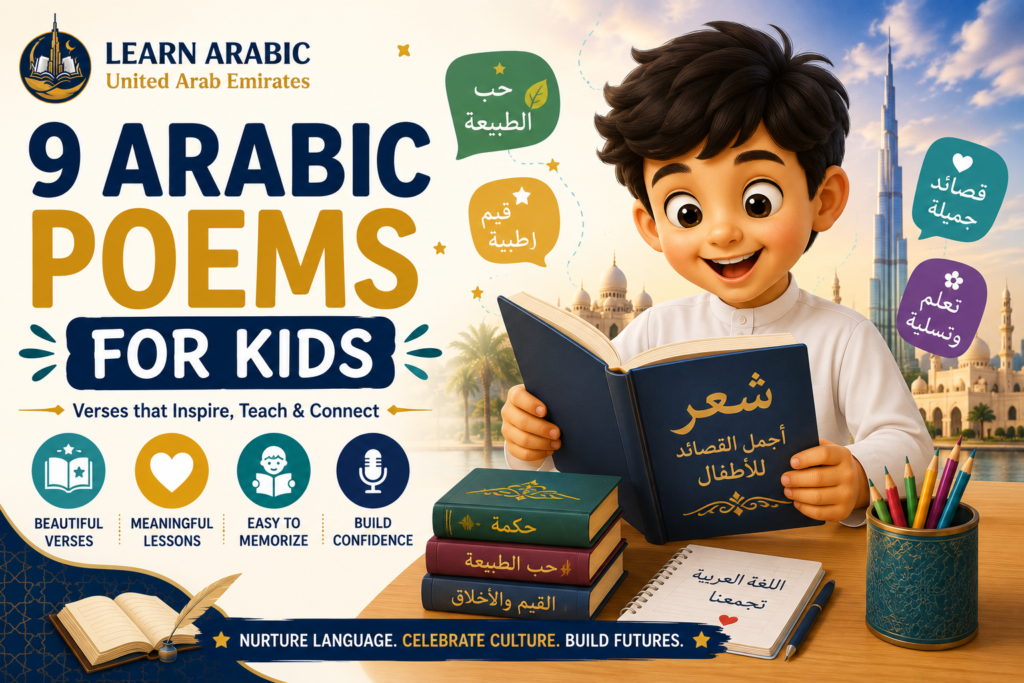
Arabic poetry has been passed down through generations as one of the most powerful tools for language development in children. Long before formal education existed, Arab families used verse to teach their children values, vocabulary, and a sense of identity.
A well-chosen Arabic poem for kids does something a worksheet simply cannot — it makes language feel alive. This collection brings together nine carefully selected Arabic poems for children, ranging from simple nursery-style chants to richer narrative verses.
Each poem is presented in Arabic with an English explanation of its theme, so parents, teachers, and students can use them right away — whether at home, in the classroom, or in a UAE Arabic learning programme.
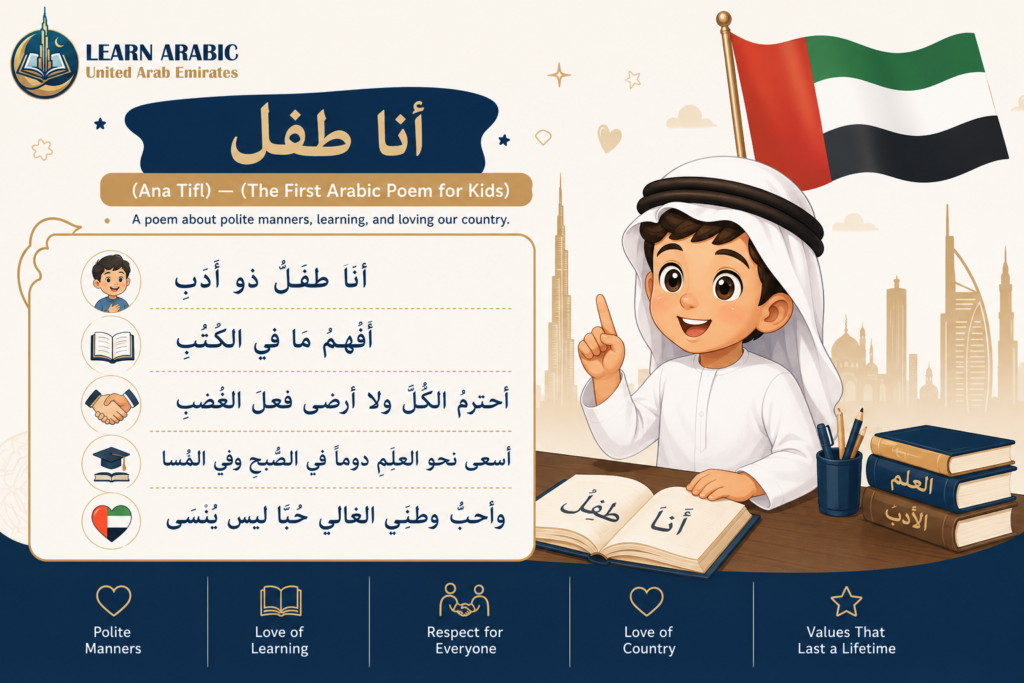
1. أنا طفل (Ana Tifl) — (The First Arabic Poem for Kids) “I Am a Child”
This short, musical poem is one of the most memorisable Arabic poems for kids. Its rhythm is steady and predictable, its vocabulary is basic, and its message — about learning, respect, and love of country — is age-appropriate across the early primary years. Children can recite it after only a few hearings.
أنا طفلٌ ذو أدبِ أفهمُ ما في الكتُبِ أحترمُ الكُلَّ ولا أرضى فعلَ الغضبِ أسعى نحو العِلمِ دوماً في الصُّبحِ وفي المَسَا وأحبُّ وطني الغالي حُبّاً ليس يُنْسَى
The theme of the poem is about politeness, learning, and patriotism.
Use this poem to introduce the concepts of أدب (manners/culture), علم (knowledge), and وطن (homeland). The alternating short-long line pattern is ideal for clapping exercises, which reinforce syllable awareness in young Arabic learners.
Read also: How to Greet People in Arabic: Complete Guide to Arabic Greetings
2. العصفور الصغير (Al-Usfour Al-Saghir) — “The Little Sparrow” by Abdul-Sattar Al-Nuaimi
This poem by Abdul-Sattar Al-Nuaimi is a masterpiece of children’s Arabic verse. It begins with a vulnerable sparrow too cold to fly in winter rain, then expands into a meditation on the sun, the sky, and the child’s own aspiration to soar. The imagery builds beautifully across verses that children can follow even before they understand every word.
المطرُ الغزيرُ لصبِّهِ هديرُ والبردُ والشتاءْ
عصفورنا الصغيرُ في البرد لا يطيرُ يحتاجُ للكساءْ
وأمُّهُ تُسقسقْ تريدهُ يحلِّقْ أعلى من السماءْ
يا شمسنا استفيقي وأشعلي طريقي بوابل العطاءْ
أنهضُ في الصباحِ مصفِّقًا جناحي أطيرُ للعلاءْ
الشمسُ في يميني والبدرُ في جبيني يغمرني السناءْ
The theme of the poem is about nature, hope, and the child’s own potential to rise above difficulty.
The three-syllable line endings (هديرُ / يطيرُ / الكساءْ) make this poem particularly useful for ear training. Ask children to clap on each rhyme and then try to predict the next rhyme sound before it arrives — this sharpens phonological awareness in Arabic.
3. نشيد العيد (Nasheed Al-Eid) — “Eid Song” by Mahmoud Mufleh
Few occasions capture a child’s attention like Eid, and this poem by Mahmoud Mufleh channels that energy into language. Its joyful rhythm mimics the festive mood and introduces vocabulary that children encounter in real life — clothing, family visits, gifts, and celebration.
أقبلَ فجرُ العيدِ الأنورْ وَعَلا صوتي فيهِ وكبَّرْ أقبلَ يحملُ لي ألواناً: فرَحاً، حُبًّا، لُعَباً، سُكَّرْ
ألعبُ فيهِ مع أصحابي والفرحةُ فوقَ الأهدابِ هذا عمِّي، هذا خالي فلْأَطرقْ كلَّ الأبوابِ
ألبسُ أغلى ثوبٍ عندي يا ثوبي يا عودَ النَّدِّ ألثمُ أمِّي، ألثمُ جَدِّي أقطفُ لهما أحلى وَرْدِ
The theme of the poem is about Eid celebration, family, and gratitude.
This poem is an ideal entry point into culturally embedded vocabulary. Words like عمّي (my uncle), خالي (my maternal uncle), and عيد (feast day/holiday) appear in natural context rather than in a vocabulary list — which is far more memorable. It pairs well with learning Arabic sentences for kids used in everyday family conversations.
Read More: Learn To Read Arabic For Kids in The UAE
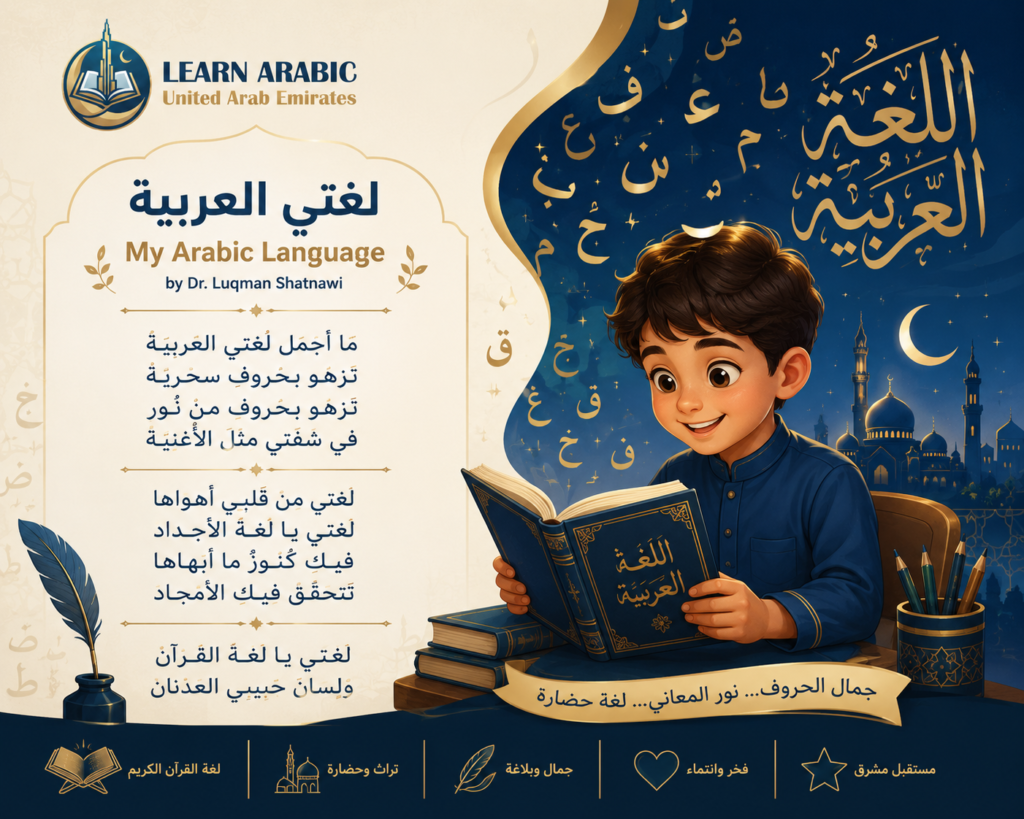
4. لغتي العربية (Lughati Al-Arabiyya) — “My Arabic Language” by Dr. Luqman Shatnawi
This poem is unusual in that it teaches children to take pride in Arabic itself — its letters, its sounds, and its status as the language of the Quran and classical civilization. For children studying Arabic as a second language, hearing the language celebrated in verse is genuinely motivating.
ما أَجمَلَ لُغَتي العَربيَّةْ تَزهُو بحُروفٍ سِحريَّةْ تَزهُو بحروفٍ مِن نُورٍ في شَفَتي مِثلَ الأُغنيَّةْ
لُغَتي مِن قَلبيْ أَهْوَاها لُغتي يا لغةَ الأَجدادْ فيكِ كنوزٌ ما أَبهاها تتحقَّقُ فِيكِ الأَمجادْ
لُغَتي يا لغةَ القرآنْ ولِسانَ حَبيبيْ العَدنانْ
The theme of the poem is about pride in the Arabic language, its beauty, and its cultural depth.
The phrase لغة القرآن (the language of the Quran) is one children in the UAE encounter often, yet many cannot explain what makes Arabic special. This poem gives them the language to articulate that pride. For children ready to explore the alphabet’s own beauty, beautiful Arabic words are a natural follow-up.
5. الهرة والنظافة (Al-Hirra wa Al-Nadafa) — “The Cat and Cleanliness” by Ahmad Shawqi
Ahmad Shawqi — known as أمير الشعراء, the Prince of Poets — wrote several poems for children that are still studied in Arab schools today. This one uses a cat’s fastidious grooming habits to teach children about cleanliness and personal hygiene, without once sounding like a lecture.
هِرَّتي جِدُّ أَليفَه وَهيَ لِلبَيتِ حَليفَه شُغلُها الفارُ تُنَقّي الرَفَّ مِنهُ وَالسَقيفَه
كُلَّما اِستَوسَخَ أَو آوى البَراغيثَ المُطيفَه غَسَلَتهُ وَكَوَتهُ بِأَساليبَ لَطيفَه
إِنَّما الثَوبُ عَلى الإِنسان عُنوانُ الصَحيفَه
The theme of the poem is about cleanliness, personal responsibility, and the social meaning of appearance.
Shawqi’s final couplet — “a person’s clothing is the title of their character” — is one of the most quoted lines in Arabic children’s education. It introduces children to the concept of كناية (implied meaning) in Arabic literature, laying a foundation for literary comprehension well before they encounter formal rhetorical study.
Join the Best Arabic Classes for Kids in the UAE with a FREE Trial
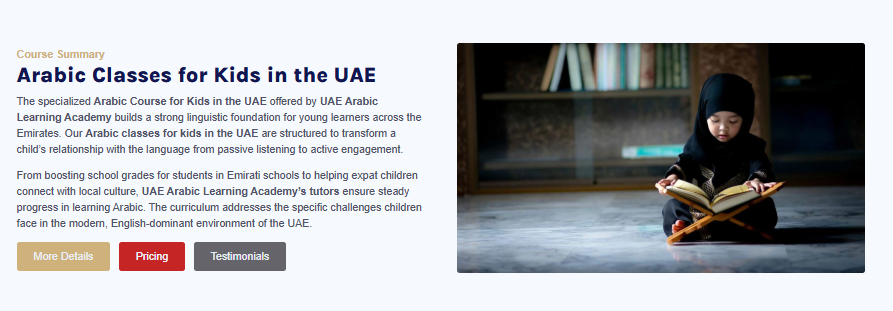
See Our Classroom Environment in Action
Experience a sneak peek into our live sessions. Watch the video below to see our specialized instructors interacting with students, breakdown complex texts, and cultivate an engaging, respectful learning environment.
Master Arabic in the UAE
Experience world-class Arabic language training designed for students and professionals in the Emirates.
Book Your Free Trial6. نشيد الرفق بالحيوان (Nasheed Al-Rifq bil-Hayawan) — “Kindness to Animals” by Ahmad Shawqi
Another Shawqi classic, this poem has appeared in Arabic school curricula across the Arab world for generations. Its subject — treating animals with compassion — is universally accessible, and its short, punchy lines are easy for young children to memorise and recite.
الحَيوانُ خَلقُ لَهُ عَلَيكَ حَقُّ سَخَّرَهُ اللَهُ لَكا وَلِلعِبادِ قَبلَكا
حَمولَةُ الأَثقالِ وَمُرضِعُ الأَطفالِ وَمُطعِمُ الجَماعَه وَخادِمُ الزِراعَه
بَهيمَةٌ مِسكينُ يَشكو فَلا يُبينُ لِسانُهُ مَقطوعُ وَما لَهُ دُموعُ
The theme of the poem is about animal welfare, empathy, and moral responsibility.
The line لسانه مقطوع وما له دموع — “his tongue is severed and he has no tears” — is among the most emotionally affecting lines in children’s Arabic literature. Teachers find this image stays with children long after the lesson, which is exactly what makes Shawqi’s children’s verse so pedagogically durable.
7. قصيدة المدرسة (Qaseedat Al-Madrasa) — “The School Poem” by Ahmad Shawqi
In this poem, Shawqi gives the school itself a voice, speaking directly to the reluctant child who sees the classroom as a prison. The result is a gentle, slightly humorous poem that reframes education as the door to friendship, knowledge, and belonging — not an obligation, but an opportunity.
أَنا المدرَسةُ اجعَلني كأُمٍّ لا تَمِلْ عَنِّي كأَني وجْهُ صَيَّادٍ وَأَنت الطيرُ في الغصن
أَنا المِصْباحُ للفِكرِ أَنا المِفتاحُ للذِّهْن أَنا البابُ إِلى المجدِ تعالَ ادخلْ على اليُمْن
غدًا تَرْتَعُ في حَوْشِي ولا تشبَعُ من صَحْنِي وَأَلقاكَ بِإِخوانٍ يُدانِيكَ في السِّنِّ
The theme of the poem is about the value of school, friendship through education, and the invitation to learn.
The metaphors in this poem — the school as a lamp, as a key, as a door — give children vocabulary for abstract concepts (فكر، ذهن، مجد) embedded in concrete images. This is a practitioner-tested technique: abstract Arabic vocabulary is best introduced through extended metaphor rather than direct definition.
Secure Your Child’s Spot in the Best Arabic Classes for Kids in The UAE with a FREE trial

9. هيَّا إلى البستان (Hayya ila Al-Bustan) — “Let’s Go to the Garden” by Asaad Al-Deiri
This bright, rhythmic poem by Asaad Al-Deiri is built around the repeated call هيَّا إلى البستان — “let’s go to the garden.” That refrain gives children a hook to hold onto and makes the poem ideal for group recitation and movement activities in the classroom.
هيَّا إلى البُستانْ كَي يَلعبَ الأَولادْ هيَّا إلى البُستانْ كَي نَملأَ السَّلَّهْ بالخوخِ والرمَّانْ
هيَّا إلى البُستانْ لنبصرَ العُصفورْ بصوتِهِ الرنَّانْ يغازلُ الشُّحرورْ
هيَّا إلى البُستانْ كي نشكُرَ الفلاَّحْ يقلِّمُ الأَغصانْ كي تكبُرَ الأَدواحْ
The theme of the poem is about nature, play, fruit, birdsong, and gratitude to farmers.
The vocabulary here covers a rich semantic field: خوخ (peach), رمّان (pomegranate), عصفور (sparrow), شحرور (blackbird), فلاّح (farmer), أغصان (branches). Children absorb this vocabulary through the poem’s rhythm without stopping to study it — which is precisely how acquisition works.
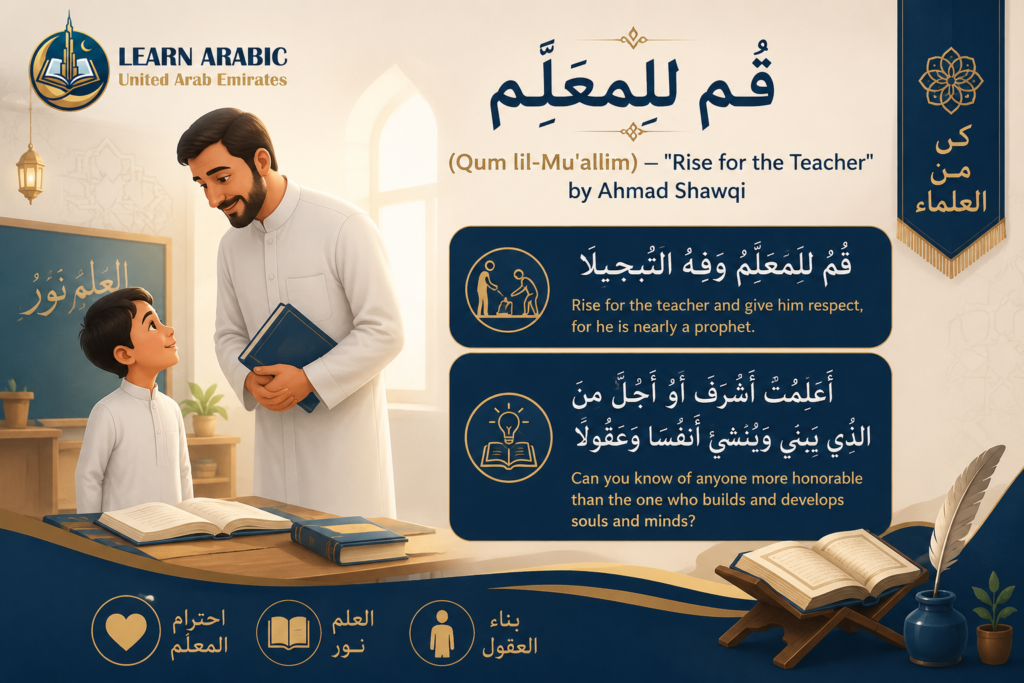
10. قُم للمعلِّم (Qum lil-Mu’allim) — “Rise for the Teacher” by Ahmad Shawqi
This is one of the most famous lines in the Arabic literary tradition, and every Arabic-speaking child encounters it at some point in their schooling. The full poem is long, but even the opening couplet — universally known — is a complete statement that children can recite and understand.
قُم للمعلِّم وفِّه التبجيلا كاد المعلِّمُ أن يكون رسولا
أعلِمتَ أشرَفَ أو أجلَّ مِن الذي يبني ويُنشِئ أنفُسًا وعقولا
The theme of the poem is about reverence for teachers, the nobility of education, and the moral weight of the teaching profession.
Shawqi’s simile — the teacher who “almost became a messenger” — is one of the strongest hyperbolic statements in classical Arabic and introduces children to the concept of مبالغة (hyperbole) in Arabic rhetoric. For older children learning to write their own Arabic, studying how Shawqi constructs comparison is an excellent bridge into Arabic writing classes.
Read also: Hard Arabic Words and Letters to Pronounce: The Advanced Learner’s Complete Guide
How To Use Arabic Poems In Daily Learning?
Poetry only builds language competence when it’s used regularly, not just read once and set aside. These practical approaches come from experienced Arabic teachers and apply across age groups and learning settings.
Read Aloud First, Explain Second
Let children hear the poem at least twice before asking any comprehension questions. The rhythm registers before the meaning does, and that’s fine — in fact, it’s how native speakers first encounter poetry.
Use Movement For Rhythm
Clapping, tapping, or stepping to the beat of a poem locks the prosodic pattern into muscle memory. Children who have physically felt an Arabic meter can later recognise it in new poems they encounter.
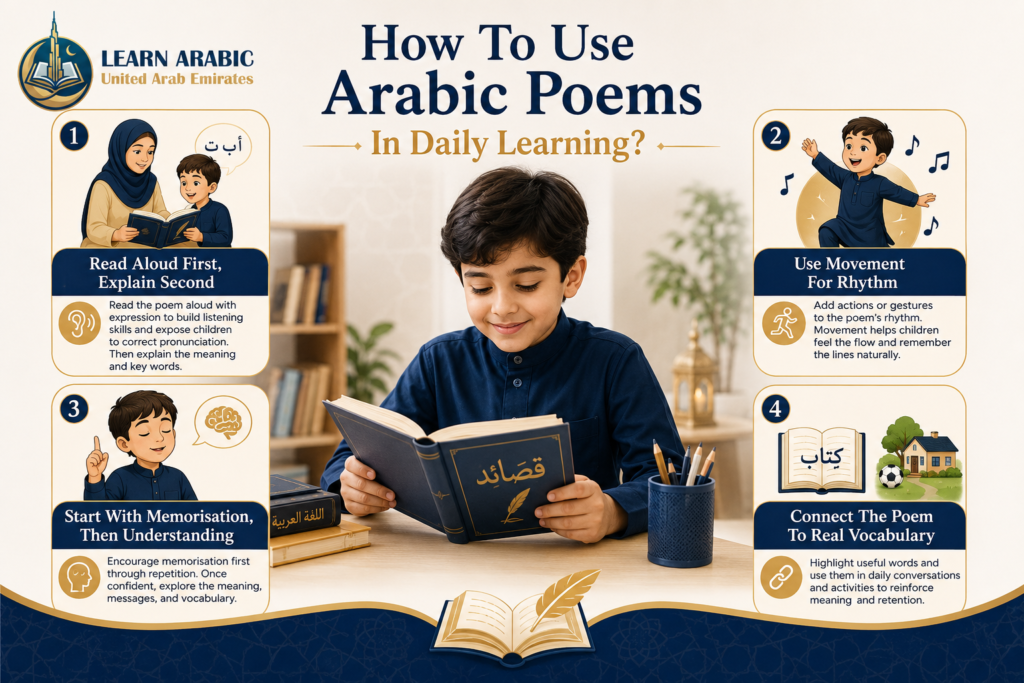
Start With Memorisation, Then Understanding
Classical Arabic pedagogy — and modern research — agree: children memorise first and extract meaning as their vocabulary grows. A five-year-old who can recite أنا طفل accurately is building a linguistic reservoir that pays dividends for years.
Connect The Poem To Real Vocabulary
After reading هيَّا إلى البستان, name real fruits in Arabic at the dinner table. After العصفور الصغير, point out birds in the garden. This is how vocabulary moves from passive to active. For children working on building a broader word base, a structured approach to learn Arabic for kids in the UAE can give that vocabulary acquisition the structure it needs.
For children who want to read original Arabic poetry collections, developing strong reading fluency and vocabulary recognition is essential. Arabic classes for kindergarten in the UAE are specifically structured to build that early literacy foundation, giving young children the tools to eventually access poetry in its original form.
Step Inside Our Classrooms
Don’t just take our word for it—see our community in action. Click below to watch real, live snippets from our recent classes and experience our engaging teaching style firsthand!
Master Arabic in the UAE
Experience world-class Arabic language training designed for students and professionals in the Emirates.
Book Your Free TrialBuild Your Child’s Arabic Further With Learn Arabic UAE
Poetry opens the door, but sustained language acquisition needs structure. Learn Arabic UAE works with children and adults across the Emirates, offering courses designed specifically for learners at every stage — from children encountering Arabic letters for the first time to adults pursuing professional fluency.
Begin Your Child’s Arabic Learning Journey with a FREE Trial Class

Children who come to Learn Arabic UAE with some prior exposure to Arabic — through poems, songs, or family conversations — consistently progress faster than those starting from scratch. The courses are designed to capitalise on that prior knowledge, building reading, writing, grammar, and speaking skills in a logical sequence that keeps children genuinely engaged.
For families in the UAE wondering where to begin, a diagnostic session with one of our instructors will identify exactly where your child is and what they need next. There is no guessing, no one-size-fits-all curriculum — just a clear path forward.
Book your free trial lesson today at UAE Arabic Learning Academy and start you Quran and Arabic Journey
Our Arabic Courses
- Arabic Course in the UAE
- Arabic Intensive Course
- Arabic Classes for Beginners (Learn Arabic from Scratch)
- Madinah Arabic Course
- Arabic Classes for Adults
- Self-Paced Arabic Course
- Arabic Speaking Classes
- Arabic Grammar Course
- Quranic Arabic Course
- Business Arabic Course UAE
- Arabic Language Classes for Professionals in UAE
Master Arabic in the UAE
Experience world-class Arabic language training designed for students and professionals in the Emirates.
Book Your Free TrialConclusion
Arabic poems for kids are among the most underused resources in children’s language education, and among the most effective. A short poem like أنا طفل gives a child their first taste of Arabic rhythm, while Shawqi’s animal fables give an older child their first encounter with Arabic metaphor, moral reasoning, and rich descriptive vocabulary.
The nine poems in this collection span early childhood through late primary level. Used regularly — read aloud, memorised in sections, discussed for meaning — they build a child’s Arabic vocabulary, sharpen their ear for the language’s distinctive sounds, and connect them to a literary tradition that stretches back more than fifteen centuries.Arabic poetry is not a supplement to language learning. At its best, it is language learning.
Frequently Asked Questions
What is a good first Arabic poem for a young child?
أنا طفل (I Am a Child) is widely considered the best starting point for very young learners. Its lines are short, the vocabulary is high-frequency, and the rhythm is easy to clap along to — all of which make it simple to memorise and enjoyable to recite.
At what age can children start learning Arabic poetry?
Children as young as three can benefit from hearing simple Arabic rhymes and chants. Structured memorisation of short poems is appropriate from around age four to five, while longer narrative poems like Shawqi’s animal fables suit children from about age seven onwards.
Are Ahmad Shawqi’s poems suitable for children learning Arabic as a second language?
Yes, with the right selection. Shawqi’s shorter animal poems — such as نشيد الرفق بالحيوان and الهرة والنظافة — use straightforward vocabulary and clear narrative structure. They are appropriate for children at an intermediate level. His longer political and elegiac poetry is better suited to secondary students.
How many lines should a child memorise at a time?
Four to six lines is the practical limit for most children under eight. Longer poems should be broken into stanzas and learned one section per session, with review of the previous section before adding new lines.
Does memorising Arabic poetry actually help with language learning?
It does, consistently. Memorisation builds a phonological model of the language — children internalise what correct Arabic sounds and feels like before they can analyse it grammatically. Many Arabic teachers report that children who have memorised poetry make faster progress in reading comprehension and writing than those who have not.
Where can I find more Arabic poems for children online?
The Alukah network (alukah.net) maintains one of the largest free archives of Arabic children’s poetry in print. The collections from the Islamic Literature Association (Rabitat Al-Adab Al-Islami) are also widely available as downloadable PDFs and are well suited for home learning.



Leave a Reply