 Learn Arabic
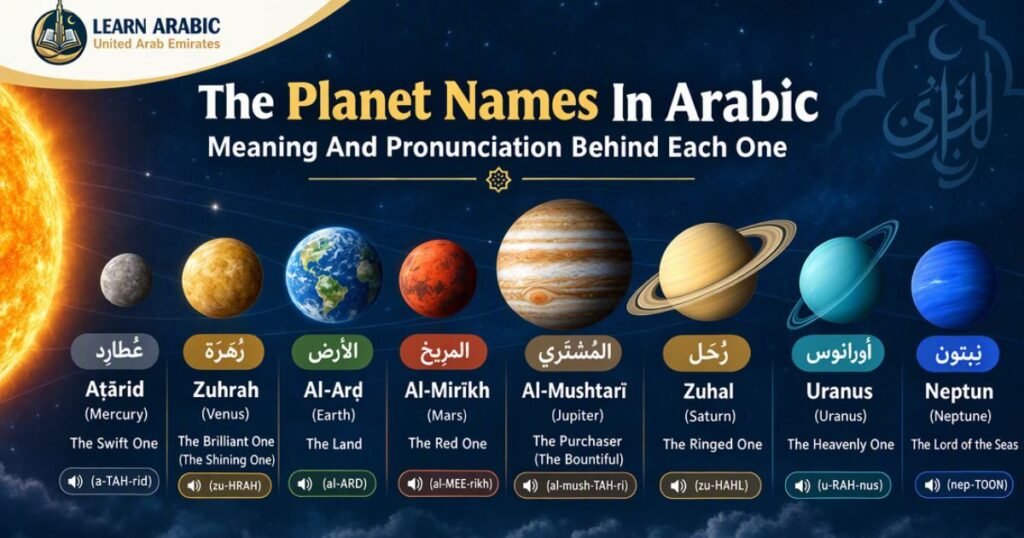
Ask any Arabic learner in the UAE what stumps them most outside daily conversation, and astronomy vocabulary usually comes up fast.
Planet names in Arabic aren’t random transliterations — most of them carry real meaning rooted in classical Arabic, tied to how ancient astronomers actually saw the sky. Knowing where these names come from makes them far easier to remember than just memorizing a word list.
At Learn Arabic In the UAE Academy, we get asked about this topic often, especially by students who want vocabulary that goes beyond textbook greetings and into subjects they’re genuinely curious about.
This guide walks through the Arabic name of every planet in the solar system, how to pronounce it, what it means, and the history behind it — plus extra space vocabulary you can use once you’ve got the planets down.
What You’ll Learn in This Article
- The Arabic name and pronunciation for all nine planets, Mercury through Pluto.
- The Arabic root behind each name and what it originally meant.
- Which planet names are native Arabic and which are transliterated from Western. languages.
- Extra vocabulary for talking about space, stars, and astronomy in Arabic.
- How Arab astronomers shaped the star names still used worldwide today.
Understanding Planets Names in Arabic
Planets names in Arabic split into two clear groups. The five planets visible to the naked eye — Mercury, Venus, Mars, Jupiter, and Saturn — have genuine Arabic names, coined by early astronomers who tracked their movement across the sky for centuries.
The three planets discovered after the invention of the telescope — Uranus, Neptune, and (formerly) Pluto — have no native Arabic root, since Arab astronomers of the classical era never observed them. Their Arabic names are transliterations of the Latin and Greek originals.
This split matters for learners. It explains why five of these words feel deeply Arabic in structure and meaning, while the other three sound close to their English counterparts.
Planets Names in Arabic and Everyday Vocabulary
Several planet names show up outside astronomy entirely.
المريخ (Al-Mirrikh, Mars) and الزهرة (Az-Zuhra, Venus) appear in poetry, place names, and even people’s given names. Knowing these terms gives you vocabulary that reaches well past a science lesson.
The Planets Names In Arabic, From Mercury To Pluto
Below is the Arabic name, transliteration, and meaning for each planet, ordered by distance from the sun — the same order used in Arabic-language science textbooks.
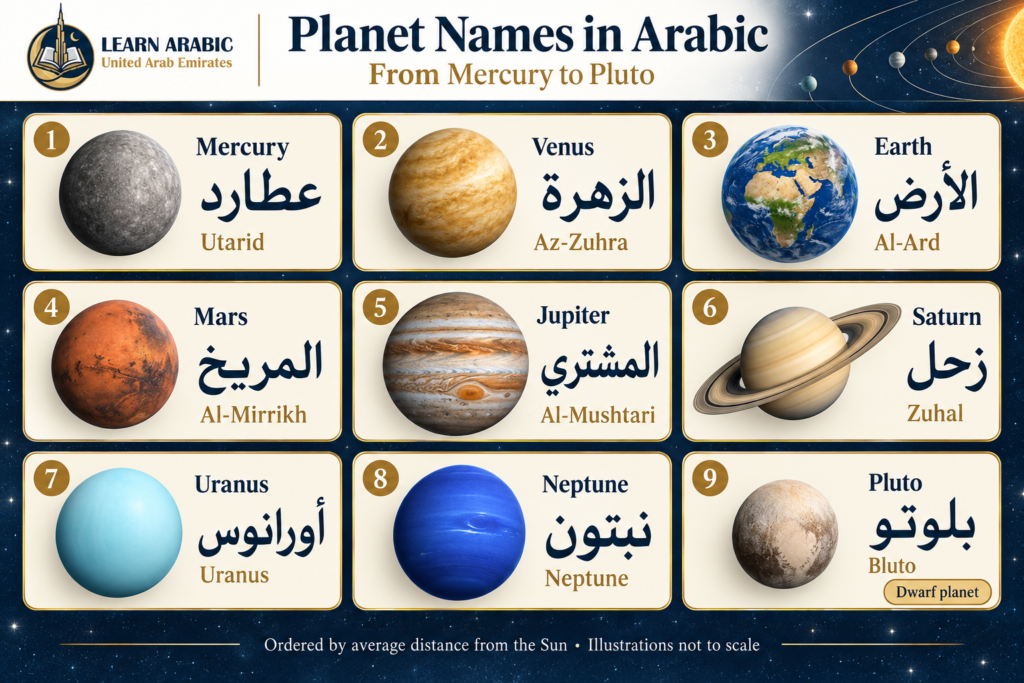
1. Mercury – عطارد (Utarid)
Mercury’s Arabic name, عطارد (Utarid), comes from the root “atrad” or “tarad,” meaning fast-paced, chasing, or continuously following.
Ancient observers named it for exactly what they saw: the fastest-moving object in the sky, completing its orbit around the sun in just 88 Earth days. Some regional dialects also refer to it as “the writer” (الكاتب).
2. Venus – الزهرة (Az-Zuhra)
الزهرة (Az-Zuhra) comes from “zahir,” meaning bright, radiant, or flower-like. It’s a direct nod to Venus’s brilliance — it’s the brightest object in the night sky after the moon.
Ancient poets referenced its glow for centuries before it earned a scientific classification, and today’s astronomers still describe Venus as Earth’s near-twin in size and composition.
3. Earth – الأرض (Al-Ard)
الأرض (Al-Ard) is the most straightforward of the nine: in Arabic, “ard” simply means ground or land.
Earth is the only planet in our solar system confirmed to support life, largely because of its water coverage and breathable atmosphere — which is also why it’s sometimes called “the blue planet” in both English and Arabic.
4. Mars – المريخ (Al-Mirrikh)
المريخ (Al-Mirrikh) is often linked to “markh,” a type of dry wood that ignites easily from friction — a reference to the planet’s reddish, fire-like appearance, caused by iron oxide in its soil.
Mars is roughly half the size of Earth and is widely known in English as the Red Planet, a description that lines up closely with its Arabic imagery.
5. Jupiter – المشتري (Al-Mushtari)
المشتري (Al-Mushtari) comes from “ishtara,” meaning “to buy” or “to acquire.” One interpretation ties this to the idea of a planet that has “acquired” beauty and stability for itself — Jupiter’s structure has remained largely unchanged since the early solar system formed.
It’s also the largest planet in the solar system, massive enough to deflect comets away from the inner planets.
6. Saturn – زحل (Zuhal)
زحل (Zuhal) comes from “zahala,” meaning to withdraw, retreat, or move slowly away. That’s a precise description of what ancient astronomers observed: Saturn was the most distant of the five visible planets, and its long, slow orbit made it appear to lag behind the others. Saturn now has more than 50 confirmed moons.
7. Uranus – أورانوس
Uranus has no classical Arabic name because Arab astronomers never observed it — it wasn’t discovered until 1781, by William Herschel.
Arabic simply transliterates the Greek name, referring to Ouranos, the god of the sky. Uranus is the coldest planet in the solar system, with temperatures dropping to around -224°C.
8. Neptune – نبتون
Like Uranus, نبتون (Neptune) has no Arabic root — it’s a transliteration of the Roman god of the sea, chosen for the planet’s deep blue color, caused by methane gas in its atmosphere. Neptune is the most distant planet from the sun, sitting roughly 4.5 billion kilometers away.
9. Pluto – بلوتو
Though reclassified as a dwarf planet in 2006, بلوتو (Bluto) still comes up often in Arabic-language astronomy content, again as a direct transliteration of its English name.
If you’re building vocabulary from scratch, this is exactly the kind of subject-specific list our Arabic Classes for Beginners are designed around — real topics, not just isolated word drills.
See Our Classroom Environment in Action
Experience a sneak peek into our live sessions. Watch the video below to see our specialized instructors interacting with students, breakdown complex texts, and cultivate an engaging, respectful learning environment.
Master Arabic in the UAE
Experience world-class Arabic language training designed for students and professionals in the Emirates.
Book Your Free TrialRead Also: The Month Names In Arabic
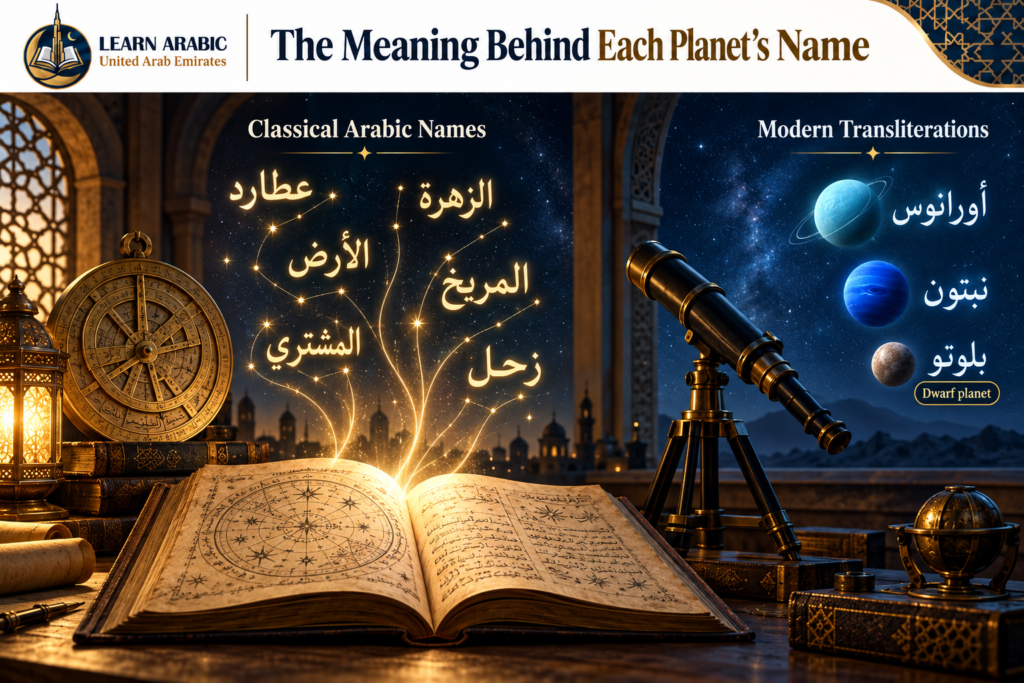
The Meaning Behind Each Planet’s Name
Understanding the root of a word is one of the fastest ways to actually retain it, rather than just recognizing it on a flashcard.
A. Names Rooted in Classical Arabic
Mercury, Venus, Earth, Mars, Jupiter, and Saturn all derive from Arabic roots tied to observable behavior — speed, brightness, plainness, color, growth, and distance. This is a common pattern in classical Arabic vocabulary: names describe function or appearance rather than being arbitrary labels.
A useful decision rule for learners is this — if a planet name sounds like a regular Arabic verb or adjective, it almost certainly has an ancient Arabic origin, not a transliterated one.
B.Transliterated Names for Modern Discoveries
Uranus, Neptune, and Pluto follow no such pattern, since they were named centuries after Arabic’s classical astronomical vocabulary was already fixed.
Recognizing this distinction stops learners from hunting for meaning that doesn’t exist in these three specific words — a common source of confusion we see in class.
If root patterns like these interest you, they become much clearer once you’re comfortable with the alphabet itself — something our Learn Arabic Alphabet Course is built to cover first.
Extra Space Vocabulary In Arabic
Once you know the planet’s names in Arabic, a handful of related terms round out the topic.
| English | Transliteration | Arabic |
|---|---|---|
| Planet | Kawkab | كوكب |
| Sun | Shams | شمس |
| Moon | Al-qamar | القمر |
| Galaxy | Majarah | مجرة |
| Star | Najm | نجم |
| Comet | Muthanab | مذنب |
| Orbit | Falak | فَلَك |
| Black hole | Al-thuqb al-aswad | الثقب الأسود |
Vocabulary like this sits outside most beginner curricula, which is exactly why students who want to hold real conversations often move into our Modern Standard Arabic (MSA) Course once they’ve covered the basics — MSA is the register used across news, science writing, and formal contexts like this one.
Arabic’s Lasting Mark on Astronomy
Arab astronomers didn’t just name planets — they shaped the field itself. In 964 CE, Persian astronomer Abd al-Rahman al-Sufi documented the Andromeda Galaxy in his Book of Fixed Stars, describing it as a “little cloud” centuries before telescopes existed.
In 1006, the SN 1006 supernova — still the brightest stellar event ever recorded — was independently observed by Egyptian astronomer Ali ibn Ridwan and Chinese astronomers of the same era.
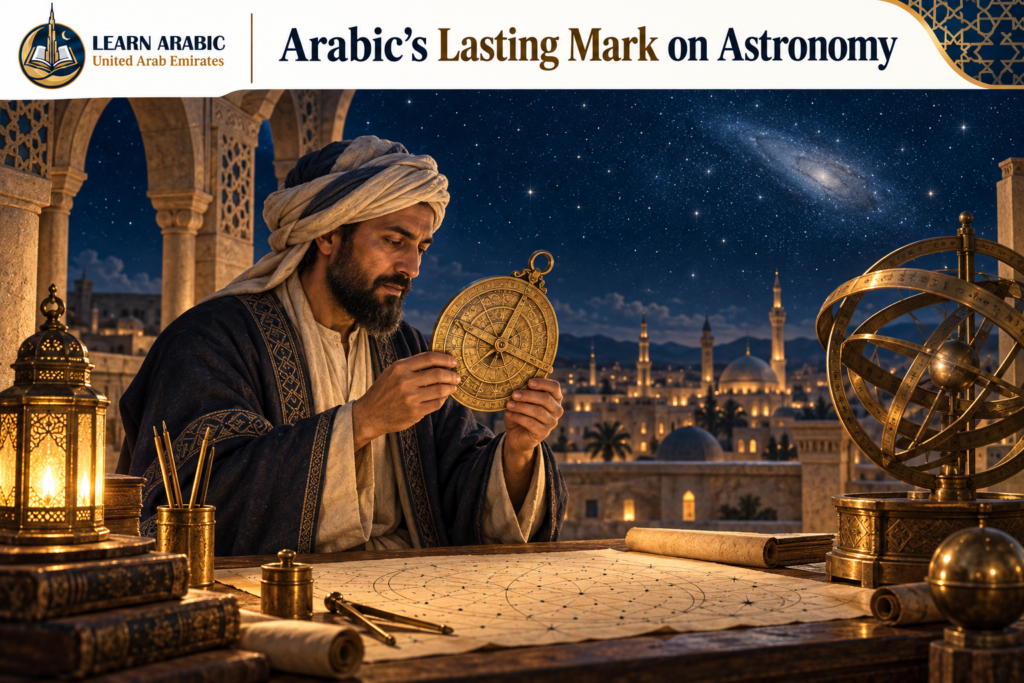
That legacy is why 165 stars still carry Arabic names today, including Denebola (from “dhanab,” meaning tail) and Rigel (meaning “the foot”) in the constellation Orion, and Aldebaran, the orange star in Taurus whose name means “the follower.”
Step Inside Our Classrooms
Don’t just take our word for it—see our community in action. Click below to watch real, live snippets from our recent classes and experience our engaging teaching style firsthand!
Master Arabic in the UAE
Experience world-class Arabic language training designed for students and professionals in the Emirates.
Book Your Free TrialRead Also: 10 Interesting Easy Arabic Stories For Kids
Start Learning Arabic Vocabulary That Actually Sticks
Word lists fade fast when there’s no structure behind them. If topics like planet names in Arabic interest you, imagine covering an entire language this way — one grounded in real context, not rote memorization.
Learn Arabic In the UAE Academy builds every course around exactly that approach, whether you’re starting from the alphabet or pushing toward fluency. If you want to move quickly, our Arabic Intensive Course is built for faster, focused progress.
Our Arabic courses:
- Arabic Classes for Beginners
- Madinah Arabic Course
- Arabic Classes for Adults
- Self-Paced Arabic Course
- Arabic Speaking Classes
- Learn to Write Arabic Course
- Arabic Grammar Course
- Learn Arabic Alphabet Course
- Modern Standard Arabic (MSA) Course
- Quranic Arabic Course
- Fusha Arabic Course

Conclusion
Planets names in Arabic aren’t arbitrary — five of the nine carry meanings tied directly to what ancient astronomers observed, from عطارد’s speed to زحل’s slow retreat across the sky.
The other three, discovered centuries later, are simple transliterations with no classical root. Together, this vocabulary connects you to a language shaped by real scientific history, not just a subject taught in isolation.
Whether you’re a beginner or already comfortable with Arabic, planet names in Arabic are a genuinely useful, memorable way to expand what you know — and at Learn Arabic In the UAE Academy, that’s exactly the kind of vocabulary we build our lessons around.

Frequently Asked Questions
Here are quick answers to the questions learners ask most often about planet names in Arabic, based on common searches and classroom questions.
1. What is the Arabic name for Earth?
Earth’s Arabic name is الأرض (Al-Ard), meaning “the ground” or “the land.” It’s one of the most commonly used Arabic words in everyday speech, not just in astronomy.
2. Why don’t Uranus and Neptune have Arabic names?
Uranus and Neptune don’t have native Arabic names because they were discovered after the era of classical Arab astronomy had ended. Both names are direct transliterations of their Greek and Roman originals.
3. Is Pluto still called a planet in Arabic-language materials?
Pluto (بلوتو) has been officially classified as a dwarf planet since 2006, but it’s still commonly discussed alongside the eight planets in Arabic-language educational content for consistency with older material.
4. What does زحل (Zuhal) mean in Arabic?
زحل (Zuhal), the Arabic name for Saturn, means “to withdraw” or “move slowly away.” It describes Saturn’s distant position and long orbital period compared to the other visible planets.
5. How many stars still have Arabic names?
Around 165 stars still carry Arabic-derived names today, a legacy of medieval Arab astronomers who mapped and named the night sky in detail. Rigel and Aldebaran are two well-known examples.



[…] Read Also: The Planet Names In Arabic […]