 Learn Arabic
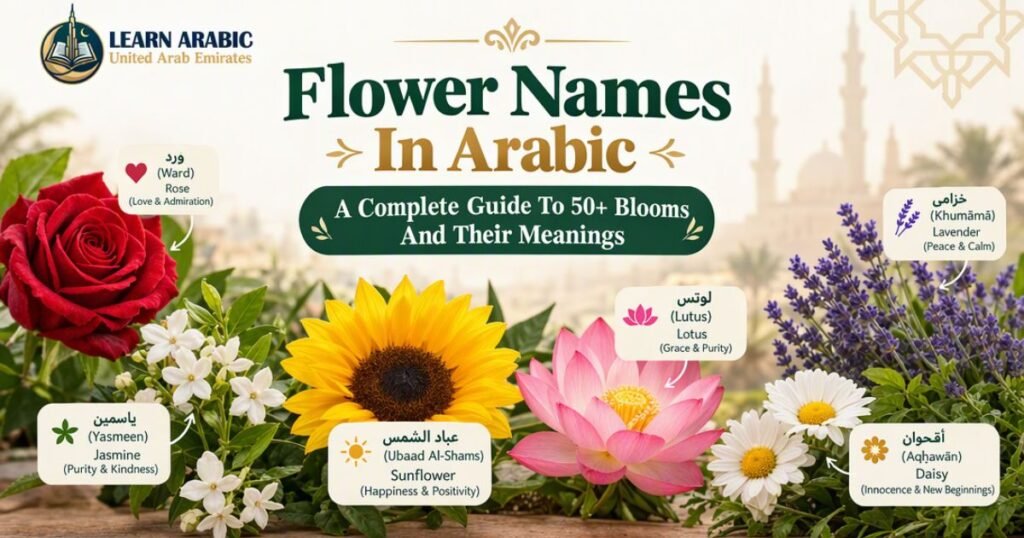
Flowers open a door into Arabic that grammar drills rarely reach. Learning flower names in Arabic lets you read a line of Arabic poetry, order the right bouquet in a UAE flower souk, or understand why a red rose and a sprig of jasmine carry such weight in everyday Arabic conversation.
This guide organizes more than 50 flower names in Arabic into clear categories, with native script, transliteration, and English meaning for each one. You’ll also learn the cultural symbolism behind the most common blooms, how regional Arabic dialects change certain names, and the pronunciation habits that trip up new learners.
Everything here is built for real use, not just memorization. By the end, you’ll be able to describe a bouquet, follow a line of Arabic poetry about roses, and recognize flower vocabulary the way a native speaker actually uses it.
What You’ll Learn in This Article
Here’s a quick overview of what this guide covers before you dive into the full vocabulary breakdown.
- The two core Arabic words for “flower” and when each one is used.
- 50 flower names in Arabic grouped by type, with pronunciation.
- What specific flowers symbolize in Arab culture and poetry.
- How flower names shift across Gulf, Levantine, and Egyptian Arabic.
- Common pronunciation mistakes and how to avoid them.
What Are Flowers Called In Arabic?
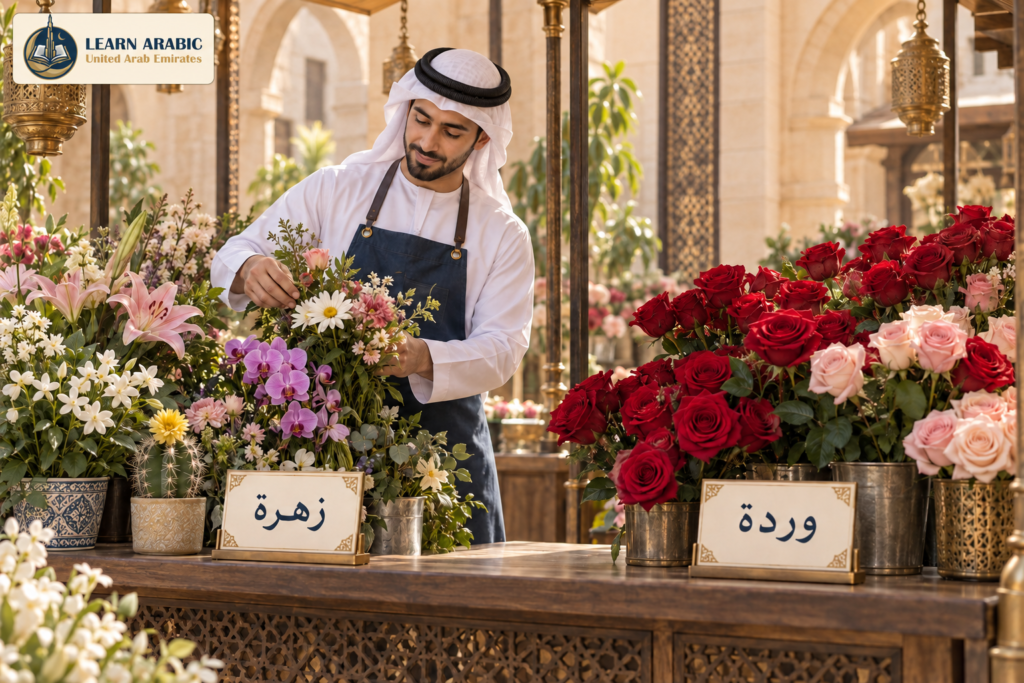
Flowers in Arabic are most commonly called زهرة (zahra) for a single flower, with the plural زهور (zuhūr). The word وردة (warda) technically means “rose” but is used so widely that many speakers use it as a general stand-in for “flower,” much like English speakers sometimes say “roses” loosely to mean flowers in general.
Both words appear constantly in formal writing, song lyrics, and daily speech, so understanding the distinction between them is the first real step toward mastering flower names in Arabic.
Zahra vs. Warda: The Two Words for Flower
زهرة (zahra) is the neutral, dictionary-correct word for “flower” and works for any bloom, from a daisy to a cactus flower.
وردة (warda), by contrast, specifically means “rose,” and its plural ورد (ward) is often used in poetry and formal speech to mean flowers broadly.
If you’re naming a flower and you’re not sure which word fits, zahra is always the safe, grammatically correct choice. Warda is reserved for the rose itself or for stylistic, poetic use.
Why Flower Vocabulary Matters for Arabic Learners?
Flower names show up far more often than beginners expect: in wedding vocabulary, perfume descriptions, restaurant menus (rose water, orange blossom water), and classical Arabic poetry, where flowers are used as metaphors for beauty, love, and loss. Building this vocabulary early makes intermediate reading and listening noticeably easier.
Common Flower Names in Arabic Every Learner Should Know
These are the flower names in Arabic you’ll hear most often in daily conversation, media, and casual writing across the Arab world. Start memorizing here before moving to the more specialized categories below.
1. Rose, Jasmine, And Lily: The Big Three
These three names carry more cultural weight than any other flowers in the language, so they come first.
- وردة (warda) – rose – the single most referenced flower in Arabic culture
- ياسمين (yāsamīn) – jasmine – linked to Damascus, nicknamed “the City of Jasmine”
- زنبق (zanbaq) – lily – associated with purity, common in wedding vocabulary
These three names appear disproportionately often in Arabic songs, greeting cards, and casual speech, which makes them the highest-value words to learn first if your goal is real conversational use.
2. Other Everyday Flower Names in Arabic
There isn’t an inconsistency in the language; the name reflects the difference between everyday spoken Arabic and more formal, written Arabic — a distinction that becomes second nature once you’ve had structured practice as follows:
- توليب (tūlīb) – tulip
- قرنفل (qaranful) – carnation
- بنفسج (banafsaj) – violet
- بابونج (bābūnaj) – chamomile, the everyday spoken term for daisy-like blooms
- كركديه (karkadēh) – hibiscus, also the name of the popular hibiscus drink
- أقحوان (uqḥuwān) – the more formal, dictionary term covering chamomile and daisy-type flowers
- أوركيد (urkīd) – orchid
Notice that Arabic sometimes has two valid words for a similar flower type, as with بابونج and أقحوان above.
The Classical Arabic Course at Learn Arabic in the UAE Academy covers exactly this kind of formal-versus-colloquial vocabulary shift in detail.
Garden And Fragrant Flower Names In Arabic
Beyond the everyday basics, a second layer of flower names in Arabic covers the varieties associated with perfume, home gardens, and gift-giving. These come up often in conversations about scent, home décor, and special occasions.
Flowers Used in Arabic Perfumes and Teas
These blooms are the ones you’ll most often smell before you see — they show up in perfume counters, tea blends, and traditional Gulf hospitality rituals.
| Arabic | Transliteration | English | Note |
| زهرة الفُلّ | zahrat al-full | Arabian jasmine (sambac) | A heavily fragrant variety used in perfume and traditional adornments |
| خزامى | khuzāmā | Lavender | Used in aromatherapy and traditional remedies across the Middle East |
| زهرة البرتقال | zahrat al-burtuqāl | Orange blossom | Used to flavor orange blossom water, a staple in Gulf and Levantine desserts |
| الريحان | ar-rīḥān | Basil flower | Common in Middle Eastern cooking and salads |
Ornamental Garden Varieties
These are the flowers most likely to appear in a home garden or a formal floral arrangement rather than in a kitchen or perfume bottle.
| Arabic | Transliteration | English | Note |
| سوسن | sawsan | Iris | Prized for its elegant, intricate petals |
| نرجس | narjis | Narcissus | Associated with spring and renewal |
| غاردينيا | gārdīniyā | Gardenia | Known for its intense fragrance |
| فاونيا | fāwniyā | Peony | Large, showy blooms often used in bouquets |
| كاميليا | kāmīliyā | Camellia | An elegant, winter-blooming variety |
A practical note for learners: long vowels (the ā, ī, and ū sounds) appear constantly in this category — khuzāmā, gārdīniyā, kāmīliyā. Holding these vowels slightly longer than you would in English is what makes Arabic flower names sound natural instead of clipped.
Step Inside Our Classrooms
Don’t just take our word for it—see our community in action. Click below to watch real, live snippets from our recent classes and experience our engaging teaching style firsthand!
Master Arabic in the UAE
Experience world-class Arabic language training designed for students and professionals in the Emirates.
Book Your Free TrialRead Also: The Planet Names In Arabic
Wild, Seasonal, And Regional Flower Names In Arabic
Some of the most distinctive flower names in Arabic describe blooms tied to a specific season, landscape, or region — desert wildflowers, Mediterranean varieties, and names that shift depending on which Arabic-speaking country you’re in.
Wildflowers Across the Arab World:
There is a wide variety in the wildflowers across the Arab world such as:
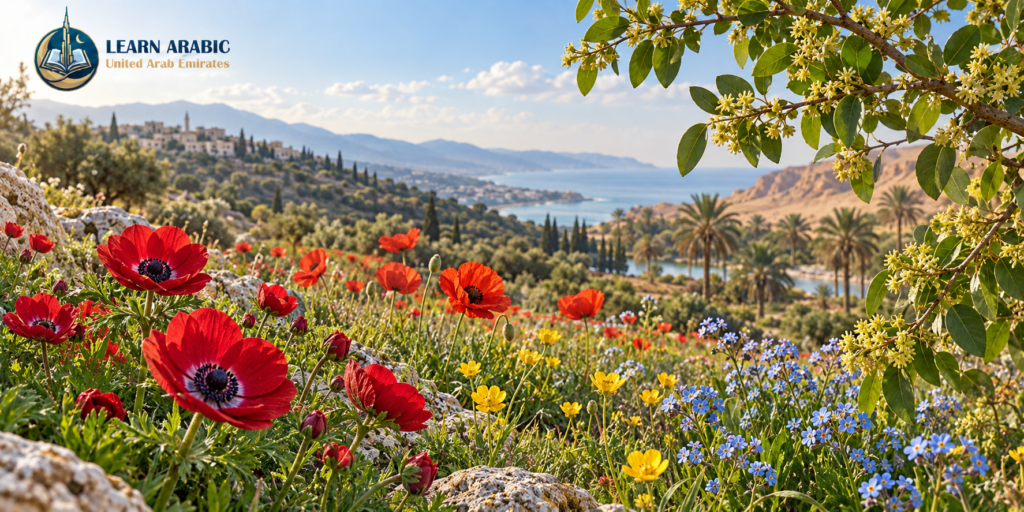
- شقائق النعمان (shaqāʾiq an-nuʿmān): anemone – a bright red wildflower common across the Levant each spring
- خشخاش (khashkhāsh): poppy: a familiar bright red field flower
- حوذان (ḥawdhān): buttercup
- لا تنساني (lā tansānī): forget-me-not, a literal translation of the English name
- زهرة السدر (zahrat as-sidr): the flower of the Sidr tree, notable because its honey is highly prized across the Gulf and Levant
Regional Dialect Variations in Flower Names
Flower vocabulary isn’t identical everywhere.
بوغنفيليا (bughanfīliya) is the standard term for bougainvillea in many countries, but the same plant is often called جهنمية (jahannamiyya) in parts of the Levant and Gulf — both names are correct, they simply reflect local usage. Similarly, داوود الشمس and عباد الشمس are both heard for sunflower depending on the region.
This kind of variation is one reason generic vocabulary lists sometimes fall short: a word that’s standard in Cairo may sound unusual in Abu Dhabi.
If you’re learning Arabic specifically for life in the UAE, the Emirati Arabic Course and Gulf Arabic Course at Learn Arabic in the UAE Academy teach the exact regional vocabulary and pronunciation patterns you’ll actually hear day to day.
Decorative And Additional Flower Names In Arabic
The final layer of vocabulary covers flowers you’ll mostly encounter in bouquets, florist shops, and casual conversation about gardens — useful for rounding out a complete list of flower names in Arabic.
A. Flowers for Bouquets and Special Occasions
These flowers are the ones florists and gift-givers reach for most often for weddings, holidays, and centerpieces.
| Arabic | Transliteration | English | Note |
| داليا | dāliyā | Dahlia | Large, colorful blooms popular in centerpieces |
| بيتونيا | baytūniyā | Petunia | A common trailing plant in floral arrangements |
| بنت القنصل | bint al-qunṣul | Poinsettia | Literally “the consul’s daughter,” a holiday favorite |
| فم السمكة | fam as-samaka | Snapdragon | Literally “fish mouth,” named for its shape |
| فريزيا | frīziyā | Freesia | Delicate and fragrant, common in cut-flower bouquets |
| غلاديولس | glādīwlus | Gladiolus | Tall stems with sword-like leaves |
| مجد الصباح | majd aṣ-ṣabāḥ | Morning glory | A climbing vine with trumpet-shaped blooms |
B. More Flower Names to Round Out Your Vocabulary
This last set covers additional flowers worth knowing once you’ve mastered the categories above.
| Arabic | Transliteration | English | Note |
| كوبية | kūbīyā | Hydrangea | Large, round flower clusters |
| زهرة الربيع | zahrat ar-rabīʿ | Primrose | Literally “spring flower,” among the first to bloom |
| بخور مريم | bakhūr maryam | Cyclamen | Literally “Mary’s incense,” a fragrant winter bloom |
| وستارية | wistāriyā | Wisteria | Cascading purple blooms |
| قفاز الثعلب | quffāz ath-thaʿlab | Foxglove | Literally “fox’s glove,” tall flower spikes |
| أمارلس | amārlis | Amaryllis | Large, trumpet-shaped flowers |
| ليلك | laylak | Lilac | A fragrant spring shrub |
| خربق | kharbaq | Hellebore | A winter-blooming perennial |
| فلوكس | flūks | Phlox | Dense clusters of small flowers |
| لويزة | luwayza | Verbena | Small blooms that attract butterflies and bees |
| زينيا | zīniyā | Zinnia | A bright summer annual |
| آذريون | ādhariyūn | Calendula | A medicinal orange flower |
| مريمية | maryamiyya | Salvia | An aromatic herb with colorful flower spikes |
| بسلة الزهور | basalat az-zuhūr | Sweet pea | Literally “flower pea,” a climbing, sweetly scented vine |
| خطمي | khatamī | Hollyhock | A tall cottage-garden flower |
| قطيفة | qaṭīfa | Marigold | A bright garden favorite often used in bouquets |
| زهرة الكرز | zahrat al-karaz | Cherry blossom | A springtime symbol of renewal |
| زهرة الزيتون | zahrat az-zaytūn | Olive blossom | Associated with the Mediterranean and, symbolically, with peace |
| زهرة الرمان | zahrat ar-rummān | Pomegranate blossom | Associated with autumn and prosperity |
How To Pronounce And Use Flower Names In Arabic Sentences?
Knowing a flower’s name in Arabic script does little good if you can’t produce it correctly out loud, especially since several sounds in this vocabulary set don’t exist in English.
Arabic distinguishes between short and long vowels, and flower names are full of long ones: zanbaq, yāsamīn, khuzāmā, gārdīniyā. Holding the long vowel for roughly double the duration of a short one is what separates a native-sounding pronunciation from a flattened, Anglicized one.
Practicing pairs like ورد (ward, roses) versus وردة (warda, a rose) is a useful way to train your ear for this distinction.
Common Mistakes Learners Make
A frequent error is treating every flower list online as equally reliable — some circulating vocabulary lists include invented or non-standard Arabic spellings for flowers that don’t map to any word an Arabic speaker actually uses.
When in doubt, default to the two safest, most universally understood terms: زهرة (zahra) for “flower” in general and the specific botanical name (like زنبق for lily) when you know it.
A second common mistake is dropping the ة (ta marbuta) ending sound, which changes زهرة (zahra) into something that no longer sounds like a real word to a native listener.
Structured pronunciation practice with a real instructor catches these habits early, before they become fixed. Learners working through the Arabic Intensive Course at Learn Arabic in the UAE Academy get this kind of direct correction from day one, rather than guessing based on transliteration alone.
See Our Classroom Environment in Action
Experience a sneak peek into our live sessions. Watch the video below to see our specialized instructors interacting with students, breakdown complex texts, and cultivate an engaging, respectful learning environment.
Master Arabic in the UAE
Experience world-class Arabic language training designed for students and professionals in the Emirates.
Book Your Free TrialRead Also: 10 Steps To Learn Egyptian Arabic for Kids
Start Speaking Real Arabic with Learn Arabic in the UAE Academy
Reading a list of flower names in Arabic is a strong first step, but real fluency comes from speaking, listening, and getting corrected in real time by someone who knows exactly where Arabic learners tend to go wrong.
Learn Arabic in the UAE Academy builds that structured practice into every course, whether you’re starting from zero or refining pronunciation you’ve picked up on your own.
Explore the full range of programs through the Arabic Course in the UAE and find the track that matches your goals, from formal Classical Arabic to the Gulf dialect spoken across the Emirates.
Our Arabic courses:
- Arabic Course in the UAE
- Arabic Intensive Course
- Madinah Arabic Course
- Arabic Classes for Adults
- Self-Paced Arabic Course
- Arabic Speaking Classes
- Learn to Write Arabic Course
- Arabic Grammar Course
- Learn Arabic Alphabet Course
- Modern Standard Arabic (MSA) Course
- Quranic Arabic Course
- Fusha Arabic Course

Conclusion
Flower names in Arabic are one of the richest, most rewarding vocabulary sets you can learn, connecting you to poetry, everyday expressions, and cultural traditions that go far beyond botany.
From the foundational وردة (warda) and ياسمين (yāsamīn) to regional variations like جهنمية for bougainvillea, this vocabulary rewards learners who go past memorization and into real usage and pronunciation.
The single most useful habit is pairing vocabulary with structured, corrected practice — learning flower names in Arabic is far more useful when you can also pronounce them correctly and use them in a real sentence.
Learn Arabic in the UAE Academy offers exactly that kind of guided practice across formal, Gulf, and Emirati Arabic tracks.

Frequently Asked Questions About Flower Names in Arabic
The questions below cover the details learners ask most often when studying flower names in Arabic, from basic vocabulary to regional pronunciation differences.
1. What is the Arabic word for flower?
The Arabic word for flower is زهرة (zahra), with the plural زهور (zuhūr). The related word وردة (warda) specifically means “rose” but is often used informally to mean “flower” in general.
2. How do you say rose in Arabic?
Rose in Arabic is وردة (warda), or ورد (ward) in its plural or collective form. It’s the most culturally significant flower name in Arabic, appearing throughout poetry, music, and everyday expressions of love and hospitality.
3. Are flower names the same in every Arabic-speaking country?
No, some flower names in Arabic vary by region even though the standard Modern Standard Arabic term is understood everywhere. Bougainvillea, for example, is called بوغنفيليا (bughanfīliya) in some places and جهنمية (jahannamiyya) in others, depending on local dialect.
4. Is it hard to pronounce Arabic flower names correctly?
The main challenge is Arabic’s long vowels, which don’t have a direct English equivalent and need to be held longer than a short vowel. Most learners improve quickly with focused speaking practice and direct correction from an instructor rather than from written transliteration alone.
5. What does jasmine symbolize in Arabic culture?
Jasmine (ياسمين) symbolizes purity, grace, and hospitality in Arabic culture. It’s closely tied to Damascus, popularly known as “the City of Jasmine,” and to Tunisia, where it’s the national flower.
6. Why do some Arabic flower lists give different spellings for the same flower?
Different spellings often reflect the gap between formal Modern Standard Arabic and everyday spoken dialects, or genuine regional variation. Less reliably, some online lists include non-standard or inaccurate spellings, so it’s worth confirming unfamiliar terms with a native speaker or instructor.




[…] Read Also: Flower Names In Arabic […]