 Learn Arabic
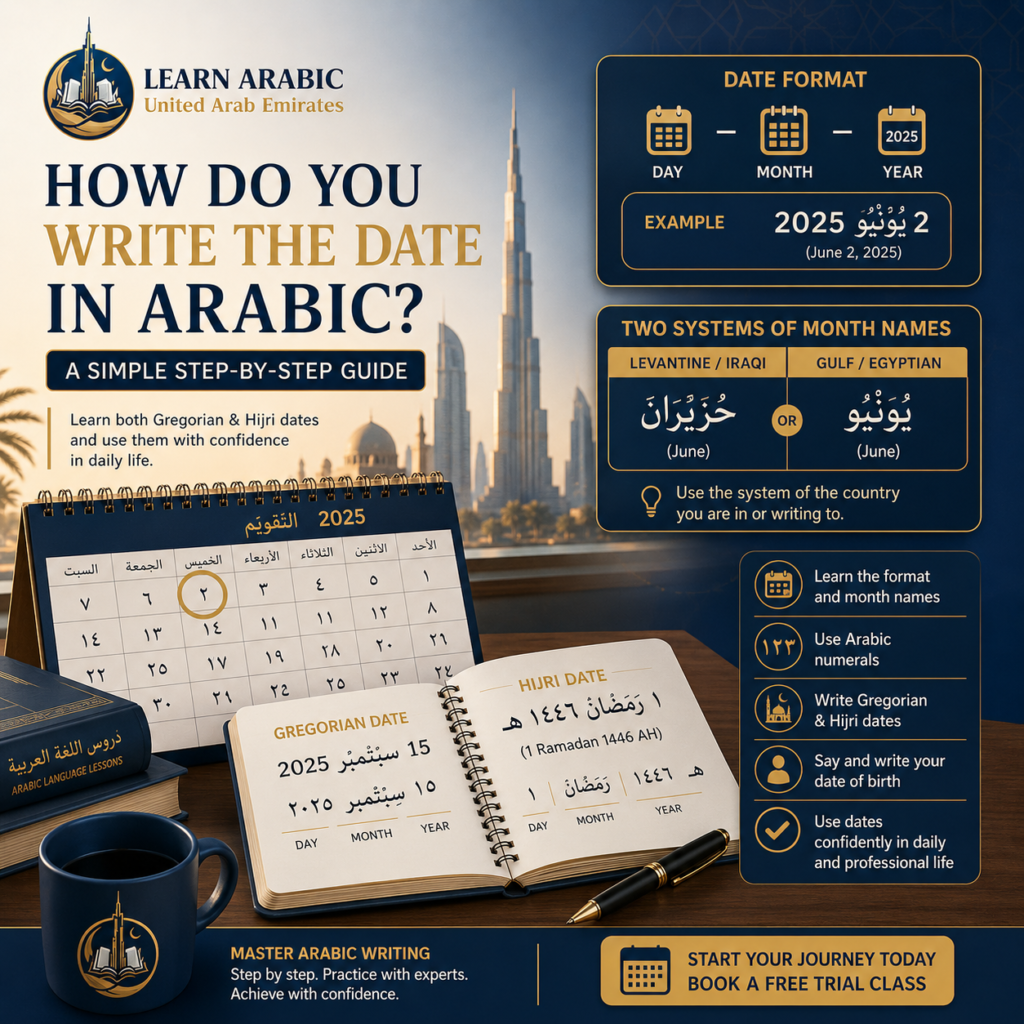
Learning how to write the date in Arabic is one of those practical skills that textbooks rush past — yet it comes up constantly, whether you’re filling out a form in Dubai, reading an Arabic newspaper, or messaging a colleague in Riyadh. Arabic uses two calendar systems, two sets of month names, and a different numeral convention depending on the context. Get any one of those wrong, and the date reads awkwardly to a native speaker.
This guide breaks the whole system down into eight focused steps. By the end, you’ll know exactly how to write the date in Arabic — in both the Gregorian and Hijri systems — and how to say your date of birth confidently in any Arab country.
1. Understand the Format: Day–Month–Year
The standard Arabic date format for the Gregorian calendar follows this order:
Day (number) — Month (name) — Year (number)
Example: 2 يُونْيُو 2025 (June 2, 2025)
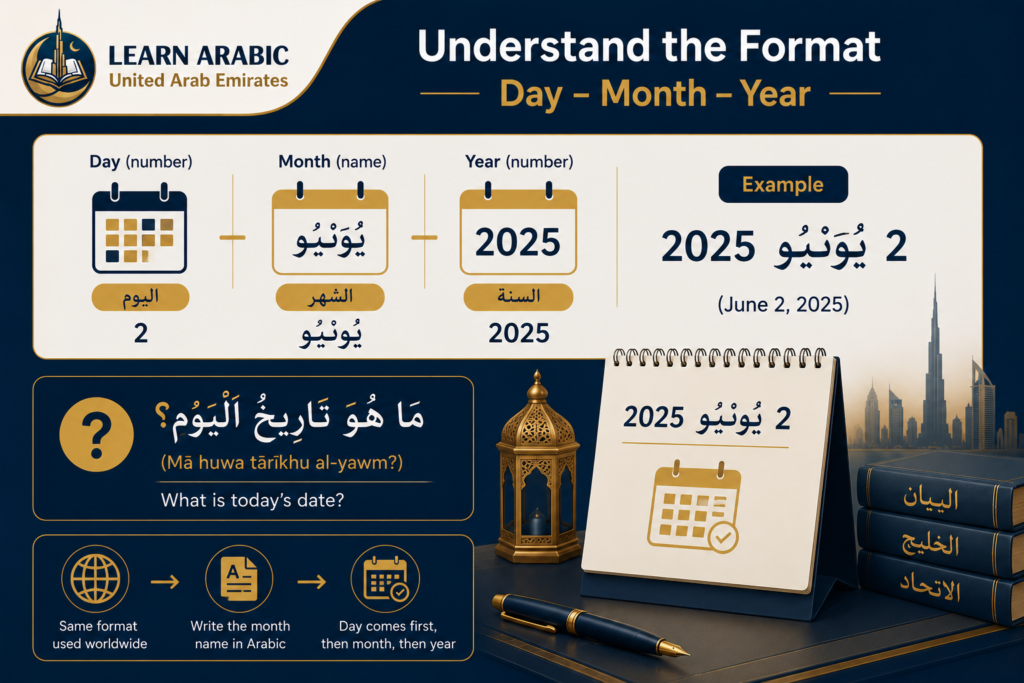
This is the same sequence used in most of the world outside the United States. The day comes first, then the month name written out in Arabic, then the four-digit year. You do not write the month as a number in formal Arabic writing — you write its Arabic name.
To ask today’s date in Arabic, say:
مَا هُوَ تَارِيخُ الْيَوْم؟ (Mā huwa tārīkhu al-yawm?) — “What is today’s date?”
The reply follows the day–month–year structure above.
2. Learn the Two Systems of Arabic Month Names
This is where most learners stall. Arabic-speaking countries use two different sets of Gregorian month names depending on the region, and a native speaker notices immediately if you use the wrong system for their country.
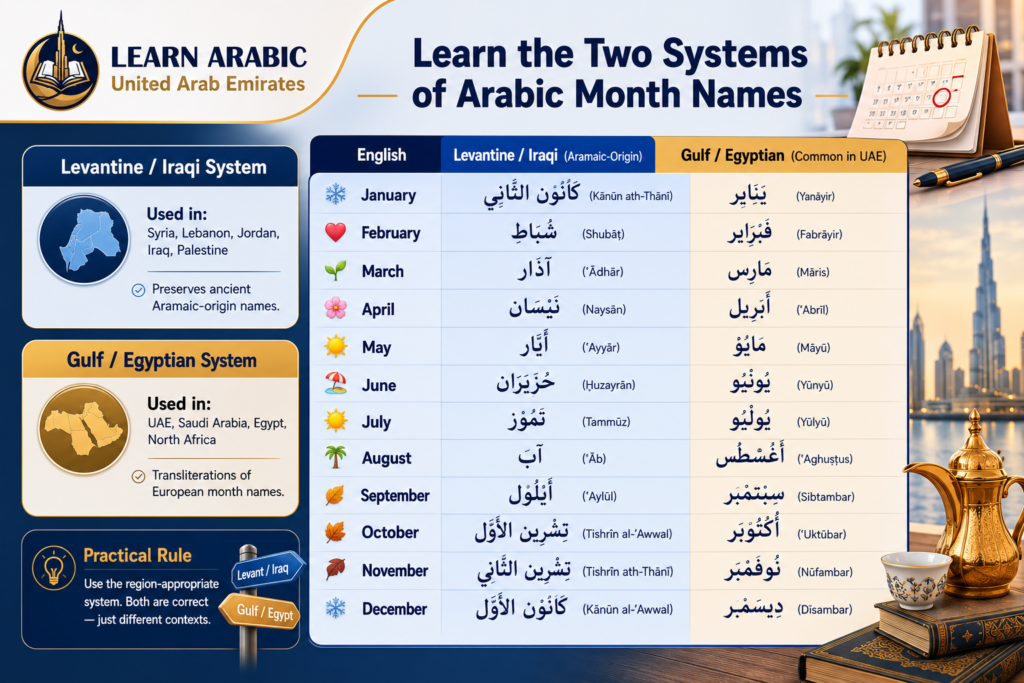
The Levantine/Iraqi system preserves ancient Aramaic-origin names still used across Syria, Lebanon, Jordan, Iraq, and Palestine.
The Gulf/Egyptian system uses transliterations of the European month names and is standard in Egypt, Saudi Arabia, the UAE, and North Africa.
| English | Levantine/Iraqi | Gulf/Egyptian |
| January | كَانُون الثَّانِي (Kānūn ath-Thānī) | يَنَايِر (Yanāyir) |
| February | شُبَاط (Shubāṭ) | فَبْرَايِر (Fabrāyir) |
| March | آذَار (ʾĀdhār) | مَارِس (Māris) |
| April | نَيْسَان (Naysān) | أَبْرِيل (ʾAbrīl) |
| May | أَيَّار (ʾAyyār) | مَايُو (Māyū) |
| June | حُزَيْرَان (Ḥuzayrān) | يُونْيُو (Yūnyū) |
| July | تَمُّوز (Tammūz) | يُولْيُو (Yūlyū) |
| August | آب (ʾĀb) | أَغُسْطُس (ʾAghusṭus) |
| September | أَيْلُول (ʾAylūl) | سِبْتَمْبَر (Sibtambar) |
| October | تِشْرِين الْأَوَّل (Tishrīn al-ʾAwwal) | أُكْتُوبَر (ʾUktūbar) |
| November | تِشْرِين الثَّانِي (Tishrīn ath-Thānī) | نُوفَمْبَر (Nūfambar) |
| December | كَانُون الْأَوَّل (Kānūn al-ʾAwwal) | دِيسَمْبَر (Dīsambar) |
Practical rule: if you’re in or writing to someone in the Gulf, Egypt, or North Africa, use the Gulf/Egyptian column. If you’re in the Levant or Iraq, use the Levantine/Iraqi column. Both are correct Arabic — they just belong to different contexts.
See Our Classroom Environment in Action
Experience a sneak peek into our live sessions. Watch the video below to see our specialized instructors interacting with students, breakdown complex texts, and cultivate an engaging, respectful learning environment.
Master Arabic in the UAE
Experience world-class Arabic language training designed for students and professionals in the Emirates.
Book Your Free TrialRead More: How to Write in Arabic in the UAE?
3. Learn How To Write Today’s Date in Arabic Numbers
Arabic uses two numeral systems that learners frequently confuse:
Eastern Arabic numerals (٠ ١ ٢ ٣ ٤ ٥ ٦ ٧ ٨ ٩) — used in print across Egypt, the Gulf, and the Levant, especially in handwritten and formal contexts.
Western Arabic numerals (0 1 2 3 4 5 6 7 8 9) — the digits used globally, and also widely used in digital and informal Arabic contexts.
To write today’s date in Arabic numbers, the format stays the same — day first, then month name, then year. For example, the 15th of September 2025 written with Eastern Arabic numerals reads:
١٥ سِبْتَمْبَر ٢٠٢٥
And with Western Arabic numerals:
15 سِبْتَمْبَر 2025
Both are used in real-world Arabic writing. Formal printed documents and some newspapers prefer Eastern Arabic numerals; digital platforms and official government forms in the Gulf increasingly use Western numerals. Knowing both prevents confusion when you encounter either in the wild.
Build Your Arabic Writing Skills with a FREE Trial Class

4. Learn How to Write the Hijri Date in Arabic
The Islamic (Hijri) calendar — التَّقْوِيم الْهِجْرِيّ (at-Taqwīm al-Hijrī) — is a lunar calendar that began with the Prophet Muhammad’s (peace be upon him) migration from Mecca to Medina in 622 CE. It runs approximately 11 days shorter than the Gregorian year, which means Hijri dates cycle through all seasons over a 33-year period.
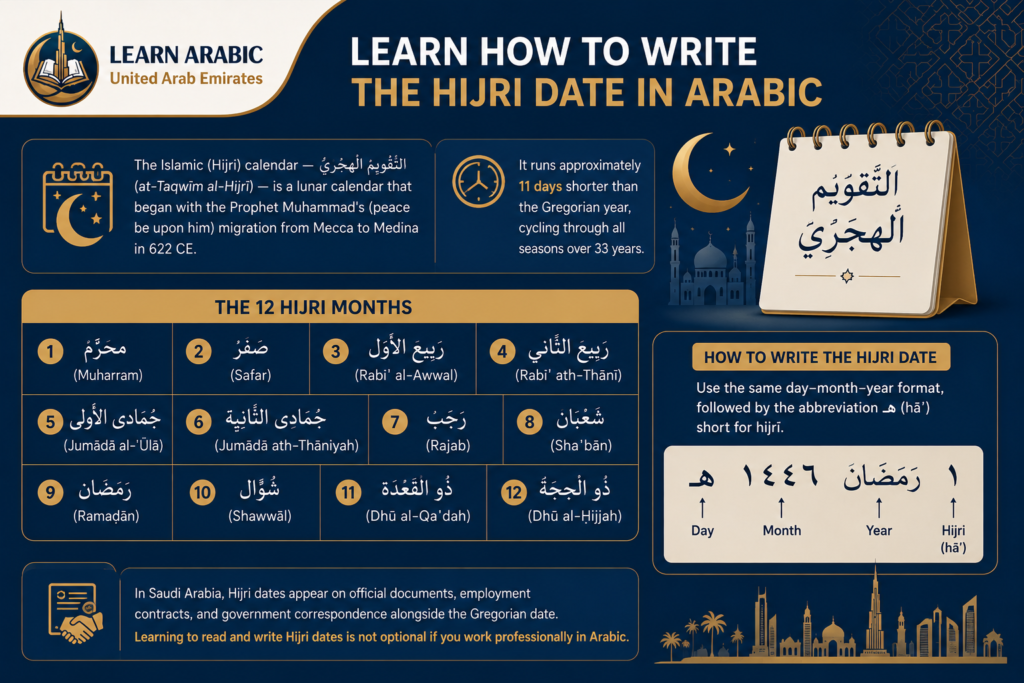
The Hijri calendar has 12 lunar months:
- مُحَرَّم (Muharram)
- صَفَر (Safar)
- رَبِيع الْأَوَّل (Rabī’ al-Awwal)
- رَبِيع الثَّانِي (Rabī’ ath-Thānī)
- جُمَادَى الْأُولَى (Jumādā al-ʾŪlā)
- جُمَادَى الثَّانِيَة (Jumādā ath-Thāniyah)
- رَجَب (Rajab)
- شَعْبَان (Shaʿbān)
- رَمَضَان (Ramaḍān)
- شَوَّال (Shawwāl)
- ذُو الْقَعْدَة (Dhū al-Qaʿdah)
- ذُو الْحِجَّة (Dhū al-Ḥijjah)
To write the Hijri date in Arabic, use the same day–month–year format, followed by the abbreviation هـ (short for hijrī):
١ رَمَضَان ١٤٤٦ هـ
In Saudi Arabia, Hijri dates appear on official documents, employment contracts, and government correspondence alongside the Gregorian date. Learning to read and write Hijri dates is not optional if you work professionally in Arabic.
Read also: Arabic Worksheets for Kids – A Complete Guide
5. Learn the Days of the Week in Arabic
Dates often require the day of the week alongside the calendar date. Most Arabic day names are derived directly from numbers, which makes them logical once you see the pattern:
| Day | Arabic | Transliteration |
| Sunday | الأَحَد | al-ʾAḥad |
| Monday | الاِثْنَيْن | al-Ithnayn |
| Tuesday | الثُّلَاثَاء | ath-Thulāthāʾ |
| Wednesday | الأَرْبِعَاء | al-ʾArbiʿāʾ |
| Thursday | الخَمِيس | al-Khamīs |
| Friday | الجُمُعَة | al-Jumuʿah |
| Saturday | السَّبْت | as-Sabt |
Sunday through Thursday map to the numerals one through five (aḥad = one, ithnayn = two, etc.). Friday (Jumuʿah, from the root for “gathering”) and Saturday (Sabt, cognate with the Hebrew Sabbath) are the exceptions. Linking the number-based days to their numerals is one of the most effective memory shortcuts for this vocabulary set — and exactly the kind of grammatical logic pattern explored in our Arabic grammar courses.
Join the Best Arabic Grammar Classes in the UAE with a FREE Trial Class

Read More: Spanish Words From Arabic
6. Write Your Date of Birth in Arabic
Stating your date of birth in Arabic comes up in introductions, official forms, and online profiles. The phrasing is straightforward once you know the structure.
To ask someone’s date of birth:
- To a male: مَتَى وَلَدْتَ؟ (Matā waladta?)
- To a female: مَتَى وَلَدْتِ؟ (Matā waladti?)
- Formal (both): مَا هُوَ تَارِيخ مِيلَادِكَ؟ (Mā huwa tārīkh mīlādika?)
To state your date of birth:
تَارِيخ مِيلَادِي هُوَ… (Tārīkh mīlādī huwa…)
Example: “My date of birth is September 15, 1990.” تَارِيخ مِيلَادِي هُوَ ١٥ سِبْتَمْبَر ١٩٩٠. (Tārīkh mīlādī huwa 15 Sibtambar 1990.)
7. Practice With Real Contexts
Knowing the rules is only half the skill. Fluent date-writing in Arabic comes from encounter and repetition in real contexts.
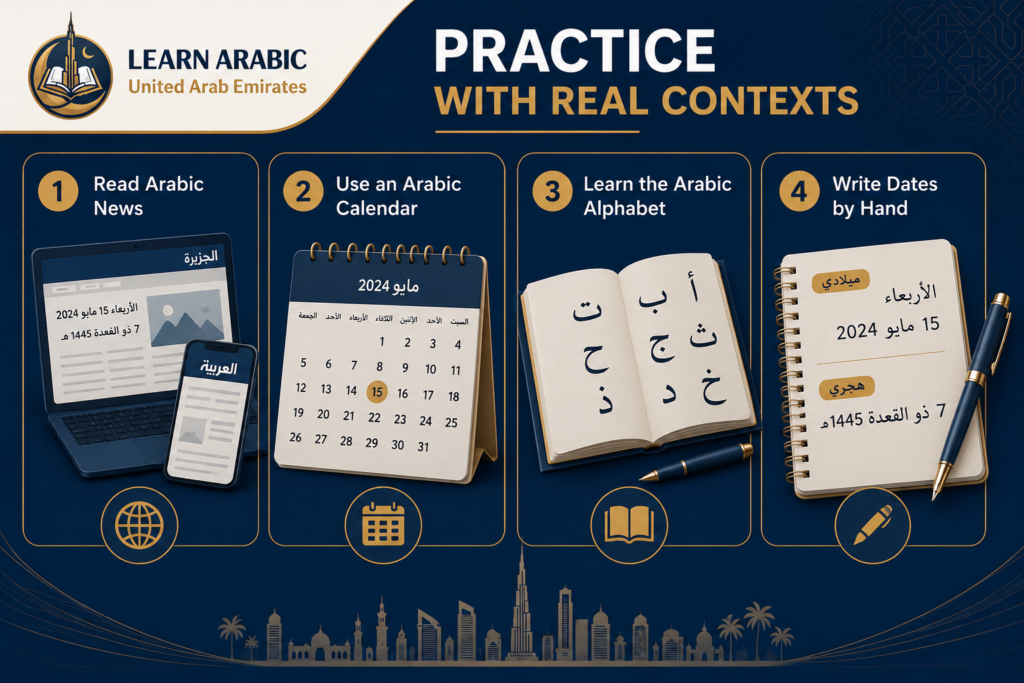
Here are the four most effective practice methods:
A. Read Arabic news headlines
Arabic news sites use dates constantly — often in both Gregorian and Hijri formats. Al Jazeera Arabic, BBC Arabic, and regional newspapers are free resources for daily exposure.
B. Keep an Arabic calendar
Switch your phone or computer calendar to Arabic display. Seeing the day names and month names daily builds passive recognition faster than flashcard drills.
C. Practice the Arabic alphabet first
If reading Arabic script is still slow for you, work through the Arabic alphabet course before drilling date formats — fluent date recognition requires fluid letter recognition.
D. Write dates by hand
Typing Arabic trains your eyes; handwriting trains your hand and forces you to produce each letter intentionally. Write today’s date in both Gregorian and Hijri formats every morning for two weeks.
Read more: Vegetables in Arabic
8. Avoid the Three Most Common Mistakes
Most learners who can recite month names still make these errors in real writing:
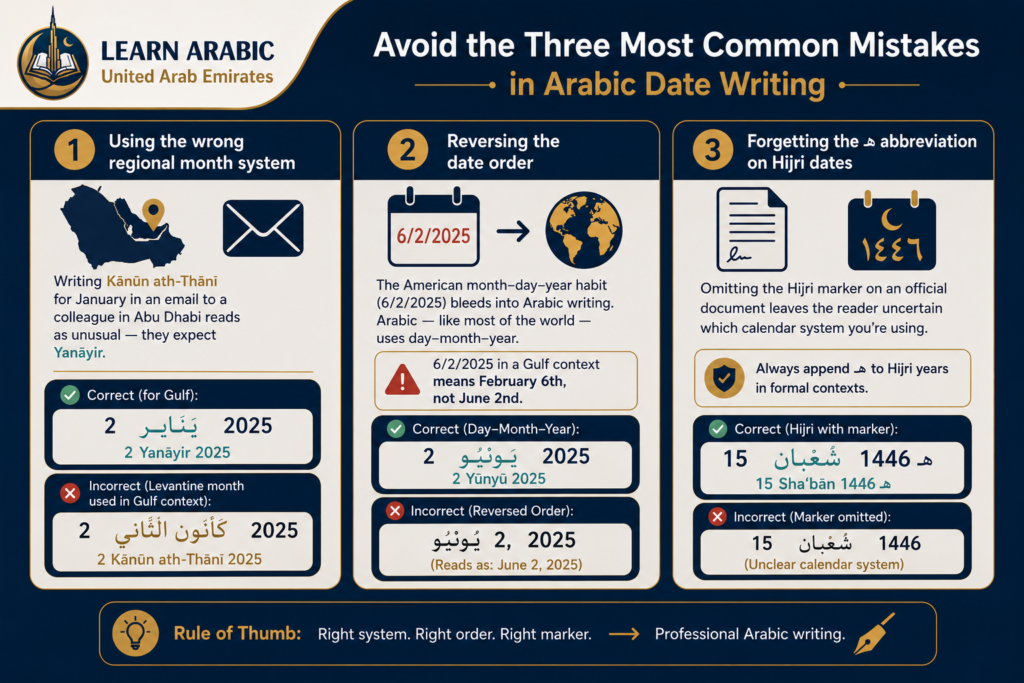
Mistake 1 — Using the wrong regional month system
Writing Kānūn ath-Thānī for January in an email to a colleague in Abu Dhabi reads as unusual — they expect Yanāyir. Match your month names to your audience’s region.
Mistake 2 — Reversing the date order
The American month–day–year habit (June 2 / 6-2-2025) bleeds into Arabic writing for learners whose first language is English. Arabic — like most of the world — uses day–month–year. Writing 6/2/2025 in a Gulf context means February 6th, not June 2nd.
Mistake 3 — Forgetting the هـ abbreviation on Hijri dates
Omitting the Hijri marker on an official document leaves the reader uncertain which calendar system you’re using. Always append هـ to Hijri years in formal contexts.
Step Inside Our Classrooms
Don’t just take our word for it—see our community in action. Click below to watch real, live snippets from our recent classes and experience our engaging teaching style firsthand!
Master Arabic in the UAE
Experience world-class Arabic language training designed for students and professionals in the Emirates.
Book Your Free TrialBuild Strong Arabic Writing Skills with Learn Arabic UAE
Learning how to write in Arabic is a skill that opens the door to confident communication in the UAE. By mastering the Arabic alphabet, letter connections, handwriting, and sentence structure, you’ll be able to read and write with greater accuracy in everyday, academic, and professional settings.
At Learn Arabic UAE, our structured online courses help learners progress from complete beginners to confident Arabic writers. Whether you’re learning the Arabic script for the first time or looking to improve your writing, grammar, reading, and communication skills, our experienced native Arabic instructors provide personalized guidance every step of the way.
[Explore our Arabic courses and start your free trial today →]

Our Arabic courses
- Self-Paced Arabic Course
- Arabic Speaking Classes
- Learn to Write Arabic Course
- Arabic Grammar Course
- Learn Arabic Alphabet Course
- Modern Standard Arabic (MSA) Course
- Quranic Arabic Course
- Fusha Arabic Course
- Classical Arabic Course
- Emirati Arabic Course
Master Arabic in the UAE
Experience world-class Arabic language training designed for students and professionals in the Emirates.
Book Your Free TrialConclusion
Learning how to write the date in Arabic is a practical skill that makes everyday communication, travel, work, and study much easier. Once you understand the standard day–month–year format, recognize the regional differences in month names, and know when to use the Gregorian or Hijri calendar, you’ll be able to read and write dates with confidence in any Arabic-speaking environment.
Like any language skill, consistency is the key. Practice writing today’s date every day, pay attention to how dates appear in Arabic books, news articles, and official documents, and you’ll quickly develop the habit of using the correct format naturally.
Frequently Asked Questions
Still have questions about writing dates in Arabic? Here are clear answers to the most common questions learners ask about Arabic date formats, Hijri dates, numerals, month names, and everyday usage.
How do you write the date in Arabic?
The standard Arabic date format is day–month name–year, written right to left. Example: 15 سِبْتَمْبَر 2025. The month is written as a word, not a number. In formal or official writing, Eastern Arabic numerals (١٥) are often used for the day and year.
How do you write the Hijri date in Arabic?
Write the Hijri date using the same day–month–year format, with the Hijri month name and the abbreviation هـ after the year. Example: ١ رَمَضَان ١٤٤٦ هـ. The هـ clarifies that the year is Hijri, not Gregorian.
How do you write today’s date in Arabic numbers?
Today’s date uses either Eastern Arabic numerals (١، ٢، ٣) or Western Arabic numerals (1, 2, 3) depending on context. Both are correct. Formal printed documents and handwritten forms in the Arab world often prefer Eastern numerals; digital platforms and Gulf government portals frequently use Western ones.
Why do Arabic month names differ by country?
Arabic-speaking countries use two distinct systems for Gregorian months. The Levantine/Iraqi system preserves ancient Aramaic-origin names (كَانُون الثَّانِي for January). The Gulf/Egyptian system uses transliterations of European month names (يَنَايِر for January). Both are grammatically correct — the difference is regional convention, not formality.
How do you say “date of birth” in Arabic?
“Date of birth” in Arabic is تَارِيخ الْمِيلَاد (tārīkh al-mīlād). To give your own date of birth, say: تَارِيخ مِيلَادِي هُوَ… followed by the date in day–month–year format. The question form changes by gender: Matā waladta? (to a male) or Matā waladti? (to a female).
Is the Hijri calendar still used officially today?
Yes. Saudi Arabia uses the Hijri calendar on official documents, legal contracts, and government correspondence. Across the Muslim world, it determines the dates of Ramadan, Eid al-Fitr, Eid al-Adha, and Hajj. Civil and business matters in most countries use the Gregorian calendar alongside it.
Related Articles
Learn Arabic



Leave a Reply