 Learn Arabic
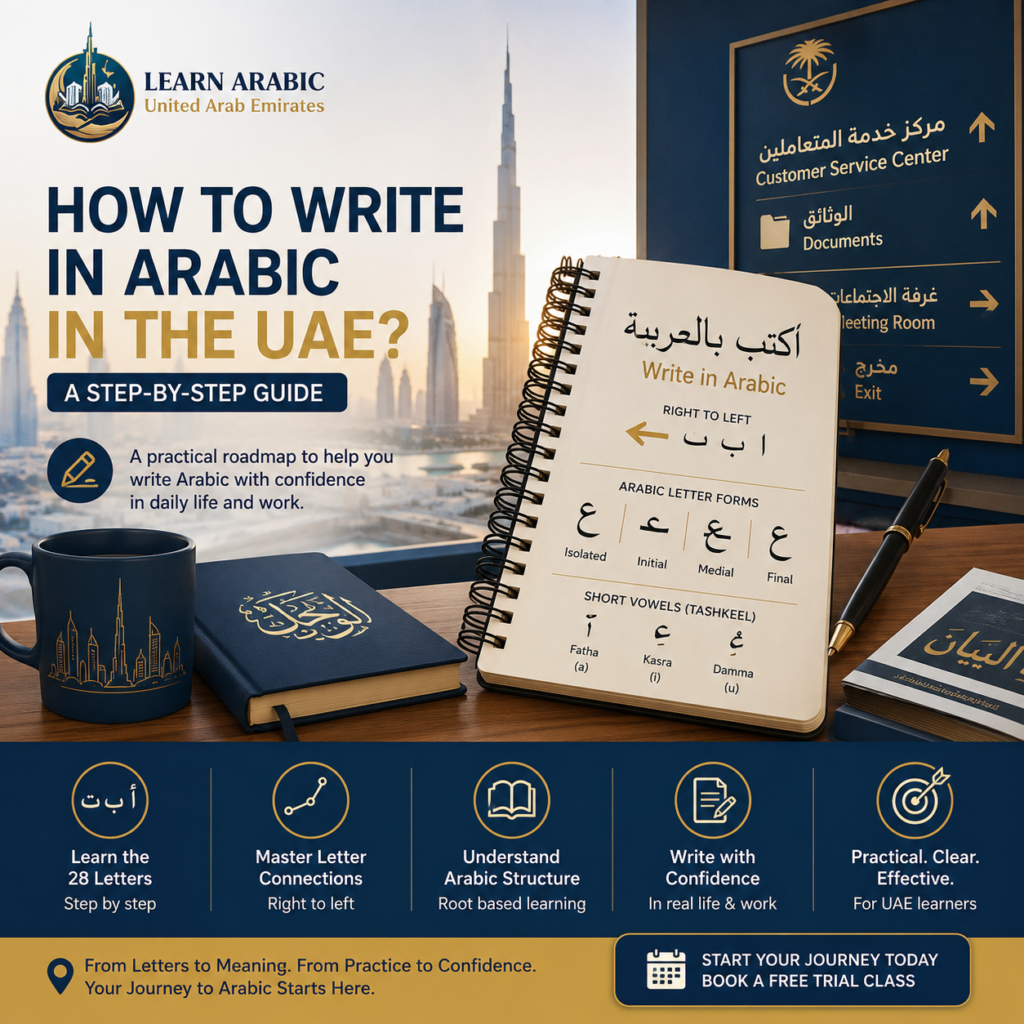
You live in the UAE. Arabic is on every road sign, government form, business card, and WhatsApp message from your Emirati colleagues — and you still cannot write a single word of it. That gap is more common than you’d think among long-term residents, and it carries a real professional cost in a country where written Arabic signals cultural competence.
The good news: Arabic writing follows a consistent, logical system. With the right instruction sequence, most motivated adult learners in the UAE move from zero to functional written Arabic in months — not years. This guide walks you through exactly how.
Step 1: Understand What Arabic Writing Is Before You Touch a Pen
Learning how to write in Arabic in the UAE starts with one insight that most beginners miss entirely: Arabic is not an alphabet. It is an abjad — a writing system where letters represent consonants, and short vowels are either implied by context or marked by small symbols called Tashkeel (تشكيل).
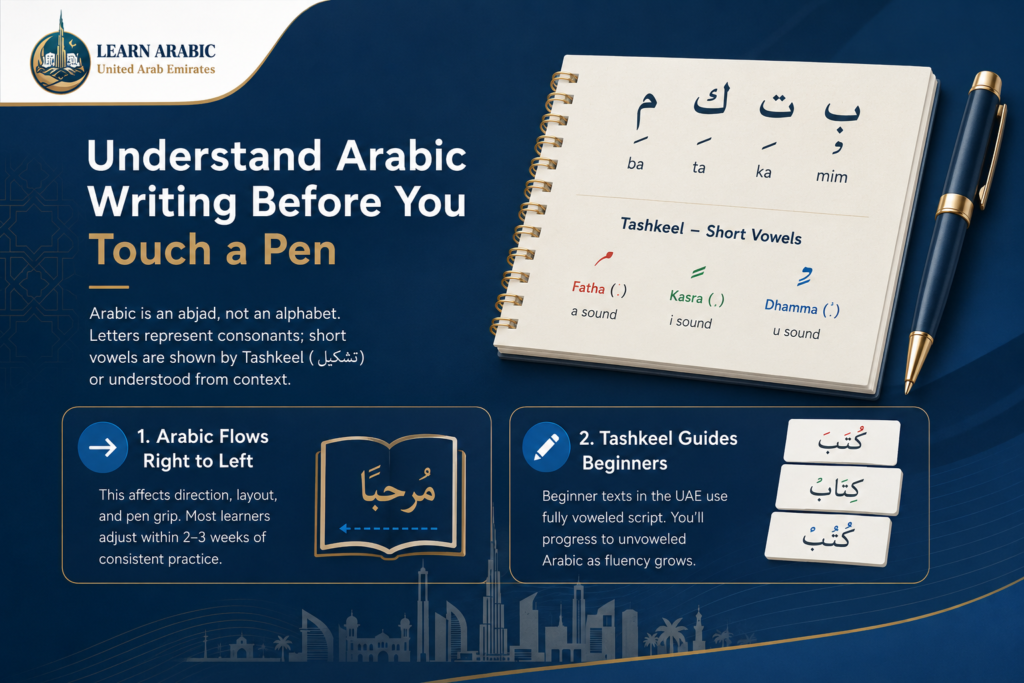
This matters because English readers are trained to expect a vowel for every vowel sound. Arabic doesn’t work that way. In everyday UAE signage, newspapers, and professional correspondence, short vowels are omitted entirely — the reader infers them from context and vocabulary knowledge. Learners who don’t understand this spend months confused about “missing” sounds before a good instructor explains it in a single session Two foundational features to internalize before lesson one.
Arabic flows right to left
This affects not just letter direction but page layout, document structure, and pen grip. Most UAE-based learners adjust within two to three weeks of consistent practice — it feels disorienting at first, then becomes automatic.
Tashkeel marks short vowels for beginners
The Fatha (َ) marks an “a” sound, the Kasra (ِ) marks an “i,” and the Dhamma (ُ) marks a “u.” Beginner Arabic texts in the UAE use fully voweled script; you’ll progress to unvoweled Modern Standard Arabic as fluency develops.
Step 2: Learn the 28 Arabic Letters in Groups, Not in Alphabetical Order
Before you connect letters into words, you need to know each of the 28 Arabic letters in isolation — their shape, sound, and structural logic. This is where every serious Arabic writing program begins, and where rushing ahead causes compounding problems.
The fastest learning method is grouping letters by shared base shape, not working through the alphabet sequentially.
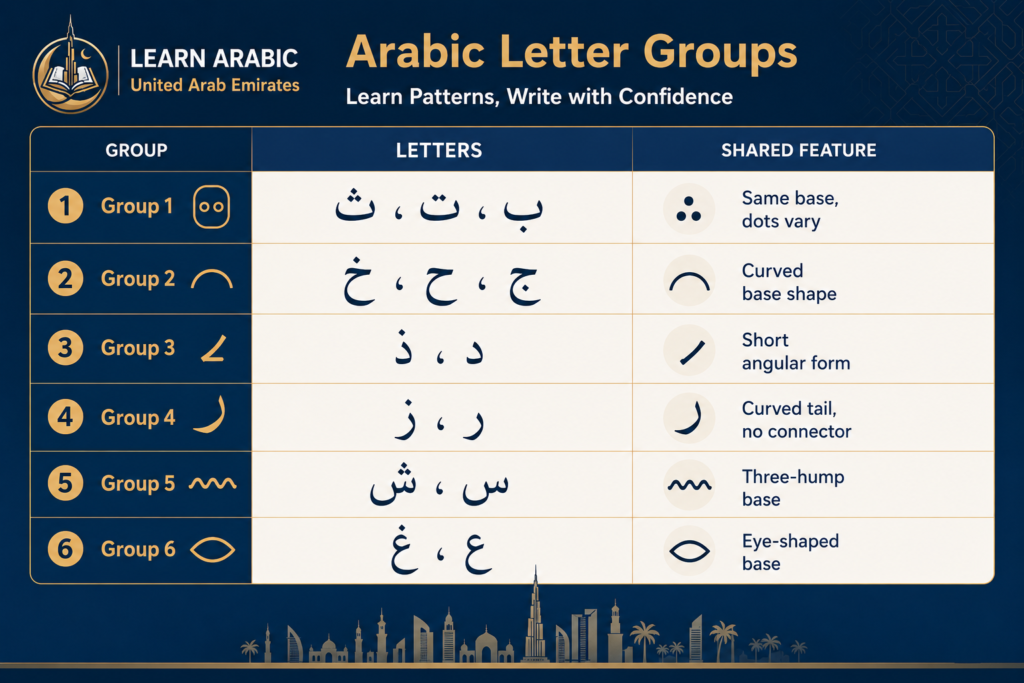
This grouped approach typically halves memorization time compared to alphabetical drilling. Abjad Academy’s Arabic Alphabet course uses this exact method, with video demonstrations from native Arabic instructors so you internalize correct stroke order from the start rather than building habits you’ll need to unlearn.
Learn Arabic Letters in the UAE with a FREE Trial Class

What Are the Six Non-Connecting Arabic Letters?
Six Arabic letters — و، ز، ر، ذ، د، أ — do not connect to the letter that follows them in a word. This is one of the most consistently confusing features for beginners writing Arabic for the first time, and it causes a disproportionate number of spelling errors even at intermediate level. A trained instructor flags this on day one; self-taught learners often discover it after months of writing it wrong.
Step 3: Master How Arabic Letters Change Shape Based on Position
This is the step that surprises almost every beginner: most Arabic letters have four different forms depending on where they appear in a word — isolated, initial (start), medial (middle), or final (end). Mastering positional variation is non-negotiable for producing readable Arabic writing.
Take the letter ع (Ayn) as an example:
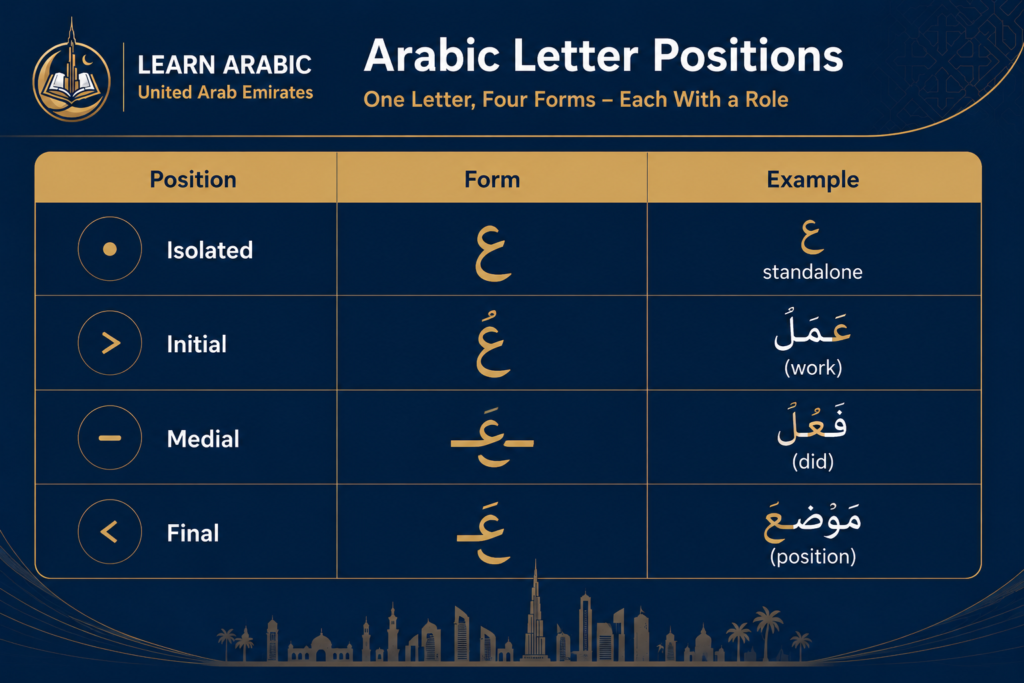
The most common error among UAE residents learning without structured instruction is writing every letter in its isolated form throughout entire words — producing text that native Arabic speakers cannot read, even when each individual letter is correct. Positional variation is the single most corrected error in Abjad Academy’s first writing sessions.
See Our Classroom Environment in Action
Experience a sneak peek into our live sessions. Watch the video below to see our specialized instructors interacting with students, breakdown complex texts, and cultivate an engaging, respectful learning environment.
Master Arabic in the UAE
Experience world-class Arabic language training designed for students and professionals in the Emirates.
Book Your Free TrialRead More: Spanish Words From Arabic
Step 4: Practice Connecting Letters Using Arabic’s Root System
Once you know the letter forms, you begin connecting them — and this is where Arabic writing starts to feel genuinely rewarding. Arabic letters within a word connect like cursive handwriting, flowing right to left.
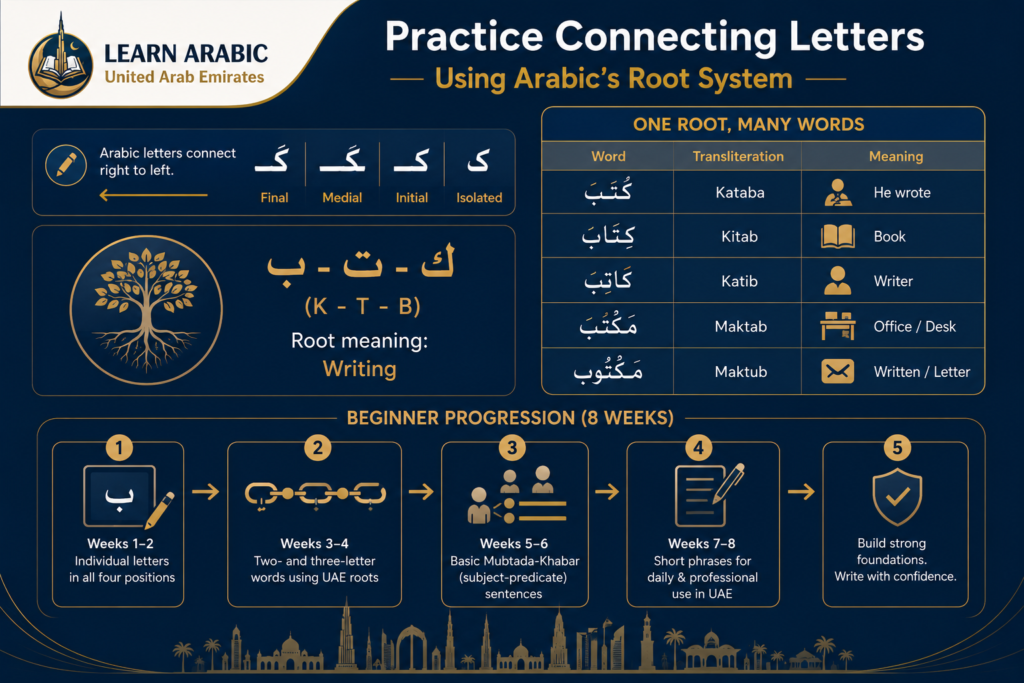
The most efficient way to build this skill is through root-based writing drills. Arabic is a root-based language: most words derive from a three-consonant root (الجذر — Al-Jidhr) that carries a core meaning. Once you can write a root correctly in connected script, you’ve unlocked the writing pattern for an entire word family.
Take the root ك-ت-ب (K-T-B), relating to writing:
| Word | Transliteration | Meaning |
| كَتَبَ | Kataba | He wrote |
| كِتَاب | Kitab | Book |
| كَاتِب | Katib | Writer |
| مَكْتَب | Maktab | Office/Desk |
| مَكْتُوب | Maktub | Written/Letter |
This is more than a vocabulary trick. Understanding root structure directly builds the grammatical awareness — I’rab (إعراب) — that separates intermediate writers from advanced ones. You begin to recognize why word endings shift based on grammatical function, not just memorize forms blindly.
A realistic beginner progression for UAE learners looks like this:
- Weeks 1–2: Individual letters in all four positions
- Weeks 3–4: Two- and three-letter word combinations using common UAE roots
- Weeks 5–6: Basic Mubtada-Khabar (subject-predicate) nominal sentences
- Weeks 7–8: Short descriptive phrases used in UAE daily and professional contexts
Rushing to full sentences before positional forms are solid creates foundational errors that are genuinely difficult to unlearn.
Step 5: Understand Modern Standard Arabic — the Written Standard in the UAE
All formal written Arabic in the UAE — government documents, official correspondence, UAE newspapers like Al-Bayan (البيان) and Al-Khaleej (الخليج), and professional settings — uses Modern Standard Arabic (MSA), known as Al-Fusha (الفصحى). This is the written standard across all Arabic-speaking countries.
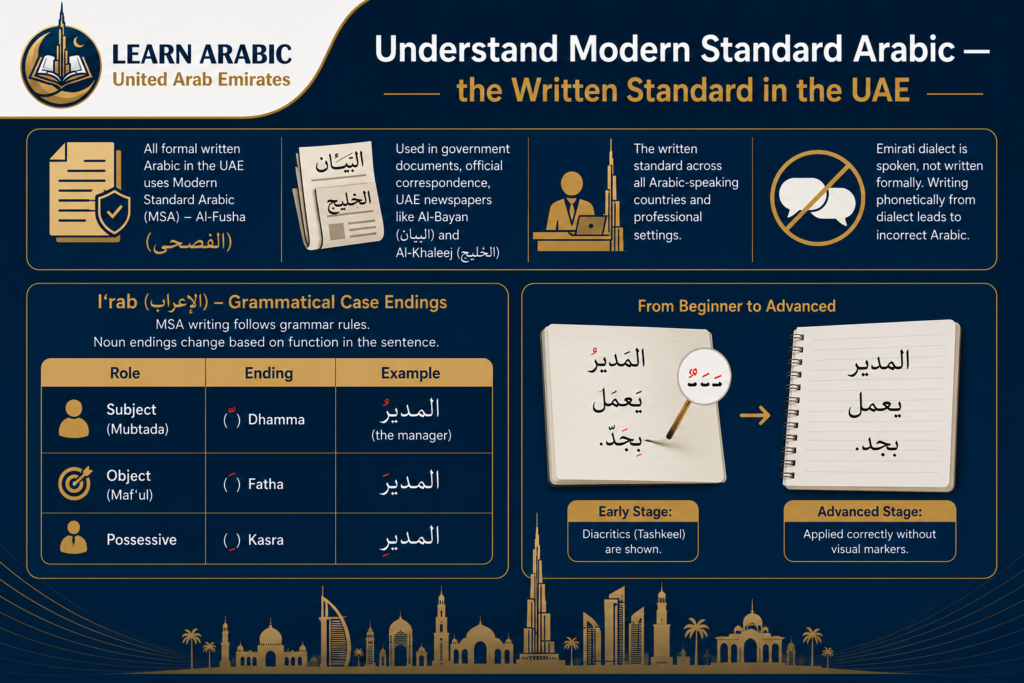
The most important early distinction for UAE residents: what Emiratis say in conversation is not what they write in formal contexts. Emirati Arabic dialect is spoken but rarely written formally. Attempting to write phonetically based on dialect sounds heard on the street is one of the most common errors expat learners make, and it produces written Arabic that reads as incorrect to native speakers.
MSA writing follows specific grammar rules that are critical for professional UAE contexts. The most significant is I’rab (الإعراب) — grammatical case endings that change noun endings based on function in the sentence:
| Role | Ending | Example |
| Subject (Mubtada) | ُ Dhamma | المديرُ (the manager) |
| Object (Maf’ul) | َ Fatha | المديرَ |
| Possessive | ِ Kasra | المديرِ |
In early instruction, these appear as Tashkeel above letters. As you advance, you apply them correctly without visual markers — which is the standard expected in professional UAE written communication.
Read More: Hospital Vocabulary in Arabic
Step 6: Practice Handwriting Before You Move to Digital Typing
There is a persistent misconception among UAE-based learners — particularly those using language apps — that typing Arabic on a phone is an acceptable substitute for handwriting practice. It is not, especially in the first two months.
Handwriting Arabic trains muscle memory for letter shapes, connection points, and proportions in ways that tapping a keyboard cannot replicate. Learners who skip handwriting produce inconsistent digital Arabic because they learned key positions without internalizing the underlying letter geometry. Abjad Academy dedicates the first six to eight weeks of the writing program to handwritten practice before introducing digital input.
A practical daily handwriting routine for UAE residents:
- 10–15 minutes daily, on Arabic calligraphy-lined paper (available at most UAE stationery shops and via noon.com or Amazon.ae)
- Write each letter in all four positions, five times, before attempting words
- Copy Arabic text from UAE signage, government documents, or news sources — not invented sentences
- Have a native instructor correct formation errors early; incorrect stroke habits are hard to reverse
The UAE’s physical environment is a free handwriting resource that learners elsewhere don’t have: every road sign, metro station name (دبي مول، البرشاء، ديرة), and government building placard is a legitimate copy exercise in correctly spelled MSA Arabic.
Build Your Arabic Skills with a FREE Trial Class
Step 7: Use UAE-Specific Writing Exercises to Accelerate Real-World Fluency
Generic Arabic textbooks cover the same vocabulary lists regardless of where you live. These exercises are built for UAE residents specifically — and they produce faster practical results because the Arabic is immediately meaningful and recurs constantly in daily life here.
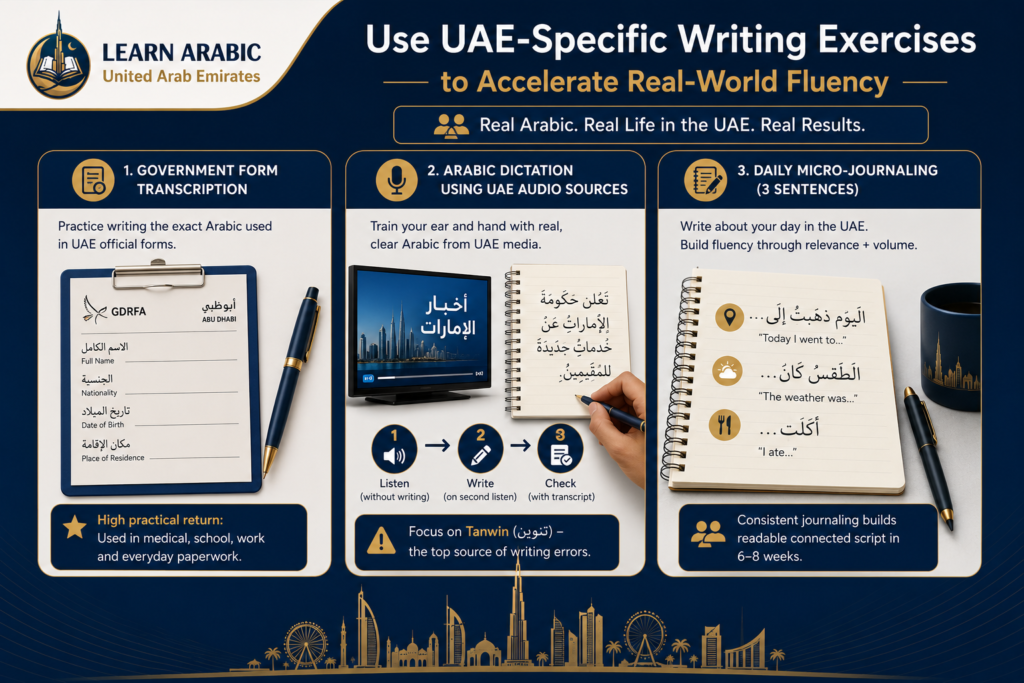
Government Form Transcription UAE government services — from GDRFA (General Directorate of Residency and Foreigners Affairs) forms to ADHA applications — include Arabic fields alongside English.
Transcribing these is a practical writing exercise that exposes you to the exact vocabulary of UAE official communication: الاسم الكامل (Full Name), الجنسية (Nationality), تاريخ الميلاد (Date of Birth), مكان الإقامة (Place of Residence).
These phrases recur across medical appointments, school enrollment forms, and employment paperwork throughout your life in the UAE — a density of practical return that no vocabulary list matches.
Arabic Dictation Using UAE Audio Sources Dictation — إملاء (Imla’) — trains the critical connection between hearing Arabic phonemes and producing correct written forms. For UAE-based learners, Abu Dhabi TV news broadcasts and UAE government official announcements provide high-quality MSA audio with clear enunciation.
Run each session in three passes: listen once without writing, write on the second listen, check against a transcript on the third. Pay specific attention to Tanwin (تنوين) — double vowel markings indicating grammatical case — which is the highest-error element in dictation for non-native writers.
Daily Micro-Journaling Three sentences per day about your day in the UAE produces faster script fluency than isolated drilling because volume combines with personal relevance. A starter template:
- اليوم ذهبت إلى… — “Today I went to…”
- الطقس كان… — “The weather was…”
- أكلت… — “I ate…”
Adult expat learners in Dubai who journal consistently — even imperfectly — typically develop readable connected script within six to eight weeks.
Read more: 100 Beautiful Arabic Words With Meaning
Step 8: Learn Professional Arabic Writing for UAE Workplace Contexts
For professionals working in UAE government entities or multinational corporations, written Arabic in formal correspondence is a direct signal of professional credibility.
The most common error among UAE professionals who attempt business Arabic without instruction is direct translation from English — which produces phrasing that native Arabic readers experience as blunt or culturally inappropriate.
Formal UAE Arabic email conventions follow fixed formulas that are expected and culturally required:
Standard opening: حضرة السيد / السيدة [الاسم]، المحترم/ة “Dear Respected Mr. / Ms. [Name]”
Standard closing: وتفضلوا بقبول فائق الاحترام والتقدير “Please accept the highest regards and appreciation”
Omitting these formulas — or replacing them with a direct English equivalent — signals unfamiliarity with Arabic professional norms. In the UAE’s government and corporate environments, where written Arabic is used in federal ministry correspondence and inter-departmental communication, this matters.
Help Your Child Master Arabic Grammar with a FREE Trial Class
Step Inside Our Classrooms
Don’t just take our word for it—see our community in action. Click below to watch real, live snippets from our recent classes and experience our engaging teaching style firsthand!
Master Arabic in the UAE
Experience world-class Arabic language training designed for students and professionals in the Emirates.
Book Your Free TrialStart Writing Arabic in the UAE with Learn Arabic UAE
Learning how to write in Arabic becomes faster and more effective when you follow a structured curriculum with experienced native instructors. Instead of relying on trial and error, you’ll build your writing skills step by step—from mastering Arabic letters to writing accurate sentences for everyday and professional communication in the UAE.
At Learn Arabic UAE, you’ll benefit from:
- Structured Arabic writing lessons taught by qualified native Arabic instructors
- A practical UAE-focused curriculum covering Modern Standard Arabic (MSA) for daily life, work, and official communication
- Personalized feedback on your handwriting, spelling, grammar, and sentence construction during every lesson
- One-to-one and small group classes available online with flexible scheduling for learners across Dubai, Abu Dhabi, Sharjah, and the UAE
- A supportive learning environment designed for complete beginners, expats, professionals, and students of all ages
Book your free trial class today and discover how structured Arabic instruction can help you write with confidence from your very first lessons.

Our Arabic courses
- Arabic Course in the UAE
- Arabic Intensive Course
- Arabic Classes for Beginners (Learn Arabic from Scratch)
- Madinah Arabic Course
- Arabic Classes for Adults
- Self-Paced Arabic Course
- Arabic Speaking Classes
- Learn to Write Arabic Course
- Arabic Grammar Course
- Learn Arabic Alphabet Course
- Modern Standard Arabic (MSA) Course
Master Arabic in the UAE
Experience world-class Arabic language training designed for students and professionals in the Emirates.
Book Your Free TrialConclusion
Learning how to write in Arabic in the UAE follows a clear, sequential path: understand the abjad system, master letter forms in groups, internalize positional variation, build connected writing through root-based drills, and apply MSA grammar rules to professional and civic contexts. None of these steps can be skipped without creating errors that slow everything that follows.
Progress in Arabic script fluency is nonlinear. Most adult learners in the UAE reach readable connected handwriting within two to three months of daily 20-minute practice. Accuracy in grammar and case endings takes longer — typically eight to twelve months to reach professional written standard. Tracking specific error patterns (letter connectivity, word boundaries, Tanwin consistency) gives a more honest picture of progress than overall impressions.
The UAE’s environment is, uniquely, a daily classroom. Every Arabic word on every sign, form, and official document around you is a legitimate writing exercise — and one that generic language learning platforms cannot replicate.
Frequently Asked Questions About How to Write in Arabic in the UAE
Below are the most frequently asked questions about how to write in Arabic in the UAE. These answers cover the essentials—from learning the Arabic alphabet and improving handwriting to choosing the right form of Arabic for everyday and professional communication.
How long does it take to learn to write Arabic from scratch in the UAE?
Most adult beginners can write simple, accurate Arabic sentences within three to four months of structured weekly instruction — typically two to three sessions per week. Reaching professional written Arabic proficiency for formal UAE correspondence takes most learners between eight and twelve months, depending on consistency and prior linguistic background.
Do I need to learn the Arabic alphabet before writing Arabic words?
Yes — and in a specific way. You need to learn not just the 28 letter names and sounds, but their four positional forms (isolated, initial, medial, and final) before you can produce readable connected words. Skipping positional forms and moving straight to word writing is the most consistent foundational error among self-taught Arabic learners in the UAE.
Is handwriting Arabic necessary if my goal is digital writing?
Handwriting is essential in the early stages, even for learners whose primary goal is typing Arabic. Handwriting builds the structural understanding of letter shapes and connection logic that makes digital typing accurate. Learners who skip handwriting produce inconsistent typed Arabic because they learned key positions without internalizing letter geometry.
What is the difference between MSA and Emirati Arabic dialect for writing?
Modern Standard Arabic (MSA) is the written standard used in all formal UAE contexts — government documents, professional emails, official correspondence, and print media. Emirati dialect is spoken in conversation but rarely written formally. For UAE residents whose goal includes professional or civic written Arabic, MSA is the correct and most transferable writing foundation.
How much Arabic writing practice do I need per day?
Twenty minutes of daily focused practice — letter drilling, copy exercises from UAE signage, or short dictation — consistently outperforms longer but irregular sessions. Adult expat learners in Dubai who practice daily typically develop legible connected handwriting within six to eight weeks; those who practice two to three times per week take two to three months to reach the same point.



Leave a Reply