 Learn Arabic
When you start to learn Arabic pronunciation, you may notice a mismatch: the Arabic alphabet has 28 letters, but linguists talk about 34 sounds. That brings up a question: how many phonemes are in Arabic actually?
The answer, according to the majority of modern phoneticians, is 34. 28 of the phonemes are consonants, and the remaining 6 are vowel phonemes. That single number explains a lot about why Arabic pronunciation feels more layered than the alphabet chart suggests.
This gap between “letters” and “sounds” is exactly where most self-taught learners get stuck. You memorize 28 shapes, but your ear needs to catch 34 distinct sounds, some of which never get their own written symbol.
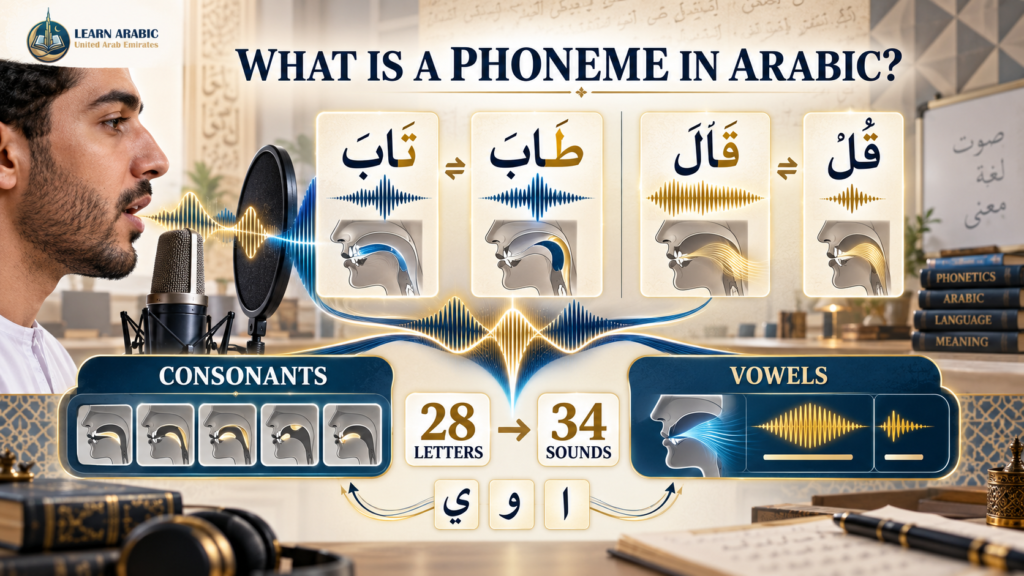
A phoneme is the smallest sound unit in a language that changes meaning when swapped for another sound. In Arabic, swapping /ت/ for /ط/ in “تاب” versus “طاب” produces two different words; that’s a phoneme distinction, not a spelling difference.
How Many Consonant Phonemes Does Arabic Have?
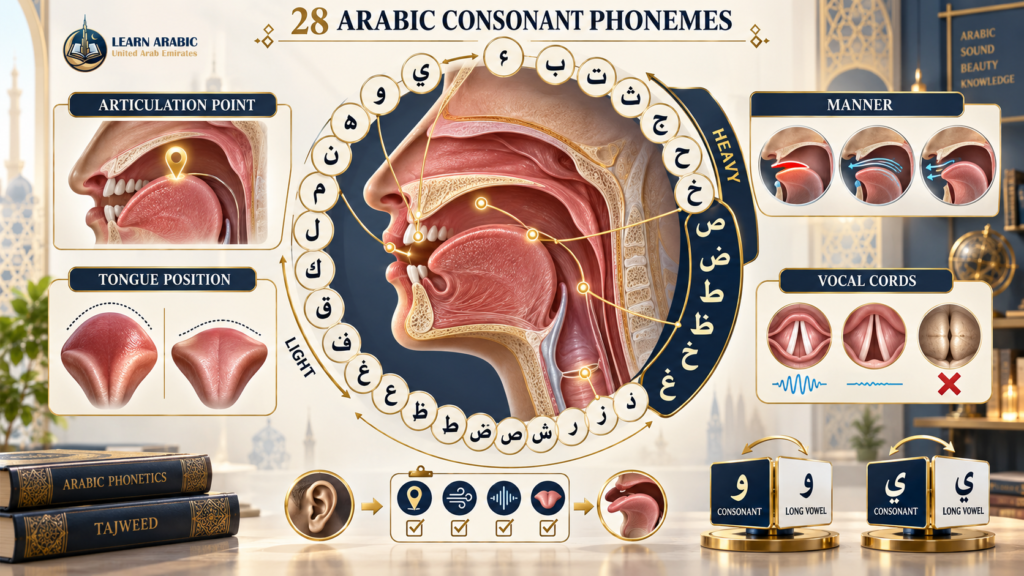
Arabic has 28 consonant phonemes. They run alphabetically from hamza (ء) to ya (ي). These are the sounds represented by the Arabic alphabet’s written letters.
The 28 Arabic Consonant Sounds
The full consonant inventory is: ء، ب، ت، ث، ج، ح، خ، د، ذ، ر، ز، س، ش، ص، ض، ط، ظ، ع، غ، ف، ق، ك، ل، م، ن، ه، و، ي. Note that و (waw) and ي (ya) appear in this consonant list as well as functioning as long-vowel markers, a dual identity that represents a frequent source of confusion for learners moving from reading to phonetic analysis.
Consonant Description – Four Features Every Sound Has
Phoneticians describe every Arabic consonant using four features. The first one is articulation point (مخرج), where the airflow in the vocal tract is interrupted. The second is the manner of articulation: full closure, partial narrowing, or a controlled release.
The third is vocal cord activity, whether the cords vibrate (voiced), stay still (voiceless), or press fully together (as with hamza).
The fourth is tongue position, whether the back of the tongue raises toward the soft palate, producing the “heavy” (مفخم) sounds like ص، ض، ط، ظ، خ، غ، ق, or stays low, producing the “light” (مرقق) sounds that make up most of the inventory.
This four-part description isn’t academic trivia. It’s the practical checklist a tajweed teacher uses to correct a learner’s pronunciation of a single letter. If you can’t yet name the articulation point of a sound you’re struggling with, you don’t have a fixed target to aim your tongue at.
Read Also: Arabic Numerals – The True Origin Of The World’s Most-Used Number System
How Many Vowel Phonemes Does Arabic Have?
Arabic has 6 vowel phonemes: three short vowels and three long vowels. Short and long versions of the same vowel quality count as separate phonemes because vowel length changes word meaning in Arabic. It isn’t a stylistic variation.
Short Vowels Vs Long Vowels
The three short vowels are fatha, damma, and kasra. The diacritical marks are placed above or below a letter. Each has a long counterpart. Fatha lengthens into alif (ا), damma lengthens into waw (و), and kasra lengthens into ya (ي). That gives six distinct vowel sounds total, even though only three vowel qualities exist.
Classical grammarians noticed this pairing early. Ibn Jinni described the short vowel as essentially a compressed version of its long counterpart, noting that stretching a short vowel produces the matching long letter.
Read Also: How To Read And Write Arabic Numbers?
Semi-Vowels – The Special Case Of Waw And Ya
Waw و and ya ي aren’t always vowels. When they function as consonants, as in “وَلَد” (waw as a consonant) or “بَيْت” (ya closing a diphthong), they’re called semi-vowels because their articulation begins in a vowel-like position but shifts rapidly toward a different one during a single act of speech.
This is why the same two letters show up in three different roles across Arabic phonetics: as consonants, as long-vowel markers, and as semi-vowels in diphthongs.
Understanding which role a given و or ي is playing in a specific word is one of the more advanced skills in Arabic pronunciation. It’s rarely taught explicitly outside dedicated phonetics or tajweed instruction.
For learners who keep mixing up when waw and ya are acting as vowels versus consonants, that distinction is exactly the kind of thing a live instructor catches in seconds but a textbook glosses over. It is one of the areas where Learn Arabic UAE’s live sessions save learners months of guesswork.
Read Also: How Are Arabic Names Structured?
Phonemes Vs Letters – Why The Numbers Differ
A letter (حرف) is a written symbol, while a phoneme is a sound. Arabic has 28 consonant letters, but it produces 34 total sounds because short and long vowels, which aren’t written as independent letters in the alphabet, still count as separate phonemes.
The alif أ, waw و, and ya ي do double duty in the script. Sometimes they act as consonant letters, sometimes as markers for long vowels. That dual role is precisely why the letter count and the phoneme count diverge.
The Two Categories Of Arabic Sounds
Arabic sounds split into two groups. The first group is consonants (الصوامت), which are produced by closing or narrowing the vocal tract at some point. The second group is vowels (الصوائت), produced by shaping the airflow without any closure or narrowing.
Every phoneme in Arabic belongs to one of these two categories. Pronunciation training usually treats them as separate skills: consonant articulation points on one side, vowel length and quality on the other.
A common mistake among learners is treating vowel length as a stylistic choice rather than a phonemic one. In Arabic, “قال” and “قل” aren’t the same word said differently. The vowel length itself carries meaning, the same way a consonant swap does.
Read also: How to Learn Arabic in the UAE?
If pronunciation drills like this feel abstract without a native speaker correcting your ear, Learn Arabic UAE’s structured courses build phoneme recognition into every lesson, so you catch these distinctions early instead of building habits you’ll have to unlearn later.
Phonemes and Allophones – A Distinction Worth Knowing
A phoneme changes meaning when substituted for another sound. An allophone is a variation of the same phoneme that doesn’t change meaning.
Linguist Muhammad Ali al-Khouli’s framework describes phonemes as abstract sound categories realized through groups of allophones, physical variations in articulation that native speakers unconsciously group as “the same sound.”
This matters practically. A slightly different realization of a heavy consonant across regional accents is usually allophonic variation, not a phoneme change.
That is why regional Arabic pronunciation can sound different without changing what a word means.
Recognizing this distinction helps you set realistic pronunciation goals. You’re aiming to master 34 phonemic contrasts precisely, not to eliminate every trace of accent variation, which even native speakers don’t do.
Read Also: Common Mistakes New Arabic Learners Make (And How To Fix Them)
Step Inside Our Classrooms
Don’t just take our word for it—see our community in action. Click below to watch real, live snippets from our recent classes and experience our engaging teaching style firsthand!
Master Arabic in the UAE
Experience world-class Arabic language training designed for students and professionals in the Emirates.
Book Your Free TrialStart Practicing The Full Arabic Sound System
You now know the count: 34 phonemes, not 28. Knowing the number is the easy part; training your ear and tongue to produce all 34 accurately is the part that actually changes how you sound.
Learn Arabic UAE’s courses are built around this exact phonetic framework: 28 consonants, 6 vowels, and the articulation-point corrections that turn theory into a working accent, guided by instructors who catch what a textbook can’t.
If you would like guided support as you develop these distinctions, Learn Arabic UAE offers structured pronunciation practice that helps you hear, compare, and produce Arabic sounds more confidently.
Our Arabic courses
- Arabic Course in the UAE
- Arabic Intensive Course
- Arabic Classes for Beginners (Learn Arabic from Scratch)
- Madinah Arabic Course
- Arabic Classes for Adults
- Self-Paced Arabic Course
- Arabic Speaking Classes
- Learn to Write Arabic Course
- Arabic Grammar Course
- Learn Arabic Alphabet Course
- Modern Standard Arabic (MSA) Course
- Quranic Arabic Course
- Fusha Arabic Course
- Classical Arabic Course
- Emirati Arabic Course
- Gulf Arabic Course
- Learn Saudi Arabic
- Business Arabic Course UAE
- Arabic Language Classes for Professionals in UAE
Our Arabic Courses for Kids
- Arabic Course for Kids
- Arabic Conversation Course for Kids
- Arabic Qaida Course for Kids
- Beginner Arabic Course for Kids
- Arabic Grammar Course for Kids
- Teen Arabic Summer Course
- UAE Kindergarten Arabic Classes

Conclusion
Arabic has 34 phonemes in total: 28 consonants and 6 vowels, split evenly between three short and three long vowel sounds. The 28-letter alphabet undercounts the spoken language because vowel length isn’t written as a separate letter, and because waw and ya each carry multiple phonetic roles depending on context.
Understanding this 34-sound system, rather than just the 28-letter script, gives you the actual target for accurate Arabic pronunciation, and it’s the framework tajweed and phonetics instruction is built on.
With consistent listening, repetition, and corrective feedback, this phonemic framework becomes more than theory. It gives learners a practical foundation for clearer speech, stronger listening skills, and more confident Arabic communication.
Frequently Asked Questions
How Many Letters Are In The Arabic Alphabet?
The Arabic alphabet has 28 written letters, from hamza (ء) to ya (ي). This is a smaller count than the 34 total phonemes because vowel length isn’t represented by separate alphabet letters.
How Many Vowels Does Arabic Have?
Arabic has 6 vowel phonemes: three short vowels (fatha, damma, kasra) and three long vowels (alif, waw, ya). Each short vowel has a matching long counterpart, and the two lengths count as separate phonemes because length changes word meaning.
What Is The Difference Between A Phoneme And A Letter?
A phoneme is a spoken sound that changes meaning when swapped for another sound, while a letter is the written symbol representing that sound. Arabic has 34 phonemes but only 28 consonant letters, since some vowel phonemes aren’t written as standalone letters.
Are Waw And Ya Consonants Or Vowels In Arabic?
Waw and ya can function as either, depending on the word. They act as consonants in words like “وَلَد,” as long-vowel markers extending damma and kasra, and as semi-vowels in diphthongs like “بَيْت.”
What Is The Difference Between A Phoneme And An Allophone?
A phoneme changes a word’s meaning when substituted for another sound, while an allophone is a variation of the same phoneme that leaves meaning unchanged. Regional differences in how a consonant is pronounced are usually allophonic, not phonemic.
Why Do Sources Sometimes Give Different Totals For Arabic Sounds?
Some sources count only the 28 consonant letters; others add 3 short vowels for 31, and the majority of modern phoneticians add all 6 vowel phonemes (3 short, 3 long) to reach 34. The 34 figure reflects the full spoken sound system rather than just the written alphabet.




Leave a Reply