 Learn Arabic

If you’ve been living in the UAE and thinking “I really should learn some Arabic” — you’re not alone. Whether you’re in Dubai, Abu Dhabi, or Sharjah, Arabic surrounds you every day: on road signs, in shops, at government offices, and in conversations with Emirati colleagues and neighbours.
This 7-day plan shows you how to learn Arabic in the UAE step by step, starting from zero. If you’re asking how to learn Arabic in 7 days in the UAE from zero, the Arabic alphabet is the right place to start. You don’t need to master all 28 letters in one sitting, but you do need to become familiar with how Arabic looks and works.
Day 1: Learn the Arabic Alphabet — The Foundation of Everything
Arabic has 28 letters, all written right to left in a connected cursive script. Each letter has up to four forms depending on its position in a word — isolated, initial, medial, and final. That sounds daunting, but the logic is consistent once you see it.
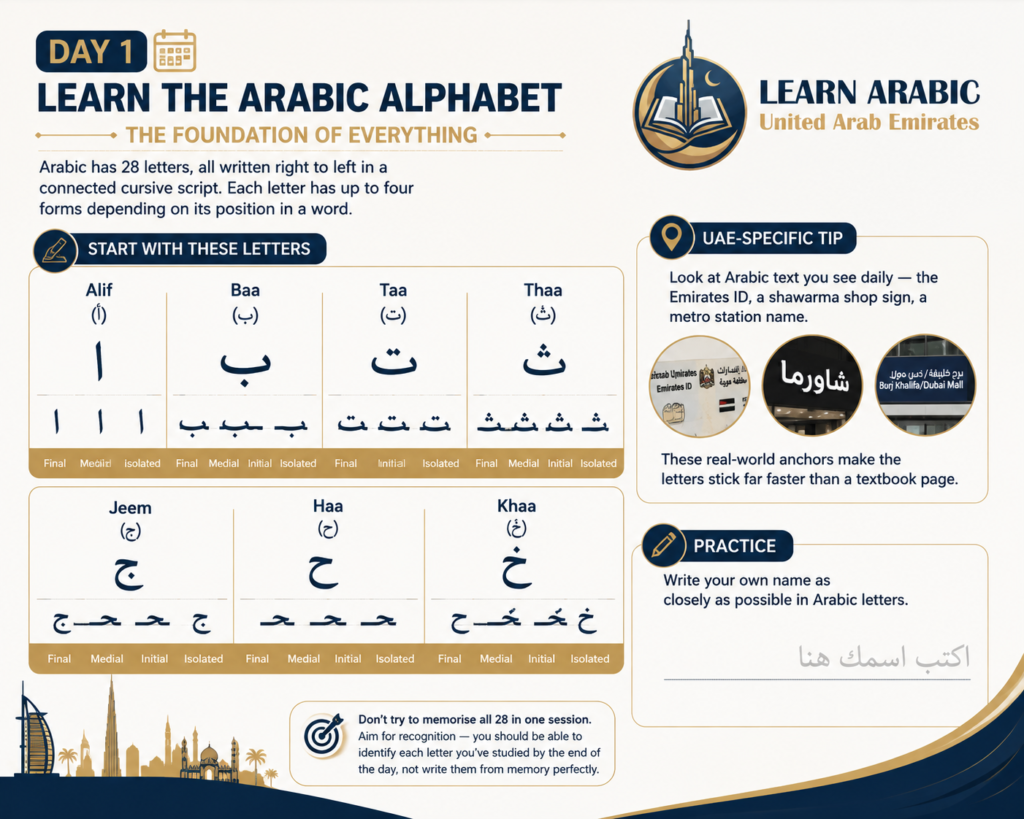
Start with the foundational letters: Alif (أ), Baa (ب), Taa (ت), and Thaa (ث). Write each one 10 times in its isolated form, then in its connected forms. Then move to the next group: Jeem (ج), Haa (ح), and Khaa (خ).
Don’t try to memorise all 28 in one session. Aim for recognition — you should be able to identify each letter you’ve studied by the end of the day, not write them from memory perfectly.
UAE-specific tip: Look at Arabic text you see daily — the Emirates ID, a shawarma shop sign, a metro station name. These real-world anchors make the letters stick far faster than a textbook page.
Practice: Write your own name as closely as possible in Arabic letters.
If you’re helping a young child build these same foundations, structured Arabic courses for kids in kindergarten can introduce letter recognition and early Arabic reading and writing in an age-appropriate way.
Day 2: Master Arabic Pronunciation — Especially the Sounds English Doesn’t Have
Arabic has several sounds that don’t exist in English. Getting these wrong doesn’t just sound odd — it can change the meaning of a word entirely.
Read also: Can I Learn Arabic in 3 Months in the UAE?
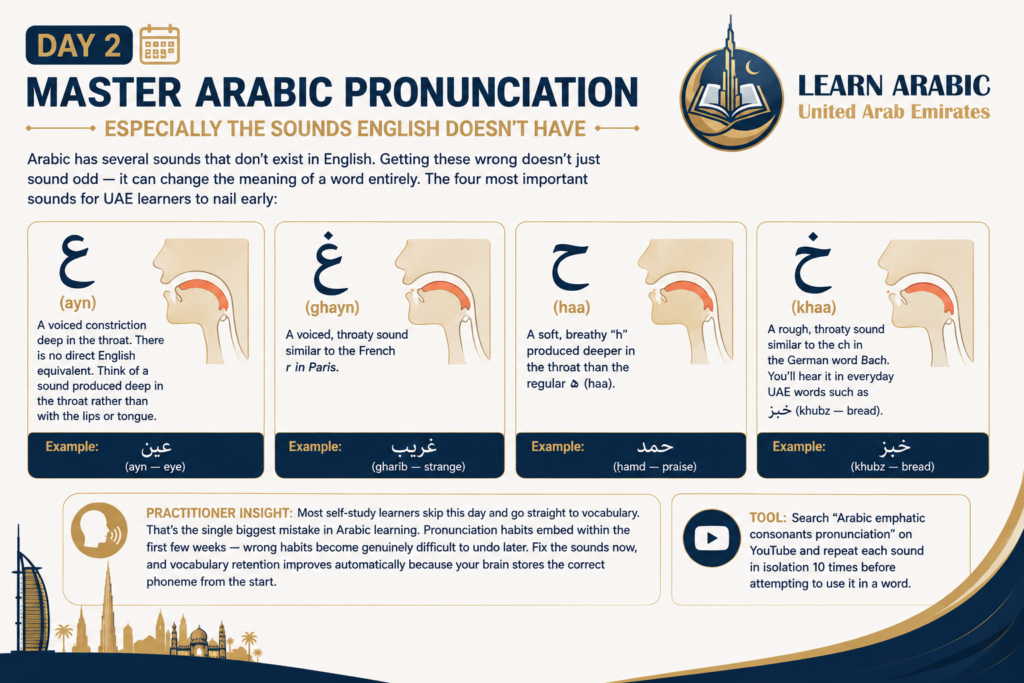
The four most important sounds for UAE learners to nail early:
- ع (ayn) — a voiced constriction deep in the throat. There is no direct English equivalent. Think of a sound produced deep in the throat rather than with the lips or tongue.
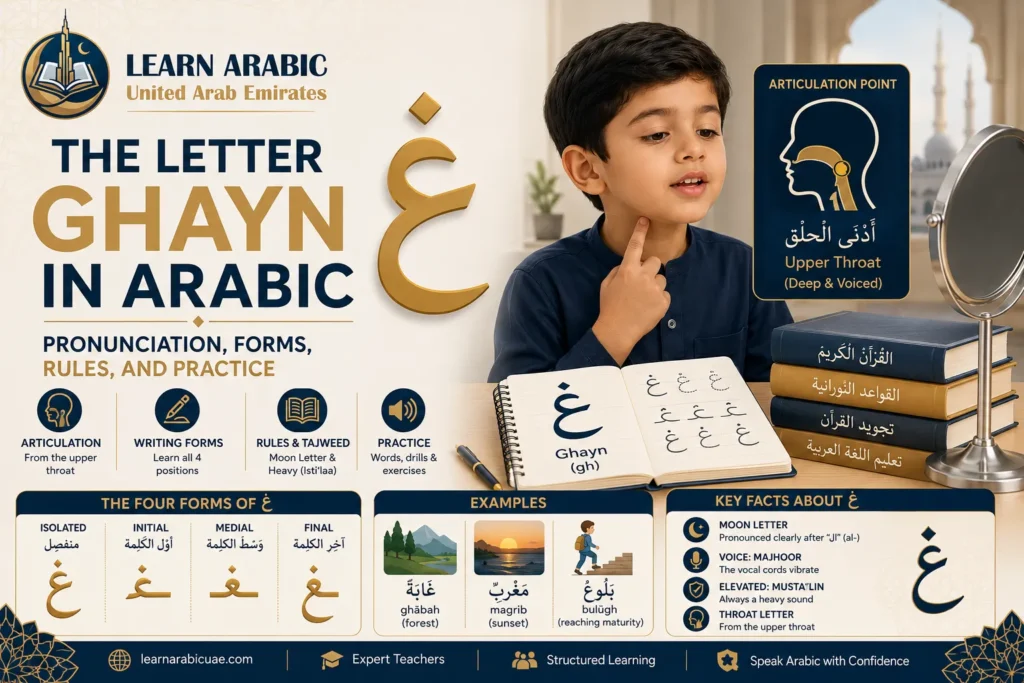
- غ (ghayn) — a voiced, throaty sound similar to the French r in Paris.
- ح (haa) — a soft, breathy “h” produced deeper in the throat than the regular ه (haa).
- خ (khaa) — a rough, throaty sound similar to the ch in the German word Bach. You’ll hear it in everyday UAE words such as خبز (khubz — bread).
Knowing how to learn Arabic in 7 days in the UAE isn’t just about memorising vocabulary. Pronunciation matters from the beginning.
The practitioner-level insight here: most self-study learners skip this day and go straight to vocabulary. That’s the single biggest mistake in Arabic learning. Pronunciation habits embed within the first few weeks — wrong habits become genuinely difficult to undo later. Fix the sounds now, and vocabulary retention improves automatically because your brain stores the correct phoneme from the start.
Tool: Search “Arabic emphatic consonants pronunciation” on YouTube and repeat each sound in isolation 10 times before attempting to use it in a word.
Day 3: Essential Arabic for Numbers, Days, and Daily Life
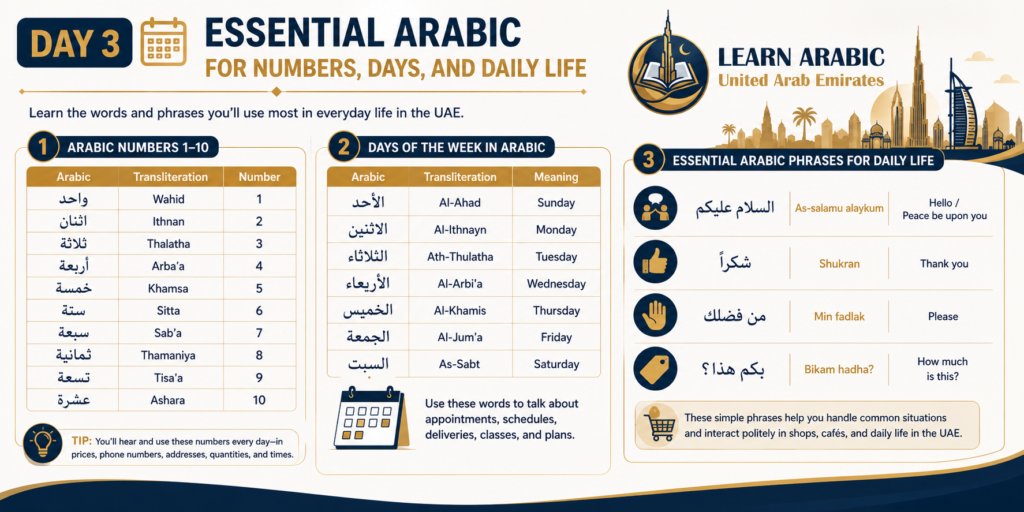
Start with the Arabic words and phrases you’ll use most often in everyday situations. One of the most practical parts of learning how to learn Arabic in 7 days in the UAE is knowing the numbers, days, and everyday phrases you’re likely to use immediately.
Arabic Numbers 1–10
Arabic numbers are some of the most useful words to learn first because you’ll hear and use them constantly in everyday life in the UAE—from asking about prices and giving your phone number to understanding addresses, quantities, and times.
| Arabic | Transliteration | Number |
| واحد | Wahid | 1 |
| اثنان | Ithnan | 2 |
| ثلاثة | Thalatha | 3 |
| أربعة | Arba’a | 4 |
| خمسة | Khamsa | 5 |
| ستة | Sitta | 6 |
| سبعة | Sab’a | 7 |
| ثمانية | Thamaniya | 8 |
| تسعة | Tisa’a | 9 |
| عشرة | Ashara | 10 |
Once you’re comfortable with the numbers, learn the days of the week so you can talk about appointments, schedules, and everyday plans.
Read also: Diwani Arabic Calligraphy – History, Types, and Artistic Legacy
Days of the Week in Arabic
These are useful for talking about appointments, work schedules, deliveries, classes, and everyday plans.
| Arabic | Transliteration | Meaning |
| الأحد | Al-Ahad | Sunday |
| الاثنين | Al-Ithnayn | Monday |
| الثلاثاء | Ath-Thulatha | Tuesday |
| الأربعاء | Al-Arbi’a | Wednesday |
| الخميس | Al-Khamis | Thursday |
| الجمعة | Al-Jum’a | Friday |
| السبت | As-Sabt | Saturday |
Essential Arabic Phrases for Daily Life
Finally, add a few simple phrases that you can start using immediately in shops, cafés, and everyday conversations:
- السلام عليكم — As-salamu alaykum — Hello / Peace be upon you
- شكراً — Shukran — Thank you
- من فضلك — Min fadlak — Please
- بكم هذا؟ — Bikam hadha? — How much is this?
These phrases may seem basic, but they give you the vocabulary you need to handle common situations such as shopping, asking about prices, understanding schedules, and interacting politely with people in the UAE.
Step Inside Our Classrooms
Don’t just take our word for it—see our community in action. Click below to watch real, live snippets from our recent classes and experience our engaging teaching style firsthand!
Master Arabic in the UAE
Experience world-class Arabic language training designed for students and professionals in the Emirates.
Book Your Free TrialDay 4: Essential Arabic Grammar — Pronouns, Verbs, and Simple Sentences
Arabic grammar has a reputation for complexity, and at advanced levels it earns it. But the layer you need for basic UAE communication is genuinely manageable. If you’re learning with children, the same principle applies: Arabic grammar courses for kids can introduce sentence structures and grammar concepts gradually without overwhelming beginners.
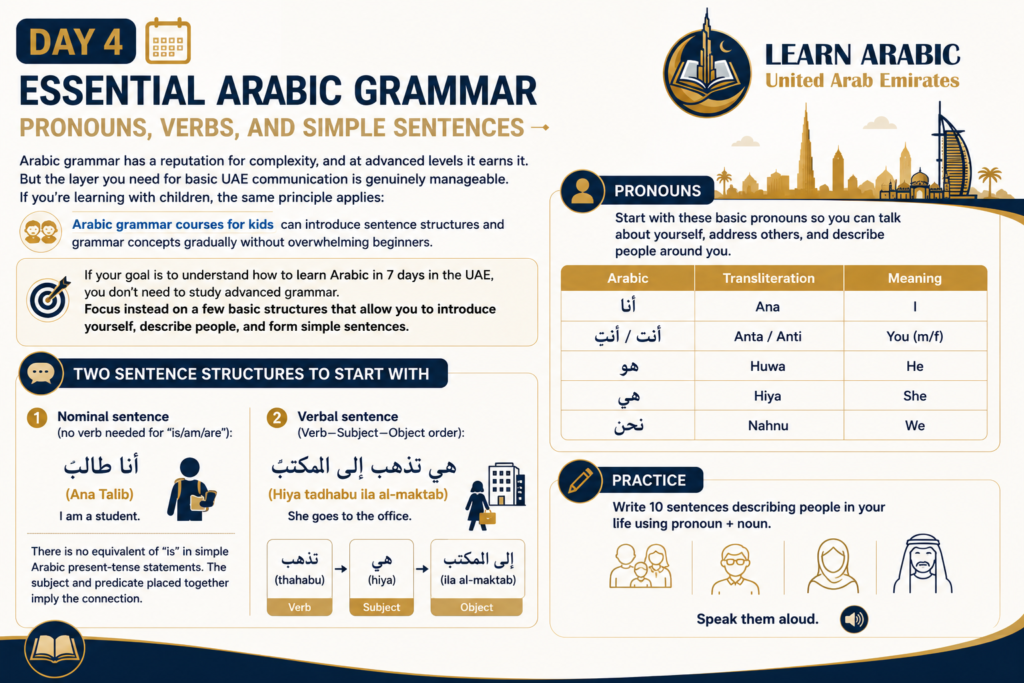
If your goal is to understand how to learn Arabic in 7 days in the UAE, you don’t need to study advanced grammar. Focus instead on a few basic structures that allow you to introduce yourself, describe people, and form simple sentences.
Pronouns:
Pronouns are essential for building simple Arabic sentences and introducing yourself in everyday conversations. Start with these basic pronouns so you can talk about yourself, address others, and describe people around you.
| Arabic | Transliteration | Meaning |
| أنا | Ana | I |
| أنتَ / أنتِ | Anta / Anti | You (m/f) |
| هو | Huwa | He |
| هي | Hiya | She |
| نحن | Nahnu | We |
Two sentence structures to start with:
- Nominal sentence (no verb needed for “is/am/are”): أنا طالب (Ana Talib) — I am a student. There is no equivalent of “is” in simple Arabic present-tense statements. The subject and predicate placed together imply the connection.
- Verbal sentence (Verb-Subject-Object order): هي تذهب إلى المكتب (Hiya tadhabu ila al-maktab) — She goes to the office.
Practice: Write 10 sentences describing people in your life using pronoun + noun. Speak them aloud.
Read also: How to Learn Arabic in 6 Months in the UAE?
Day 5: Build Your UAE Arabic Vocabulary — Essential Words That Actually Matter
Generic Arabic vocabulary lists often focus on words like “camel” and “desert.” If your goal is to communicate in the UAE, you’ll get more value from words and expressions you can actually use at work, in shops, at government offices, and in everyday conversations.
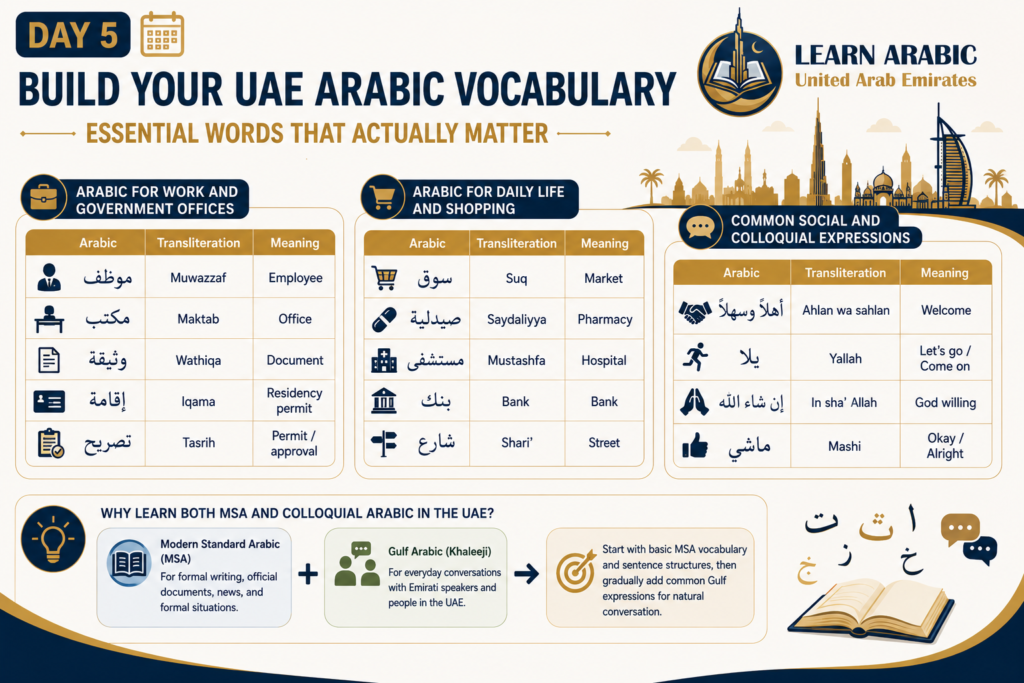
Instead of memorizing random vocabulary, focus on high-frequency Arabic words grouped by real-life situations.A practical answer to how to learn Arabic in 7 days in the UAE must include vocabulary that reflects your actual surroundings.
Arabic for Work and Government Offices
These words are useful when dealing with employers, paperwork, government services, and administrative tasks:
| Arabic | Transliteration | Meaning |
| موظف | Muwazzaf | Employee |
| مكتب | Maktab | Office |
| وثيقة | Wathiqa | Document |
| إقامة | Iqama | Residency permit |
| تصريح | Tasrih | Permit / approval |
Arabic for Daily Life and Shopping
These everyday words will help you navigate common places and services across the UAE:
| Arabic | Transliteration | Meaning |
| سوق | Suq | Market |
| صيدلية | Saydaliyya | Pharmacy |
| مستشفى | Mustashfa | Hospital |
| بنك | Bank | Bank |
| شارع | Shari’ | Street |
Common Social and Colloquial Expressions
Alongside formal Arabic, learn a few expressions you’ll hear frequently in everyday conversations:
| Arabic | Transliteration | Meaning |
| أهلاً وسهلاً | Ahlan wa sahlan | Welcome |
| يلا | Yallah | Let’s go / Come on |
| إن شاء الله | In sha’ Allah | God willing |
| ماشي | Mashi | Okay / Alright |
Why Learn Both MSA and Colloquial Arabic in the UAE?
Modern Standard Arabic (MSA) is common in formal writing, official documents, news, and many formal contexts across the UAE. Gulf Arabic (Khaleeji), meanwhile, is more relevant to everyday spoken conversations with Emirati speakers and other Gulf Arabic speakers.
You don’t need to master both at once. Start with basic MSA vocabulary and sentence structures, then gradually add common Gulf expressions so you can understand and participate in everyday conversations more naturally.
Day 6: Arabic Listening Practice — Training Your Ear for the Gulf
Listening is where most self-study learners fall behind. Arabic has sounds that your ear has never needed to distinguish before. The ear needs training before the brain can process the language efficiently.
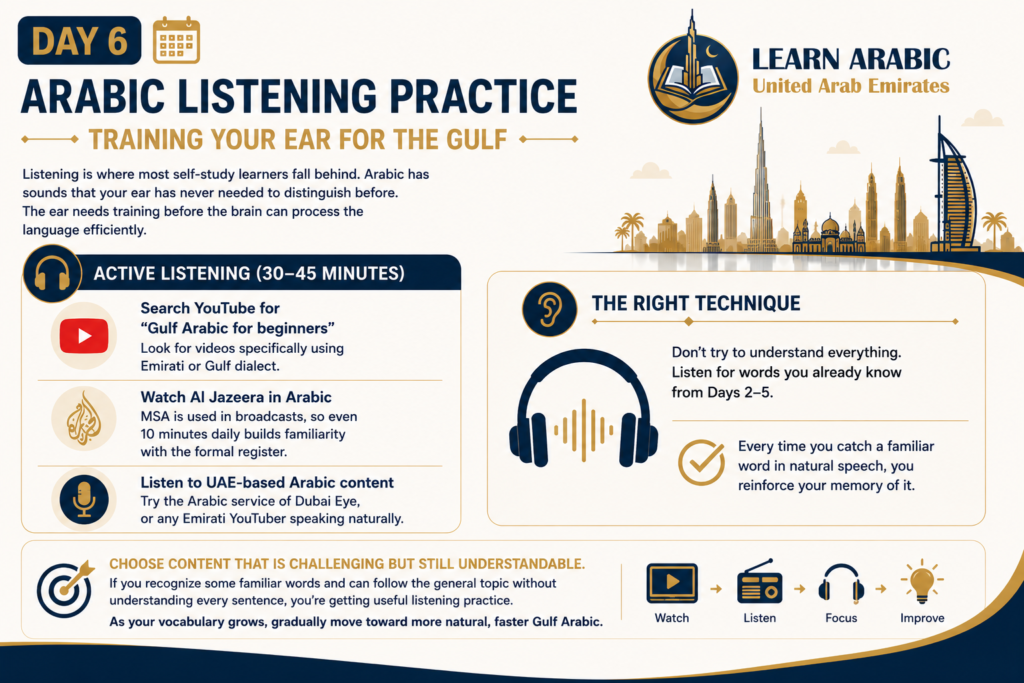
Active listening (30–45 minutes):
- Search YouTube for “Gulf Arabic for beginners” — look for videos specifically using Emirati or Gulf dialect, not Egyptian or Levantine
- Watch Al Jazeera in Arabic — MSA is used in broadcasts, so even 10 minutes daily builds familiarity with the formal register
- Listen to UAE-based Arabic content: the Arabic service of Dubai Eye, or any Emirati YouTuber speaking naturally
The right technique: Don’t try to understand everything. Listen for words you already know from Days 2–5. Every time you catch a familiar word in natural speech, you reinforce your memory of it.
Choose content that is challenging but still understandable. If you recognize some familiar words and can follow the general topic without understanding every sentence, you’re getting useful listening practice. As your vocabulary grows, gradually move toward more natural, faster Gulf Arabic.
Day 7: Arabic Speaking Practice — Use What You’ve Built
Day 7 is about output. Everything you’ve practised receptively this week gets tested actively today The final step in how to learn Arabic in 7 days in the UAE is putting everything you’ve learned into practice.
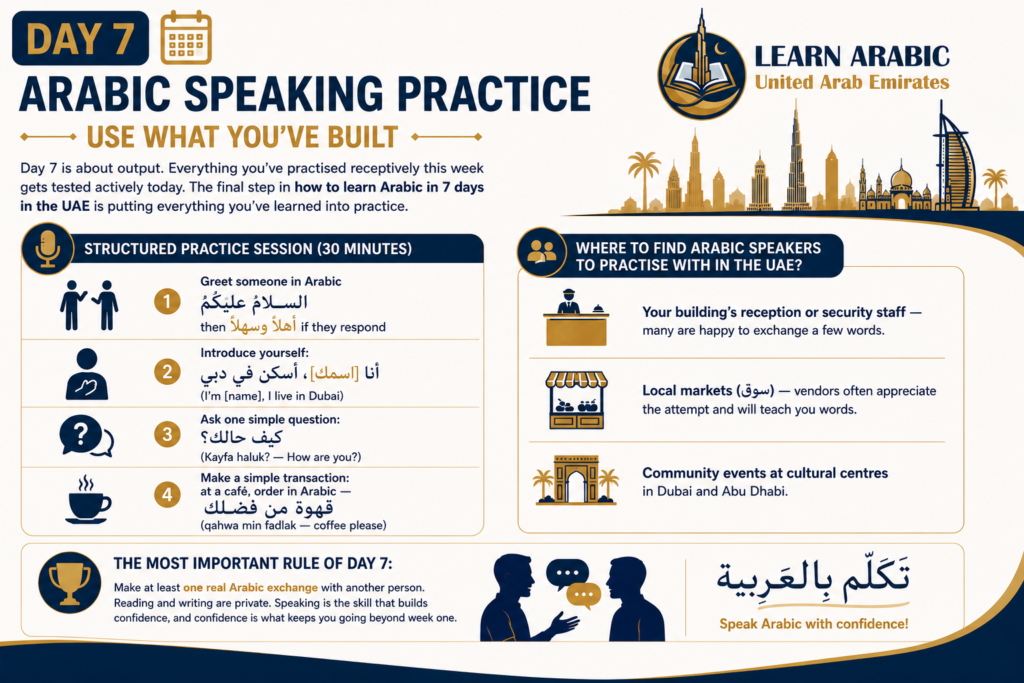
Structured practice session (30 minutes):
- Greet someone in Arabic — السلام عليكم, then أهلاً وسهلاً if they respond
- Introduce yourself: أنا [اسمك]، أسكن في دبي (I’m [name], I live in Dubai)
- Ask one simple question: كيف حالك؟ (Kayfa haluk? — How are you?)
- Make a simple transaction: at a café, order in Arabic — قهوة من فضلك (qahwa min fadlak — coffee please)
Where to find Arabic speakers to practise with in the UAE?
- Your building’s reception or security staff — many are happy to exchange a few words
- Local markets (سوق) — vendors often appreciate the attempt and will teach you words
- Community events at cultural centres in Dubai and Abu Dhabi
The most important rule of Day 7: make at least one real Arabic exchange with another person. Reading and writing are private. Speaking is the skill that builds confidence, and confidence is what keeps you going beyond week one.
For children who need more opportunities to practise speaking beyond basic vocabulary, Arabic conversation courses for kids can help turn these foundational phrases into regular speaking practice.
See Our Classroom Environment in Action
Experience a sneak peek into our live sessions. Watch the video below to see our specialized instructors interacting with students, breakdown complex texts, and cultivate an engaging, respectful learning environment.
Master Arabic in the UAE
Experience world-class Arabic language training designed for students and professionals in the Emirates.
Book Your Free TrialStart Your Arabic Journey the Right Way in the UAE
Seven days gives you a solid foundation — but Arabic is a language you build over months. The fastest learners in the UAE are those who combine daily self-study with a qualified teacher who can correct pronunciation, answer grammar questions, and tailor lessons to their specific goals.
If you’re looking for structured Arabic instruction in the UAE, learnarabicuae.com connects you with qualified Arabic tutors and courses designed for UAE residents — from complete beginners to intermediate learners.
Our Arabic courses
- Arabic Course in the UAE
- Arabic Intensive Course
- Arabic Classes for Beginners (Learn Arabic from Scratch)
- Madinah Arabic Course
- Arabic Classes for Adults
- Self-Paced Arabic Course
- Arabic Speaking Classes
- Learn to Write Arabic Course
- Arabic Grammar Course
- Learn Arabic Alphabet Course
- Modern Standard Arabic (MSA) Course
- Quranic Arabic Course
- Fusha Arabic Course
- Classical Arabic Course
- Emirati Arabic Course
- Gulf Arabic Course
- Learn Saudi Arabic
- Business Arabic Course UAE
- Arabic Language Classes for Professionals in UAE
Master Arabic in the UAE
Experience world-class Arabic language training designed for students and professionals in the Emirates.
Book Your Free TrialStart your Arabic learning journey with Learn Arabic UAE

Conclusion
Learning Arabic in 7 days in the UAE is not about reaching fluency — it’s about building a real, usable foundation in a structured, daily sequence. Start with the alphabet and sounds on Day 1, build vocabulary and grammar through Days 3–5, train your ear on Day 6, and speak with real people on Day 7.
The UAE gives you one advantage that no textbook can replicate: Arabic is everywhere around you. Signs, conversations, menus, government documents — every one of them is a practice opportunity. Use them.
After Day 7, the path forward is clear: consistent daily practice, a structured course, and a qualified teacher who can correct what you can’t hear yourself getting wrong.
Frequently Asked Questions
Can I really learn Arabic in 7 days in the UAE?
You can learn the foundations of Arabic in 7 days — the alphabet, essential pronunciation, basic vocabulary, numbers, and simple sentences. You will not be conversationally fluent, but you will have a structured, usable starting point. Seven days of focused daily practice is enough to hold simple exchanges and understand common signs and phrases across the UAE.
Which Arabic should I learn in the UAE — Gulf Arabic or Modern Standard Arabic?
Both are useful. Modern Standard Arabic (MSA) is used in formal contexts, government settings, newspapers, and official signage across the UAE. Gulf Arabic (Khaleeji) is what Emirati nationals speak conversationally. For beginners, start with MSA to build a grammatical foundation, then layer in Gulf vocabulary and phrases for everyday UAE communication.
How long does it take to become fluent in Arabic in the UAE?
There is no single timeline for Arabic fluency because progress depends on your study time, learning goals, previous language experience, and how much Arabic you use outside lessons. With consistent daily practice, many learners can develop functional conversational Arabic over a year or more, while reaching a higher level of fluency takes longer.
Is there Arabic tutoring available for kids in the UAE?
Yes. Specialised Arabic tutors for kids in the UAE use age-appropriate methods that focus on letter recognition, simple vocabulary, and conversational confidence. Children typically progress faster than adults in pronunciation because their phonological systems are still flexible.
What is the best way to practise Arabic speaking in the UAE?
The most effective method is to use Arabic in low-stakes daily transactions: greet your building staff, order at a café, or ask for directions in Arabic. These short, real-world exchanges build spoken confidence faster than practice sessions alone. Pair this with a structured speaking course or a conversation tutor for corrections you won’t catch on your own.
Do I need to learn the Arabic alphabet first, or can I start with spoken phrases?
Learn the alphabet first. Skipping the alphabet and learning only spoken phrases creates a ceiling you will hit within weeks — you cannot read signs, menus, or any written content, and your pronunciation will drift without the anchor of understanding the script. The Arabic alphabet takes most adults 2–4 weeks to recognise confidently with daily 20-minute sessions. It is worth every minute.



Leave a Reply