 Learn Arabic
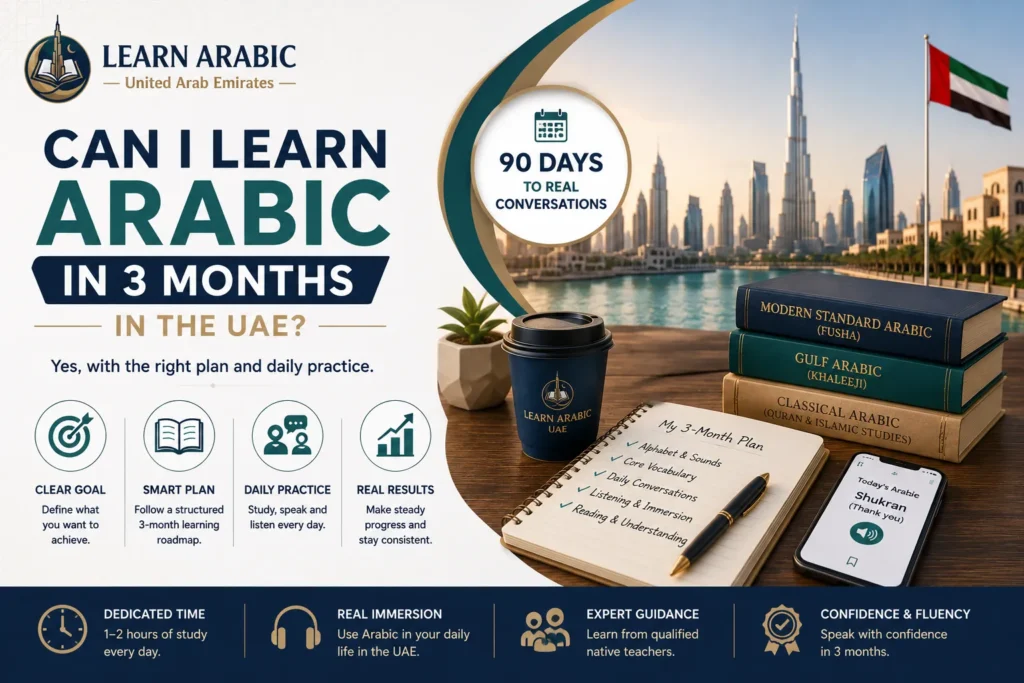
Living in the UAE puts you in one of the best environments on earth to learn Arabic fast — Arabic surrounds you in signs, conversations, and daily life. But can you actually become conversational in 3 months? The honest answer: yes, if you define “conversational” correctly and build a plan that uses your UAE environment as an asset.
The U.S. Foreign Service Institute (FSI) classifies Arabic as a Category V language — the hardest category for English speakers — estimating around 2,200 hours to reach professional proficiency. Full fluency in three months is not realistic. But basic conversational ability, reading the Arabic script, and holding real daily interactions in the UAE? Absolutely achievable — and living here gives you an immersion advantage most Arabic learners never get.
Can You Learn Arabic in 3 Months in the UAE?
Living in the UAE is one of the single biggest advantages an Arabic learner can have. Immersion is not something you have to create artificially — it is built into the fabric of daily life here. Road signs, government services, mosque announcements, supermarket labels, and casual conversations with Emirati and Arab colleagues all provide natural Arabic exposure that accelerates acquisition in ways a classroom in London or New York simply cannot.
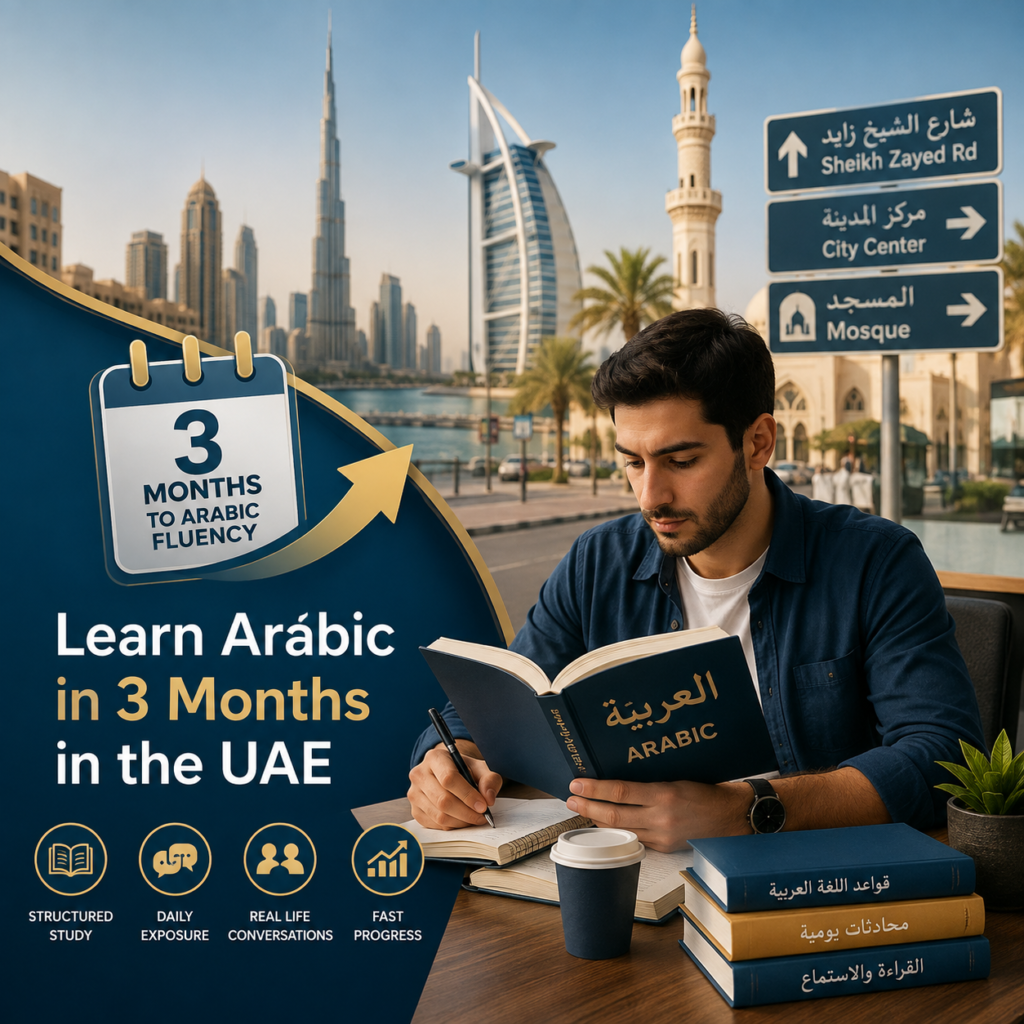
That said, immersion without structure produces slow, uneven results. The learners who make dramatic progress in 3 months in the UAE are those who combine structured study with active daily exposure — not those who simply “pick it up” passively.
For adults balancing work, family, and daily responsibilities, choosing a structured program designed specifically for adult learners can make this process more manageable. A dedicated Arabic course for adults can provide the structure and practice needed to turn daily exposure into measurable progress.
What Arabic Type Should You Learn in the UAE?
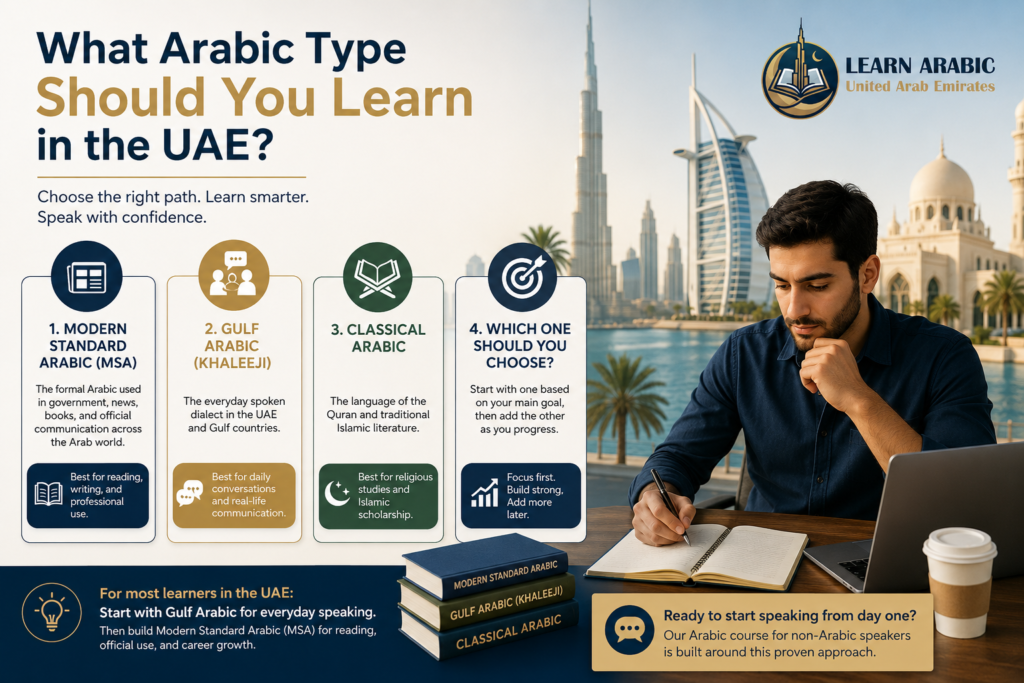
Choosing the right type of Arabic from the beginning helps you learn more efficiently and avoid dividing your attention between different language varieties. Your choice should depend on how you plan to use Arabic in the UAE.
1. Modern Standard Arabic (MSA)
Modern Standard Arabic (MSA), also known as Fuṣḥā, is the formal version of Arabic used in government documents, newspapers, television news, books, and official communication across the Arab world. It is the best option if your goal is reading, writing, or using Arabic in professional or academic settings.
2. Gulf Arabic (Khaleeji)
Gulf Arabic is the everyday spoken dialect used in the UAE and neighboring Gulf countries. It is the language you’ll hear in daily conversations with Emiratis, at local markets, and in many social situations. If your main goal is communicating with people in the UAE, Gulf Arabic offers the most practical starting point.
3. Classical Arabic
Classical Arabic is the language of the Quran and traditional Islamic literature. While it is essential for religious studies and Islamic scholarship, it is not the most practical choice for learners whose immediate goal is everyday communication in the UAE.
4. Which One Should You Choose?
For most UAE learners, the best approach is to start with Gulf Arabic if your priority is speaking with people in everyday situations. If your goals include reading official documents, following Arabic news, or advancing professionally, build a foundation in Modern Standard Arabic (MSA) as well. Rather than trying to master both at the same time, focus on one first and add the other as your skills develop.
If your goal is to use Arabic professionally, a specialized Arabic course for professionals can help you develop language skills that are relevant to workplace communication and professional situations.
Read also: Diwani Arabic Calligraphy – History, Types, and Artistic Legacy
What Level Can You Realistically Reach in 3 Months in the UAE?
Before asking can I learn Arabic in 3 months in the UAE, it’s important to understand what level of Arabic is realistic within 90 days.
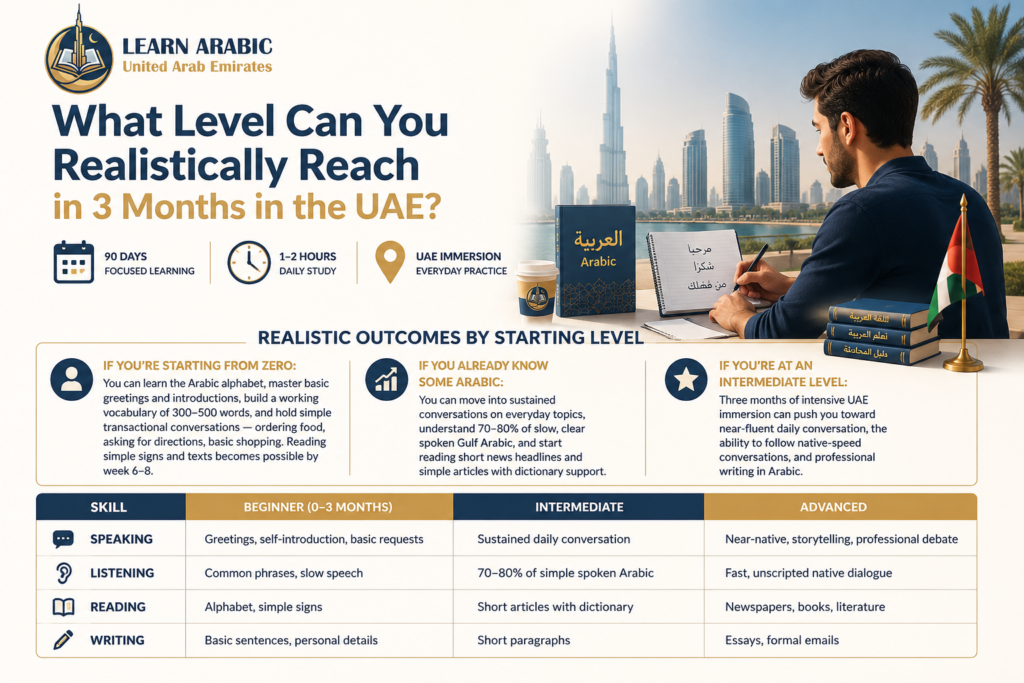
This depends on two variables: how many hours you study per day, and where you start.
The FSI’s research is clear: casual learners studying 3 hours per week can take 8–10 years to reach intermediate Arabic. Intensive learners putting in 5–8 hours daily can make substantial progress in 3 months. The UAE lifestyle can support the middle ground — 1–2 dedicated study hours daily plus 2–3 hours of natural immersion exposure through work, commute, and environment.
Read also: How to Learn Arabic in 6 Months in the UAE?
Step Inside Our Classrooms
Don’t just take our word for it—see our community in action. Click below to watch real, live snippets from our recent classes and experience our engaging teaching style firsthand!
Master Arabic in the UAE
Experience world-class Arabic language training designed for students and professionals in the Emirates.
Book Your Free TrialRealistic Outcomes by Starting Level
The results you can achieve in three months depend on your current level. Here’s what most learners can realistically expect based on where they start.
If you’re starting from zero: You can learn the Arabic alphabet, master basic greetings and introductions, build a working vocabulary of 300–500 words, and hold simple transactional conversations — ordering food, asking for directions, basic shopping. Reading simple signs and texts becomes possible by week 6–8.
If you already know some Arabic: You can move into sustained conversations on everyday topics, understand 70–80% of slow, clear spoken Gulf Arabic, and start reading short news headlines and simple articles with dictionary support.
If you’re at an intermediate level: Three months of intensive UAE immersion can push you toward near-fluent daily conversation, the ability to follow native-speed conversations, and professional writing in Arabic.
| Skill | Beginner (0–3 months) | Intermediate | Advanced |
| Speaking | Greetings, self-introduction, basic requests | Sustained daily conversation | Near-native, storytelling, professional debate |
| Listening | Common phrases, slow speech | 70–80% of simple spoken Arabic | Fast, unscripted native dialogue |
| Reading | Alphabet, simple signs | Short articles with dictionary | Newspapers, books, literature |
| Writing | Basic sentences, personal details | Short paragraphs | Essays, formal emails |
Factors That Determine How Fast You Learn Arabic in the UAE
Whether can I learn Arabic in 3 months in the UAE becomes a reality depends largely on the following factors.
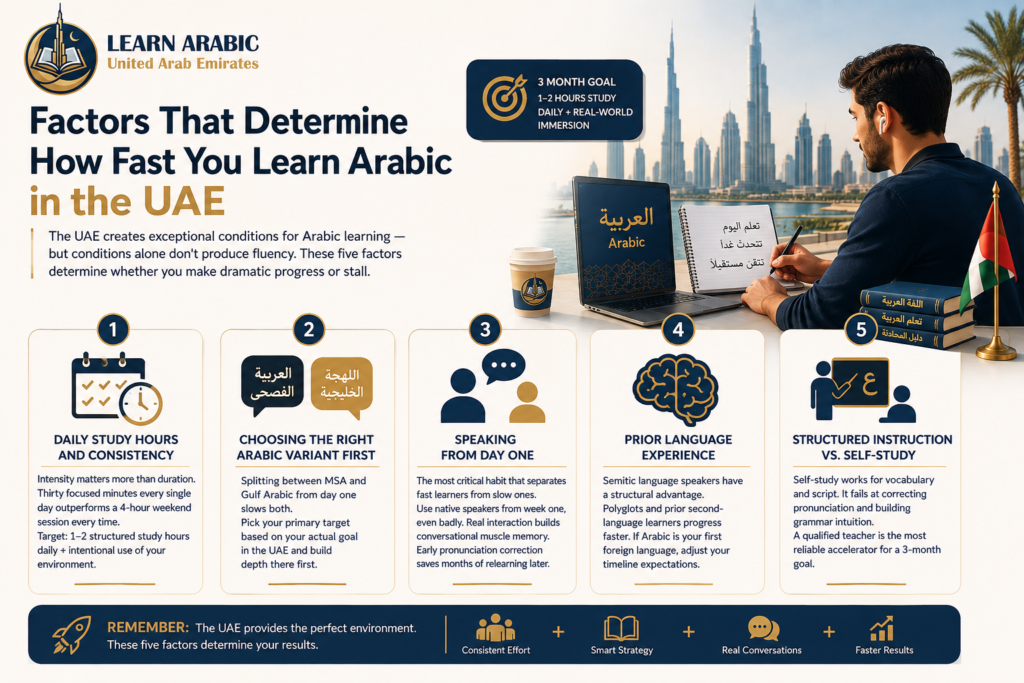
The UAE creates exceptional conditions for Arabic learning — but conditions alone don’t produce fluency. These five factors determine whether you make dramatic progress or stall.
1. Daily Study Hours and Consistency
Intensity matters more than duration. Thirty focused minutes every single day outperforms a 4-hour weekend session every time. The target for a 3-month result in the UAE: 1–2 structured study hours daily, plus intentional use of your environment (listening to Arabic radio during commute, speaking to Arabic-speaking colleagues, reading Arabic signs rather than defaulting to English).
2. Choosing the Right Arabic Variant First
As noted above, splitting between MSA and Gulf Arabic from day one slows both. Pick your primary target based on your actual goal in the UAE and build depth there first.
3. Speaking from Day One
This is the most critical habit that separates fast learners from slow ones. Learners who wait until they “know enough” to speak never build the conversational muscle memory that real interaction creates. In the UAE, you have native Arabic speakers accessible every day — use them from week one, even badly. Pronunciation errors corrected early save months of relearning later.
4. Prior Language Experience
Speakers of Semitic languages (Hebrew, Aramaic, Maltese) have a measurable structural advantage in Arabic because the root-based morphology is familiar. Polyglots and people who have already learned a second language also tend to progress faster, having developed the meta-skill of language acquisition itself. If Arabic is your first foreign language, account for this in your timeline expectations.
5. Structured Instruction vs. Self-Study
Self-study works for script recognition and vocabulary building. It fails — consistently — at correcting pronunciation errors and building grammar intuition. An instructor catches a mispronounced ع (ayn) or ق (qaf) in real time; an app cannot. For a 3-month goal, structured instruction with a qualified teacher is the most reliable accelerator.
For learners who want to strengthen this area systematically, a dedicated Arabic grammar course can provide focused practice with sentence structure, grammar rules, and correct usage. For a 3-month goal, structured instruction with a qualified teacher is the most reliable accelerator.
Read also: How to Learn Arabic in 5 Minutes in the UAE?

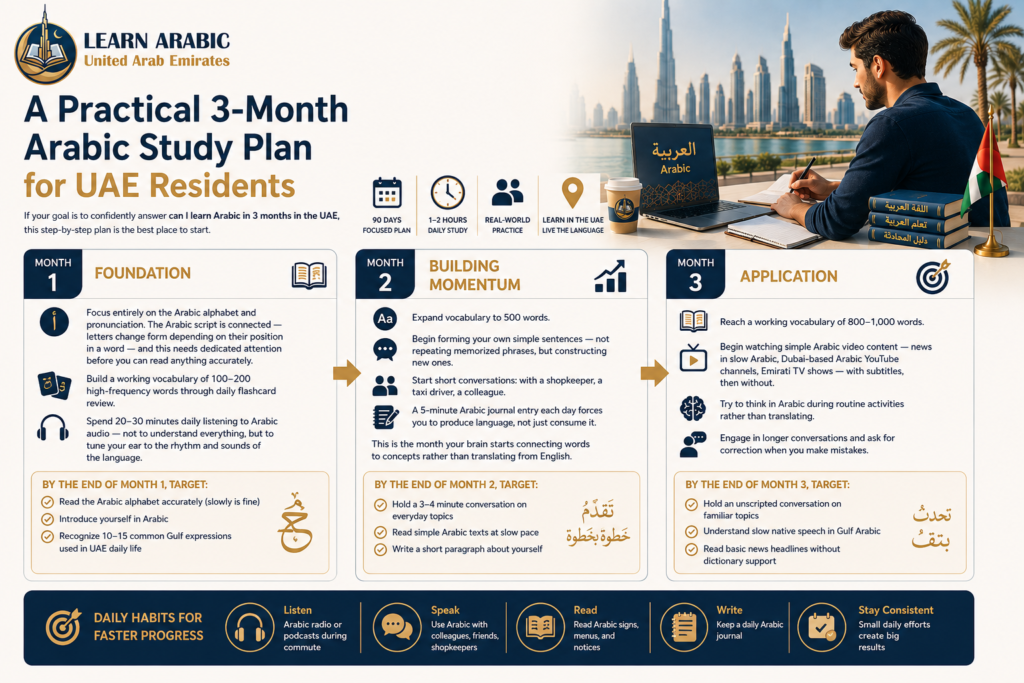
A Practical 3-Month Arabic Study Plan for UAE Residents
If your goal is to confidently answer can I learn Arabic in 3 months in the UAE, this step-by-step plan is the best place to start.
Breaking your learning into monthly goals makes it easier to stay consistent and measure your progress. Follow this practical three-month plan to build Arabic skills step by step while living in the UAE.
Month 1: Foundation
Focus entirely on the Arabic alphabet and pronunciation. The Arabic script is connected — letters change form depending on their position in a word — and this needs dedicated attention before you can read anything accurately. Simultaneously, build a working vocabulary of 100–200 high-frequency words through daily flashcard review. Spend 20–30 minutes daily listening to Arabic audio — not to understand everything, but to tune your ear to the rhythm and sounds of the language.
By the end of month 1, target: read the Arabic alphabet accurately (slowly is fine), introduce yourself in Arabic, recognize 10–15 common Gulf expressions used in UAE daily life.
Month 2: Building Momentum
Expand vocabulary to 500 words. Begin forming your own simple sentences — not repeating memorized phrases, but constructing new ones. Start short conversations: with a shopkeeper, a taxi driver, a colleague. A 5-minute Arabic journal entry each day forces you to produce language, not just consume it.
This is the month your brain starts connecting words to concepts rather than translating from English.
By the end of month 2, target: hold a 3–4 minute conversation on everyday topics, read simple Arabic texts at slow pace, write a short paragraph about yourself.
Month 3: Application
Reach a working vocabulary of 800–1,000 words. Begin watching simple Arabic video content — news in slow Arabic, Dubai-based Arabic YouTube channels, Emirati TV shows — with subtitles, then without. Try to think in Arabic during routine activities rather than translating. Engage in longer conversations and ask for correction when you make mistakes.
By the end of month 3, target: hold an unscripted conversation on familiar topics, understand slow native speech in Gulf Arabic, read basic news headlines without dictionary support.
See Our Classroom Environment in Action
Experience a sneak peek into our live sessions. Watch the video below to see our specialized instructors interacting with students, breakdown complex texts, and cultivate an engaging, respectful learning environment.
Master Arabic in the UAE
Experience world-class Arabic language training designed for students and professionals in the Emirates.
Book Your Free TrialBuild Real Arabic Skills in Just 3 Months in the UAE
Three months in the UAE can be the perfect opportunity to build a strong foundation in Arabic when you follow a structured learning plan. While everyday exposure helps, lasting progress comes from consistent practice, expert guidance, and lessons that develop your speaking, listening, reading, and writing skills together.
At Learn Arabic UAE, our live online Arabic courses are designed for expats, professionals, and residents who want to make the most of their time in the UAE. Whether you’re starting from scratch or refreshing your Arabic, our native instructors provide a personalized learning path that matches your goals, schedule, and current level.
Our Arabic courses
- Arabic Course in the UAE
- Arabic Intensive Course
- Arabic Classes for Beginners (Learn Arabic from Scratch)
- Madinah Arabic Course
- Arabic Classes for Adults
- Self-Paced Arabic Course
- Arabic Speaking Classes
- Learn to Write Arabic Course
- Arabic Grammar Course
- Learn Arabic Alphabet Course
- Modern Standard Arabic (MSA) Course
- Quranic Arabic Course
- Fusha Arabic Course
- Classical Arabic Course
- Emirati Arabic Course
- Gulf Arabic Course
- Learn Saudi Arabic
- Business Arabic Course UAE
- Arabic Language Classes for Professionals in UAE
Book your free trial lesson today and make the most of your next three months of Arabic learning.

Master Arabic in the UAE
Experience world-class Arabic language training designed for students and professionals in the Emirates.
Book Your Free TrialConclusion
Can you learn Arabic in 3 months in the UAE? Yes — with a realistic definition of the goal and a structured approach that uses your environment deliberately. Full fluency is not the target for 3 months; conversational competence, script literacy, and the foundation for long-term progress are. The FSI’s 2,200-hour estimate reflects professional proficiency — not the basic, functional Arabic that makes daily life, professional relationships, and cultural connection in the UAE genuinely richer.
The advantage UAE residents have over Arabic learners anywhere else in the world is real. You are not simulating immersion — you are inside it. The learners who convert that advantage into measurable progress are the ones who combine daily structured study with intentional exposure, start speaking immediately, and get qualified instruction that corrects their errors before habits set. Three months is not a finish line for Arabic. It is, with the right start, a very strong first chapter.
Frequently Asked Questions
Can I learn Arabic in 3 months in the UAE with no prior experience?
Yes — beginners can achieve basic conversational ability in 3 months in the UAE with daily study of 1–2 hours. You will learn the alphabet, master 300–500 high-frequency words, and hold simple daily interactions. Full fluency is not realistic in this timeframe, but a functional, confidence-building foundation is.
Is Gulf Arabic or Modern Standard Arabic better to learn for living in the UAE?
For daily life in the UAE, Gulf Arabic is more immediately useful — it is what Emiratis speak in casual and professional contexts. MSA is better for reading, formal communication, and accessing Arabic media across the Arab world. Most UAE-based learners benefit from starting with Gulf Arabic for speaking and adding MSA reading skills progressively.
How many hours a day do I need to study Arabic to make real progress in 3 months?
Intensive learners studying 5–8 hours daily can reach intermediate-level Arabic in 3 months. For most working UAE residents, 1–2 structured study hours daily combined with deliberate use of Arabic in your environment (conversations, media, reading signs) produces meaningful progress within 90 days.
Is it hard to learn Arabic as an English speaker?
Arabic is classified as the hardest language category for English speakers by the FSI, primarily because of its different script, right-to-left reading direction, sounds not found in English (like ع and ق), and a root-based grammar system unlike any European language. This makes it more challenging — not impossible. Structured instruction from week one dramatically reduces the difficulty curve.
What is the biggest mistake Arabic learners in the UAE make?
Waiting too long to speak. Most beginners spend weeks learning rules and vocabulary before attempting a real conversation. In the UAE, you are surrounded by native Arabic speakers — using the language badly from day one builds muscle memory and confidence that no amount of passive study can replicate. Start speaking in week one, accept mistakes, and improve from real feedback.
Can children learn Arabic faster than adults in the UAE?
Children acquire Arabic more naturally through immersion and have a phonological advantage in picking up sounds like ع and غ that adults find difficult. Adults, however, learn grammar and vocabulary more efficiently through structured instruction and generally make faster measurable progress in the short term. Both benefit from the UAE’s immersive environment — the approach simply differs.



Leave a Reply