 Learn Arabic
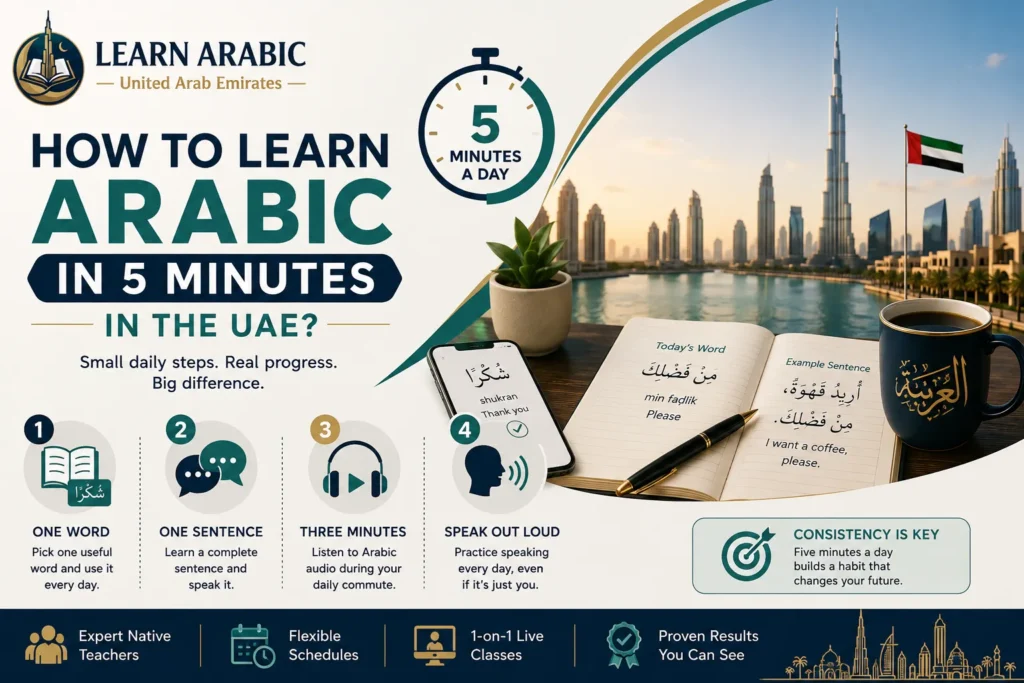
If you live in the UAE, Arabic is not a foreign language — it is the language of the country you call home. It is on every road sign between Abu Dhabi and Dubai, in every government form, in every conversation at the market. Most expats want to learn it. Most never do — not because they lack time, but because they believe they need more of it than they actually do.
If you’re wondering how to learn Arabic in 5 minutes in the UAE, five minutes a day is enough to start building a habit that leads to real progress.
Step 1: Pick One Word From the UAE’s Most-Used Arabic Vocabulary
The first step in how to learn Arabic in 5 minutes in the UAE is choosing vocabulary you’ll actually use every day.
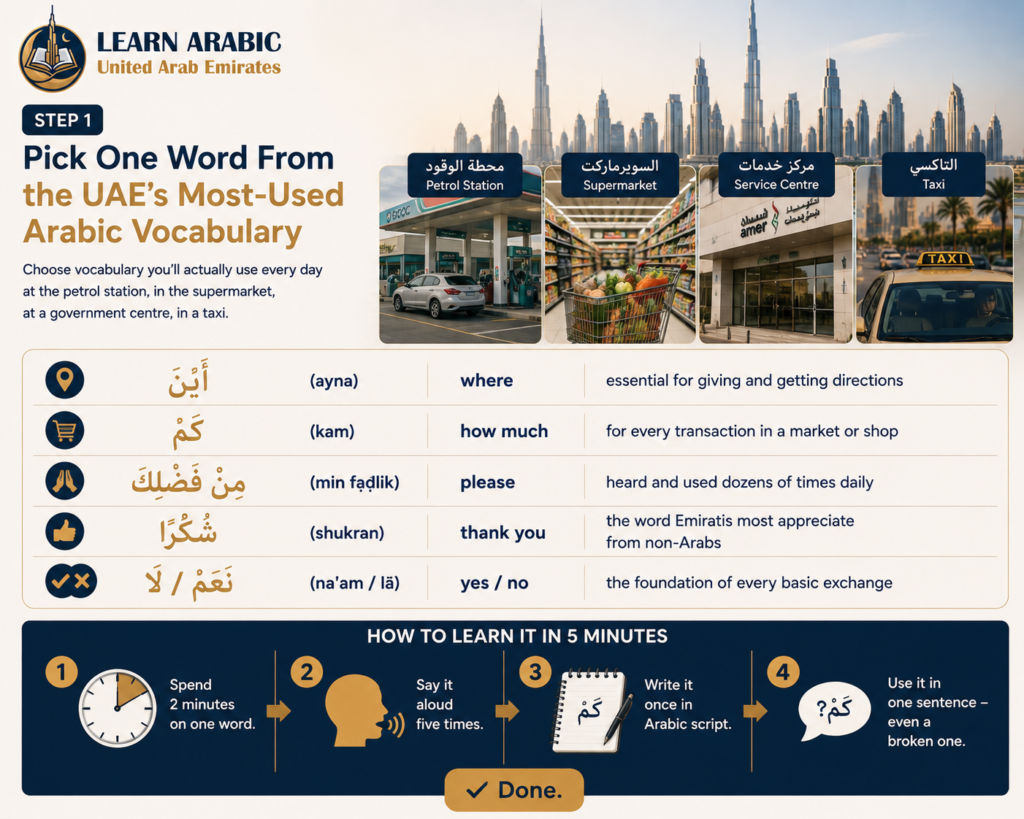
Start instead with words that appear in daily UAE life: at the petrol station, in the supermarket, at a government service centre, in a taxi.
Prioritise these first:
- أَيْنَ (ayna) — where — essential for giving and getting directions
- كَمْ (kam) — how much — for every transaction in a market or shop
- مِنْ فَضْلِكَ (min faḍlik) — please — heard and used dozens of times daily
- شُكْرًا (shukran) — thank you — the word Emiratis most appreciate from non-Arabs
- نَعَمْ / لَا (naʿam / lā) — yes / no — the foundation of every basic exchange
Spend 2 minutes on one word. Say it aloud five times. Write it once in Arabic script. Use it in one sentence — even a broken one. Done.
One word a day is 365 words in a year. At around 300 words, you can handle most practical interactions in the UAE without switching to English.For beginners, structured Arabic courses for beginners can provide the foundation needed to build vocabulary and pronunciation correctly from the start.
Read also: The Arabic Letter أ (Alif) – Pronunciation, Writing, and What It Really Means

Step 2: Learn a Complete Sentence, Not Just Individual Words
Anyone learning how to learn Arabic in 5 minutes in the UAE should practice complete sentences instead of isolated words.
كَمِ السِّعْرُ؟ (How much is the price?) teaches you three things at once: the word for “how much,” the word for “price,” and the sentence pattern Arabic uses for questions. That is three times the return on the same two minutes.
Sentences also prepare you to speak — which isolated words never do. Your mouth learns the rhythm and sound of real Arabic, not just dictionary entries.
Practical UAE sentences to start with:
- أُرِيدُ قَهْوَةً، مِنْ فَضْلِكَ — I want a coffee, please
- أَيْنَ أَقْرَبُ صَيْدَلِيَّةٍ؟ — Where is the nearest pharmacy?
- لَا أَتَكَلَّمُ عَرَبِيًّا جَيِّدًا — I don’t speak Arabic well
- هَلْ تَقْبَلُونَ بِطَاقَةَ الِائْتِمَانِ؟ — Do you accept credit cards?
Each of these sentences will come up within your first week in the UAE — and using one correctly, even once, is the kind of early win that keeps you studying.
Step 3: Train Your Ear With 3 Minutes of Arabic Audio on Your Commute
One of the easiest ways to learn how to learn Arabic in 5 minutes in the UAE is by turning your daily commute into listening practice — whether it is the Dubai Metro, a drive on Sheikh Zayed Road, or an Uber between emirate — is dead time that most Arabic learners waste. Three minutes of Arabic audio during that commute costs nothing and trains something no app can replicate: your ear.
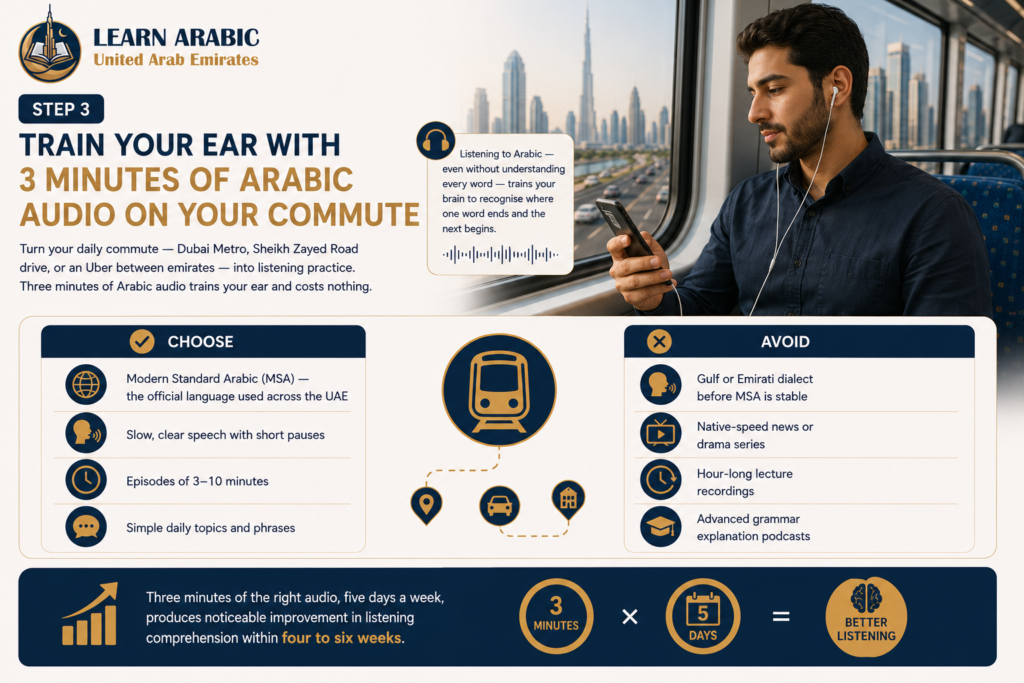
Listening to Arabic — even without understanding every word — trains your brain to recognise where one word ends and the next begins. That pattern recognition is essential for real conversation. Learners who skip audio and study only text consistently fail when they hear Arabic spoken at natural speed.
What to listen to at the beginner stage:
| Choose | Avoid |
| Modern Standard Arabic (MSA) — the official language used across the UAE | Gulf or Emirati dialect before MSA is stable |
| Slow, clear speech with short pauses | Native-speed news or drama series |
| Episodes of 3–10 minutes | Hour-long lecture recordings |
| Simple daily topics and phrases | Advanced grammar explanation podcasts |
Three minutes of the right audio, five days a week, produces noticeable improvement in listening comprehension within four to six weeks — measurable, not theoretical.
Read also: 10 Steps to Learning Arabic Numbers for Kids in the UAE
Step Inside Our Classrooms
Don’t just take our word for it—see our community in action. Click below to watch real, live snippets from our recent classes and experience our engaging teaching style firsthand!
Master Arabic in the UAE
Experience world-class Arabic language training designed for students and professionals in the Emirates.
Book Your Free TrialStep 4: Speak Arabic Out Loud — Even Alone, Even Badly
This is the step most UAE learners skip. It is also the step that makes the biggest difference.
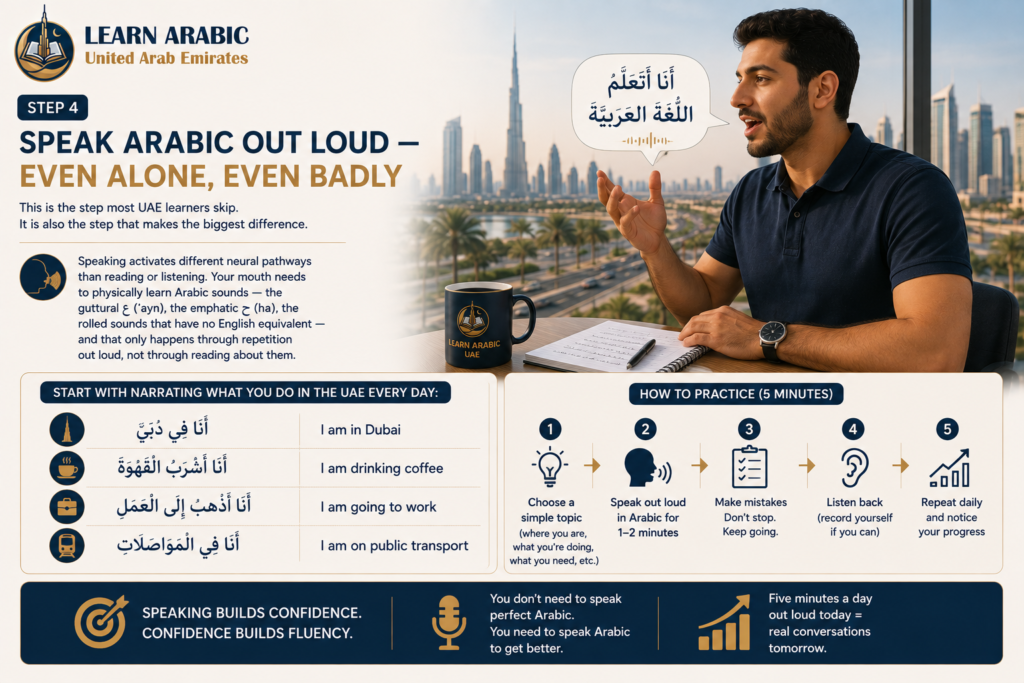
Speaking activates different neural pathways than reading or listening. Your mouth needs to physically learn Arabic sounds — the guttural ع (ʿayn), the emphatic ح (ḥa), the rolled sounds that have no English equivalent — and that only happens through repetition out loud, not through reading about them.
Start with narrating what you do in the UAE every day:
- أَنَا فِي دُبَيّ — I am in Dubai
- أَنَا أَشْرَبُ الْقَهْوَةَ — I am drinking coffee
- أَنَا أَذْهَبُ إِلَى الْعَمَلِ — I am going to work
- أَنَا فِي الْمَوَاصَلَاتِ — I am on public transport
Two minutes of this each day — alone in your car, in your kitchen, walking between Metro stations — builds the speaking automaticity that makes real conversations possible. Accuracy comes later. The habit comes first.For younger learners, regular speaking practice can be especially effective when supported by structured Arabic conversation courses for kids.
Step 5: Use Your UAE Environment as a Free Arabic Classroom
Living in the UAE gives you daily exposure to Arabic that many learners never have. By making small changes to your routine, you can turn your surroundings into a free Arabic classroom without adding extra study time.
1. Change Your Phone Language to Arabic
Switch your phone’s interface to Arabic so that notifications, menus, and common settings become part of your daily learning. Within a week, you’ll naturally recognize many high-frequency words simply through repeated exposure.
2. Read Arabic Signs During Your Daily Commute
Use your commute as a reading exercise by paying attention to Arabic road signs, Metro station names, and shopping mall directories. Even if you don’t understand every word yet, regularly recognizing letter shapes helps improve reading speed and confidence.These same everyday techniques can be adapted for children, especially when combined with structured Arabic courses for kids.

3. Label Everyday Objects Around You
Place Arabic labels on a few common items at home or in the office, such as your desk, chair, or laptop. Seeing these words multiple times throughout the day creates effortless vocabulary review without requiring additional study sessions.
Step 6: Anchor Arabic to Something You Already Do Every Day in the UAE
The most common reason UAE-based Arabic learners quit is not lack of motivation — it is lack of a trigger. They intend to study but never find the “right moment.” The right moment never arrives on its own.

The solution is habit anchoring: attach Arabic practice to something you already do every day without thinking.
Practical UAE anchors:
- Morning coffee before work → review 5 Arabic vocabulary cards while it cools
- Dubai Metro ride → one 5-minute audio episode, every commute
- Lunch break → write one Arabic sentence in your phone notes
- After Fajr prayer → review the week’s words, 3 minutes
- Before sleep → say three Arabic sentences aloud from memory
When Arabic is triggered by an existing habit, you stop relying on motivation to start. The habit fires automatically — and that is when 5 minutes a day becomes 180 sessions in six months.
Read also: The Letter Ghayn in Arabic غ — Pronunciation, Forms, Rules, and Practice
Why 5 Minutes of Arabic a Day Actually Works?
Understanding how to learn Arabic in 5 minutes in the UAE is not about finding shortcuts—it’s about creating a habit that lasts.
Most people quit Arabic because they start with too much. A 45-minute study session after a full workday in Dubai feels like a punishment — and when you miss one day, the guilt kills the habit entirely.
The 5-minute approach works for the opposite reason: it is so small it becomes impossible to skip. A learner who spends 5 minutes on Arabic every day for a year accumulates over 30 hours of focused practice — more than most people ever reach through irregular marathon sessions.
The science behind it is straightforward. Every time you encounter an Arabic word and retrieve it the following day — before the neural connection fades — that connection strengthens. This is spaced repetition in its simplest form, and 5 minutes of daily contact is enough to keep those connections alive.
In the UAE, this compounds further. Arabic is on signs, menus, and packaging around you every day. Every 5-minute session you complete makes that environment more readable — and that visibility becomes its own motivation.
At 30 minutes of daily focused practice, most dedicated learners reach conversational Modern Standard Arabic within 18–24 months.
See Our Classroom Environment in Action
Experience a sneak peek into our live sessions. Watch the video below to see our specialized instructors interacting with students, breakdown complex texts, and cultivate an engaging, respectful learning environment.
Master Arabic in the UAE
Experience world-class Arabic language training designed for students and professionals in the Emirates.
Book Your Free TrialMake Every Minute Count With Learn Arabic UAE
Learning Arabic for just five minutes a day is a powerful way to build consistency, but turning those small daily sessions into lasting progress requires the right structure and guidance. Learn Arabic UAE helps learners move beyond memorizing a few words each day by providing organized Arabic courses that build vocabulary, pronunciation, listening, and speaking skills step by step.
Whether you’re starting Arabic from scratch or helping your child develop practical language skills, structured learning can make your daily practice more effective. By combining consistent study with the Arabic you encounter throughout your day in the UAE, you can turn those five-minute sessions into a sustainable learning routine and steadily build real confidence in Arabic.
Our Arabic courses
- Arabic Course in the UAE
- Arabic Intensive Course
- Arabic Classes for Beginners (Learn Arabic from Scratch)
- Madinah Arabic Course
- Arabic Classes for Adults
- Self-Paced Arabic Course
- Arabic Speaking Classes
- Learn to Write Arabic Course
- Arabic Grammar Course
- Learn Arabic Alphabet Course
- Modern Standard Arabic (MSA) Course
- Quranic Arabic Course
- Fusha Arabic Course
- Classical Arabic Course
- Emirati Arabic Course
- Gulf Arabic Course
- Learn Saudi Arabic
- Business Arabic Course UAE
- Arabic Language Classes for Professionals in UAE
Start your Arabic learning journey with Learn Arabic UAE

Master Arabic in the UAE
Experience world-class Arabic language training designed for students and professionals in the Emirates.
Book Your Free TrialConclusion
Learning how to learn Arabic in 5 minutes in the UAE does not require clearing your schedule—it requires showing up consistently for a few focused minutes every day. It requires showing up for five minutes every day — with the right activity, at the right time, attached to the right trigger.
The six steps in this guide give you exactly that: one word, one sentence, three minutes of audio, two minutes of speaking, your UAE environment as a free classroom, and a daily anchor that makes showing up automatic. Follow the weekly rotation. Use the 8-week expansion plan. Apply the one consistency rule.
The Arabic will come. The habit is the work. Start today with five minutes — and let the UAE do the rest of the teaching for you.
Frequently Asked Questions
How long does it take to learn Arabic in the UAE with 5 minutes a day?
Five minutes daily of the right activities — spaced vocabulary review, listening, and speaking — produces noticeable progress within 4–6 weeks and functional basic Arabic within 6–12 months. Adding one weekly lesson with a qualified teacher shortens this timeline significantly. UAE residents have an advantage: Arabic reinforcement surrounds them daily outside of study sessions.
What Arabic should I learn first as a UAE resident?
Modern Standard Arabic (MSA) is the right starting point. MSA is the official language of the UAE, used in government, media, education, and formal communication. Gulf Arabic dialect is valuable for casual conversation with Emiratis, but learning it before MSA creates confusion. Build MSA first — Gulf dialect becomes much easier to pick up once MSA is stable.
What is the most effective 5-minute Arabic activity for beginners?
Vocabulary review using spaced repetition (Anki with a pre-made Arabic frequency deck) is the most retention-efficient 5-minute activity available. For speaking confidence, two minutes of Arabic self-narration daily produces the fastest improvement in pronunciation. For listening comprehension, three minutes of beginner MSA audio five days a week produces measurable results within four to six weeks.
Can I learn Arabic for free in the UAE?
Yes. Free Arabic learning resources include Anki for vocabulary, YouTube for pronunciation and alphabet instruction, Arabic audio podcasts for listening practice, and your UAE environment itself — signs, menus, and apps — for constant low-effort exposure. Free tools work best as supplements to structured instruction rather than as a complete learning plan.
How do I stay consistent with Arabic during a busy UAE work week?
Attach Arabic practice to an existing daily habit — your commute, your morning coffee, your lunch break. Set your daily minimum so small it is impossible to skip: even three Arabic words said aloud counts as completing your session. Track your streak visually on a paper calendar. Never miss two consecutive days — that is the one rule that separates learners who make it from those who quit.
Is it worth learning Arabic if I am only in the UAE short-term?
Yes. Even basic Arabic — greetings, numbers, market phrases, direction questions — changes your experience of the UAE significantly. Emiratis respond warmly to any non-Arab who makes the effort. Beyond culture, Arabic is the official language of 22 countries and one of six UN official languages. The investment in 5 minutes a day pays returns far beyond the UAE.



Leave a Reply