 Learn Arabic

Plenty of residents move to Dubai or Abu Dhabi, live there for five years, and still can’t order coffee in Arabic beyond “shukran.” That’s not a failure of willpower — it’s a timeline problem. Most people never work out how long to learn Arabic in the UAE actually takes, so they either give up after a few weeks of Duolingo or expect fluency to arrive by osmosis simply because they live in an Arabic-speaking country.
It won’t. The UAE is a unique environment for learning Arabic: it’s an Arabic-speaking country where you can go months without needing a single Arabic word, because English runs most day-to-day business, tenancy paperwork, and workplace conversation. That changes the calculation in ways a generic “learn Arabic” guide never accounts for.
This guide breaks down how long to learn Arabic in the UAE at each stage, what actually happens to your timeline living here versus studying it abroad, and the specific mistakes that keep motivated residents stuck at the same level for years.
How long does it take to learn Arabic in the UAE, realistically?
Most learners need 1 to 3 years of consistent study to reach conversational fluency in Arabic. The U.S. Foreign Service Institute (FSI) — the body that trains American diplomats — puts Arabic in its most demanding language category for English speakers, alongside Mandarin, Japanese, and Korean, and estimates roughly 2,200 class hours (about 88 weeks of full-time intensive study) to reach professional working proficiency.
That figure scares people, and it shouldn’t, because it measures something most residents in the UAE aren’t aiming for: negotiating contracts and giving formal presentations in Arabic. If your goal is to understand your driver, read a menu, or follow a conversation at a family gathering, the honest answer to how long to learn Arabic in the UAE sits far below 2,200 hours.
Strip that down to one register (say, Gulf Arabic on its own) and one realistic goal (holding a conversation, not chairing a board meeting), and the number drops sharply. This is the gap between “Arabic is the hardest language category for English speakers” and “learning Arabic will take you years of misery” — the first is true, the second isn’t.
With 1 to 2 hours of daily study, most self-directed learners reach functional conversational ability in about a year, and conversational fluency within 18 to 24 months. That’s the range worth planning around if you’re a working adult in the UAE fitting Arabic in around a full-time job.
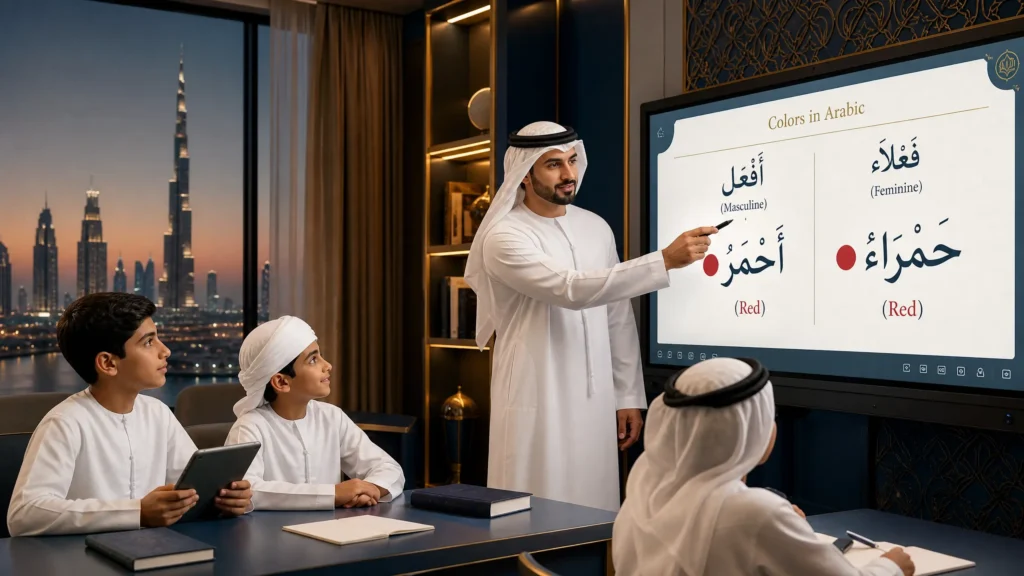
For younger children, early exposure can be especially valuable because listening, pronunciation, and vocabulary can develop alongside their regular routines. Families with children in the early years may find a kindergarten Arabic course useful when they want structured language support alongside everyday practice.
How many hours to learn Arabic do you need at each level?
Hours, not calendar time, are the honest unit here, because two people studying “for a year” can log wildly different totals. Knowing how many hours to learn Arabic to a working level lets you set a study plan instead of an open-ended hope.
Under the CEFR framework used across language schools, the jump from zero to genuine conversational ability breaks into three bands, each with its own demands and its own realistic ceiling.
1. Beginner stage (A1-A2): hours and timeline
Reaching A1-A2 typically takes 250 to 400 hours, spread over 6 to 12 months of consistent practice. In this stage you’re mastering the 28 letters of the Arabic alphabet in their different forms, building a base of 500 to 1,000 words, and handling simple exchanges — introductions, directions, basic transactions.
Reading stays slow at this stage, and that’s normal. The alphabet and short-vowel system take longer to become automatic than spoken vocabulary does.
2. Intermediate stage (B1-B2): hours and timeline
Intermediate proficiency adds another 600 to 800 hours on top of beginner, bringing your running total to roughly 850 to 1,200 hours — about 1 to 2 years of steady study. By B2 you’re working with 3,000 to 5,000 words, handling verb conjugations, following normal-speed conversation on familiar topics, and starting to read paragraphs without translating word by word.
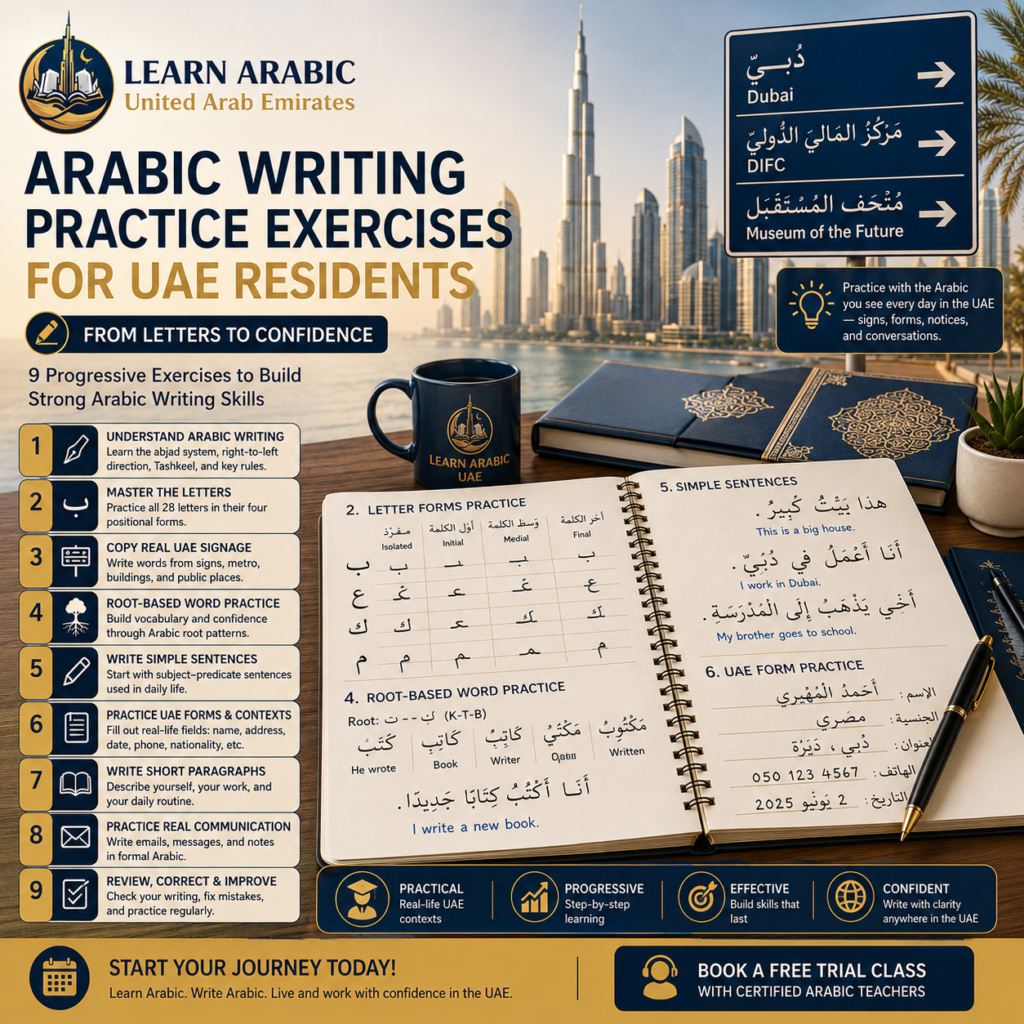
This is also where the root-and-pattern system of Arabic starts paying off: once you recognize that ك-ت-ب underlies “kitab” (book), “kātib” (writer), and “maktaba” (library), new vocabulary stops feeling random.
3. Advanced stage (C1-C2): hours and timeline
Advanced fluency needs a further 1,000 to 1,400 hours, for a total of roughly 1,850 to 2,600 hours — typically 2 to 4+ years of dedicated study. At this level you follow rapid native speech between two Emiratis, catch humor and idiom, and operate professionally in Arabic without translating in your head first.
Very few residents need to go this far unless Arabic is a professional requirement. Most people living and working in the UAE get everything they need from solid B1-B2 ability.
Step Inside Our Classrooms
Don’t just take our word for it—see our community in action. Click below to watch real, live snippets from our recent classes and experience our engaging teaching style firsthand!
Master Arabic in the UAE
Experience world-class Arabic language training designed for students and professionals in the Emirates.
Book Your Free TrialWhy learning Arabic in the UAE is different from learning it abroad?
Living in an Arabic-speaking country should, in theory, cut your timeline dramatically. In the UAE, it cuts part of it and leaves the rest untouched — and knowing which part is what separates residents who actually progress from residents who don’t.
Modern Standard Arabic vs. Gulf Arabic (Khaleeji) in daily UAE life
The Arabic used in UAE government documents, news, and school curricula is Modern Standard Arabic (MSA). The Arabic spoken on the street, in taxis, and among Emirati colleagues is Gulf Arabic (Khaleeji) — closer to the dialects of Saudi Arabia, Qatar, and Bahrain than to the Egyptian Arabic most learners encounter first through films and music.
Trying to learn both at once slows everyone down. The practical approach most UAE-based learners use is to prioritize Gulf Arabic for daily interaction, then layer in MSA later if reading government Arabic, news, or formal writing becomes a goal. Picking one register and sticking to it for the first 6 to 12 months is worth more than any app or textbook.
How daily immersion in Dubai and Abu Dhabi shortens the timeline?
Here’s the part guides written for a generic audience miss entirely: the UAE is one of the few Arabic-speaking countries where you can build an entire life without needing Arabic.
English is the default language of business, most restaurants, ride-hailing apps, and a large share of workplace communication, especially in Dubai. Emiratis themselves are typically fluent in English and will switch to it the moment they sense you’re struggling — a politeness that, ironically, removes your best source of free practice.
The immersion advantage only shows up if you go looking for it: switching your phone’s Arabic keyboard on, asking for the Arabic menu instead of the English one, greeting your building’s security staff in Arabic instead of English. None of that happens automatically just because you’re in the country.
Passive exposure — hearing Arabic on the radio, seeing bilingual signage — builds recognition of sounds and letters faster than it builds speaking ability, so residents often plateau at “I can read some signs” without ever getting to “I can hold a conversation.”
For families living in the UAE, the timeline can look different for younger learners because children often develop language skills through school, play, and repeated exposure. Parents considering a more structured route can also explore Arabic courses for kids alongside the everyday exposure children receive at home and school.

What factors affect how long it takes to learn Arabic in the UAE?
Beyond the hours themselves, a handful of variables shift the total up or down by months. These are the same factors that affect learners anywhere, but they play out differently once you’re living among Arabic speakers rather than studying from a distance.
1. Prior language experience
Familiarity with another Semitic language (Hebrew, Amharic) or another non-Latin, right-to-left script gives a genuine head start with the alphabet and root system. Most UAE residents don’t have this advantage, which is normal — it just means budgeting slightly more time for the alphabet stage rather than rushing past it.
2. Study consistency
Thirty minutes daily produces better long-term retention than three hours crammed into one weekly session, because the brain consolidates new vocabulary and grammar patterns during sleep after repeated, frequent exposure — not after one long burst. Missing this is the single most common reason residents who’ve “studied Arabic for two years” still can’t follow a conversation: sporadic effort keeps re-laying the same foundation instead of building on it.
3. Dialect choice: MSA, Gulf Arabic, or both
As covered above, choosing one register and building real ability in it before adding a second cuts confusion and speeds up real progress. Mixing MSA grammar with Gulf Arabic vocabulary mid-sentence is confusing for native listeners and slows your own fluency, not just theirs.
4. Access to native speakers in the UAE
This is the one clear advantage of being here: Emirati and wider Gulf Arabic speakers are around you daily, even if the default interaction language is English. Structured practice — a weekly class, a language partner, a standing arrangement to speak Arabic with one colleague — turns that proximity into actual progress instead of background noise.
For adults balancing Arabic with work and other responsibilities, a structured Arabic course for adults can make this practice more consistent by giving learners regular lessons, feedback, and a clear progression instead of relying entirely on casual exposure.

Common mistakes that slow down Arabic learners in the UAE
Most of the residents who stall out make one of a small number of predictable mistakes, all of them fixable once you know to watch for them.
1. Alphabet and similar-sound mix-ups
Letters like ب (ba), ت (ta), and ث (tha) differ only by the number and placement of dots, and س (seen) vs.
ص (saad) or د (daal) vs.
ض (daad) sound nearly identical to an untrained ear. Grouping look-alike letters on flashcards and practicing minimal-pair words (pairs that differ by one sound only) trains the distinction faster than passive reading does.
2. Mixing dialects and ignoring short vowels
Combining MSA and Gulf vocabulary in one sentence, or guessing at the short vowels (harakat) that unvoweled Arabic text omits, both bake in habits that are harder to unlearn than to avoid. Practicing with fully-voweled beginner materials before moving to unvoweled native text prevents this from becoming a long-term pronunciation problem.
3. Skipping listening practice
Learners who focus on reading and writing while neglecting listening hit a wall the first time a native speaker talks at normal speed. Daily listening — even 10 minutes of an Arabic podcast or a UAE-based news clip — closes that gap faster than any amount of extra vocabulary memorization.
See Our Classroom Environment in Action
Experience a sneak peek into our live sessions. Watch the video below to see our specialized instructors interacting with students, breakdown complex texts, and cultivate an engaging, respectful learning environment.
Master Arabic in the UAE
Experience world-class Arabic language training designed for students and professionals in the Emirates.
Book Your Free TrialReady to Learn Arabic in the UAE the Right Way?
Learning Arabic is easier when you have a structured program and experienced teachers guiding you every step of the way. Instead of relying on apps or studying on your own, you’ll receive live feedback, improve your pronunciation, and build practical communication skills through lessons tailored to your level.
At Learn Arabic UAE, we offer flexible online Arabic classes for beginners and advanced learners across the UAE. Whether you’re learning Arabic for work, daily life, travel, or personal growth, our native tutors will help you follow a clear learning path that fits your schedule and keeps you progressing with confidence.
Our Arabic courses
- Arabic Course in the UAE
- Arabic Intensive Course
- Arabic Classes for Beginners (Learn Arabic from Scratch)
- Madinah Arabic Course
- Arabic Classes for Adults
- Self-Paced Arabic Course
- Arabic Speaking Classes
- Learn to Write Arabic Course
- Arabic Grammar Course
- Learn Arabic Alphabet Course
- Modern Standard Arabic (MSA) Course
- Quranic Arabic Course
- Fusha Arabic Course
- Classical Arabic Course
- Emirati Arabic Course
- Gulf Arabic Course
- Learn Saudi Arabic
- Business Arabic Course UAE
- Arabic Language Classes for Professionals in UAE
Book your free trial lesson today and take the first step toward speaking Arabic with confidence.

Master Arabic in the UAE
Experience world-class Arabic language training designed for students and professionals in the Emirates.
Book Your Free TrialConclusion
So, how long to learn Arabic in the UAE? For most working adults aiming at real conversational ability rather than professional fluency, budget 250-400 hours (6-12 months) to get through the alphabet and basics, another 600-800 hours to reach a comfortable intermediate level, and treat anything beyond that as a bonus rather than a requirement.
The UAE gives you Arabic speakers everywhere and almost no forced need to talk to them in Arabic — that’s the trade-off that makes this environment different from studying Arabic anywhere else. Consistency, one clear dialect choice, and structured speaking practice close that gap faster than living here on its own ever will.
Frequently asked questions
How long to learn Arabic in the UAE for complete beginners?
Complete beginners typically need 250 to 400 hours, spread across 6 to 12 months of consistent practice, to reach basic conversational ability (A1-A2). That covers the alphabet, 500-1,000 core words, and simple everyday exchanges like introductions and directions.
How many hours to learn Arabic are needed for basic conversation?
Basic, functional conversation generally opens up between 500 and 1,000 hours of real practice — roughly the point where beginner-level material stops feeling slow and everyday topics become followable without heavy effort.
Is it faster to learn Arabic in the UAE than elsewhere?
Not automatically. Living in the UAE gives you Arabic speakers nearby, but English covers most daily business, so immersion only helps if you actively seek out Arabic interactions — asking for the Arabic menu, greeting staff in Arabic, taking structured classes. Passive exposure alone barely moves the needle.
Should I learn Modern Standard Arabic or Gulf Arabic in the UAE?
For daily life in Dubai or Abu Dhabi, Gulf Arabic (Khaleeji) is more useful, since it’s what’s actually spoken around you. Modern Standard Arabic matters more for reading government documents, news, and formal writing. Most learners do best picking one to start and adding the other later.
Do I need Arabic for daily life in Dubai or Abu Dhabi?
Not strictly — English covers most restaurants, ride-hailing, and workplace interactions. But basic Arabic noticeably improves interactions with drivers, government service staff, and Emirati colleagues, and it’s often required for specific professional or licensing contexts.
Related Articles
Learn Arabic



Leave a Reply